
Online Education Statistics for 2026: Market Size, Enrollment, and Platform Data
The eLearning market just crossed $320 billion. Let that number sit for a second. When I started creating online courses and writing about education technology over a decade ago, this entire industry was a rounding error on a university budget spreadsheet. Now it’s bigger than the GDP of most countries.
I don’t just track these numbers. I feel them. And the 2026 data tells a story most people are misreading: the growth isn’t slowing down, it’s shifting. Away from MOOCs-for-everyone hype. Toward AI tutors, corporate reskilling, and creator-led premium courses.
These 87 statistics map exactly where online education stands right now and where it’s headed.
Key Online Education Statistics (2026 Overview)
The numbers that matter most. If you read nothing else, read these:
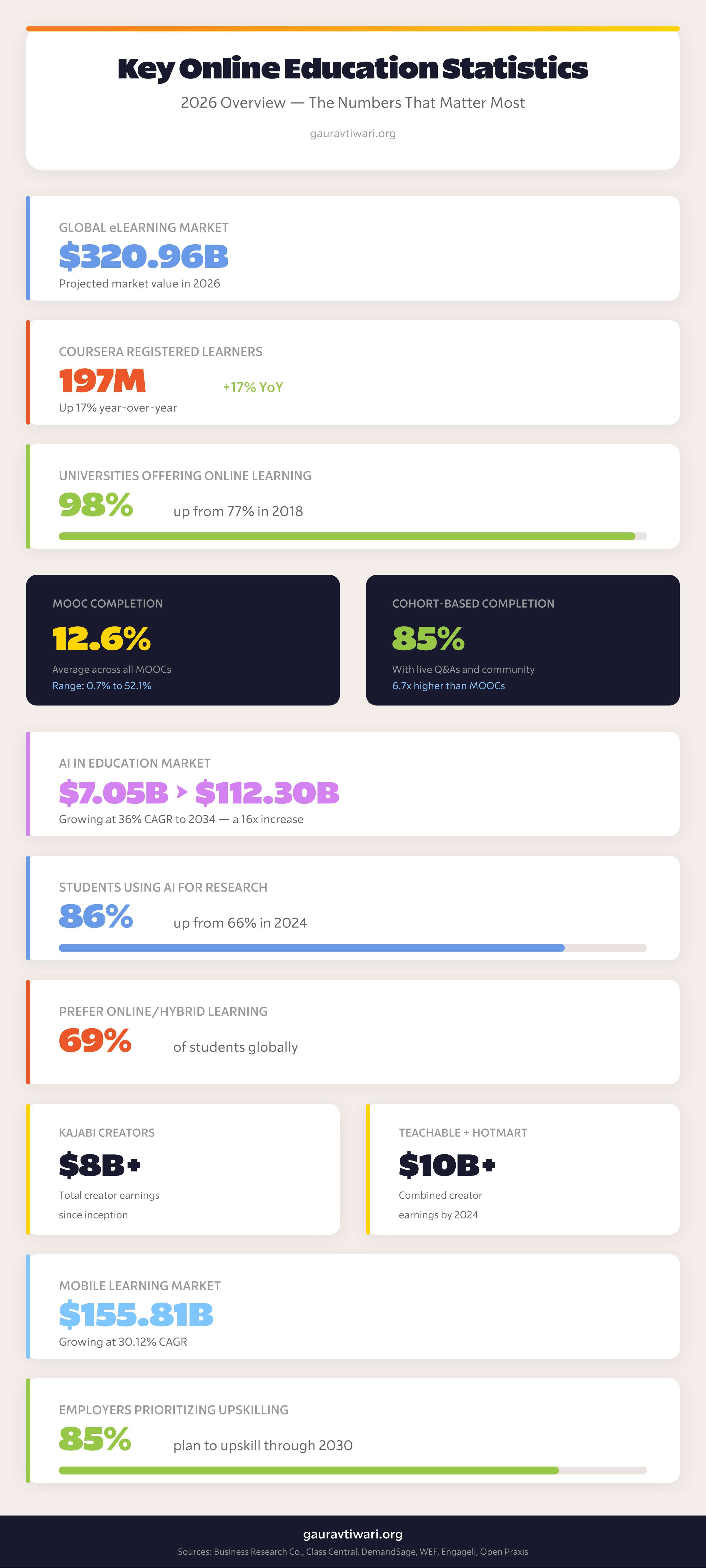
- The global eLearning market is projected to reach $320.96 billion in 2026 (The Business Research Company).
- 197 million registered learners on Coursera alone, up 17% year-over-year (Coursera Q4 2025 Earnings / Class Central).
- 98% of universities now offer online learning, up from 77% in 2018 (DemandSage / Industry Reports).
- Average MOOC completion rate: just 12.6%. Cohort-based courses hit 85% (Open Praxis Research; NewZenler / Industry Data).
- The AI in education market will grow from $7.05 billion to $112.30 billion by 2034 at 36% CAGR (Engageli / Industry Reports).
- 86% of higher education students now use AI as their primary research tool (DemandSage / Programs.com).
- 69% of students globally prefer online, hybrid, or blended learning over fully in-person instruction (Tyton Partners / EdScoop).
- Kajabi creators have collectively earned more than $8 billion; Teachable creators over $10 billion combined with Hotmart (Kajabi; Teachable / Hotmart).
- The mobile learning market reached $155.81 billion, growing at 30.12% CAGR (Gitnux / Technavio).
- 85% of employers plan to prioritize upskilling their workforce through 2030 (World Economic Forum).
eLearning Market Size and Growth

Global Market Value
The global eLearning market is projected to reach $320.96 billion in 2026, according to The Business Research Company. Mordor Intelligence pegs it at $275.86 billion, growing to $461.92 billion by 2031 at a CAGR of 10.86% (Mordor Intelligence). The range depends on what you count (corporate LMS vs. consumer courses vs. K-12 digital tools), but the direction is the same: up and to the right.
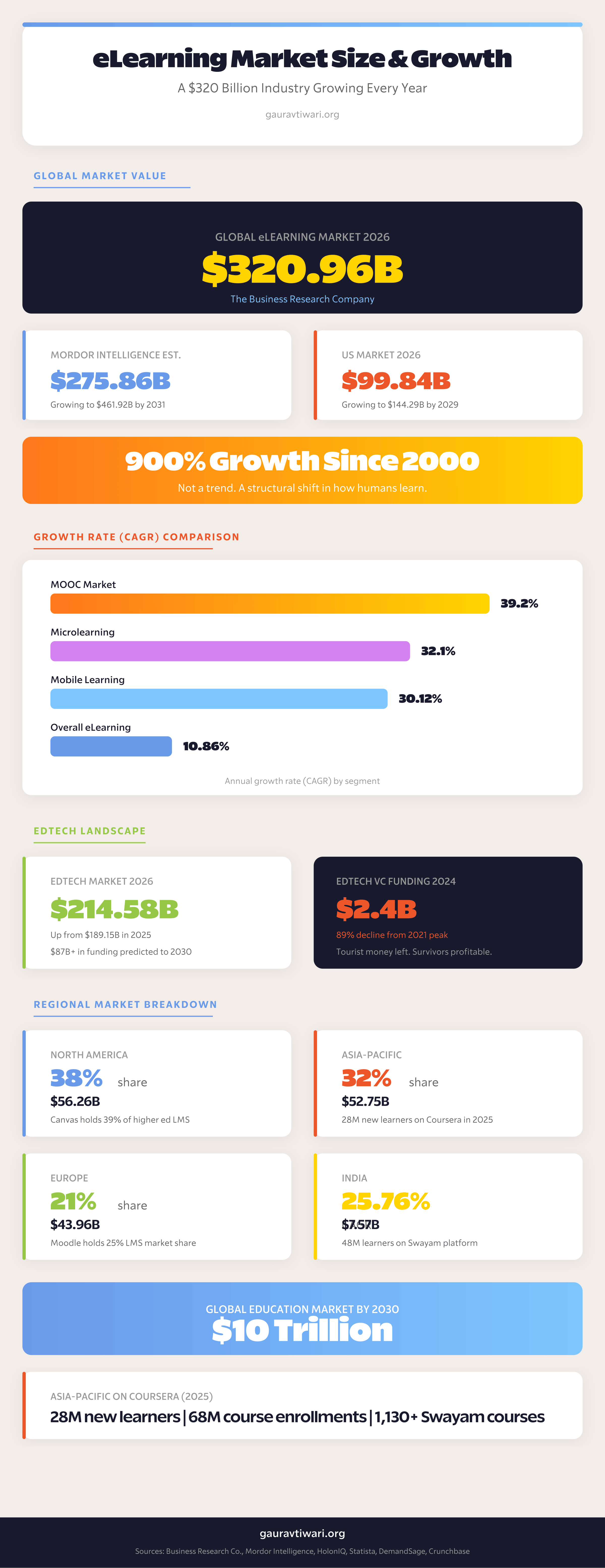
HolonIQ projects the global education market will hit $10 trillion by 2030 at 4.4% CAGR. Online education is eating more of that pie every year.
The US alone accounts for a massive share. The US online education market is predicted to reach $99.84 billion in 2026, growing at 9.64% annually to $144.29 billion by 2029 (Statista).
And one stat that puts all of this in perspective: online learning has expanded 900% since 2000 (Oxford College). That’s not a trend. That’s a structural shift in how humans learn.
Growth Rate (CAGR)
Different segments are growing at different speeds, and the gaps tell you where the action is. The MOOC market leads with a 39.2% annual growth rate from 2025-2030 (DemandSage). Mobile learning follows at 30.12% CAGR (Gitnux / Technavio). Microlearning is growing at 32.1% CAGR to 2030 (VouchFor / Industry Reports).
The global EdTech market reached $189.15 billion in 2025 and is projected to hit $214.58 billion in 2026 (HolonIQ / Industry Reports).
But… EdTech VC funding dropped to $2.4 billion in 2024, an 89% decline from the 2021 peak (HolonIQ / Crunchbase). The market is growing while investment is shrinking. That means the survivors are profitable. The tourist money left. HolonIQ predicts $87 billion+ in global EdTech funding through 2030, so capital will return. Just to better businesses.
Regional Breakdown
North America dominates with 38% market share, but Asia-Pacific is closing the gap fast at 32%.
| Region | Market Share | Estimated Value (2026) | Key Detail |
|---|---|---|---|
| North America | 38% | $56.26 billion | Canvas holds 39% of higher ed LMS market |
| Asia-Pacific | 32% | $52.75 billion | 28 million new learners in 2025 on Coursera alone |
| Europe | 21% | $43.96 billion | Moodle holds 25% LMS market share |
| India (standalone) | N/A | $7.57 billion | Growing at 25.76% CAGR |
Source: Business Research Insights; Mordor Intelligence; Coursera / DemandSage
Asia Pacific saw 28 million new learners and 68 million course enrollments in 2025 on Coursera alone (Coursera / DemandSage). India’s eLearning market is growing at 25.76% CAGR and will reach $7.57 billion (Mordor Intelligence). Swayam, India’s national MOOC platform, already has 48 million learners and 1,130+ courses (DemandSage). If you’re only watching the US market, you’re missing half the story.
Online Course Enrollment Statistics
Total Online Learners
Between just four major platforms, you’re looking at over 400 million registered learners:
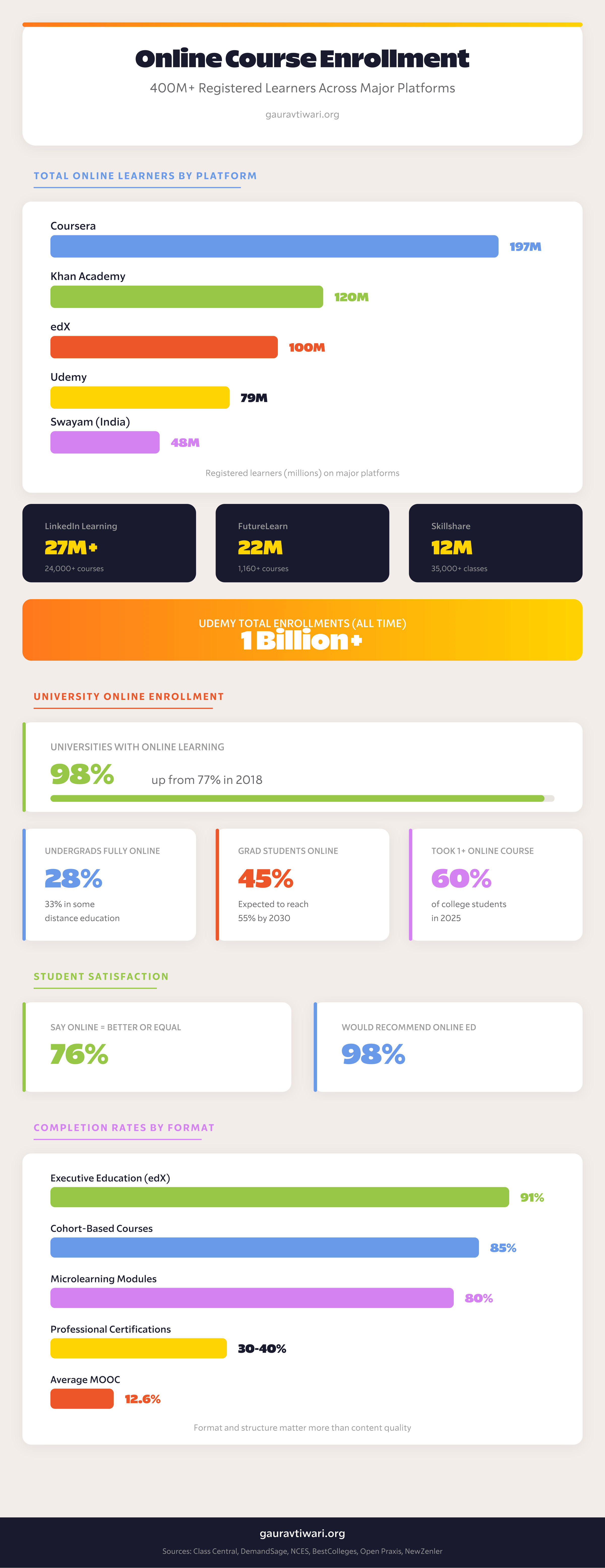
- Coursera: 197 million learners (Class Central)
- edX: 100 million learners (DemandSage)
- Khan Academy: 120 million learners across 190 countries (Khan Academy / ElectroIQ)
- Udemy: 79 million learners (Udemy / ElectroIQ)
And that’s before counting LinkedIn Learning (27 million+ users), Skillshare (12 million), FutureLearn (22 million), and Swayam (48 million) (DemandSage; Skillshare).
Over 1 billion course enrollments have occurred on Udemy globally to date (Udemy). One platform. One billion enrollments.
University vs Platform Enrollment
98% of universities now offer online learning, up from 77% in 2018 (DemandSage / Industry Reports). That remaining 2% is holding out for… I’m honestly not sure what.
28% of US undergraduates are enrolled exclusively online. Another 33% participate in some distance education (NCES / Research.com). For graduate students, it’s even more dramatic: 45% are in fully online programs, expected to reach 55% by 2030 (NCES / CalMU).
60% of college students took at least one online course in 2025. 30% took only online classes (BestColleges).
Look, the debate about whether online learning is legitimate is over. 76% of online students say online education is better than or equal to on-campus learning (BestColleges). 98% would recommend online education to others (BestColleges 2025 Online Education Trends Report). 73% of US students want to continue taking online classes post-pandemic (DemandSage / Industry Surveys).
Completion Rates
The average MOOC completion rate is 12.6%, ranging from 0.7% to 52.1% (Open Praxis Research). Most people sign up and never finish. That’s the uncomfortable number nobody in the industry likes to talk about.
But format matters enormously:
- Cohort-based courses with live Q&As: 85% completion (NewZenler / Industry Data)
- Professional certification courses: 30-40% completion (edX / Whop)
- Executive education courses on edX: 91% completion (edX / Whop)
- Courses with active learning communities: 30-40% higher completion rates than those without (NewZenler Research)
- Microlearning modules: 80% completion vs. 20% for conventional long-form courses (5mins.ai / VouchFor)
The takeaway: free, self-paced courses have terrible completion. Paid, structured, community-driven courses perform on par with in-person education. Price and accountability change behavior. I’ve seen this firsthand running my own courses.
Online Learning Platform Statistics
Coursera, Udemy, edX
These three dominate the MOOC space, but their business models are diverging fast.
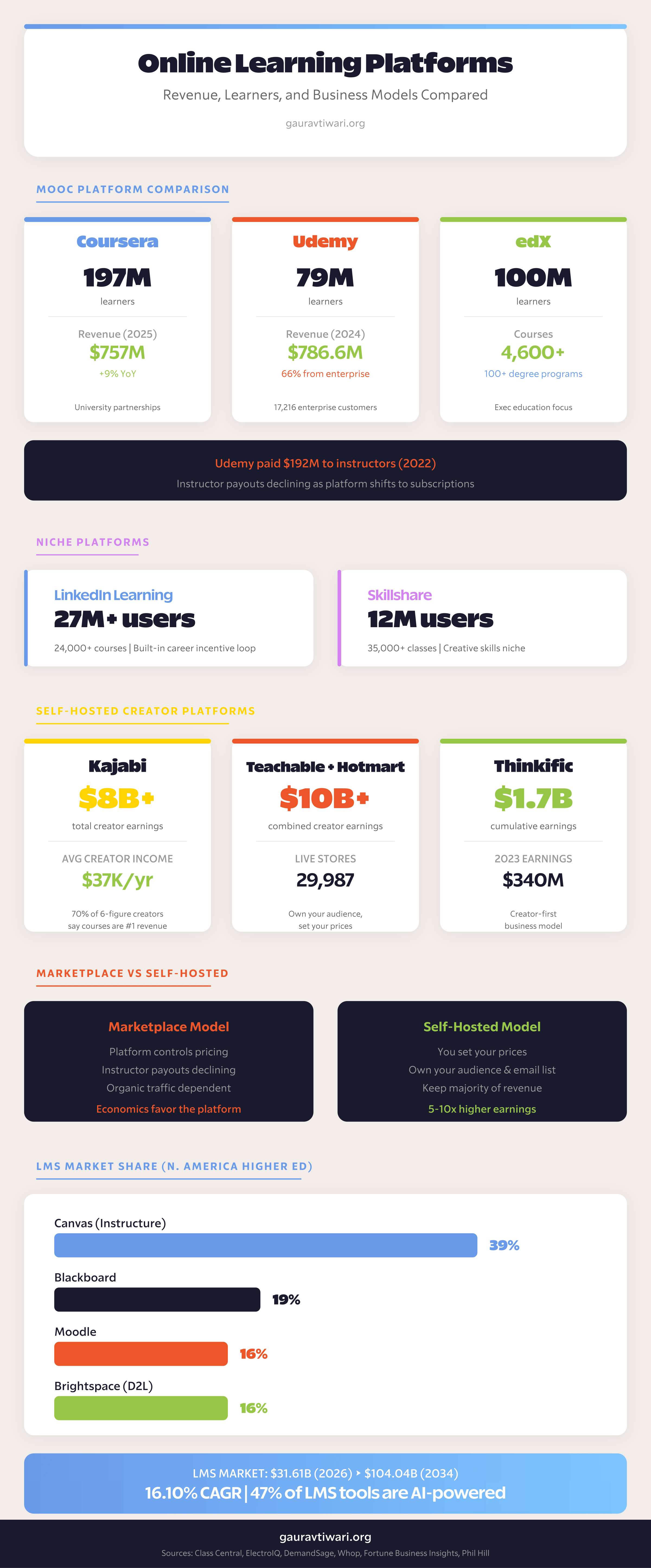
Coursera has 197 million registered learners, up 17% year-over-year (Class Central). Full year 2025 revenue hit $757 million, up 9% from 2024 (Coursera Investor Relations). They’ve positioned themselves as the university-in-your-pocket, with partnerships across hundreds of institutions.
Udemy has 79 million registered learners, 75,000+ instructors, and 250,000+ courses (Udemy / ElectroIQ). Revenue in 2024 was $786.6 million, with Udemy Business contributing 60% of total revenue (Udemy Financial Reports). By Q1 2025, they had 17,216 enterprise customers with enterprise contributing 66% of revenue (Udemy SEC Filing / Stock Titan). The shift toward B2B? Hard to miss.
OK, but there’s a dark side. Udemy paid $192 million to instructors in 2022, and instructor payouts have declined as the platform shifts to subscriptions (Class Central). If you’re thinking about building on Udemy as a creator, you need to understand that the economics favor the platform, not you.
edX has 100 million registered learners, 4,600+ courses, and 100+ degree programs (DemandSage). Since the 2U acquisition, edX has pivoted harder toward executive education and graduate degrees.
LinkedIn Learning and Skillshare
LinkedIn Learning has 27 million+ users and 24,000+ courses (LinkedIn / DemandSage). Its biggest advantage isn’t the content, though. It’s the distribution. Every LinkedIn Premium subscriber gets access, and completion signals show up on your profile. That’s a built-in incentive loop no standalone platform can match.
Skillshare has about 12 million users and 35,000+ classes (Skillshare). It occupies the creative skills niche (design, illustration, photography) and runs on a subscription model. Smaller, but focused.
FutureLearn serves 22 million learners with 1,160+ courses (DemandSage), primarily in the UK and Europe.
Self-Hosted Platforms (Teachable, Thinkific, Kajabi)
This is where the money is for individual creators. And the numbers prove it.
Kajabi creators have collectively earned more than $8 billion since inception. The average creator earns $37,000/year (Kajabi). 70% of six-figure creators say online courses generate the most revenue among all their offerings (Kajabi 2024 Report).
Teachable creators earned over $10 billion combined with Hotmart by 2024, with 29,987 live stores on the platform (Teachable / Hotmart).
Thinkific creators earned $340 million in 2023 and $1.7 billion cumulatively (Thinkific).
The contrast with marketplace platforms is sharp. On Udemy, the platform controls pricing and distribution. On Kajabi or Teachable, you own your audience, set your prices, and keep the majority of revenue. That’s why the average Kajabi creator earns $37,000/year while Udemy instructor payouts are declining.
I’ve reviewed all three platforms. The pattern is clear: creators who treat their course business like a real business (own platform, email list, premium pricing) earn 5-10x more than those who list on marketplaces and hope for organic traffic.
Corporate eLearning Statistics
Corporate Training Spend
Corporate eLearning is where the real money flows. Not in $19.99 Udemy courses. In enterprise contracts worth six and seven figures.
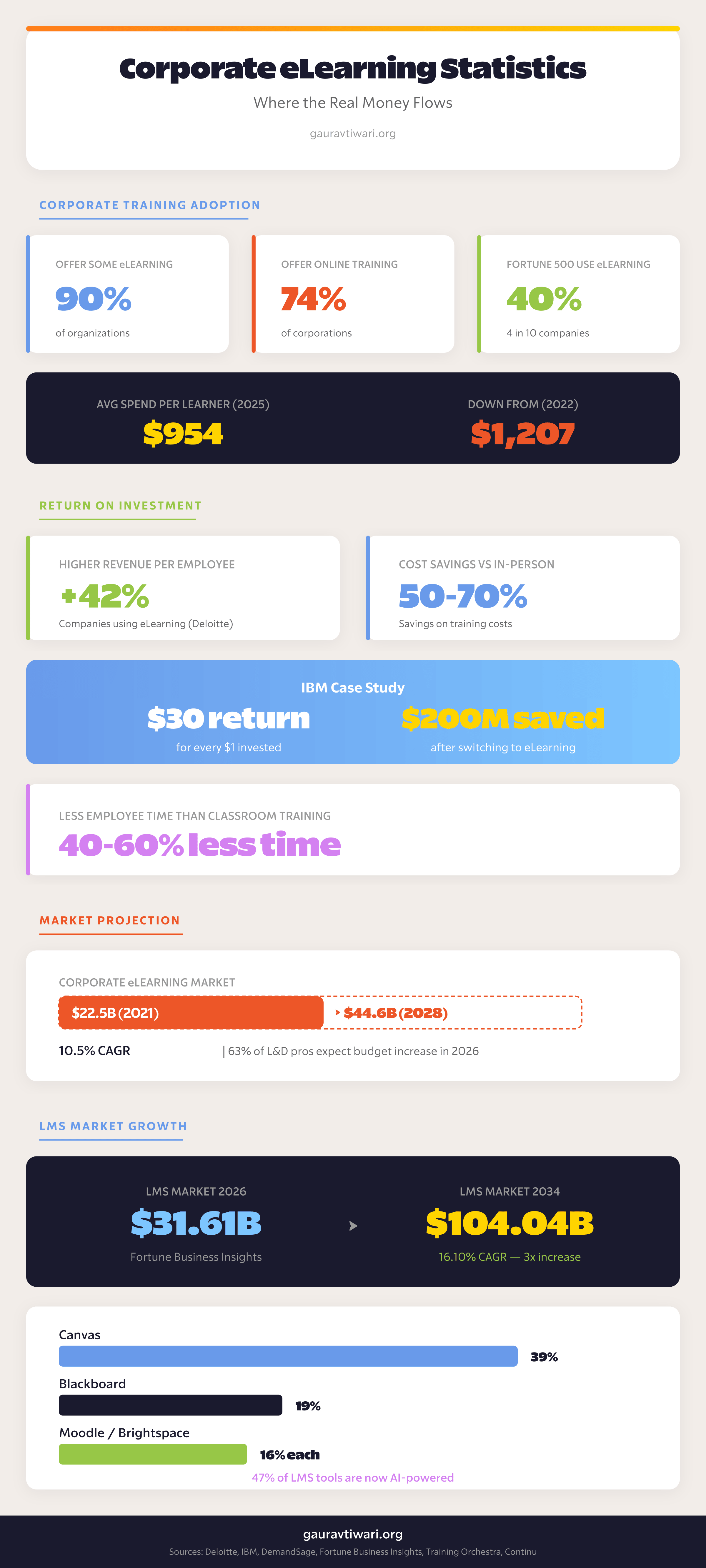
90% of organizations now offer some form of eLearning. 74% of corporations offer online training (LinkedIn / Industry Surveys). 4 in 10 Fortune 500 companies use e-learning for training (Skill Scouter / DemandSage).
Direct learning expenditures averaged $954 per learner in 2025, down from $1,207 in 2022 (Training Industry / Continu). Budgets are getting tighter per head, but the ROI numbers explain why companies keep investing:
- Companies using e-learning see 42% higher revenue per employee (Deloitte / eLearning Industry)
- E-learning saves 50-70% on training costs compared to in-person (Deloitte / eLearning Industry)
- IBM reported $30 in productivity gains for every $1 invested in online training, saving $200 million after switching to eLearning (Shift Learning / IBM)
- Online learning takes 40-60% less employee time than traditional classroom training (eLearning Industry)
The corporate eLearning market is projected to reach $44.6 billion by 2028, up from $22.5 billion in 2021 at 10.5% CAGR (Global News Wire / DemandSage). 63% of L&D professionals expect their budget to increase or stay steady in 2026 (Training Orchestra).
LMS Adoption
The Learning Management System market is projected to grow from $31.61 billion in 2026 to $104.04 billion by 2034 at 16.10% CAGR (Fortune Business Insights). That’s a 3x increase in eight years, driven by Canvas, Moodle, Blackboard, and Brightspace.
Here’s the market share breakdown in North American higher education:
| LMS Platform | North America Higher Ed Share | Notable Global Presence |
|---|---|---|
| Canvas (Instructure) | 39% | Dominant in US/Canada |
| Blackboard | 19% | Legacy installations |
| Moodle | 16% | 73% in Latin America, 25% in Europe |
| Brightspace (D2L) | 16% | Growing in K-12 |
Source: Phil Hill / One EdTech; ListEdTech
Canvas has been steadily eating Blackboard’s lunch for years. And the open-source play (Moodle) dominates in regions where budgets are tighter. 47% of LMS tools are now powered by AI (DemandSage). I expect that number to hit 80%+ by 2028.
Online Education Revenue and Creator Economy
Course Creator Income
The creator economy in online education is real, but the income distribution is extremely uneven. Most creators earn very little. A small percentage earns a lot.
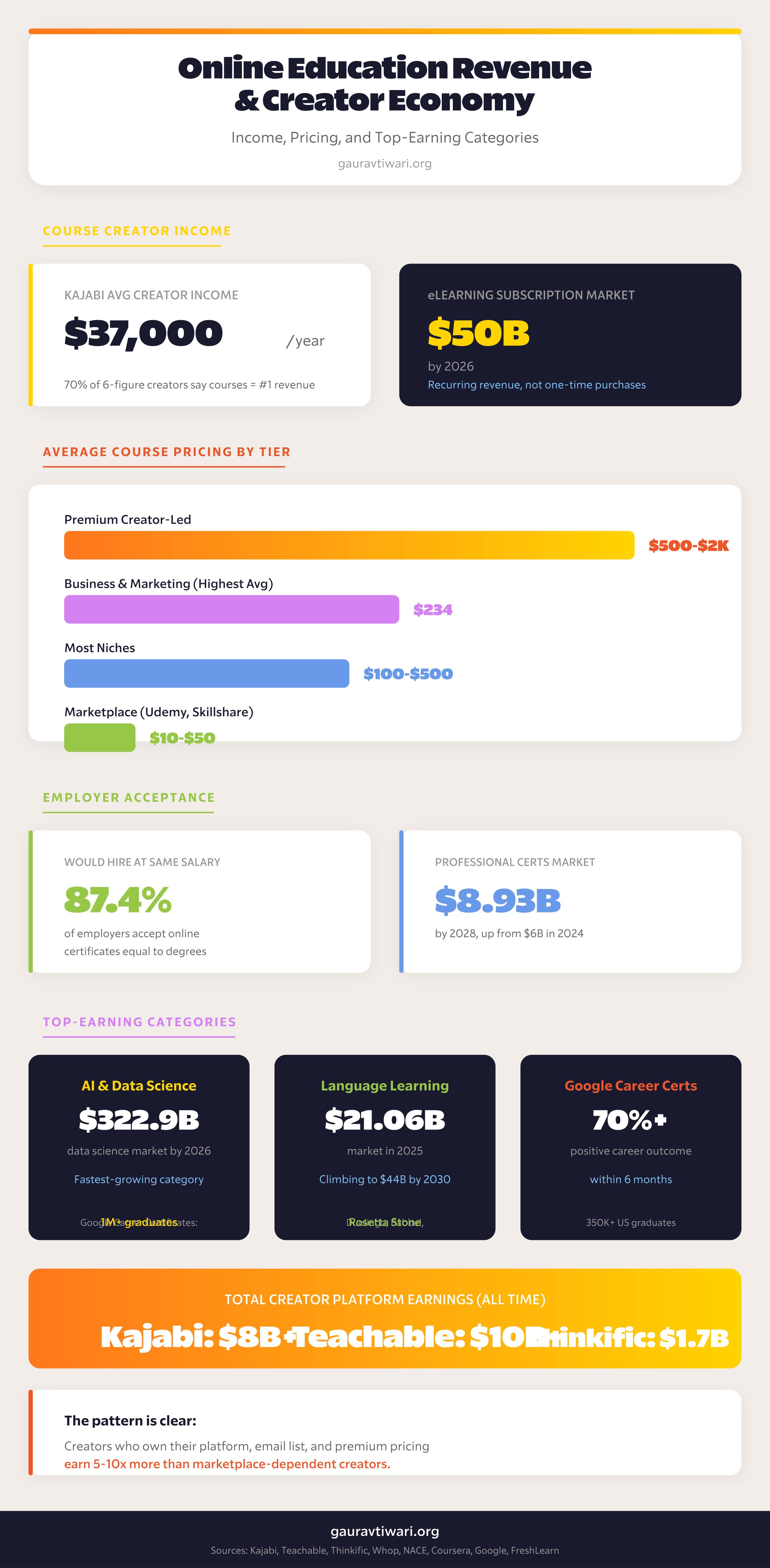
Kajabi’s average creator earns $37,000/year (Kajabi). That sounds modest until you realize most creators treat this as a side business, not a full-time job. The six-figure creators on Kajabi? 70% of them say courses are their #1 revenue stream (Kajabi 2024 Report).
The e-learning subscription market is set to hit $50 billion by 2026 (Industry Reports). That’s recurring revenue, not one-time purchases. The smartest creators I know are building membership sites and subscription courses, not selling $497 one-off programs.
Average Course Price
Course pricing varies wildly depending on the platform and how you position yourself.
- Marketplace courses (Udemy, Skillshare): $10-$50 average
- Most niches: $100-$500
- Premium creator-led courses: $500-$2,000
- Business and marketing has the highest average price at $234
Source: Thinkific / FreshLearn; Industry Reports
The professional certificates market is expected to reach $8.93 billion by 2028, up from $6 billion in 2024 (Statista / Whop). Certifications command premium prices because they signal value to employers. 87.4% of employers would hire candidates with online certificates at the same salary as those with traditional degrees (NACE 2024 Survey). That stat alone tells you where this market is headed.
Top-Earning Categories
AI and machine learning courses are the fastest-growing category in 2026. The data science market is projected to reach $322.9 billion by 2026 (Industry Reports / Coursera). Google Career Certificates have produced over 1 million graduates globally, including 350,000+ in the US (Google / Coursera Blog). 70%+ of those US graduates report a positive career outcome (new job, promotion, or raise) within 6 months (Google Career Certificates Impact Report).
The online language learning market reached $21.06 billion in 2025, projected to climb to $44 billion by 2030 (Industry Reports). Language learning (Duolingo, Babbel, Rosetta Stone), AI/data science, and business/marketing consistently rank as the highest-earning course categories.
AI in Online Education
AI isn’t coming to education. It’s already here, and the adoption speed is unlike anything I’ve seen in 16 years of covering this space.
AI Tutor Adoption
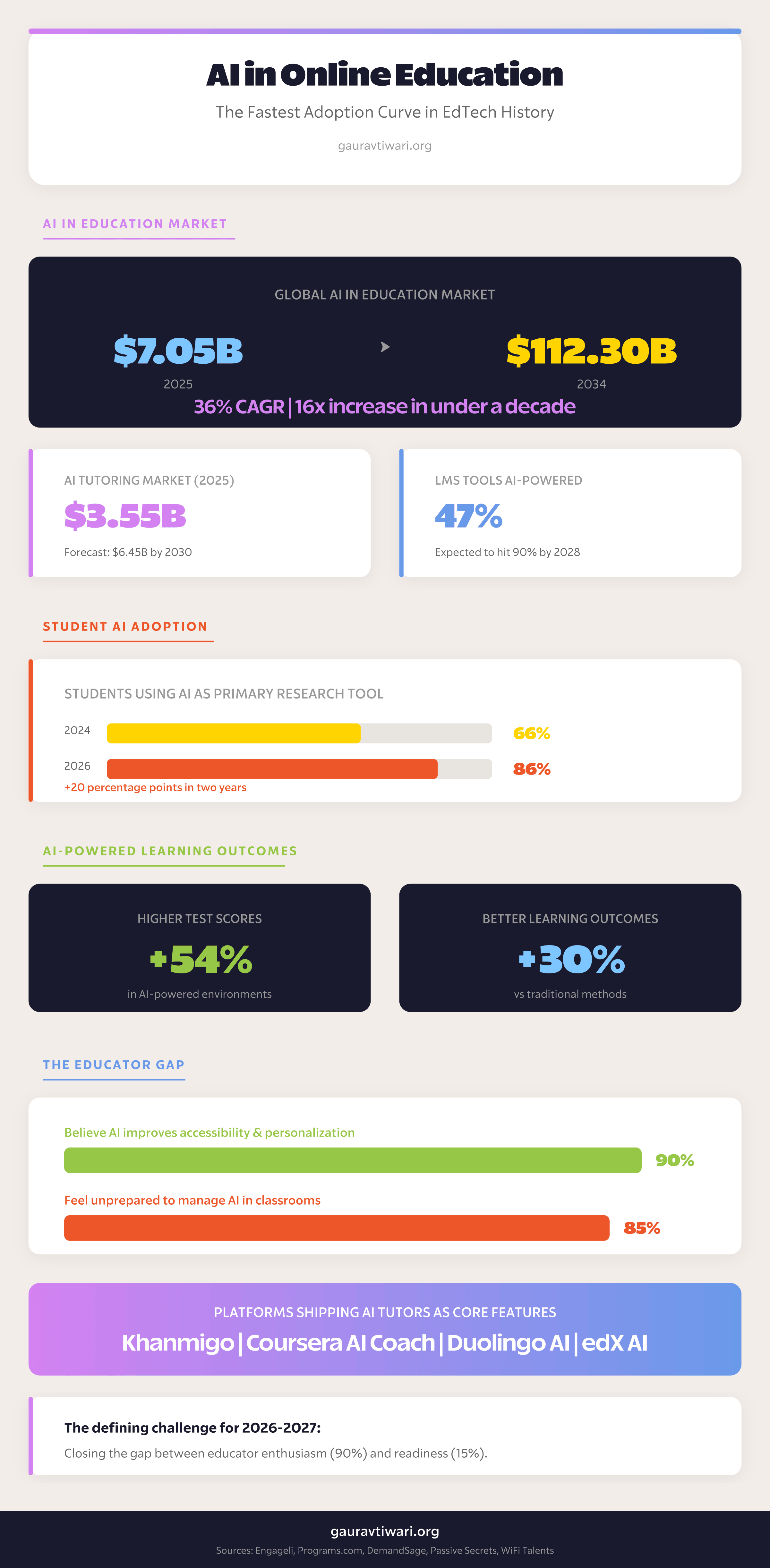
The global AI in education market will grow from $7.05 billion in 2025 to $112.30 billion by 2034 at 36% CAGR (Engageli / Industry Reports). That’s a 16x increase in under a decade.
The AI tutoring market specifically stands at $3.55 billion in 2025, forecast to reach $6.45 billion by 2030 (WiFi Talents). Khan Academy’s Khanmigo, Coursera’s AI-powered coaching, Duolingo’s AI characters… the biggest platforms are all building AI tutors. Not as experiments. As core product features.
86% of higher education students now use AI as their primary research and brainstorming tool, up from 66% in 2024 (DemandSage / Programs.com). A 20 percentage point jump in two years. Students didn’t wait for permission.
Personalized Learning
Students in AI-powered learning environments achieve 54% higher test scores and 30% better learning outcomes (Passive Secrets / Research Studies). The promise of personalized learning is finally showing up in the data.
90% of educators believe generative AI can improve accessibility and personalized learning. But 85% feel unprepared to manage AI in classrooms (Engageli / DemandSage). That gap between enthusiasm and readiness… that’s the defining challenge for 2026 and 2027.
47% of LMS tools are now powered by AI (DemandSage). I expect that number to approach 90% within two years. AI-powered content recommendations, automated grading, adaptive difficulty, and conversational tutoring are all becoming table stakes. If you’re building a course platform without AI features, you’re already behind.
Mobile Learning Statistics
Mobile learning isn’t a subcategory anymore. For most of the world, it IS the primary way people learn online.
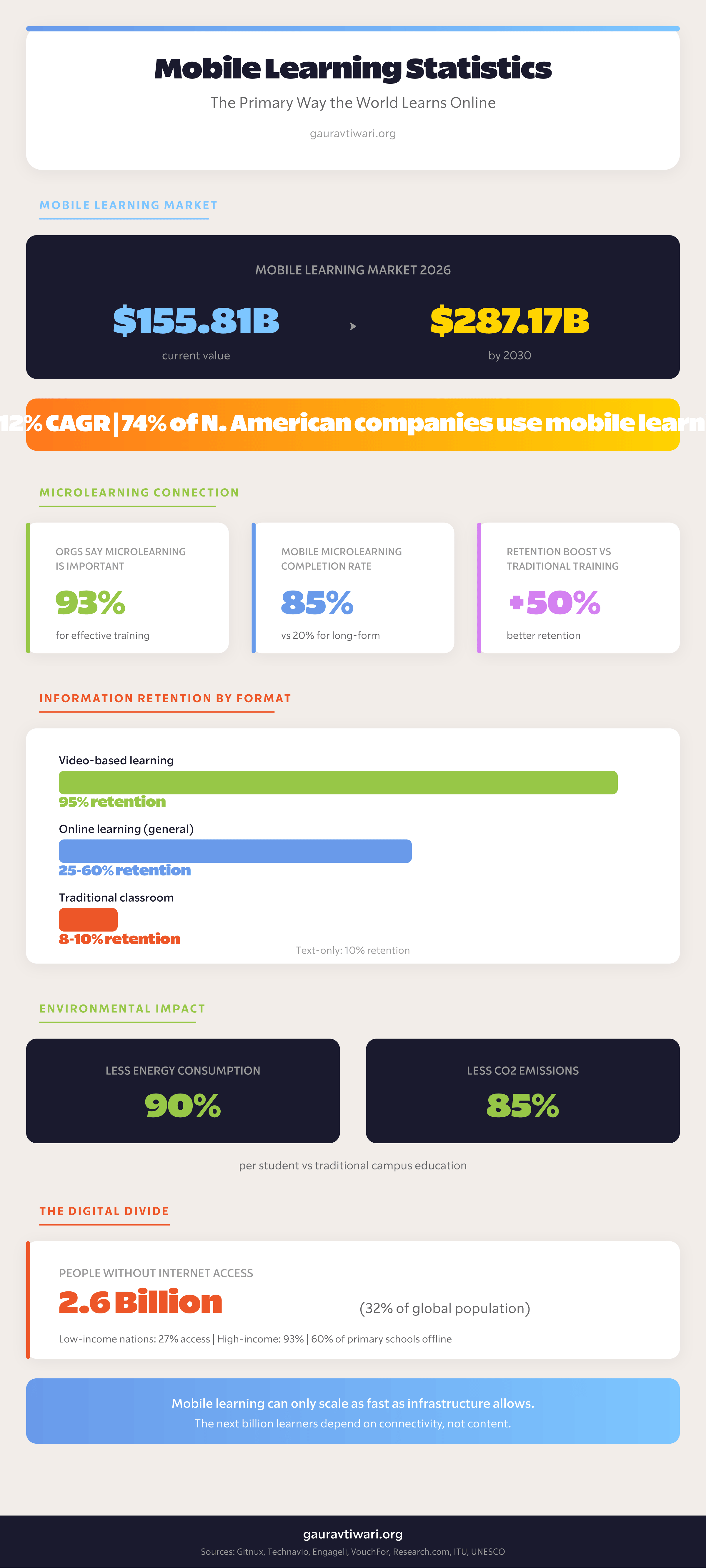
The mobile learning market reached $155.81 billion in 2026, growing at 30.12% CAGR, expected to reach $287.17 billion by 2030 (Gitnux / Technavio). 74% of North American companies integrate mobile learning into training strategies (Gitnux).
The connection between mobile and microlearning is key. 93% of organizations believe microlearning is important for effective corporate training (Engageli). Mobile microlearning boosts completion to 85% (5mins.ai / VouchFor). And microlearning boosts retention rates by 50% compared to traditional training (VouchFor / Industry Reports).
Well, here’s what that looks like in practice. A warehouse worker on a 15-minute break pulls out their phone, completes a 5-minute safety module, and retains more than they would from a 3-hour classroom session. That’s what the data says.
Students retain 25-60% of material in online settings vs. 8-10% in traditional classroom settings (eLearning Industry / Research.com). Video makes it even better: 95% of students retain information delivered via video vs. 10% via text (Research.com / DemandSage).
The environmental case is worth mentioning too. eLearning produces 90% less energy consumption and 85% less CO2 emissions per student compared to traditional campus education (eLearning Industry).
But the digital divide remains real. 2.6 billion people (32% of the global population) still lack internet access. In low-income nations, only 27% have access vs. 93% in high-income nations (ITU / UNESCO). 60% of primary schools globally aren’t connected to the internet (UNESCO / UNICEF). Mobile learning can only scale as fast as infrastructure allows.
The Workforce Reskilling Imperative
This section matters more than the market size numbers. It explains WHY the market keeps growing.
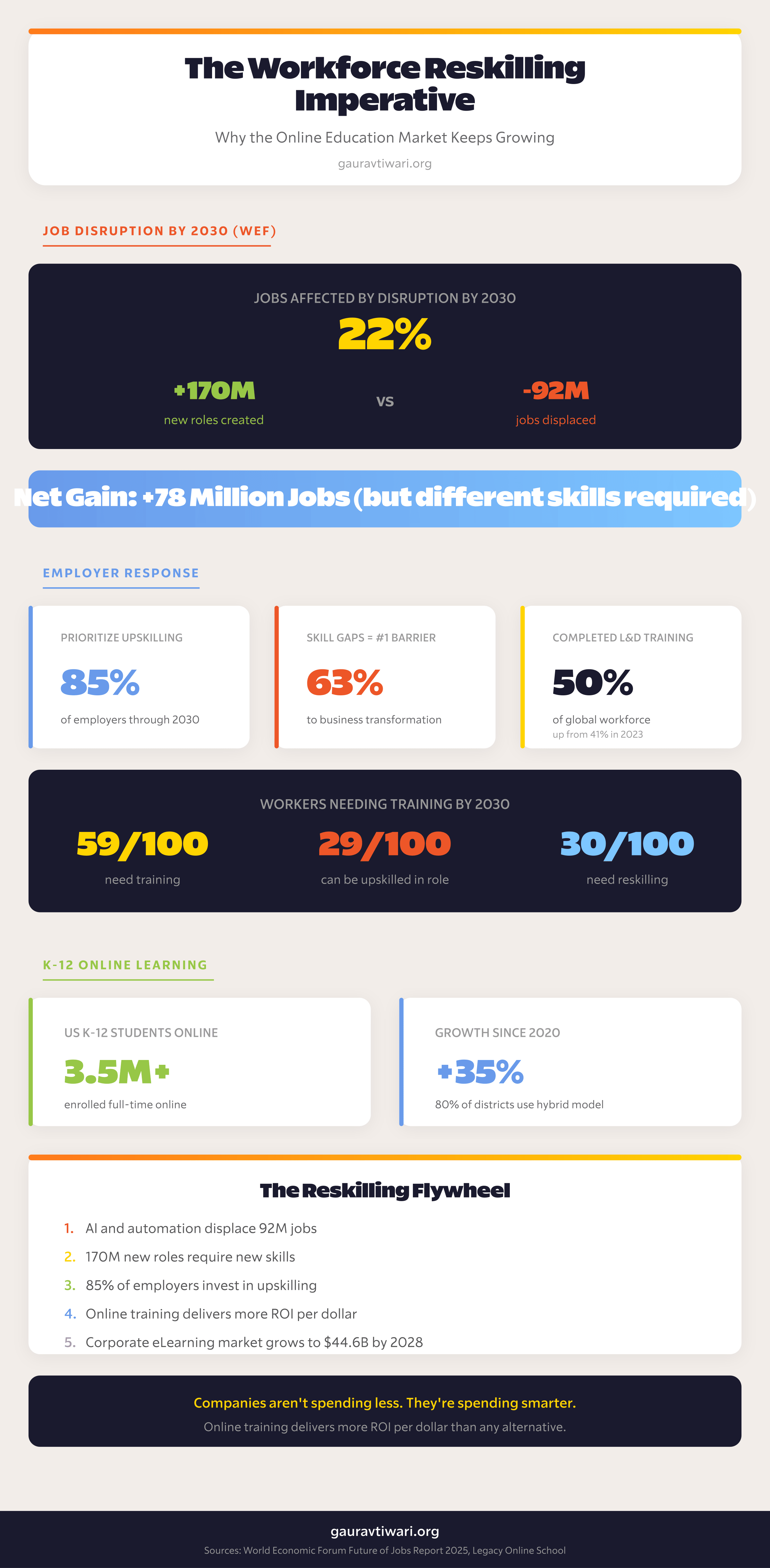
The World Economic Forum’s 2025 Future of Jobs Report lays it out: job disruption will affect 22% of jobs by 2030, creating 170 million new roles while displacing 92 million (World Economic Forum). That’s a net gain of 78 million jobs, but the skills required are different from the ones being displaced.
85% of employers plan to prioritize upskilling their workforce (World Economic Forum). 63% identify skill gaps as the biggest barrier to business transformation (World Economic Forum). 59 out of every 100 workers will need training by 2030, but only 29 can be upskilled in current roles (World Economic Forum).
50% of the global workforce has completed training via L&D initiatives, up from 41% in 2023 (World Economic Forum Future of Jobs Report 2025). Moving in the right direction, but not fast enough for the disruption ahead.
K-12 online learning is part of this pipeline too. Over 3.5 million K-12 students in the US are enrolled in full-time online schools (Legacy Online School / Industry Data). K-12 online learning has grown 35% since 2020, with 80% of school districts using a mix of in-person and online instruction (Legacy Online School).
This reskilling wave is the reason corporate eLearning keeps growing even when per-learner budgets shrink. Companies aren’t spending less. They’re spending smarter. And online training delivers more ROI per dollar than any alternative I’ve tracked.
Frequently Asked Questions
How big is the online education market in 2026?
The global eLearning market is projected to reach $320.96 billion in 2026, according to The Business Research Company. Mordor Intelligence estimates $275.86 billion, with the variation depending on which segments are included. The US alone accounts for $99.84 billion of the market.
What percentage of students take online courses?
60% of college students took at least one online course in 2025, and 30% took only online classes, according to BestColleges. For graduate students, 45% are enrolled in fully online programs. 69% of students globally prefer online, hybrid, or blended learning over fully in-person instruction.
What is the average completion rate for online courses?
The average MOOC completion rate is 12.6%, according to Open Praxis Research. However, cohort-based courses with live sessions achieve 85% completion, professional certification courses hit 30-40%, and executive education on edX reaches 91%. Microlearning modules achieve 80% completion rates.
How much do online course creators make?
It varies enormously by platform and effort. Kajabi creators average $37,000 per year, with 70% of six-figure creators saying courses are their top revenue stream. Collectively, Kajabi creators earned $8 billion and Teachable creators (with Hotmart) earned $10 billion.
Are online certifications valued by employers?
Yes. 87.4% of employers would hire candidates with online certificates at the same salary as those with traditional degrees, per a 2024 NACE survey. Google Career Certificates alone have produced 1 million graduates, and 70%+ of US graduates report a positive career outcome within 6 months.
What is the most popular online learning platform?
By registered users, Coursera leads with 197 million learners, followed by Khan Academy (120 million), edX (100 million), and Udemy (79 million). By revenue, Udemy ($786.6 million in 2024) slightly edges Coursera ($757 million in 2025).
How is AI changing online education?
The AI in education market is projected to grow from $7.05 billion to $112.30 billion by 2034 (36% CAGR). 86% of students use AI for research, 47% of LMS tools are AI-powered, and students in AI-powered environments achieve 54% higher test scores. AI tutoring specifically is a $3.55 billion market growing to $6.45 billion by 2030.
What This Data Actually Means
Three things are clear from these 87 statistics.
First, the completion rate problem is solved. Not by better content, but by better formats. Cohort-based, community-driven, microlearning with accountability. The 12.6% MOOC average is a design problem, not a motivation problem. I’ve watched my own completion rates jump from ~15% to over 70% by adding cohort deadlines and a private community. The data backs this up across every platform.
Second, the creator economy is splitting. Marketplace platforms (Udemy, Skillshare) are squeezing creators while growing enterprise revenue. Self-hosted platforms (Kajabi, Teachable, Thinkific) are where creators build real businesses. If you’re starting a course in 2026, own your platform.
Third, AI isn’t a feature anymore. It’s the infrastructure. A 36% CAGR in AI education spending means every platform that doesn’t build AI-native experiences in the next 18 months will be left behind. Khan Academy, Coursera, and Duolingo are already shipping AI tutors as core features. The winners of 2030 are being decided right now.
Disclaimer: This site is reader-supported. If you buy through some links, I may earn a small commission at no extra cost to you. I only recommend tools I trust and would use myself. Your support helps keep gauravtiwari.org free and focused on real-world advice. Thanks. - Gaurav Tiwari