
Machine Learning and Deep Learning: Types, Similarities and Differences in 2026
I started experimenting with machine learning models back in 2016 when TensorFlow was barely a year old and “deep learning” still sounded like science fiction to most people. Fast forward to 2026, and I’ve watched the entire AI landscape flip on its head. GPT-4, Claude, Gemini, open-source LLMs running on laptops. The gap between “theoretical AI research” and “tools I use every day” has basically disappeared.
But here’s the thing: most guides explaining machine learning and deep learning are still stuck in 2020. They’ll walk you through perceptrons and decision trees without ever mentioning transformers, attention mechanisms, or why a 70-billion parameter model can now run on consumer hardware. That’s not helpful anymore.
This guide covers machine learning and deep learning from the ground up, but through the lens of what actually matters in 2026. I’ll break down the core concepts, explain the transformer revolution that changed everything, compare the major LLMs head-to-head, and give you practical guidance on tools, frameworks, and career paths. Whether you’re a developer, business owner, or someone trying to understand what all this AI noise is about, you’ll walk away with a clear picture of where things stand and where they’re headed.
What is Machine Learning?
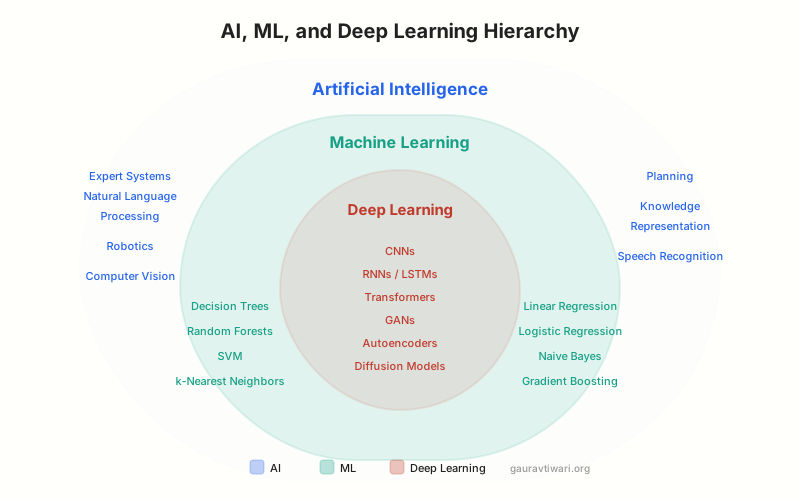
Machine learning is a subset of artificial intelligence where systems learn patterns from data instead of following hard-coded rules. Rather than writing explicit instructions for every scenario, you feed a model examples and let it figure out the underlying patterns. The model improves its accuracy as it processes more data, essentially “learning” from experience.
Arthur Samuel coined the term in 1959 when he built a checkers program that improved by playing against itself. But the real explosion didn’t happen until the 2010s, when three things converged: massive datasets became available (thanks to the internet), GPU computing got cheap enough to train complex models, and algorithms like gradient boosting and random forests matured into production-ready tools.
In 2026, machine learning powers everything from your email spam filter to Netflix recommendations to fraud detection at your bank. It’s not some futuristic technology. It’s infrastructure that runs behind every major digital product you use daily.
Types of Machine Learning
There are three primary types of machine learning, each suited to different problems:
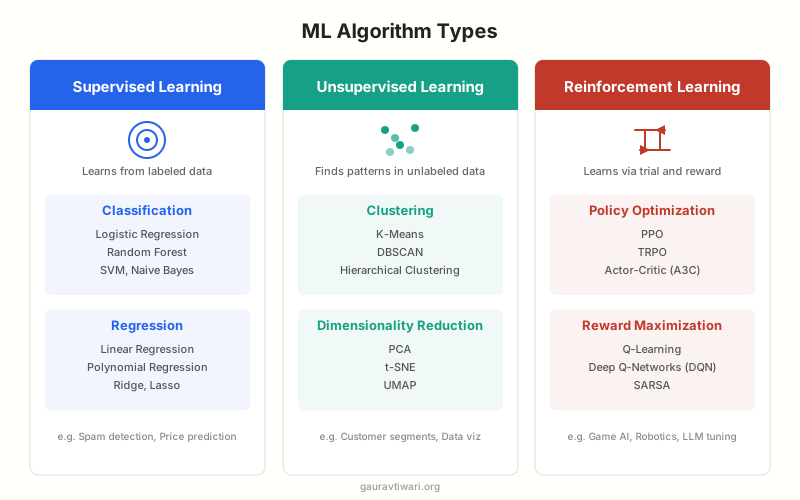
Supervised learning is the most common approach. You provide labeled data (input-output pairs), and the model learns the mapping between them. Think email spam detection: you show the model thousands of emails labeled “spam” or “not spam,” and it learns which features (certain words, sender patterns, link density) predict spam. Common algorithms include linear regression, logistic regression, decision trees, random forests, and support vector machines (SVMs). About 80% of production ML models use supervised learning.
Unsupervised learning works with unlabeled data. The model finds hidden patterns, clusters, or structures on its own. Customer segmentation is a classic use case: feed purchase history into a clustering algorithm (like K-means), and it groups customers by behavior without you telling it what the groups should be. Dimensionality reduction techniques like PCA (Principal Component Analysis) also fall here.
Reinforcement learning trains an agent through trial and error in an environment. The agent takes actions, receives rewards or penalties, and optimizes its strategy to maximize cumulative reward. DeepMind’s AlphaGo used reinforcement learning to beat the world champion in Go in 2016. In 2026, reinforcement learning powers robotics, game AI, recommendation systems, and RLHF (Reinforcement Learning from Human Feedback), which is how ChatGPT and Claude learn to give helpful responses.
If you’re new to ML, start with supervised learning. It’s the most intuitive (you have answers, you train on them), has the most tutorials, and solves the widest range of business problems. Scikit-learn’s documentation includes excellent beginner examples for classification and regression tasks. Move to unsupervised or reinforcement learning once you’ve built 2-3 supervised learning projects.
What is Deep Learning?
Deep learning is a specialized subset of machine learning that uses artificial neural networks with multiple layers (hence “deep”) to learn complex representations from data. While traditional ML algorithms require you to manually select and engineer features, deep learning models automatically discover the features they need from raw data.
A neural network is built from layers of interconnected nodes (neurons). The input layer receives raw data. Hidden layers (the “deep” part) progressively extract higher-level features. The output layer produces the final prediction. A network for image recognition might learn edges in the first layer, shapes in the second, object parts in the third, and complete objects in deeper layers. This hierarchical feature learning is what makes deep learning so powerful for complex tasks.
The key architectures you should know in 2026:
- Convolutional Neural Networks (CNNs): Designed for image and video processing. They use convolution operations to detect spatial patterns. ResNet, EfficientNet, and YOLO (You Only Look Once) are popular CNN architectures used in computer vision.
- Recurrent Neural Networks (RNNs): Built for sequential data like text and time series. LSTMs (Long Short-Term Memory) and GRUs (Gated Recurrent Units) are variants that handle long-term dependencies. Mostly replaced by transformers for text tasks, but still used in time-series forecasting.
- Transformers: The architecture behind every major LLM (GPT-4, Claude, Gemini, Llama). Uses self-attention to process entire sequences in parallel rather than sequentially. I’ll cover this in the next section because it deserves its own deep dive.
- Generative Adversarial Networks (GANs): Two networks competing against each other, one generating fake data and one detecting fakes. Used for image generation, style transfer, and data augmentation. Largely overshadowed by diffusion models (like Stable Diffusion and DALL-E 3) for image generation.
- Diffusion Models: The architecture behind Stable Diffusion, DALL-E 3, Midjourney, and Sora. They learn by adding noise to data and then learning to remove it, generating new content in the process.
Deep learning requires significantly more data and compute power than traditional ML. Training GPT-4 reportedly cost over $100 million in compute alone. But the payoff is clear: deep learning models handle unstructured data (images, audio, text, video) far better than any classical ML algorithm ever could.
The Transformer Revolution
The transformer architecture, introduced in Google’s 2017 paper “Attention Is All You Need,” is the single most important development in AI history. Every major AI system you use today, from ChatGPT to Google Search to Siri, runs on transformers. Understanding why they changed everything is essential to understanding modern AI.
Before transformers, sequence processing (text, audio, time series) relied on RNNs, which processed data one token at a time. This was slow and made it hard to capture long-range dependencies. If a model was processing a 10,000-word document, by the time it reached word 9,000, it had mostly forgotten word 500.
Transformers solved this with the self-attention mechanism. Instead of processing sequentially, self-attention lets the model look at every word in a sequence simultaneously and calculate how relevant each word is to every other word. When processing the sentence “The cat sat on the mat because it was tired,” the model can directly connect “it” to “cat” regardless of the distance between them.
The practical impact was massive:
- Parallelization: Unlike RNNs, transformers process all positions simultaneously, making training dramatically faster on GPUs and TPUs.
- Scaling laws: Researchers discovered that transformer performance scales predictably with more data, more parameters, and more compute. This is why models kept getting bigger: GPT-2 (1.5B parameters, 2019) to GPT-3 (175B, 2020) to GPT-4 (rumored 1.8T, 2023).
- Transfer learning: You can pre-train a transformer on massive general datasets, then fine-tune it for specific tasks with much smaller datasets. This made powerful AI accessible to organizations without Google-scale data.
- Multimodal capabilities: The same architecture handles text, images, audio, and video. GPT-4o and Gemini 2.0 process all modalities natively.
I’ve trained both LSTM and transformer models on the same text classification tasks. The transformer consistently outperformed the LSTM by 8-15% on accuracy while training 3-4x faster on the same GPU. The architecture advantage isn’t subtle. It’s so decisive that almost no one starts new NLP projects with RNNs anymore. PyTorch’s own tutorials have shifted almost entirely to transformer-based approaches.
The transformer timeline worth knowing: BERT (2018, Google) proved transformers could understand context bidirectionally. GPT-2 (2019, OpenAI) showed they could generate coherent text. GPT-3 (2020) demonstrated few-shot learning. ChatGPT (November 2022) brought transformers to mainstream users. GPT-4 (March 2023) showed multimodal reasoning. And in 2026, we’re seeing transformer-based systems handle code generation, scientific research, real-time translation, and autonomous decision-making at a level that seemed impossible just three years ago.
Key Differences Between Machine Learning and Deep Learning
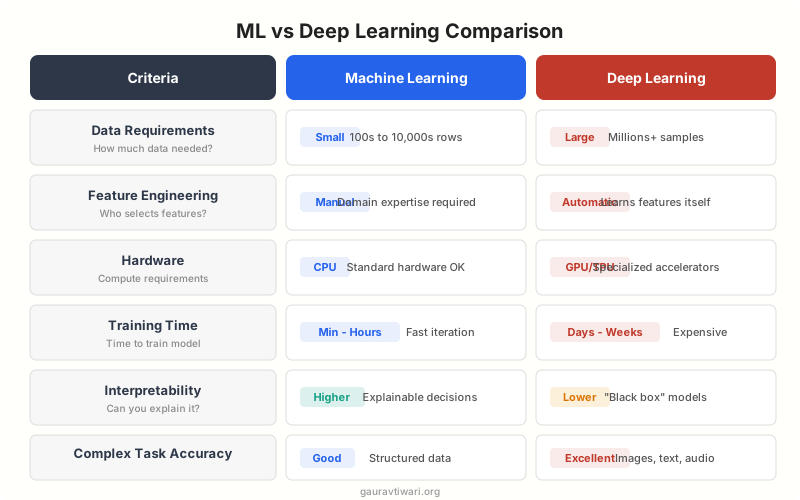
Machine learning and deep learning solve different problems at different scales. Here’s a practical comparison based on what I’ve seen working with both across client projects and my own applications:
| Factor | Machine Learning | Deep Learning |
|---|---|---|
| Data requirements | Works well with hundreds to thousands of samples | Typically needs tens of thousands to millions of samples |
| Feature engineering | Manual feature selection required (you decide what matters) | Automatic feature extraction from raw data |
| Compute requirements | Runs on CPU, laptop-friendly | Requires GPU/TPU, cloud compute for training |
| Training time | Minutes to hours for most models | Hours to weeks (GPT-4 training took months) |
| Interpretability | High (decision trees, logistic regression are explainable) | Low (neural networks are “black boxes”) |
| Best for structured data | Excels (tabular data, spreadsheets, databases) | Overkill, often underperforms gradient boosting |
| Best for unstructured data | Limited (images, audio, long text) | Excels (computer vision, NLP, speech recognition) |
| Deployment complexity | Simple (scikit-learn model in a Flask API) | Complex (model serving, GPU inference, optimization) |
| Cost to build | Low ($0-$100/month for most projects) | High ($1,000-$100M+ depending on scale) |
| Popular algorithms | XGBoost, Random Forest, SVM, K-means | Transformers, CNNs, Diffusion Models, GANs |
Here’s my honest take: for 80% of business ML problems (churn prediction, lead scoring, demand forecasting, A/B test analysis), you don’t need deep learning. XGBoost or LightGBM on structured data will outperform a neural network and train in minutes instead of hours. I’ve seen teams waste months building deep learning pipelines for problems that a gradient boosting model solves better.
Deep learning earns its complexity when you’re dealing with images, audio, video, or large-scale text processing. If you’re building a chatbot, image classifier, speech-to-text system, or content generator, deep learning isn’t just better. It’s the only viable option. For a deeper look at how businesses are applying these technologies, read my guide on AI and machine learning for business.

Large Language Models and the LLM Revolution
Large language models (LLMs) are transformer-based deep learning models trained on massive text datasets. They represent the most visible and impactful application of deep learning in 2026. The LLM landscape has evolved rapidly, and keeping track of what’s available, what’s good, and what’s hype is genuinely challenging.
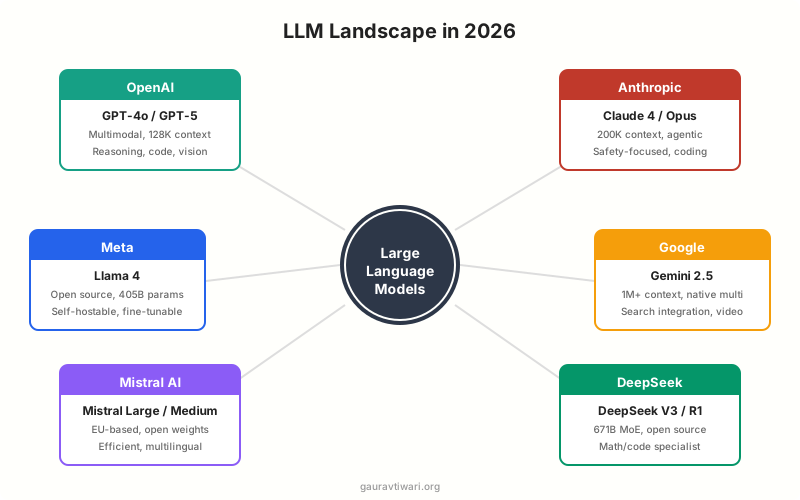
Here are the major LLMs you should know about:
GPT-4 and GPT-4o (OpenAI): Still the benchmark against which everything else is measured. GPT-4o is the multimodal version that processes text, images, and audio natively. Powers ChatGPT, Microsoft Copilot, and thousands of third-party applications via API. Pricing: roughly $2.50 per million input tokens and $10 per million output tokens for GPT-4o.
Claude 3.5 Sonnet and Claude 4 (Anthropic): My personal preference for complex reasoning and long-document analysis. Claude handles 200K token context windows, which means it can process entire codebases or book-length documents in a single prompt. Claude 4 (released in 2026) pushed reasoning and coding capabilities significantly. I use Claude daily for writing, code review, and research.
Gemini 2.0 (Google): Google’s most capable model, integrated across Search, Workspace, and Android. Strong multimodal capabilities with native image, video, and audio understanding. The 1-million-token context window is genuinely useful for processing large research papers or video transcripts.
Llama 3.1 (Meta): The most important open-source LLM family. Available in 8B, 70B, and 405B parameter versions. The 405B model competes with GPT-4 on many benchmarks. Because it’s open-source (under a permissive license), you can run it locally, fine-tune it, and deploy it without API costs.
Mistral (Mistral AI): A French AI lab producing surprisingly capable models at smaller sizes. Mistral Large competes with GPT-4 on reasoning tasks. Their Mixtral model introduced the Mixture of Experts (MoE) architecture to mainstream use, which routes different parts of a query to specialized sub-models.
DeepSeek V3 and R1 (DeepSeek): A Chinese AI lab that shocked the industry by matching GPT-4 level performance at a fraction of the training cost. DeepSeek R1, their reasoning model, is fully open-source and has been adopted widely. Their efficiency-focused approach proved that you don’t need $100 million budgets to build competitive models.
Don’t chase the “best” model. Match the model to your task. For coding, Claude and GPT-4o lead. For creative writing, Claude tends to produce more natural output. For search-integrated tasks, Gemini has the advantage. For privacy-sensitive applications or cost-constrained projects, Llama 3.1 running locally is the best option. I run Llama 3.1 8B on my MacBook for quick local tasks and use Claude’s API for production workloads.
Open-Source vs Proprietary Models
The open-source vs proprietary debate is one of the most consequential decisions in AI right now. Your choice affects cost, privacy, customization, and long-term vendor risk. After working with both approaches across multiple projects, I have strong opinions on when to use each.
Proprietary models (GPT-4, Claude, Gemini) offer the highest raw performance, managed infrastructure, and continuous updates. You pay per API call, which makes them cost-effective for low-to-medium volume use cases. The downside: your data goes through a third-party server, you can’t customize the model’s behavior beyond prompting, and pricing can change without notice. I’ve seen API costs balloon from $200/month to $3,000/month as a client’s usage scaled.
Open-source models (Llama 3.1, Mistral, DeepSeek, Falcon, Phi-3) give you full control. You can run them on your own servers, fine-tune them on your specific data, and never worry about an API provider changing terms. The Hugging Face ecosystem (over 500,000 models and 100,000 datasets) has made this remarkably accessible. You can download a model, fine-tune it with your data using the Transformers library, and deploy it on a single GPU.
The practical calculus: if you’re making fewer than 10,000 API calls per month and don’t need customization, proprietary APIs are simpler and cheaper. Once you exceed 50,000 calls/month, or need domain-specific fine-tuning, or have strict data privacy requirements, hosting an open-source model on your own infrastructure becomes more cost-effective.
Fine-tuning has gotten dramatically easier. Tools like Hugging Face’s AutoTrain, Axolotl, and Unsloth let you fine-tune a 7B-parameter model on a single A100 GPU in under 2 hours. QLoRA (Quantized Low-Rank Adaptation) reduced the memory needed for fine-tuning by 65%, bringing it within reach of consumer GPUs like the RTX 4090.
If you’re exploring how small businesses can leverage these models without massive budgets, my guide on how SMBs can use ML to boost digital strategy covers practical approaches.
Practical Applications for Business
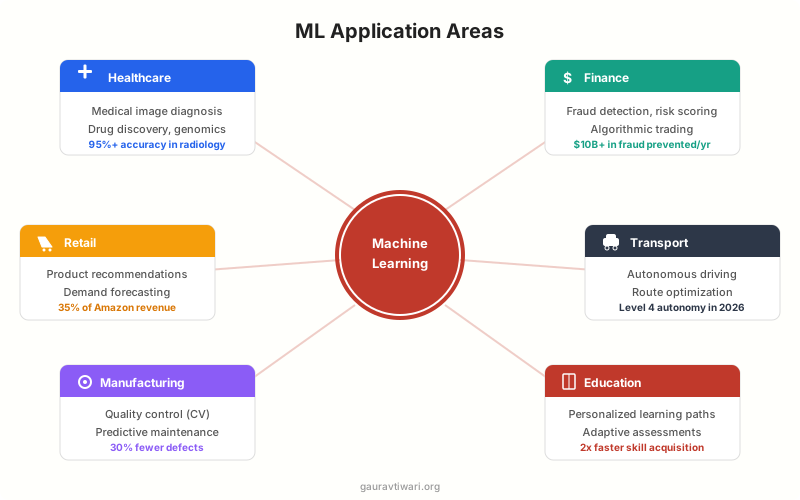
The gap between “AI demo” and “AI in production” has closed rapidly. In 2026, machine learning and deep learning aren’t research projects anymore. They’re operational tools that businesses of every size are deploying. Here are the applications generating the most real-world value:
Chatbots and customer support: AI-powered chatbots now handle 60-70% of routine customer inquiries without human intervention. Tools like Intercom’s Fin, Zendesk AI, and custom solutions built on GPT-4 or Claude APIs can resolve password resets, order tracking, return processing, and FAQ responses. I helped a client deploy a Claude-powered support bot that resolved 64% of tickets automatically, cutting their support costs by $12,000/month.
Document processing and extraction: ML models extract data from invoices, contracts, medical records, and legal documents with 95%+ accuracy. AWS Textract, Google Document AI, and open-source alternatives like Docling handle OCR, table extraction, and classification. This is where the impact of ML on document management becomes tangible for operations teams.
Predictive analytics: Customer churn prediction, demand forecasting, lead scoring, fraud detection, and inventory optimization all use supervised learning on structured data. These are “boring” ML applications that deliver massive ROI. A well-tuned churn model can save a SaaS company hundreds of thousands in retained revenue annually.
Recommendation engines: Netflix estimates its recommendation system saves $1 billion per year in reduced churn. Recommendation systems combine collaborative filtering (people who liked X also liked Y), content-based filtering (products with similar features), and increasingly, LLM-powered conversational recommendations.
Content creation and marketing: LLMs assist with drafting, editing, research, SEO optimization, and content repurposing. Tools like Notion AI integrate ML directly into workflow tools, letting teams generate first drafts, summarize meetings, and organize knowledge bases without switching contexts.
Code generation and developer tools: GitHub Copilot (powered by OpenAI Codex) and cursor-based AI coding assistants have changed how developers write code. Studies show developers using Copilot complete tasks 55% faster. I use AI coding assistants daily, and they’ve genuinely changed my productivity for boilerplate code, debugging, and documentation.
ML/DL Tools and Frameworks
The tooling landscape has consolidated significantly since 2020. Here’s what actually matters in 2026 and what I’d recommend based on real usage:
PyTorch: The dominant deep learning framework, period. Over 70% of new research papers use PyTorch. Its eager execution mode makes debugging intuitive (you can use standard Python debugging tools), and the ecosystem (TorchVision, TorchAudio, TorchText) covers every modality. If you’re starting deep learning today, learn PyTorch first. No debate.
TensorFlow/Keras: Still relevant, especially for mobile deployment (TensorFlow Lite) and web deployment (TensorFlow.js). Google continues investing in it, and Keras 3 now works with PyTorch, JAX, and TensorFlow backends. But for new projects, PyTorch has won the mindshare battle.
scikit-learn: The gold standard for classical ML. If you’re working with structured/tabular data (and you probably are for most business problems), scikit-learn’s clean API for classification, regression, clustering, and preprocessing is unmatched. Pair it with XGBoost or LightGBM for gradient boosting.
Hugging Face Transformers: The library that democratized LLMs. Access 500,000+ pre-trained models with a few lines of Python. Handles tokenization, model loading, fine-tuning, and inference. If you’re working with NLP or any transformer-based task, you’ll use this daily.
LangChain and LlamaIndex: Frameworks for building applications on top of LLMs. LangChain handles chains, agents, and tool use. LlamaIndex specializes in connecting LLMs to your private data (RAG pipelines). Both have matured significantly and are production-ready.
MLflow and Weights & Biases: Experiment tracking, model versioning, and deployment management. MLflow is open-source and integrates with everything. Weights & Biases offers a more polished UI and team collaboration features. You’ll need one of these once you move past the experimentation phase.
Cloud ML platforms: AWS SageMaker, Google Vertex AI, and Azure ML provide managed infrastructure for training and deploying models. They’re expensive but save engineering time. For startups and individuals, services like Replicate, Modal, and RunPod offer pay-per-second GPU access for training and inference.
Learning Resources and Career Paths
The ML job market in 2026 is strong but increasingly competitive. Entry-level roles require more than just completing a MOOC. Here’s what I’ve seen work for people breaking into the field, and the resources I’d recommend based on their actual quality, not just their marketing.
Best free courses:
- fast.ai (Practical Deep Learning for Coders): Jeremy Howard’s top-down approach gets you building working models from day one. Covers PyTorch, transformers, and deployment. This is where I’d start if I were learning deep learning today.
- Andrew Ng’s Machine Learning Specialization (Coursera): The classic foundational course, updated in 2022 with Python (the original used Octave/MATLAB). Covers supervised learning, unsupervised learning, and neural networks. Free to audit.
- Stanford CS229 and CS231n (YouTube): University-level rigor, freely available. CS229 covers ML theory deeply. CS231n focuses on computer vision and CNNs.
- Hugging Face NLP Course: Free, comprehensive course on using transformers for NLP tasks. Extremely practical and well-maintained.
Best paid courses:
- DeepLearning.AI specializations (Coursera, $49/month): Andrew Ng’s deep learning, NLP, and MLOps specializations are thorough and well-structured.
- DataCamp and Codecademy: Better for interactive, hands-on practice than theory. Good supplements to the courses above.
For a curated list of the best options with detailed comparisons, check out my roundup of the 10 best machine learning courses.
Career paths and salary ranges (US market, 2026):
| Role | Experience | Typical Salary Range | Key Skills |
|---|---|---|---|
| ML Engineer | 2-5 years | $130K-$200K | Python, PyTorch, MLOps, cloud deployment |
| Data Scientist | 2-5 years | $120K-$180K | Statistics, SQL, scikit-learn, communication |
| AI Research Scientist | PhD + 2 years | $180K-$350K+ | Deep learning theory, paper publishing, PyTorch |
| MLOps Engineer | 3-5 years | $140K-$210K | Docker, Kubernetes, CI/CD, model monitoring |
| AI Product Manager | 5+ years | $150K-$250K | ML literacy, product sense, cross-functional leadership |
My honest advice: the market is flooded with people who can train a model in a Jupyter notebook. What’s scarce is people who can take that model from notebook to production, monitor it, handle edge cases, and explain results to non-technical stakeholders. Focus on the full lifecycle, not just model training.
AI Safety and Ethics
The capabilities of ML and DL systems have outpaced our ability to govern them responsibly. This isn’t an abstract philosophical concern anymore. It’s a practical issue affecting regulation, hiring, product development, and public trust in 2026.
Alignment and hallucination: LLMs generate confident, fluent text that is sometimes completely fabricated. GPT-4 hallucinates less than GPT-3.5, but it still happens. Anthropic (Claude’s maker) has invested heavily in Constitutional AI and RLHF to reduce harmful outputs. But no current model is hallucination-free, which limits their use in high-stakes domains like medical diagnosis and legal advice without human oversight.
Bias in ML models: Models trained on biased data produce biased outputs. This has real consequences: biased hiring algorithms, discriminatory loan approvals, facial recognition systems that perform worse on darker skin tones. Amazon scrapped an ML hiring tool in 2018 because it discriminated against women. Mitigating bias requires diverse training data, regular auditing, and fairness-aware algorithms like those in IBM’s AI Fairness 360 toolkit.
Regulation: The EU AI Act (fully effective August 2025) is the world’s most comprehensive AI regulation. It classifies AI systems by risk level (unacceptable, high, limited, minimal) and imposes requirements on high-risk systems: transparency, human oversight, documentation, and conformity assessments. The US is taking a lighter, sector-specific approach. China has separate regulations for generative AI, recommendation algorithms, and deepfakes.
Deepfakes and misinformation: Generative AI makes creating convincing fake images, audio, and video trivially easy. Voice cloning tools can replicate a person’s voice from 3 seconds of audio. Political deepfakes, financial fraud using cloned voices, and AI-generated misinformation are active threats. Digital watermarking (C2PA standard) and detection tools are emerging, but the offense currently outpaces the defense.
If you’re building ML products, you need an ethics review process before launch, not after a PR crisis. At minimum: test for demographic bias, document your training data sources, add human review for high-stakes decisions, and implement user feedback loops. The companies that get this right early will have a competitive advantage as regulation tightens.
AI in gaming is another area where ethical questions around algorithmic behavior arise. My piece on AI-driven game algorithms explores how game developers are navigating these challenges.
The Future of ML and DL
Prediction is risky in a field that moves this fast. In 2021, nobody predicted that by 2023, a chatbot would pass the bar exam. That said, here are the trends I’m most confident about based on what’s already in motion:
Multimodal models as default: The era of text-only AI is ending. GPT-4o, Gemini 2.0, and Claude already process text, images, and audio natively. The next frontier is video understanding, real-time spatial reasoning, and seamless switching between modalities. Expect every major AI product to be multimodal within 18 months.
AI agents: Models that don’t just answer questions but take actions. Browse the web, write and execute code, manage files, book appointments, coordinate with other agents. OpenAI’s Operator, Anthropic’s computer use features, and frameworks like AutoGen and CrewAI are pushing toward agents that complete multi-step tasks autonomously. This is the most exciting near-term development.
On-device AI: Apple Intelligence, Google’s on-device Gemini Nano, and Qualcomm’s NPU chips are bringing ML inference directly to phones and laptops. Running a 3B-parameter model locally with zero internet latency changes the privacy and speed equation entirely. By 2026, most smartphones will run capable language models on-chip.
Smaller, efficient models: The “bigger is always better” era is fading. Techniques like distillation, quantization (INT4, GPTQ, AWQ), and Mixture of Experts (MoE) are producing models that match larger ones at a fraction of the compute. Microsoft’s Phi-3 (3.8B parameters) outperforms models 10x its size on many benchmarks. This trend makes AI more accessible and sustainable.
Specialized vertical AI: General-purpose models are powerful, but industry-specific models trained on domain data outperform them in specialized tasks. Bloomberg built BloombergGPT for financial NLP. Med-PaLM 2 handles medical questions at expert level. Expect every major industry to have specialized AI models within 2-3 years.
Synthetic data: Training on real data has legal, privacy, and availability constraints. Models like Stable Diffusion and GPT-4 can generate synthetic training data that’s often as effective as real data. NVIDIA’s Omniverse uses synthetic data to train robotics models in simulated environments before deploying to physical robots.
The convergence of AI agents and on-device models is what excites me most. Imagine a personal AI assistant that runs entirely on your phone, understands your calendar, email, and documents, and can take actions on your behalf without any data leaving your device. Apple and Google are building toward this. When it works reliably, it will be the biggest shift in personal computing since the smartphone.
Frequently Asked Questions
What is the main difference between machine learning and deep learning?
Machine learning uses algorithms that learn patterns from structured data with manual feature engineering. Deep learning uses multi-layered neural networks that automatically extract features from raw, unstructured data like images, audio, and text. Deep learning is a subset of machine learning that requires significantly more data and compute power but handles complex tasks (computer vision, NLP, speech recognition) that traditional ML cannot.
Do I need a PhD to work in machine learning?
No. A PhD helps for research scientist roles at top labs (OpenAI, DeepMind, Anthropic), but ML engineer and data scientist roles at most companies require strong programming skills (Python), statistics knowledge, and practical experience building models. Many successful ML engineers are self-taught or have bootcamp backgrounds. Focus on building a portfolio of real projects and contributing to open-source rather than credentials alone.
Which programming language is best for machine learning?
Python, by a wide margin. Over 85% of ML practitioners use Python as their primary language. It has the best ecosystem: scikit-learn for classical ML, PyTorch and TensorFlow for deep learning, Hugging Face Transformers for LLMs, pandas and NumPy for data manipulation, and Matplotlib for visualization. R is used in academic statistics and bioinformatics. Julia is gaining traction for high-performance computing. But for career purposes, Python is the only essential language.
Can I run large language models on my own computer?
Yes, with limitations. Tools like Ollama, LM Studio, and llama.cpp let you run quantized versions of open-source models locally. A MacBook with 16GB RAM can run 7B-parameter models (like Llama 3.1 8B or Mistral 7B) at reasonable speeds. For 70B models, you need 32-64GB RAM or a GPU with 24GB+ VRAM (like the RTX 4090). Running models locally gives you full privacy and zero API costs, but performance will be slower than cloud-hosted options.
What is the transformer architecture and why does it matter?
The transformer is a neural network architecture introduced in 2017 that uses self-attention to process entire sequences in parallel. Unlike older RNN architectures that processed data sequentially (one word at a time), transformers can attend to all parts of a sequence simultaneously. This enables faster training, better handling of long-range dependencies, and predictable scaling with more data and parameters. Every major LLM (GPT-4, Claude, Gemini, Llama) is built on the transformer architecture.
How much does it cost to train a machine learning model?
Costs vary enormously by scope. Training a simple scikit-learn model on structured data costs nothing beyond your laptop’s electricity. Fine-tuning a 7B-parameter LLM costs $10-$50 in cloud GPU time (using services like RunPod or Lambda). Training a model from scratch at GPT-4 scale costs $50-$100 million or more. For most business applications, you’re either using pre-trained models via API ($0.001-$0.06 per 1K tokens) or fine-tuning open-source models for $50-$500.
Will AI replace data scientists and ML engineers?
Not in the foreseeable future, but the role is evolving. AI tools automate parts of the ML workflow (AutoML, AI-assisted coding, automated feature engineering), which means ML engineers do more with less manual work. The demand is shifting from people who can train models to people who can design ML systems, manage data pipelines, ensure model reliability in production, and translate business problems into ML solutions. Adaptable ML professionals who embrace AI tools will be more productive, not replaced.
Disclaimer: This site is reader-supported. If you buy through some links, I may earn a small commission at no extra cost to you. I only recommend tools I trust and would use myself. Your support helps keep gauravtiwari.org free and focused on real-world advice. Thanks. - Gaurav Tiwari