
The Most Important Reading Statistics and Insights You Should Know

Reading habits have shifted dramatically over the past decade. The way people consume text, where they read, how long they spend on content, and whether they retain what they’ve read are all changing faster than most publishers realize. I track these numbers closely because they directly affect how I create content, and they should affect how you think about content too.
Whether you’re a publisher, marketer, educator, or content creator, these reading statistics will shape how you approach your audience. Here are the numbers that matter most.
Why Reading Statistics Matter
Reading remains one of the most powerful tools for learning, but how people engage with text is changing rapidly. Examining reading stats offers a clearer view of how societies adapt to technology, shifting cultural habits, and evolving education systems. Policymakers use these numbers to shape literacy initiatives. Educators adapt curricula based on them. Publishers track them to anticipate market shifts.
If you create content of any kind, understanding reading behavior isn’t optional. It determines how you structure articles, how long they should be, where to place key information, and what formats work best for your audience.
Looking closely at literacy patterns across age groups and regions reveals surprising gaps and opportunities. Some populations are reading more than ever. Others are abandoning long-form content entirely. These shifts have real consequences for education, communication, and how businesses reach their customers.
Global Reading Statistics
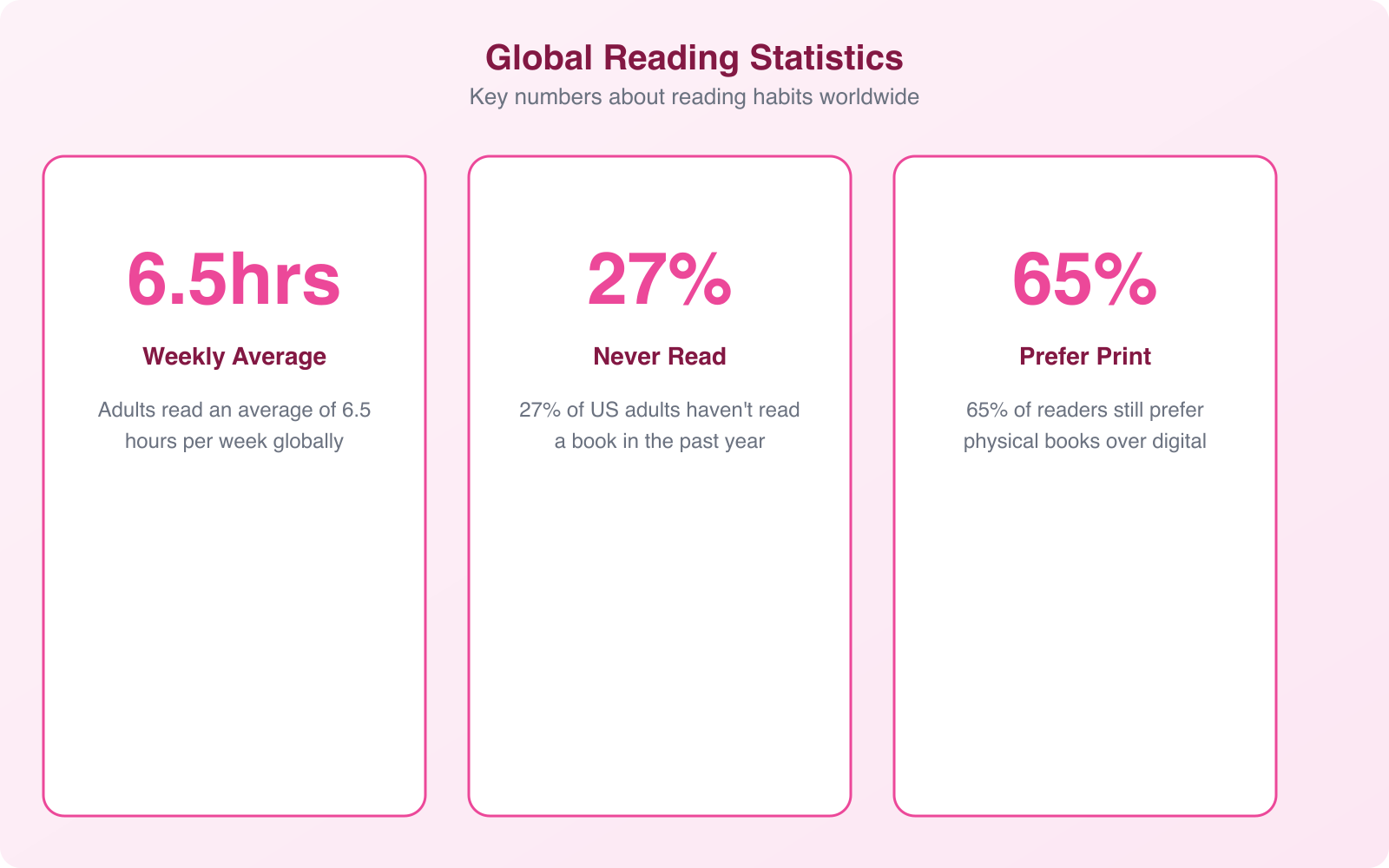
On a global scale, the adult literacy rate has reached 86.3%, but over 750 million people still lack basic literacy skills, most of them women, according to UNESCO. Two centuries ago, only around 12% of the world’s population could read. That number is now almost completely reversed.
Reading time varies significantly by country and culture:
| Country | Reading Hours per Week | Annual Total |
|---|---|---|
| India | 10.7 hours | 556 hours |
| Thailand | 9.4 hours | 489 hours |
| China | 8.0 hours | 416 hours |
| United States | 7.0 hours | 364 hours |
| France | 5.8 hours | 302 hours |
| United Kingdom | 5.3 hours | 276 hours |
The data, published by World Population Review, highlights the role of cultural and educational environments. In some regions, communal reading traditions and library systems encourage daily engagement. In others, reading spikes during specific seasons or school terms. Reading statistics in America show that participation increases during holidays and summer reading initiatives, balancing out the overall yearly averages.
Reading Habits Among Students
For students, reading is both a learning necessity and a personal choice. A national survey by the Literacy Trust found that only 32.7% of children aged 8-18 in the UK enjoy reading, and just 18.7% read daily for pleasure. These numbers reveal a widening gap between required and voluntary reading.
Students who follow structured reading programs typically finish significantly more books each year than peers without such support. The data points to a clear pattern:
- Students increasingly rely on short-form content like summaries and quick overviews instead of full texts.
- Digital reading happens primarily during class, then shifts to social media afterward.
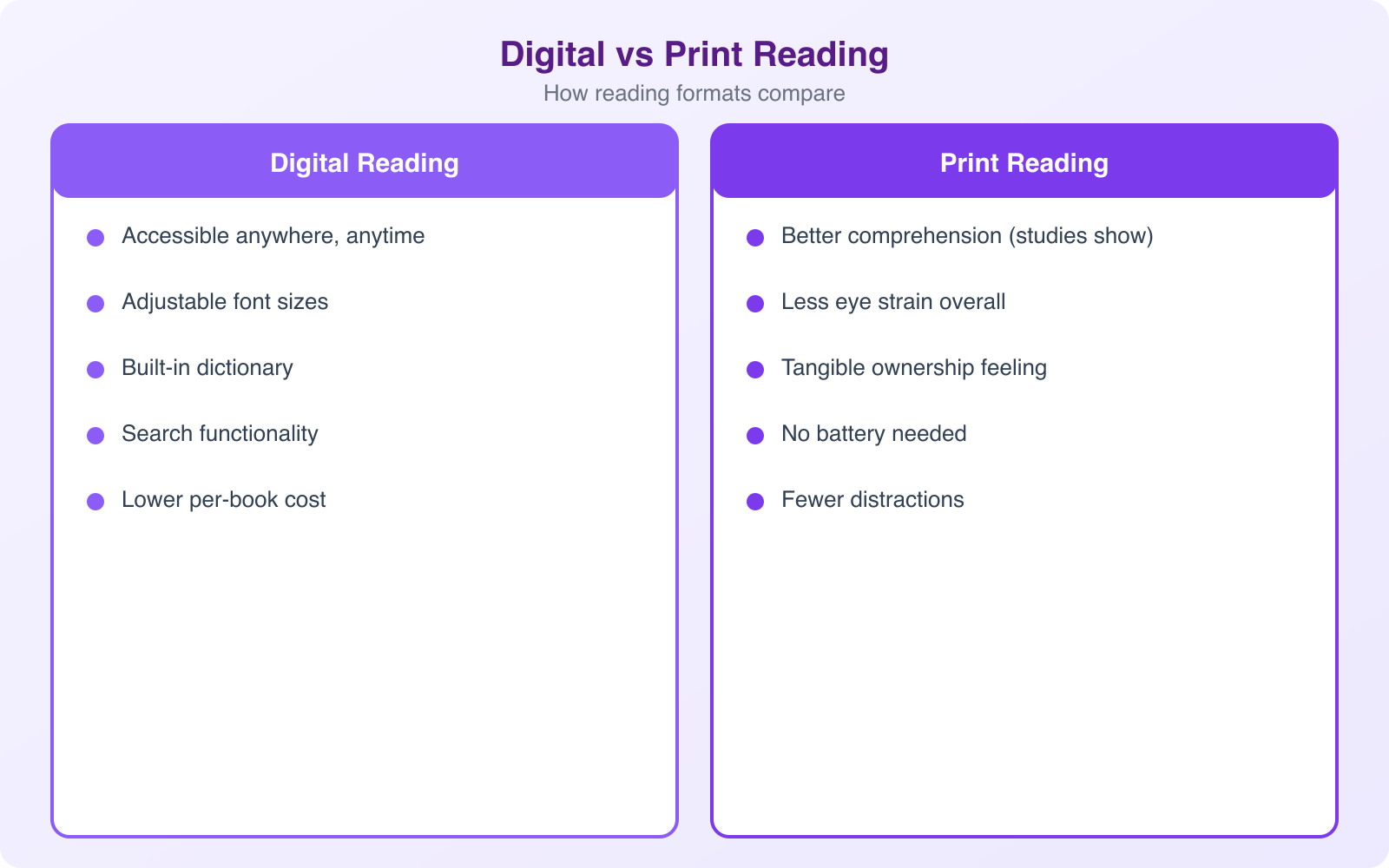
- Print books still win for deep study despite strong digital literacy among younger readers.
These trends mirror reading statistics for students across many countries. Engagement levels often reflect how schools frame reading within their curricula. Schools that make reading a shared, social activity see higher voluntary reading rates than those that treat it purely as homework.
Digital Reading and Technology
Technology has fundamentally changed how people interact with text. Pew Research Center reports that 64% of U.S. adults read at least one book in the past year in any format, but print still leads digital. Meanwhile, data from the National Endowment for the Arts shows that only 48.5% read at least one book in 2022, indicating a gradual decline in traditional reading habits.
Digital reading platforms offer accessibility and customization, but they also encourage fragmented attention. Studies show that gamified reading apps improve retention by up to 75% compared to control groups. These tools use streaks, goals, and rewards to keep readers coming back.
The key insight for content creators: your readers are likely scanning, not reading word-by-word. Research from the Nielsen Norman Group consistently shows that most web users read in an F-pattern, hitting headlines and the first few words of paragraphs before deciding to continue or bounce.
Structure your content for scanners first, readers second. Use descriptive headings, bold key phrases, and front-load important information in each paragraph. The readers who want depth will read the full text. The scanners need to find what they need fast.
Mobile Reading Statistics
Mobile devices now account for over 60% of all web traffic globally. This means the majority of your readers are consuming your content on screens between 5 and 7 inches wide. That has profound implications for content design.
Mobile readers behave differently from desktop readers:
- Session length: Average mobile reading sessions last 3-5 minutes compared to 8-12 minutes on desktop.
- Scroll depth: Only about 20-30% of mobile readers scroll past the first 1,000 words of an article.
- Bounce rate: Pages that take more than 3 seconds to load on mobile lose 53% of visitors.
- Preferred format: Lists, short paragraphs, and clear headings perform significantly better on mobile.
If your website isn’t optimized for mobile reading, you’re ignoring the majority of your potential audience. This includes fast hosting, responsive design, readable font sizes (16px minimum), and generous line spacing.
Reading and Academic Performance
The connection between reading and academic success is one of the most well-established findings in education research. Students who read four or more hours per week consistently score 12% higher on standardized assessments than peers who read less.
| Reading Frequency | Average Test Score | Improvement Over Baseline |
|---|---|---|
| 4+ hours/week | 84% | +12% |
| 1-3 hours/week | 77% | +5% |
| Less than 1 hour/week | 72% | Baseline |
Regular reading builds vocabulary, strengthens critical thinking, and improves overall comprehension. Many educators integrate reading with writing by assigning essays and reflective prompts after key readings, which further reinforces retention and analytical skills.
These findings align with international assessments like PIRLS, which repeatedly show that students who read frequently achieve better academic outcomes regardless of socioeconomic background. The effect is cumulative: consistent reading over years compounds like interest.
Attention Span and Content Consumption
The often-cited claim that human attention spans are shorter than a goldfish’s is misleading. What’s actually happening is that people have become more selective about what deserves their attention. They’re not incapable of focus. They’re just filtering faster.
Here’s what the research actually shows:
- Average time on page: 52 seconds for most web content (Chartbeat data across millions of pages).
- Decision to stay or leave: Most users decide within 10-15 seconds whether to continue reading.
- Optimal article length for engagement: 1,600-2,400 words for in-depth content (Medium’s internal data).
- Reading speed: Average adults read at 200-250 words per minute. Skilled readers hit 350-400 wpm.
The practical takeaway: your opening paragraph is the most important paragraph you’ll write. If it doesn’t hook the reader with a clear promise of value within those first 10-15 seconds, the rest of your carefully crafted content doesn’t matter because nobody will see it.
Decline or Growth? Current Trends in Reading
Recent data paints a mixed picture. A study by the University of Florida found that daily leisure reading in the U.S. has dropped by over 40% since the early 2000s. Yet 64% of readers worldwide plan to read more this year than last, according to survey data.
This isn’t contradictory. It means that while spontaneous daily reading is fading, structured and intentional reading is gaining ground. Book clubs, reading challenges, library programs, and audiobook platforms are all growing. People are reading less casually but more purposefully.
Audiobooks deserve special mention. The audio publishing industry has grown by double digits for several consecutive years. Many people who don’t identify as “readers” are consuming 20+ books per year through audio. Whether that counts as “reading” is a philosophical debate, but the information absorption is real.
For content creators: don’t just write for readers. Consider audio versions of your content. Blog posts converted to podcast episodes or audio articles expand your reach to the growing audience that “reads with their ears.”
The Future of Reading: Predictions and Insights
Gen Alpha reading statistics suggest a generation more comfortable with technology yet still responsive to print-based depth when the content is engaging enough. Several developments will likely shape the future of reading:
- Hybrid reading models that blend digital convenience with the focus benefits of print will become standard.
- Gamified and goal-based reading systems will make daily reading more habitual, especially among younger audiences.
- AI tools will scaffold complex texts for developing readers, adjusting vocabulary and structure in real time.
- Community programs aimed at closing literacy gaps will expand in underserved regions with mobile-first approaches.
- Curriculum redesign will position reading as both a practical skill and a cultural anchor rather than just an academic requirement.
The format of reading will keep evolving. But the fundamental skill of comprehending written text isn’t going anywhere. If anything, the ability to read deeply and critically is becoming more valuable as surface-level content floods every platform.
Frequently Asked Questions
How many people read books regularly?
Pew Research Center reports that 64% of adults in the U.S. read at least one book annually in any format. However, daily reading for pleasure has declined significantly over the past two decades. About 27% of American adults say they didn’t read a single book in the past year.
Do students prefer digital books over paper books?
Research consistently shows that students use digital devices for convenience and quick access but prefer print books for focused study and deep reading. The preference for print is stronger when comprehension and retention matter, such as exam preparation or research projects.
How much time does the average person spend reading per day?
Estimates vary by source, but adults typically read between 15 and 20 minutes daily for pleasure. Total reading time (including work emails, news, social media text) is much higher, averaging 2-3 hours per day for most adults, though much of this is fragmented scanning rather than sustained reading.
Does reading really improve academic performance?
Yes, consistently. Students who read 4+ hours per week score approximately 12% higher on standardized tests compared to those who read less than 1 hour per week. The effect is cumulative over time, with early childhood reading habits being the strongest predictor of later academic success.
What is the average reading speed for adults?
The average adult reads at 200-250 words per minute for comprehension. Skilled readers can reach 350-400 wpm. Speed reading techniques can push this higher, but comprehension typically drops above 500 wpm. For web content specifically, users tend to scan at much faster rates, often skipping 60-80% of the text on a page.