
How Technology Is Driving Innovation in the Digital Economy
The digital economy isn’t coming. It’s already here, and it’s moving faster than most businesses can keep up.
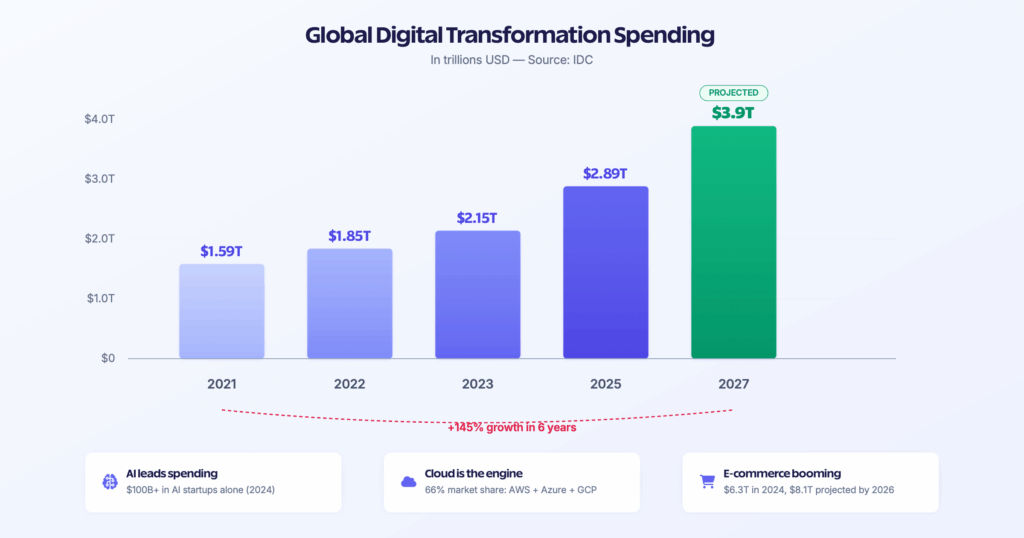
Global digital transformation spending hit $2.15 trillion in 2023 and is projected to reach $3.9 trillion by 2027, according to IDC. That’s not a trend. That’s a fundamental restructuring of how value gets created, distributed, and captured.
I’ve watched this shift firsthand over 16 years of building digital products for 800+ clients. The companies that thrive aren’t the ones with the biggest budgets. They’re the ones that understand which technologies actually matter and how to deploy them before competitors do.
Here’s what’s driving real innovation right now, not in some hypothetical future, but today.
Table of Contents
Mobile-First Isn’t a Strategy. It’s Reality.
Over 60% of global web traffic comes from mobile devices. In some markets (Southeast Asia, parts of Africa), it’s above 80%.
If your website takes more than 3 seconds to load on mobile, you’re losing 53% of visitors (Google data). If your checkout flow requires more than 4 taps, your cart abandonment rate is likely above 70%.
Mobile commerce (m-commerce) reached $2.2 trillion in 2024. Progressive Web Apps (PWAs) are closing the gap between native apps and mobile websites, giving businesses app-like experiences without the App Store gatekeepers.
Even digital entertainment platforms have adapted. Online gaming ecosystems, for instance, have shifted entirely to mobile-first design. Platforms like GameZone Tongits Game reflect this broader pattern: digital experiences built around how people actually use their devices today, not how they used them five years ago.
The takeaway for any business: test your entire customer journey on a phone first, desktop second.
AI Isn’t a Buzzword Anymore. It’s Infrastructure.
Artificial intelligence crossed the hype threshold sometime around late 2022. ChatGPT made it visible, but the real transformation happened quietly in back offices and data pipelines.
Here’s what AI actually does for businesses today:
- Customer service automation reduces support costs by 30-45%. Companies like Klarna replaced 700 support agents with AI, handling 2.3 million conversations in its first month.
- Predictive analytics lets retailers forecast demand with 85%+ accuracy, cutting inventory waste significantly.
- Content personalization drives 40% more revenue for e-commerce companies using recommendation engines (Netflix saves $1 billion annually from its algorithm alone).
- Fraud detection catches suspicious transactions in milliseconds. PayPal’s AI systems review 10 billion+ transactions per year with a fraction of the false positive rate of rule-based systems.
The mistake most businesses make? Treating AI as a product to buy rather than a capability to build. You don’t need a custom large language model. You need people who understand how to integrate AI into existing workflows.
Small businesses can start with tools like ChatGPT for content, Jasper for marketing copy, or Tidio for customer chat. The entry barrier dropped to near zero.
Cloud Computing Changed Who Gets to Compete
Ten years ago, launching a tech company required six figures in server infrastructure. Today, a $50/month AWS or Google Cloud account gives you more computing power than most Fortune 500 companies had in 2010.
Cloud computing didn’t just reduce costs. It democratized innovation.
The numbers tell the story:
| Metric | On-Premise (2015) | Cloud-Based (2025) |
|---|---|---|
| Initial infrastructure cost | $50,000-$500,000 | $0-$500/month |
| Time to deploy new application | 3-6 months | Hours to days |
| Scaling during traffic spikes | Buy more servers (weeks) | Auto-scale (seconds) |
| Team size needed for IT ops | 5-15 people | 1-3 people |
| Global availability | Custom CDN setup | Built-in |
AWS, Azure, and Google Cloud collectively control about 66% of the cloud infrastructure market. But the real disruption comes from specialized platforms: Vercel for frontend deployment, PlanetScale for databases, Cloudflare for edge computing.
Startups now ship products in weeks that would have taken enterprise teams months. That’s not an exaggeration. It’s the new baseline.
E-Commerce Hit $6.3 Trillion. Here’s Why It Keeps Growing.
Global e-commerce revenue reached $6.3 trillion in 2024, and Statista projects $8.1 trillion by 2026. The growth isn’t slowing because the technology keeps removing friction.
Three technologies are pushing e-commerce forward:
1. AI-powered search and discovery. Amazon’s recommendation engine drives 35% of its total revenue. Shopify’s AI assistant (Sidekick) helps merchants optimize stores without hiring developers.
2. Buy-now-pay-later (BNPL). Klarna, Afterpay, and Affirm processed over $300 billion in transactions in 2024. BNPL increases average order values by 20-30% for merchants.
3. Headless commerce architecture. Separating the frontend from the backend lets brands build custom shopping experiences while using Shopify, BigCommerce, or WooCommerce as the engine underneath.
The platforms winning aren’t the cheapest. They’re the ones that reduce the gap between “I want this” and “I own this” to as few clicks as possible.
Automation Saves Time. But It Does Something Bigger.
Every article about automation mentions “reducing repetitive tasks.” That’s true but incomplete.
Automation’s real value is that it lets small teams operate like large ones.
A 5-person marketing team with the right automation stack (HubSpot for email, Zapier for workflows, Buffer for social) can produce output that required a 20-person team five years ago. I’ve built these systems for clients and watched their operational costs drop by 40-60% while output increased.
Specific examples that work right now:
- Zapier + ChatGPT: Automatically summarize customer feedback from support tickets and route to product teams. Setup time: 2 hours.
- n8n + Google Sheets: Monitor competitor pricing changes and alert your team daily. Cost: free.
- Make.com + WordPress: Auto-publish social media posts when a blog article goes live. No developer needed.
The companies that resist automation don’t save jobs. They lose them to competitors who automate.
Data Is Only Valuable If You Actually Use It
Companies collect more data than ever. Most of it sits unused.
McKinsey estimates that the average organization uses less than 30% of the data it collects. That’s not a data problem. It’s a strategy problem.
The businesses extracting real value from data share three traits:
- They ask specific questions first, then collect data. Not the other way around. “What makes customers churn in the first 30 days?” is actionable. “Let’s collect everything and figure it out later” is expensive noise.
- They invest in data literacy across teams. Not just data scientists. When marketing managers can query dashboards and product managers can run cohort analyses, the entire organization moves faster.
- They prioritize first-party data. With third-party cookies disappearing (Google Chrome finally deprecated them in 2025), companies that built direct customer relationships own the future.
Tools like Google Looker Studio (free), Metabase (open source), and Amplitude (generous free tier) make analytics accessible to companies of any size.
Blockchain Beyond the Hype
Blockchain got oversold during the crypto boom and undersold after the crash. The reality is somewhere in the middle.
Practical blockchain applications gaining traction in 2025:
- Supply chain verification: Walmart tracks 500+ products using blockchain, reducing food contamination investigation time from 7 days to 2.2 seconds.
- Cross-border payments: Ripple processes international transfers in 3-5 seconds vs. 3-5 days for traditional SWIFT transfers.
- Digital identity: Estonia’s blockchain-based e-Residency program serves 100,000+ digital entrepreneurs globally.
- Smart contracts: DeFi protocols handle $50+ billion in total value locked, automating financial agreements without intermediaries.
What blockchain won’t do: solve problems that don’t involve trust between multiple parties. If a regular database works, use a regular database.
Why Startups Keep Winning
Startups produced 63% of tech innovations that scaled to mainstream adoption between 2020 and 2025, according to CB Insights data.
The reason isn’t that startup founders are smarter. It’s structural advantage:
- No legacy systems to maintain. Every technology choice is greenfield.
- Faster decision cycles. A startup can pivot in a week. An enterprise needs six months of committee meetings.
- Cloud-native by default. No migration costs, no technical debt from day one.
- AI-augmented teams. A solo founder with AI tools can now build what used to require a team of 10.
The venture capital numbers confirm it: global VC funding in AI startups alone exceeded $100 billion in 2024.
The Challenges Nobody Wants to Talk About
The digital economy has real problems that optimistic tech coverage tends to gloss over.
Cybersecurity costs are exploding
The average cost of a data breach hit $4.88 million in 2024 (IBM). Small businesses, which make up 43% of cyberattack targets, often can’t recover. Basic measures (MFA, encrypted backups, employee training) prevent 80% of breaches but adoption remains surprisingly low.
The digital divide is widening, not shrinking
2.6 billion people still lack internet access. Even in connected regions, digital literacy gaps mean technology benefits concentrate among already-advantaged populations. This isn’t just a social issue. It’s a market limitation.
Regulation can’t keep pace
GDPR was revolutionary in 2018. It’s already inadequate for AI-generated content, synthetic media, and algorithmic decision-making. The EU AI Act (2024) is a start, but enforcement mechanisms remain untested.
Sustainability concerns
Data centers consume 1-1.5% of global electricity. AI training runs are energy-intensive (training GPT-4 used an estimated 50 GWh). The industry needs to solve this before regulators solve it for them.
What This Means for Your Business
You don’t need to adopt every technology mentioned here. You need to identify which ones solve your specific problems.
- If you’re a small business: Start with cloud hosting, basic automation (Zapier), and AI-assisted customer service. Total cost: under $200/month.
- If you’re mid-market: Invest in data infrastructure, hire someone who understands AI integration, and audit your mobile experience. Budget 5-8% of revenue for digital transformation.
- If you’re enterprise: Your challenge isn’t technology. It’s organizational speed. Break down silos, empower teams to experiment, and stop requiring 12-month ROI projections for $50K pilot programs.
The digital economy rewards speed, specificity, and willingness to experiment. The technology is available to everyone. The difference is who actually uses it.