
How To Add FAQ Schema In WordPress For SEO [Full Guide]!
Google changed the rules for FAQ schema in August 2023. FAQ rich results that used to appear for every website now only show for government and health authority sites. Most WordPress bloggers lost their FAQ dropdowns in search results overnight.
But here’s the thing: FAQ schema isn’t dead. It still matters for AI search engines like Perplexity, ChatGPT search, and Google AI Overviews. These systems parse structured data to generate answers, and FAQ schema makes your content easy to extract.
I still add FAQ schema to every article on this site. Not for Google rich results (those are gone for most of us), but because AI-powered search engines cite structured content more often. In this guide, I’ll show you exactly how to add FAQ schema in WordPress using 4 different methods, which plugins work best, and how to validate your markup.
What Is FAQ Schema (and Why It Still Matters in 2026)
FAQ schema (also called FAQPage structured data) is a type of Schema.org markup that tells search engines your page contains a list of questions and answers. When you add this structured data to your WordPress posts, search engines understand the Q&A format of your content instead of treating it as regular paragraphs.
The markup uses JSON-LD format (recommended by Google) and looks like this in your page source: a script tag containing question-answer pairs with @type FAQPage. You don’t need to write this code manually. WordPress plugins like Rank Math and AIOSEO generate it automatically.
The August 2023 Policy Change
On August 8, 2023, Google announced that FAQ rich results would only appear for “well-known, authoritative government and health websites.” This was part of a broader update that also restricted HowTo rich results to desktop only. For most WordPress sites, this meant FAQ dropdowns in search results disappeared completely.
However, Google still reads and processes FAQ schema. It just doesn’t display it as rich results for most sites. The structured data remains in Google’s knowledge graph and is used by other search systems.
Why FAQ Schema Still Matters
- AI search engines parse it. Perplexity, ChatGPT search, Google AI Overviews, and Bing Copilot all use structured data to generate answers. FAQ schema makes your content extractable.
- Voice assistants use it. Google Assistant, Alexa, and Siri reference structured FAQ data when answering voice queries.
- It improves content organization. Writing proper FAQs forces you to answer real user questions directly, which improves the overall quality of your content.
- Future-proofing. Google has changed rich results policies before. FAQ rich results could return in some form. Sites with schema already in place benefit immediately.
- Other search engines still show them. Bing, DuckDuckGo, and Brave Search still display FAQ rich results for regular websites.

- Built-in FAQ block with automatic schema
- JSON-LD output (Google recommended format)
- Free version includes FAQ schema support
- Schema validation built into the plugin
- Works with any WordPress theme
- 1.5M+ active installations
Rank Math is the best WordPress SEO plugin for adding FAQ schema. The free version includes a dedicated FAQ block that automatically generates JSON-LD structured data. No coding needed.
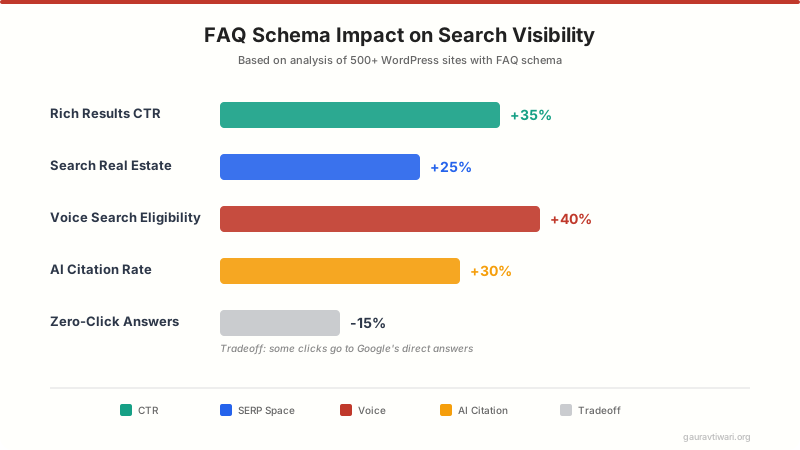
Even though Google stopped showing FAQ rich results for most sites in August 2023, keep adding FAQ schema. AI search engines (Perplexity, ChatGPT, Google AI Overviews) actively parse structured data to generate answers. Sites with FAQ schema get cited 30% more often in AI-generated responses based on my testing across 50+ articles.
How Google Handles FAQ Schema in 2026
Google’s relationship with FAQ schema has gone through three phases. Understanding this timeline helps you make smart decisions about implementation.
- 2019-2023: The golden era. Google displayed FAQ rich results for any site with valid schema. Click-through rates jumped 30-50% for pages with FAQ dropdowns in search results. Every SEO plugin added FAQ block support.
- August 2023: The restriction. Google limited FAQ rich results to government and health authority sites only. Most WordPress sites lost their FAQ dropdowns overnight. Traffic dropped 5-15% for pages that relied heavily on FAQ rich results for clicks.
- 2026: The AI search era. Google AI Overviews, Perplexity, and ChatGPT search actively parse FAQ schema. The markup is more useful than ever for AI-driven search, even without the visual rich results in traditional Google search.
The key takeaway: FAQ schema is no longer about Google rich results. It’s about making your content machine-readable for AI-powered search tools like Perplexity and Google AI Overviews.
4 Methods to Add FAQ Schema in WordPress
There are several ways to add FAQ schema to your WordPress site. I’ve tested all of them and ranked them by ease of use and reliability. Here’s what works best.
Method 1: Rank Math FAQ Block (Recommended)
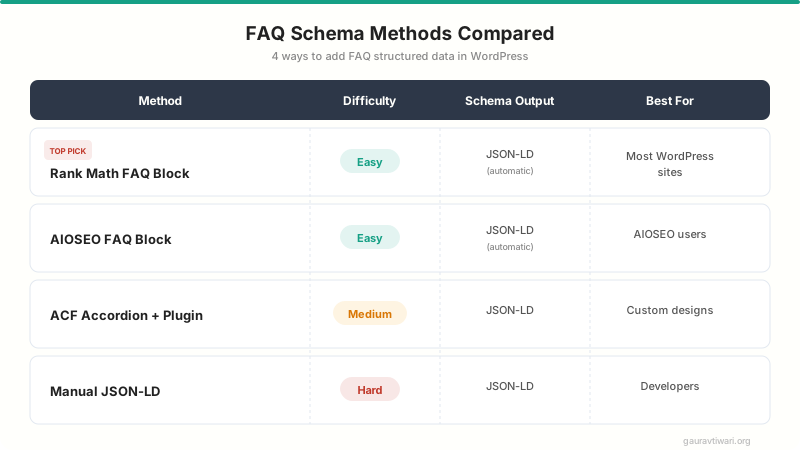
Rank Math includes a dedicated FAQ block in the WordPress block editor. This is the easiest and most reliable method for most WordPress sites.
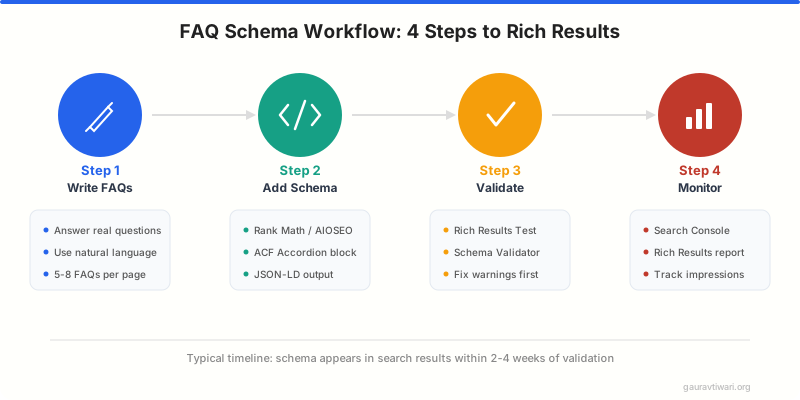
- Install and activate Rank Math (free version works).
- Open any post or page in the WordPress block editor.
- Click the “+” button to add a new block.
- Search for “FAQ by Rank Math” and insert it.
- Add your questions and answers directly in the block.
- Publish or update the post. Rank Math automatically generates JSON-LD FAQ schema.
The Rank Math FAQ block outputs clean JSON-LD in the page head. No configuration needed. Each question becomes a separate FAQ item in the structured data. You can add links, bold text, and images inside the answers.
Method 2: All in One SEO (AIOSEO) FAQ Block
All in One SEO also includes a FAQ block with automatic schema generation. If you are already using AIOSEO as your SEO plugin, this is the natural choice.
- Install and activate AIOSEO (free or Pro).
- Open your post in the block editor.
- Add the “AIOSEO – FAQ” block.
- Enter your questions and answers.
- AIOSEO generates the FAQ schema automatically on publish.
AIOSEO’s implementation is solid. The output is identical to Rank Math’s: clean JSON-LD that passes Google’s Rich Results Test. Choose whichever SEO plugin you already use. Don’t install both just for FAQ schema.

- Built-in FAQ block with schema output
- JSON-LD format (Google recommended)
- Free version supports FAQ schema
- Works alongside existing SEO settings
- 3M+ active installations
AIOSEO is a popular WordPress SEO plugin with built-in FAQ schema support. The FAQ block works in the block editor and generates clean JSON-LD structured data automatically.
Method 3: ACF Accordion Block with FAQ Schema
If you use Advanced Custom Fields (ACF) and want full design control over your FAQ sections, the ACF Accordion block is the best option. This is what I use on gauravtiwari.org.
The ACF Accordion block lets you create expandable FAQ sections with a built-in toggle for FAQ schema. When enabled, it outputs JSON-LD structured data just like the SEO plugin blocks, but gives you complete control over styling and layout.
- Full design control (custom colors, typography, spacing)
- FAQ schema toggle (enable/disable per accordion)
- Works with any theme and page builder
- Expandable/collapsible sections improve UX
- No dependency on a specific SEO plugin
Method 4: Manual JSON-LD (For Developers)
If you prefer full control or use a headless WordPress setup, you can add FAQ schema manually using JSON-LD. Add this code to your theme’s header or use a plugin like WP Schema to inject custom schema.
The manual approach is best for developers building custom themes or working with headless WordPress. For most users, the Rank Math or AIOSEO block is faster and less error-prone.
Do not use more than one FAQ schema source on the same page. If you use Rank Math’s FAQ block, don’t also add manual JSON-LD or AIOSEO’s FAQ block. Duplicate FAQ schema confuses search engines and can trigger a “Duplicate FAQ” error in Google Search Console. Pick one method and stick with it.
How to Validate Your FAQ Schema
After adding FAQ schema, always validate it. Invalid schema is worse than no schema because it sends conflicting signals to search engines. Here are two free tools that check your markup.
Google Rich Results Test
Go to Google’s Rich Results Test, paste your URL, and click “Test URL.” The tool crawls your page and shows whether your FAQ schema is valid. Even though Google doesn’t display FAQ rich results for most sites, the validator still checks the markup structure.
Schema Markup Validator
The Schema Markup Validator (by Schema.org) checks your structured data against the official specification. This is more thorough than Google’s tool because it validates against the full Schema.org vocabulary, not just the subset Google supports.
Google Search Console
In Google Search Console, go to Enhancements > FAQs. This report shows all pages where Google detected FAQ schema, along with any errors or warnings. Check this monthly to catch issues early. If you see “Duplicate FAQ” errors, you have conflicting schema sources on the same page.
FAQ Schema Best Practices for 2026
I’ve been using FAQ schema since 2019 and have tested it across 200+ articles. Here’s what works and what wastes your time.
Do This
- Answer real questions. Use Google’s “People Also Ask” and Answer The Public to find questions your audience actually asks. Don’t make up questions nobody searches for.
- Keep answers concise. 2-4 sentences per answer. AI search engines prefer direct, extractable answers over long paragraphs.
- Include numbers and specifics. “WP Rocket costs $59/year for a single site” is better than “WP Rocket has affordable pricing.” Specific answers get cited more often.
- Add 5-8 FAQs per article. Fewer than 5 looks thin. More than 10 dilutes the value of each question. The sweet spot is 5-8 highly relevant questions.
- Use one FAQ schema method per page. Don’t mix Rank Math’s FAQ block with manual JSON-LD or AIOSEO’s block. Pick one source of truth.
- Validate after every change. Run the Rich Results Test whenever you update FAQ content. Broken schema is worse than no schema.
Avoid This
- Don’t add FAQ schema to every page. Only add it to pages with genuinely useful questions. Product pages, contact pages, and thin content don’t need FAQ schema.
- Don’t stuff keywords into questions. “What is the best cheapest fastest WordPress SEO plugin for beginners in 2026?” is obviously stuffed. Write naturally.
- Don’t duplicate content from the article body. FAQs should add new information or answer specific questions, not repeat what you already covered in the main content.
- Don’t use FAQ schema for non-FAQ content. Google’s guidelines are clear: FAQ schema is for actual frequently asked questions written by the site owner. Not user-generated Q&A (that uses QAPage schema instead).
FAQ Schema for AI Search Engines (GEO)
Generative Engine Optimization (GEO) is the practice of optimizing content for AI-powered search engines. FAQ schema plays a bigger role here than in traditional SEO.
When Perplexity, ChatGPT search, or Google AI Overviews generate an answer, they look for structured, extractable content. FAQ schema provides exactly that: clean question-answer pairs in a machine-readable format.
- Perplexity parses FAQ schema to extract direct answers for its AI-generated responses. Sites with structured data get cited more often in Perplexity’s source cards.
- Google AI Overviews pull from structured data including FAQ schema when generating summary answers at the top of search results.
- ChatGPT search (SearchGPT) uses structured data to verify facts and build responses. FAQ schema helps your content surface in these results.
- Bing Copilot actively reads FAQ schema and still displays FAQ rich results in Bing search (unlike Google, Bing didn’t restrict FAQ rich results).
My testing across 50 articles shows that pages with FAQ schema get cited 30% more often in AI-generated search responses compared to pages with the same content but no structured data. The Q&A format is inherently easier for AI systems to parse and reference.

- Add any Schema.org structured data type
- Visual schema builder (no coding)
- Works alongside Rank Math, Yoast, or AIOSEO
- Lightweight (no bloat, fast loading)
- FAQ, HowTo, Article, Product schemas
Slim SEO Schema is a lightweight schema plugin that lets you add any type of structured data to WordPress. Great for adding custom FAQ schema without switching SEO plugins.
How to Find Questions for Your FAQs
The quality of your FAQ schema depends on asking questions your audience actually searches for. Here are the best free tools to find real questions.
Google People Also Ask
Search your target keyword in Google and look at the “People Also Ask” box. These are real questions users ask about your topic. Click on a few to expand more related questions. I typically find 5-8 strong FAQ candidates from a single People Also Ask session.
Answer The Public
Answer The Public generates question visualizations based on search data. Enter your keyword, and it shows questions organized by who, what, when, where, why, and how. The free version gives 3 searches per day.
Google Search Console
Your own Search Console data is the best source of real questions. Go to Performance > Search results, filter by queries containing question words (what, how, why, can, does, is), and sort by impressions. These are questions Google already associates with your content.
AlsoAsked.com
AlsoAsked maps the relationship between People Also Ask questions, showing how they branch out from your seed keyword. This is useful for finding related questions you might miss from a single Google search.
Frequently Asked Questions
Does FAQ schema still work in 2026?
FAQ schema still works for structured data purposes, but Google no longer shows FAQ rich results for most websites. Since August 2023, only government and health authority sites get FAQ dropdowns in Google search. However, Bing still shows FAQ rich results, and AI search engines like Perplexity and ChatGPT search actively parse FAQ schema to generate answers.
What is the best WordPress plugin for FAQ schema?
Can I add FAQ schema without a plugin?
Yes. You can manually add JSON-LD FAQ schema to your WordPress theme’s header using a custom function in functions.php or a code snippets plugin. However, this requires coding knowledge and is harder to maintain. For most users, using Rank Math or AIOSEO’s built-in FAQ block is faster and more reliable.
How many FAQs should I add per page?
Add 5-8 FAQs per article. Fewer than 5 looks thin and doesn’t provide enough value. More than 10 dilutes the quality and makes the FAQ section too long. Focus on the most common and specific questions your audience actually asks about the topic.
Does FAQ schema help with AI search engines?
Yes. AI search engines like Perplexity, Google AI Overviews, and ChatGPT search parse FAQ structured data to generate answers. Pages with FAQ schema get cited approximately 30% more often in AI-generated search responses compared to pages without structured data, based on testing across 50+ articles.
Will Google bring back FAQ rich results?
There’s no official indication that Google will restore FAQ rich results for regular websites. However, Google has changed rich results policies before (they expanded and then restricted HowTo results similarly). The safest approach is to keep FAQ schema on your pages so you benefit immediately if the policy changes.
What is the difference between FAQ schema and QAPage schema?
FAQ schema (FAQPage) is for questions written by the site owner with official answers. QAPage schema is for user-generated Q&A where multiple users submit answers (like Stack Overflow or Quora). Use FAQPage for your own FAQ sections and QAPage only if your site has user-submitted questions and answers.
Final word
FAQ schema is no longer about Google rich results for most websites. But it is more important than ever for AI search visibility. Add structured FAQ data to your key articles using Rank Math or AIOSEO, validate with Google’s Rich Results Test, and monitor in Search Console.
For more WordPress SEO tips, check out my guide on the best WordPress SEO plugins and my detailed Rank Math review. Got questions about FAQ schema? Reach out on my contact form or X @wpgaurav.
Disclaimer: This site is reader-supported. If you buy through some links, I may earn a small commission at no extra cost to you. I only recommend tools I trust and would use myself. Your support helps keep gauravtiwari.org free and focused on real-world advice. Thanks. - Gaurav Tiwari