
What Is Conversational AI and 5 Ways It Is Benefiting Businesses?
Conversational AI has gone from a buzzword to a business necessity in under three years. When ChatGPT launched in late 2022, it changed how people think about AI-powered conversations entirely. But conversational AI isn’t just ChatGPT. It’s the entire ecosystem of technologies that enable machines to understand, process, and respond to human language in a natural way.
I’ve implemented conversational AI solutions on client websites using tools like Tidio, Crisp, and custom chatbot integrations. The results are consistent: faster response times, lower support costs, and higher customer satisfaction scores. Let me walk you through what conversational AI actually is, how it works, and the specific ways it can transform your business operations.
What Is Conversational AI?
Conversational AI is a branch of artificial intelligence that enables machines to understand human language and respond in a way that feels natural. It powers chatbots, virtual assistants (Siri, Alexa, Google Assistant), customer service bots, and the large language models (LLMs) like ChatGPT, Claude, and Gemini that have taken over headlines.
The technology stack behind conversational AI includes three core components:
- Natural Language Processing (NLP): This handles understanding. NLP breaks down human text or speech into components the machine can analyze, including intent (what the user wants), entities (specific details like dates, names, products), and sentiment (whether the user is happy, frustrated, or confused)
- Machine Learning (ML): This handles improvement. ML algorithms learn from every conversation, getting better at understanding context, handling edge cases, and providing relevant responses over time
- Large Language Models (LLMs): The newest and most powerful component. LLMs like GPT-4, Claude, and Gemini can generate human-quality text, understand nuanced questions, maintain context across long conversations, and even reason through complex problems
The global conversational AI market was valued at roughly $10 billion in 2023 and is projected to reach $50 billion by 2030. That growth is being driven by businesses realizing that AI-powered conversations aren’t just cheaper than human agents; in many cases, they’re actually better at handling routine queries.
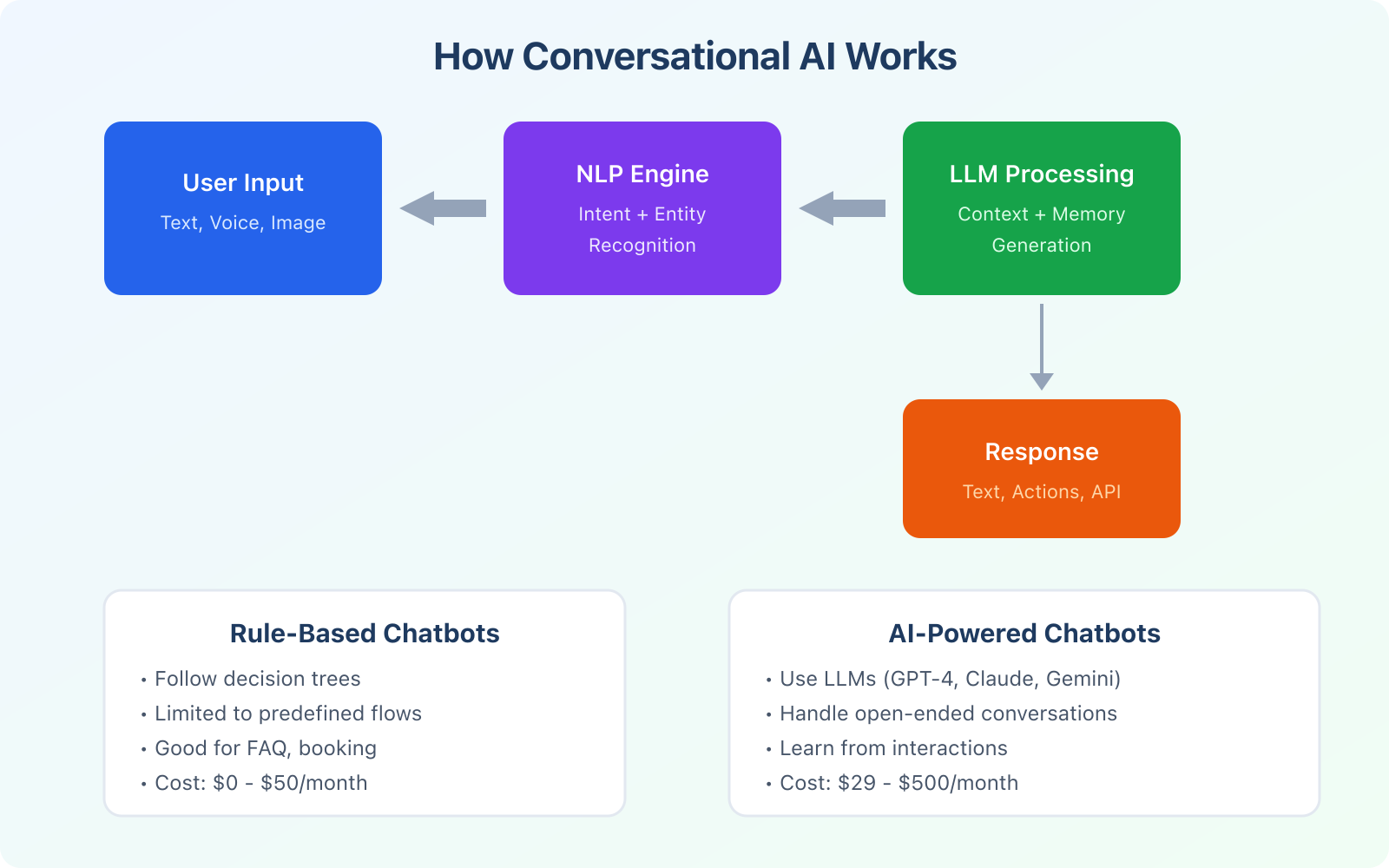
Traditional Chatbots vs AI-Powered Chatbots
There’s a massive difference between the chatbots of 2020 and the AI chatbots of 2026, and it’s worth understanding because the wrong choice wastes money.
Rule-based chatbots follow decision trees. They can answer predefined questions and guide users through scripted flows (like booking an appointment or checking order status). They’re simple, cheap ($0 to $50/month), and reliable for narrow use cases. But they break down the moment a user asks something outside the script.
AI-powered chatbots use LLMs to understand and respond to open-ended questions. They can handle conversations they’ve never seen before, understand context from previous messages, and provide nuanced answers based on your business’s knowledge base. Tools like Tidio’s Lyro AI, Intercom’s Fin, and Crisp’s AI assistant fall into this category.
The best approach for most businesses is a hybrid: use AI for the first response and complex queries, but route to human agents when the AI detects frustration, can’t answer confidently, or when the customer explicitly asks for a human. AI chatbot platforms have gotten very good at this handoff.
Start with Tidio if you’re a small to medium business or run an e-commerce store. It has a generous free tier, the AI (Lyro) learns from your existing content, and setup takes about 15 minutes. You can always upgrade to Intercom or a custom solution later as your needs grow.
The Top AI Chatbot Platforms in 2026
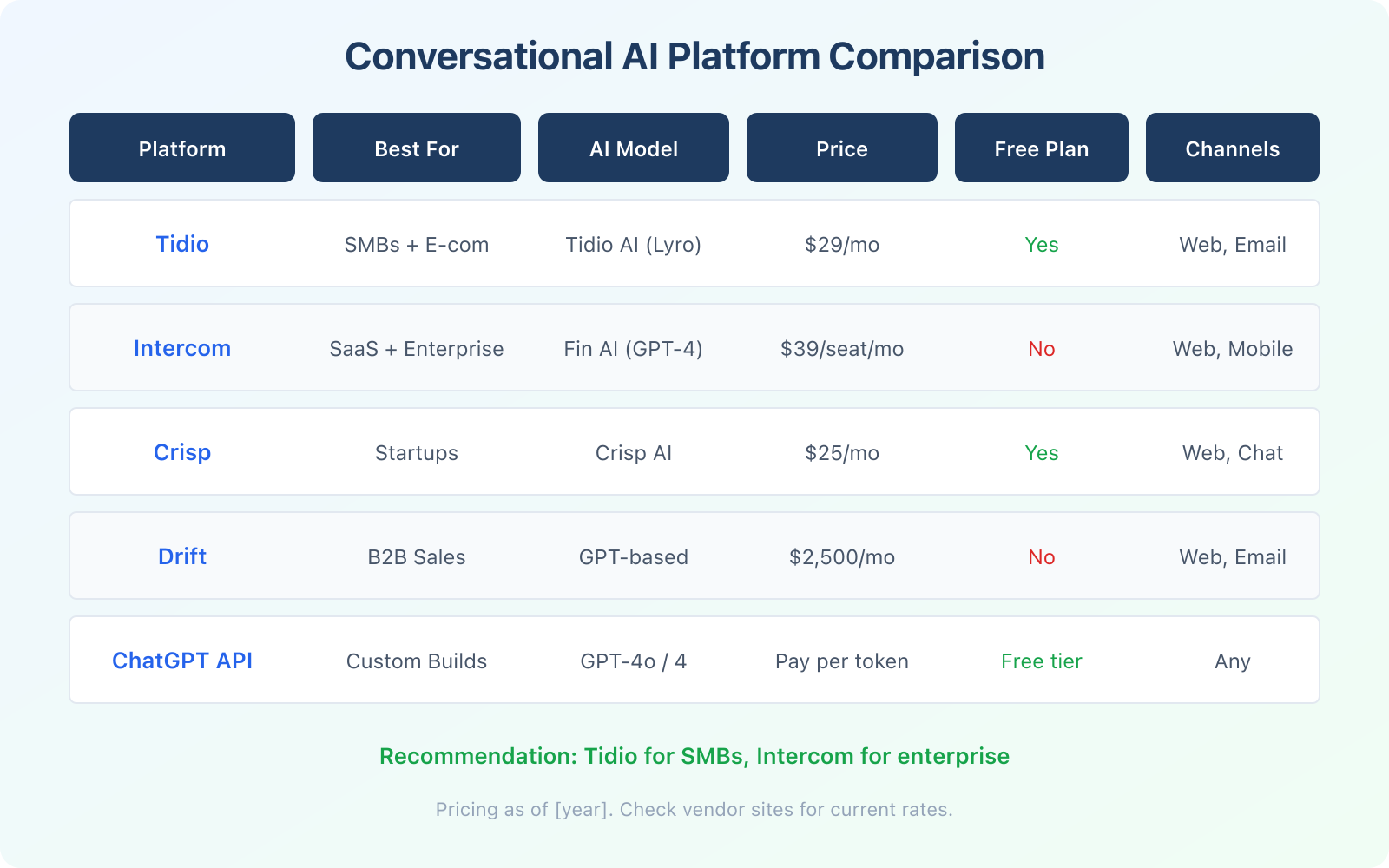
Here’s how the major conversational AI platforms compare for business use:
Tidio is my top recommendation for most businesses. It combines live chat, AI chatbot (Lyro), and email in one platform. Lyro AI learns from your FAQ pages and help docs to answer customer questions automatically. It handles about 70% of routine queries without human intervention. Pricing starts free for basic features, with AI plans from $29/month.
Intercom Fin is the enterprise choice. Built on GPT-4, Fin can resolve up to 50% of support conversations instantly. It integrates deeply with your help center, past ticket history, and internal tools. But it’s expensive: $39 per seat per month plus $0.99 per AI resolution. Worth it for SaaS companies and large support teams.
Crisp is excellent for startups on a budget. Their AI features include automated responses, conversation summaries, and smart routing. The free plan covers 2 team members, and paid plans start at $25/month. The AI isn’t as advanced as Tidio or Intercom, but it covers the basics well.
ChatGPT/Claude API is for businesses that want full control. You can build a completely custom conversational AI by connecting OpenAI’s GPT-4 or Anthropic’s Claude to your own data using RAG (Retrieval Augmented Generation). This requires developer resources but gives you unlimited customization. API costs are pay-per-token, typically $5 to $50/month for small to medium volumes.
5 Ways Conversational AI Benefits Your Business
1. Dramatically Improves Customer Experience
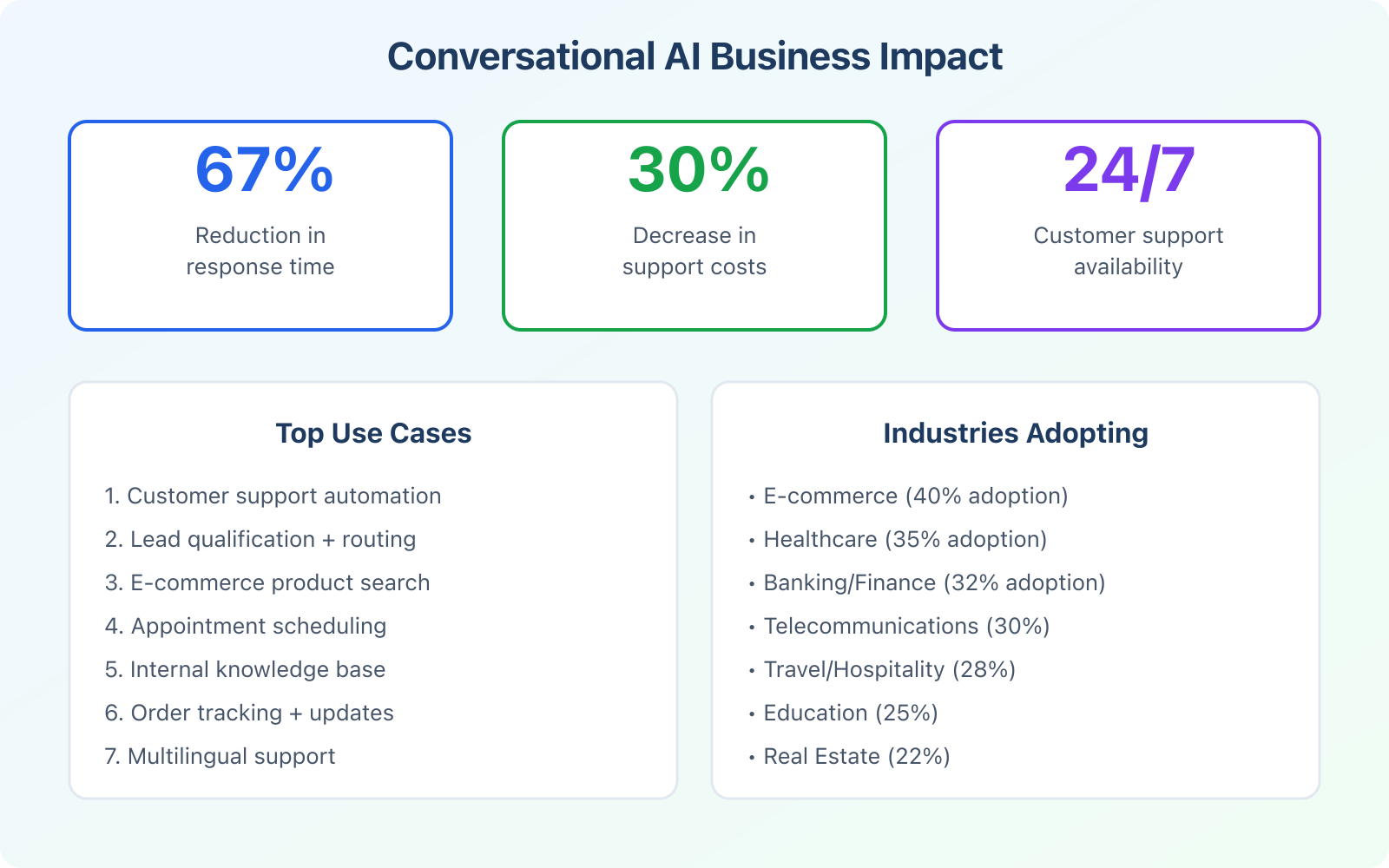
Customers hate waiting. The average customer expects a response within 5 minutes on live chat, and 62% of consumers prefer messaging a chatbot over waiting for a human agent. Conversational AI delivers instant responses 24/7, handles multiple conversations simultaneously, and never gets frustrated or has a bad day.
Modern AI chatbots can maintain context across long conversations, remember previous interactions with the same customer, and personalize responses based on the customer’s history and preferences. The experience is fundamentally better than the old “press 1 for sales, press 2 for support” model.
2. Reduces Support Costs by 30% or More
A human support agent costs $15 to $25 per hour and can handle one conversation at a time. An AI chatbot costs $29 to $500 per month and handles unlimited simultaneous conversations. The math is straightforward: businesses that implement conversational AI typically reduce support costs by 25% to 45%, according to industry reports.
The savings don’t mean you fire your support team. It means you free them up to handle complex, high-value conversations while the AI manages the routine stuff (order tracking, password resets, pricing questions, business hours, return policies). Your human agents become more productive and more satisfied because they’re solving real problems instead of answering the same question for the 50th time.
3. Generates and Qualifies Leads Automatically
Conversational AI doesn’t just answer questions. It can actively engage visitors, qualify them as leads, and route hot prospects to your sales team. A chatbot can ask qualifying questions (budget, timeline, company size), score the lead based on responses, and either book a demo directly or pass the qualified lead to the right salesperson.
This works especially well for B2B websites where the buying cycle is long. Instead of a static contact form that sits there passively, an AI chatbot actively engages visitors and captures information that would otherwise be lost when someone bounces.
4. Powers Smarter IoT and Voice Devices
Conversational AI is what makes smart devices actually smart. When you say “Alexa, order more paper towels” or “Hey Google, what’s on my calendar today,” conversational AI is processing your speech, understanding your intent, and executing the action.
For businesses, this extends to voice-enabled kiosks, smart office systems, voice-controlled inventory management, and customer-facing voice assistants. The integration between conversational AI and IoT devices is creating entirely new interaction models that didn’t exist five years ago.
5. Makes Services Accessible to Everyone
Conversational AI breaks down barriers. It can communicate in over 100 languages instantly, provide voice-based interfaces for visually impaired users, simplify complex processes through guided conversations, and make your services available to anyone with an internet connection regardless of their technical ability.
For businesses serving diverse populations, this accessibility translates directly to a larger addressable market. A Spanish-speaking customer can get the same quality of support as an English-speaking one, instantly, without hiring bilingual agents.
AI chatbots are not a complete replacement for human support. Complex emotional situations, escalated complaints, and nuanced business discussions still need a real person. The best implementations use AI as the first line of defense and seamlessly hand off to humans when needed.
How to Build a Custom AI Chatbot for Your Website
If you want more control than off-the-shelf platforms provide, building a custom chatbot is more accessible than ever. Here’s the basic architecture:
- Choose your LLM: GPT-4o from OpenAI is the most capable for general conversations. Claude from Anthropic is excellent for longer, more thoughtful responses. Gemini from Google works well if you need multimodal capabilities (text + images)
- Set up RAG (Retrieval Augmented Generation): This connects your chatbot to your specific business data. Upload your help docs, product catalog, and FAQ to a vector database. When a user asks a question, the system retrieves relevant information and passes it to the LLM for a personalized answer
- Build the interface: Use a chat widget library (like Botpress, Voiceflow, or a custom React component) to embed the chat on your website
- Add guardrails: Set system prompts that keep the AI on topic, define escalation triggers, and implement safety filters to prevent inappropriate responses
- Test extensively: Run hundreds of test conversations covering edge cases, adversarial inputs, and common user scenarios before going live
For most businesses, starting with Tidio or a similar platform and only building custom when you’ve outgrown it is the smarter path. Custom builds cost $5,000 to $50,000+ and require ongoing maintenance.
The Future of Conversational AI
Conversational AI is evolving fast. Multimodal AI that can process text, images, audio, and video simultaneously is already here. AI agents that can take actions (not just answer questions) are emerging. And the cost of running AI is dropping roughly 50% every 12 months, making it accessible to even the smallest businesses.
The businesses that adopt conversational AI now will have a significant advantage. They’ll have trained their systems on real customer data, refined their workflows, and built institutional knowledge that competitors starting later won’t have. It’s not a question of whether to implement conversational AI. It’s a question of when and how.
What is the difference between conversational AI and a regular chatbot?
Regular chatbots follow scripted decision trees and can only handle predefined questions. Conversational AI uses natural language processing and large language models to understand open-ended questions, maintain context across conversations, and generate natural responses. It can handle questions it has never seen before by reasoning about the answer, while regular chatbots simply fail or return a generic error.
How much does conversational AI cost for a small business?
Platform-based solutions like Tidio start free and offer AI features from $29/month. Crisp starts at $25/month. These are sufficient for most small businesses. Custom-built solutions using the ChatGPT or Claude API typically cost $5,000 to $50,000 to build plus $50 to $500/month in API costs. For most small businesses, a platform solution is the right starting point.
Will conversational AI replace human customer service agents?
No, but it will change their role. Conversational AI handles routine queries (order status, pricing, FAQ) that make up 60% to 80% of support volume. Human agents focus on complex issues, emotional situations, and high-value interactions. The result is typically fewer agents needed for routine work, but those agents handling more meaningful conversations with higher job satisfaction.
Which is the best conversational AI platform for e-commerce?
Tidio is the best choice for most e-commerce businesses. It integrates with Shopify, WooCommerce, and other platforms. Its Lyro AI automatically learns from your product catalog and help content. It handles product recommendations, order tracking, and pre-sale questions. The free plan includes basic chat, and AI features start at $29/month.
Is conversational AI safe and secure for handling customer data?
Reputable platforms encrypt data in transit and at rest, comply with GDPR and SOC 2 standards, and don’t use your customer conversations to train their models. However, you should always review the privacy policy and data handling practices of any AI platform you use. Avoid sharing sensitive information like credit card numbers through AI chat, and implement proper data retention policies.
Disclaimer: This site is reader-supported. If you buy through some links, I may earn a small commission at no extra cost to you. I only recommend tools I trust and would use myself. Your support helps keep gauravtiwari.org free and focused on real-world advice. Thanks. - Gaurav Tiwari