5 Best Strategies to Rank Your Business in Search
 by
by
If you are trying to work out how to rank your business in search, start with the uncomfortable possibility that the problem is not your SEO plugin. It is usually a mismatch between the query, the page, and the proof a buyer needs before taking the next step.
The fix is less glamorous than most SEO pitches. Choose terms with real intent, make the page technically reliable, show first-hand evidence, earn relevant references, and measure leads or revenue instead of celebrating impressions.
The practical order is keyword intent, on-page clarity, technical SEO, useful content, authority, and local signals where location matters. The sections below show what to change and how to tell whether the work is producing qualified visitors.
Thorough Keyword Research and Search Intent Matching
Keyword research works when it connects a real query to a real business decision. Volume is only one input. The page also needs the right format, a credible answer, and a next step that matches what the searcher is trying to do.
Search intent is commonly grouped into informational (learning), navigational (finding a known destination), commercial (comparing), and transactional (acting). A business that targets only transactional terms leaves the comparison and education stages to competitors.
Here is how I approach keyword research for client sites:
- Start with customer language. Pull a compact seed list from sales calls, support tickets, site search, and Search Console. Use the words buyers use, not the labels your team prefers.
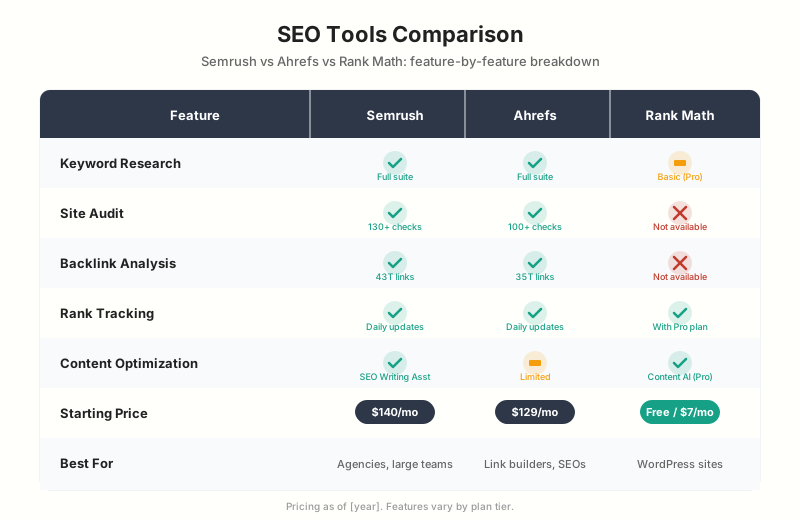
- Expand, then verify. Semrush and Ahrefs can surface related terms and competing pages. Export the candidates, inspect the live results, and remove phrases that do not match the offer.
- Analyze the SERP for each keyword. Before targeting any term, search it yourself. Are the top results blog posts, product pages, videos, or local listings? That tells you what Google considers the right format for that query.
- Treat difficulty scores as estimates. They are vendor metrics, not Google metrics. Inspect the ranking pages, query intent, required evidence, brand strength, link gap, and whether your business can produce a materially better answer.
- Group by topic clusters. Instead of targeting individual keywords, build content clusters: one pillar page covering the broad topic and supporting pages targeting long-tail variations.
Keyword research is not a calendar ritual. Revisit a query when the offer changes, Search Console shows a new pattern, the result format changes, or a competitor answers the decision better. That gives the review a reason and a measurable outcome.

Semrush
- Keyword research and topic discovery
- Technical site audit and issue review
- Competitor analysis and gap reports
- Position tracking across devices and locations
- Content optimization with SEO Writing Assistant
On-Page SEO That Actually Moves Rankings
On-page SEO is every optimization you make directly on your website pages. When people ask me how to rank your business in search without a huge budget, this is where I tell them to start. It is the part you have complete control over, and getting it right gives you an immediate advantage over competitors who neglect it.
The durable rule is simple: make the page’s subject, promise, proof, and next action obvious. Search systems change, but a page that hides the answer behind filler still wastes the reader’s time.
Title Tags and Meta Descriptions
Your title tag is one of the clearest ways to tell a searcher and a search engine what a page offers. Keep the important words visible, match the page’s actual promise, and write for the click without turning the title into bait.
Google says snippets are created primarily from page content and may use the meta description when it describes the page better. There is no fixed display length. Write a specific summary of the page and check the actual snippet guidance before treating a character count as a rule.
Header Structure and Content Organization
Use a single H1 tag (your page title), then organize content with H2 and H3 subheadings. Each H2 should cover a distinct subtopic. This structure helps both users scanning the page and search engines understanding your content hierarchy.
I structure each H2 section so a reader can understand the answer without reconstructing the rest of the page. That improves scanning, makes weak claims easier to spot, and gives search systems a clearer passage to interpret.
Internal Linking
Internal links help people and crawlers discover related pages and understand how subjects connect. Use as many as the reader’s next decision requires. A quota creates irrelevant links and hides orphaned pages behind a comforting average.
Use descriptive anchor text that tells both users and search engines what the linked page covers. “Click here” is wasted anchor text. “Our guide to keyword research” tells Google exactly what that page is about.
Schema Markup
Structured data should describe content that is visible and true on the page. Use only the types that fit the entity and format, validate the markup, and remember that eligibility does not guarantee a rich result. Google’s structured data policies set the boundary. Rank Math can generate common WordPress markup, but you still own its accuracy.
Rank Math SEO
- AI-powered content analysis and suggestions
- Schema fields for common content types
- Advanced SEO analytics dashboard in WordPress
- Google Search Console and Analytics integration
- Redirect manager and 404 monitoring
Technical SEO and Core Web Vitals
Technical SEO makes a useful page discoverable, renderable, indexable, and usable. It cannot manufacture relevance, but a wrong canonical, blocked resource, broken template, or unusable mobile layout can prevent good work from being evaluated or used.
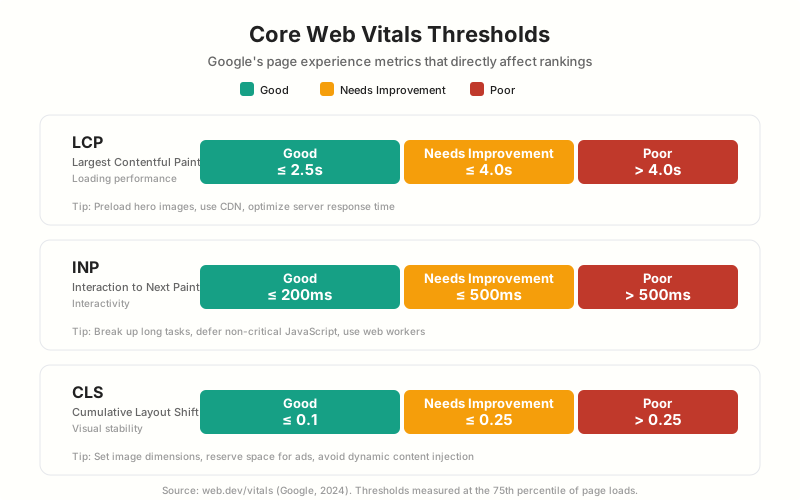
Google confirmed that Core Web Vitals remain a ranking signal in 2026. The three metrics that matter:
- Largest Contentful Paint (LCP): Measures loading speed. Target: under 2.5 seconds. The biggest content element on your page (usually a hero image or heading block) must render within this window.
- Interaction to Next Paint (INP): Replaced First Input Delay in March 2024. Measures responsiveness to all user interactions, not just the first one. Target: under 200 milliseconds.
- Cumulative Layout Shift (CLS): Measures visual stability. Target: under 0.1. Elements should not jump around as the page loads.
Technical Checklist for Business Sites
I run this technical audit on every client site before touching content:
- Mobile-first indexing: Google primarily uses the mobile version of your site for ranking. Test every page on mobile devices, not just desktop.
- HTTPS everywhere: Serve pages and subresources securely, then fix mixed-content requests that browsers may block or warn about. Treat this as security and reliability work, not a vague trust score.
- XML sitemap: Submit a clean sitemap to Google Search Console. Exclude noindex pages, redirects, and 404s.
- Index control: Inspect canonicals, redirects, noindex rules, parameter URLs, and duplicate archives before changing robots.txt. Blocking a URL can prevent a crawler from seeing the noindex or canonical signal you intended it to process.
- Page speed: Compress images (WebP format), enable browser caching, minify CSS and JavaScript, and use a CDN. Tools like WP Rocket handle most of this for WordPress sites.
- Fix broken paths: Audit after migrations, template changes, large publishing batches, or when crawl data shows a problem. Semrush’s Site Audit can flag patterns, but verify the affected URL and business impact before bulk-fixing anything.
Content Strategy That Builds Authority Over Time
Content is what you rank for. Without a deliberate strategy, you end up with a scattered collection of pages that compete with each other and confuse search engines about your site’s expertise.
E-E-A-T is not one ranking factor. Google uses the quality-rater concept to explain characteristics of helpful, reliable results, with trust at the center. Build the underlying evidence: clear authorship, first-hand work, accurate claims, primary sources, and a page that serves its stated audience. The people-first content guidance is more useful than trying to optimize a fictional E-E-A-T score.
Topic Clusters and Pillar Pages
A topic cluster can work in 2026 when one broad decision has several distinct supporting questions. Build a hub only when each page serves its own intent and the internal links help a reader move between them. There is no safe word count or required number of supporting articles.
For example, a law firm might build a pillar page on “Personal Injury Claims” with supporting articles covering car accidents, workplace injuries, slip and fall cases, medical malpractice, statute of limitations, and settlement negotiation. Each article reinforces the site’s topical authority for the entire cluster.
Content Quality Standards for 2026
In 2026, use Google’s published question instead of chasing a separate “helpful content score”: is the page primarily made to help people, or primarily made to manipulate search visibility? The useful standards are observable:
- First-hand evidence. Include original data, screenshots, decision logs, case studies, or test results. Show the sample, period, baseline, and limitation instead of asking the reader to trust a floating percentage.
- Specific, actionable advice. “Optimize your images” is generic. “Convert images to WebP format, set max width to 1200px, and use lazy loading for images below the fold” is actionable.
- Task completion. Cover what the query requires, including the decision, limitation, or next action. Do not pad a narrow answer into an encyclopedia merely to look comprehensive.
- Evidence-led maintenance. Recheck a page when its facts, product terms, regulations, results, or user needs change. Leave stable pages alone instead of manufacturing a fresh date.
For a deeper framework on building a content engine, see my content marketing strategy guide.
Link Building and Off-Page Authority
Links help search systems discover pages and understand references and reputation, but they are not interchangeable votes. Relevance, editorial reason, placement, the linking page, and the destination all matter. A directory count or vendor authority score cannot tell you how many links a query requires.
Link building in 2026 should mean earning references that make sense without an SEO metric attached. Google’s spam policies explicitly cover paid links, automated link creation, excessive exchanges, and advertorial links that pass ranking credit.
Link Building Strategies That Still Work
- Create linkable assets. Original research, industry surveys, data visualizations, and comprehensive guides naturally attract links. My SEO tools roundup earns links consistently because it provides genuine comparative value.
- Digital PR. Publish a useful dataset, test, or expert explanation, then pitch the exact journalists and publications that cover the subject. Journalist-request platforms can surface opportunities, but relevance and verifiable expertise matter more than reply volume.
- Guest posting on relevant sites. Write for publications your audience actually reads. One guest post on an industry-specific site with engaged readers beats ten posts on generic “write for us” sites.
- Broken link building. Use Ahrefs to find broken links on competitor sites and sites in your niche. Reach out to suggest your content as a replacement. This works because you are solving a problem for the site owner.
- Competitor backlink analysis. Study where your top-ranking competitors get their links. If they have links from industry directories, podcast appearances, or association memberships, pursue those same opportunities.

Ahrefs
- Backlink and referring-page research
- Content Explorer for finding linkable content ideas
- Broken link finder for outreach opportunities
- Rank tracker with SERP feature monitoring
- Site audit with actionable fix recommendations
Local SEO for Businesses Serving Specific Areas
If your business serves a specific area, local SEO often becomes the shortest path from a search to a call, booking, or visit. The local pack can appear above traditional organic results, so your business details, service relevance, reviews, and location evidence deserve their own workflow.
Google describes local results through relevance, distance, and prominence. You cannot optimize away a real distance, but you can make the business’s services, location, reputation, and current details easier to verify. Use Google’s local ranking guidance as the source of truth.
| Signal to verify | What to inspect | Practical action |
|---|---|---|
| Relevance | Category, services, landing page, query match | Choose the closest primary category and make each service explicit |
| Distance | Searcher location and legitimate service area | Use accurate locations; do not invent offices |
| Prominence | Reviews, references, links, brand evidence | Earn reviews and local references through real work |
| Trust | Hours, phone, address, website, updates | Keep every public business detail consistent |
Google Business Profile Optimization
Your Google Business Profile is a primary public record for a local business. Accurate categories, services, hours, location, and contact details help Google match the profile to relevant searches and help a customer decide whether to call or visit.
- Complete the applicable fields. Use the real business name, address or service area, phone, website, hours, attributes, categories, and services. Do not add fields or keywords that do not describe the business.
- Choose accurate categories. Pick the most specific available primary category that describes the core business. Add secondary categories only for services the business actually provides; there is no useful category quota.
- Publish useful updates. Post a current offer, event, product, or operational change when a customer would benefit from seeing it. A weekly post with no decision value is busywork.
- Request and respond to genuine reviews. Make the request neutral, never buy or gate sentiment, and respond on a cadence the team can sustain. Prioritize factual corrections, safety issues, and customer recovery over an arbitrary 24-hour rule.
- Add useful photos and videos. Show the place, team, work, products, access, and other details a customer would want to verify before visiting or calling.
Local Citations and NAP Consistency
Your business name, address or service area, phone number, hours, and website should describe the same real business everywhere. Minor formatting differences are less important than factual accuracy and duplicate control. Claim only relevant directories and maps you can maintain. For the implementation details, see mastering local SEO for brick-and-mortar businesses.
How AI Is Changing Search Engine Rankings in 2026
AI features can answer part of a query inside the search experience, which changes what a visible ranking may produce. Do not invent an appearance percentage. Measure search appearance and landing-page results for your own site, and follow Google’s AI features and website guidance.
Optimizing for AI Search
There is no proven entity-density formula or special AI-citation schema. The defensible work is familiar: make the page crawlable, answer the question clearly, identify entities precisely, publish evidence another page cannot reproduce, and support factual claims. To improve the odds of accurate interpretation:
- Answer questions directly. Start each section with a clear, factual answer before expanding with context. AI systems extract concise statements.
- Include bounded data. Name the source, date, sample, unit, calculation, and limitation. A specific but unsupported timeline is easier to repeat and still wrong.
- Use accurate structured markup. Markup can help a search system understand eligible content, but it does not guarantee a rich result, an AI citation, or a ranking.
- Demonstrate expertise. First-person experience, original research, and specific examples signal to AI systems that your content is authoritative, not just aggregated from other sources.
AI Tools for SEO Workflow
AI can help cluster exports, draft alternatives, summarize a crawl, or flag gaps, but every output needs the source and page checked. Google does not ban a creation method. Its spam policy targets scaled content abuse when many pages are produced primarily to manipulate rankings, whether people, automation, or both created them.
For WordPress sites, SEO plugins like Rank Math can assist with analysis, schema fields, and checks. A score is a prompt to inspect the page, not proof of quality. Generated markup and copy can still be wrong, duplicated, or irrelevant.
Rankings Only Matter When They Produce Qualified Visitors
Traffic is not the end product of SEO. A business needs a path from an impression to a qualified visit, then to a lead and gross profit. That is why I would rather have 300 visits from a narrow buyer query than 30,000 visits from a broad term with no commercial fit.
A 90-day Google Search Console performance export from this site makes the gap visible. The sample covers 1,152 URLs across 2,284,476 impressions and 16,582 clicks, with at least 100 impressions per URL between April 28 and July 26, 2026. Position is the page’s impression-weighted average, so the cohorts mix queries, devices, countries, and search features. Search Console can omit anonymized queries and aggregate most page data to canonical URLs, as its data limits explain. Treat the table as a portfolio diagnostic, not a universal CTR benchmark.
| Average-position cohort | URLs | Impressions | Clicks | CTR | Clicks per 1,000 impressions |
|---|---|---|---|---|---|
| 4-10 | 195 | 882,598 | 9,363 | 1.06% | 10.61 |
| 11-20 | 174 | 315,067 | 2,336 | 0.74% | 7.41 |
| 21-50 | 497 | 567,765 | 4,742 | 0.84% | 8.35 |
| 51+ | 286 | 519,046 | 141 | 0.03% | 0.27 |
The position 4-10 cohort produced 10.61 clicks per 1,000 impressions, versus 0.27 for position 51+, a 39.04-to-one ratio. Position alone did not cause that gap: query, country, device, brand, and result features differ. The practical warning is that low-position impressions can look like progress while creating almost no visits.
Turn SEO Metrics Into a Revenue Model
Use a small model before approving more content or link work. Replace every assumption below with your own Search Console, CRM, and gross profit figures.
| Organic CTR | Visits | Expected gross profit | After $1,500 SEO cost |
|---|---|---|---|
| 0.03% | 3 | $33.75 | -$1,466.25 |
| 0.50% | 50 | $562.50 | -$937.50 |
| 1.06% | 106 | $1,192.50 | -$307.50 |
| 1.50% | 150 | $1,687.50 | $187.50 |
| 2.00% | 200 | $2,250.00 | $750.00 |
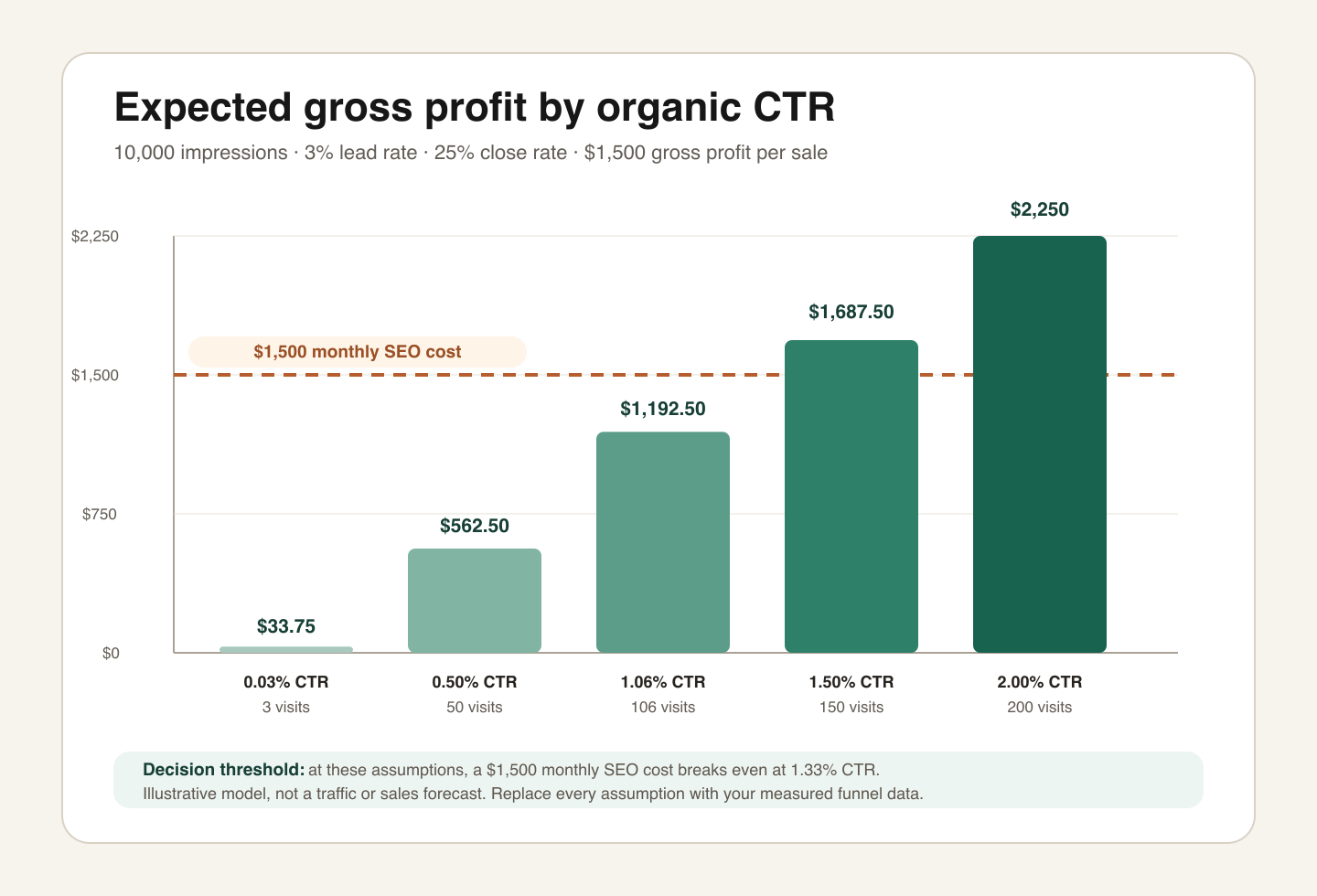
At a $1,500 monthly SEO cost, break-even CTR is 1.33%. A $750 cost breaks even at 0.67%; a $3,000 cost needs 2.67%. The model is an illustration, not a forecast. Its job is to expose which variable needs work: position, snippet, intent, landing-page conversion, sales conversion, cost, or unit economics.
This also tells you when another channel deserves the budget. Use paid search to test demand quickly, email to bring known prospects back, partnerships to borrow trusted distribution, and SEO to build durable discovery. The right traffic source is the one that can produce a qualified customer at an acceptable cost and risk.
Measuring SEO Results: Metrics That Matter
SEO measurement needs a chain from search visibility to business outcome. Review it often enough to make a decision, but do not turn a monthly dashboard ritual into a substitute for diagnosing the page that lost demand or failed to convert.
Key Performance Indicators for SEO
- Organic landing sessions: Use analytics to inspect the landing page, country, device, and subsequent action. Search queries come from Search Console, not standard GA4 reports.
- Query and page visibility: Use Search Console impressions, clicks, CTR, and average position. Segment by page and query before interpreting an average; daily position noise is not a business decision.
- Click-through rate: Compare like-for-like queries, pages, countries, devices, and search appearances. A low blended CTR may come from intent or result features, not only a weak title or snippet.
- Qualified conversions: Define the useful form, call, purchase, or booking, then mark the corresponding event as a GA4 key event. Reconcile it with CRM or order data so spam and duplicate events do not become revenue.
- Earned references: Inspect why a relevant page linked, whether the reference sends qualified visitors, and whether the destination deserves it. A rising domain count alone does not prove the content strategy is working.
- Page experience: Use field Core Web Vitals to find affected templates and lab tools to reproduce them. Prioritize problems that block use or affect many valuable pages; a poor group label does not make every URL the first task.
Realistic SEO Timeline
There is no honest universal SEO timeline. Use checkpoints tied to evidence, then decide whether the next unit of work is justified:
- Baseline: Record index state, query and page metrics, qualified leads, revenue, and major technical constraints before changing the page.
- Implementation checkpoint: Confirm the intended page is crawlable, canonical, rendered, internally linked, and actually answers the target decision. Verify the saved and public versions.
- Decision checkpoint: Compare matched periods and segments. Continue, revise, consolidate, or stop based on qualified traffic and contribution, not because a preset month arrived.
Do not judge SEO by an arbitrary month. Judge each page against its crawl state, query position, click-through rate, conversions, and the speed at which you can improve the weak stage. Paid acquisition and SEO solve different timing problems, so compare them with the same lead and revenue definitions.
When SEO Is the Wrong Channel for Your Business
SEO is usually a poor primary channel for a time-boxed launch or a market test that needs demand now. Paid search, direct outreach, partnerships, or an existing audience can produce feedback faster. Keep SEO in the mix only when durable discovery has a job and a defensible payback threshold.
Reduce the SEO budget when buyers do not use search language for the category, available demand cannot cover the cost, or the margin cannot support the measured payback. A local business may get more from an accurate Google Business Profile and review process than a large content program. A new B2B category may need direct education first. Test the channel instead of applying a generic six-to-twelve-month rule.
Common SEO Mistakes That Hold Businesses Back
Most ranking problems are not mysterious. They are visible mismatches between the query, page, crawl state, evidence, reputation, and business outcome. Diagnose the failed stage before adding more content.
- Using a vendor score as a stop rule. A broad query such as “best CRM software” can demand extensive testing, comparison data, brand trust, and earned references. Inspect those gaps directly instead of deciding from keyword difficulty or domain authority alone.
- Ignoring search intent. Creating a product page when Google shows blog posts for that query, or writing a guide when Google shows comparison tables. Always check the SERP before creating content.
- Splitting one intent across many pages. Consolidate when several URLs compete to answer the same decision. Keep separate pages when each serves a distinct user need. Word count is not the decision rule.
- Neglecting mobile experience. Google uses mobile-first indexing. If your site is clunky on phones, your rankings suffer regardless of how good the desktop version looks.
- Updating by calendar, not evidence. Recheck time-sensitive facts and pages that lost demand, links, conversions, or accuracy. Do not rewrite stable content merely to change the date.
- Skipping technical verification. Confirm the page is crawlable, canonical, rendered, internally discoverable, mobile-usable, and present in the intended sitemap. Then improve relevance and proof.
How to Rank Your Business in Search: Your 90-Day Action Plan
Use the next 90 days as an implementation and measurement window, not a promise that rankings arrive on schedule. I would follow this decision-gated sequence:
- Weeks 1-2, establish the baseline: Run a focused audit using Semrush Site Audit or Ahrefs Site Audit. Record crawl state, canonicals, templates, query/page data, qualified leads, and gross profit. Fix issues that can block discovery or use.
- Weeks 2-3, instrument the funnel: Set up Google Search Console and GA4, define qualified events, and connect them to CRM or order outcomes. If the site uses WordPress, Rank Math can manage common sitemap and schema fields.
- Weeks 3-4, map intent: Map query families to existing pages, identify cannibalization and missing decisions, and choose the smallest set of pages the business can support with real evidence.
- Month 2, improve the best opportunity: Fix the title, answer, proof, internal path, conversion step, and applicable technical issue on a small batch. Publish a new page only when no existing page can serve the intent.
- Month 3, earn and measure distribution: Promote evidence worth referencing, repair relevant broken references, and pursue editorial opportunities. Compare matched query, page, and conversion data with the baseline.
- Decision day: Continue, revise, consolidate, or stop each workstream from contribution and failure-stage evidence. Set the next audit from risk or change, not an automatic monthly or quarterly cadence.
To rank your business in search, do not confuse activity with progress. Ship one evidence-backed improvement, verify the saved and public page, measure the matched funnel, and fund the next change only when the business case survives.
If you’re newer to the discipline, start with my primer on how search engines actually work, then make sure your foundation is solid with these guides to building an SEO-friendly website structure and a properly configured SEO-friendly WordPress setup. From there, the two highest-leverage skills are writing high-quality content that ranks and following a real backlink building strategy instead of buying links.
For more tools and techniques, explore my complete list of the best SEO tools that professionals use, and check the latest digital marketing trends to stay ahead of algorithm changes.
How long does it take for SEO to show results?
There is no reliable universal timeline. A corrected indexing problem can change quickly, while competitive discovery may take many crawl, evaluation, and buying cycles. Use 90 days as an implementation window, not a ranking promise, and review crawl state, query position, CTR, qualified leads, and gross profit.
Is SEO worth it for small businesses with limited budgets?
It can be when buyers search for the problem, the business can publish a genuinely better answer, and the resulting cost per qualified customer fits the margin. Model the break-even CTR before committing. At the assumptions in this article, a $1,500 monthly cost requires about a 1.33% CTR at 10,000 impressions.
What is the difference between on-page and off-page SEO?
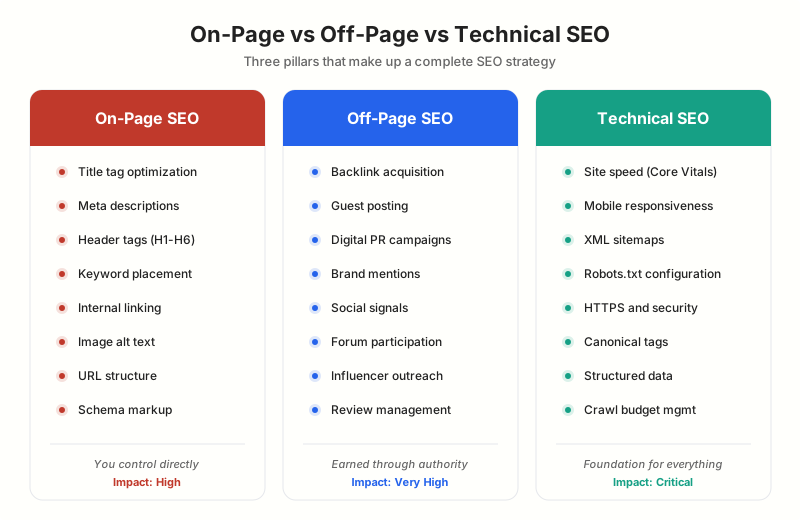
On-page SEO covers the page and site elements you control, including content, titles, headings, internal links, structured data, and technical accessibility. Off-page SEO covers external references and reputation signals. The mix depends on the query and the gap between your page and the results already serving it.
How many backlinks do I need to rank on the first page?
There is no fixed number. Compare the pages that already satisfy the query, the relevance and quality of their references, your page’s information gain, and your site’s existing reputation. No backlink count guarantees a position, and purchased link packages can violate Google’s spam policies.
Do I need to hire an SEO agency or can I do it myself?
You can handle intent mapping, page improvements, Google Business Profile accuracy, and basic measurement in-house if someone owns the work. Bring in a specialist when migrations, crawling, JavaScript rendering, structured data, attribution, or competitive research exceed the team’s skill or available time. Keep the accounts and raw data under your control.
What are Core Web Vitals and why do they matter for rankings?
Core Web Vitals measure loading experience, responsiveness, and visual stability. The good thresholds are LCP within 2.5 seconds, INP within 200 milliseconds, and CLS at 0.1 or less at the 75th percentile. They are one part of page experience, not a substitute for relevance or useful content.
How has AI changed SEO strategy?
AI search features can answer part of a query before a visit. Google says the same foundational SEO practices apply: publish helpful, reliable, people-first content, make it technically accessible, and support claims. Clear answers, original evidence, named sources, and unambiguous entities also make a page easier for people and machines to interpret.
Should I focus on SEO or paid advertising?
Use paid acquisition when you need fast demand tests or time-sensitive reach. Use SEO when durable discovery can justify the slower feedback loop. Compare both with the same qualified-lead and gross-profit definitions. A blended plan is sensible only when each channel passes its own contribution threshold.
Tell Google you want more of this.
Add Gaurav Tiwari as a preferred sourceOne tap, and this site shows up more often in your own Top Stories, AI Overviews and AI Mode. Remove it any time.
Disclaimer: This site is reader-supported. If you buy through some links, I may earn a small commission at no extra cost to you. I only recommend tools I trust and would use myself. Your support helps keep gauravtiwari.org free and focused on real-world advice. Thanks. - Gaurav Tiwari