
SEO for Dentists: What You Need to Know to Get Started
About 46% of all Google searches have local intent. That means nearly half the people typing something into Google are looking for a business, service, or product near them. If you’re a dentist, a plumber, a lawyer, or any service provider with a physical location, that number should grab your attention. Local SEO isn’t some nice-to-have marketing tactic. It’s the difference between your phone ringing 5 times a week or 50.
I’ve worked on local SEO campaigns for service businesses across different industries, and the pattern is always the same: the businesses that show up in Google’s Local Pack (those top 3 map results) get the majority of clicks and calls. Everyone else fights over scraps. This guide covers everything you need to know about local SEO for dentists and service businesses, from Google Business Profile optimization to local schema markup, review management, and building local landing pages that actually rank.
Why Local SEO Matters for Service Businesses
Let me put this bluntly: if your dental practice or service business doesn’t appear in local search results, you’re invisible to the people most likely to become customers. Consider these numbers. 76% of people who search for something nearby visit a business within a day. 28% of those searches result in a purchase. And 84% of local searches on mobile lead to some kind of action, whether that’s a phone call, a visit, or a direction request.
Local SEO is different from traditional SEO. You’re not competing with every website on the internet. You’re competing with the 10 to 20 other businesses in your area that offer the same service. That’s a much smaller playing field, and with the right approach, you can dominate it within 3 to 6 months.
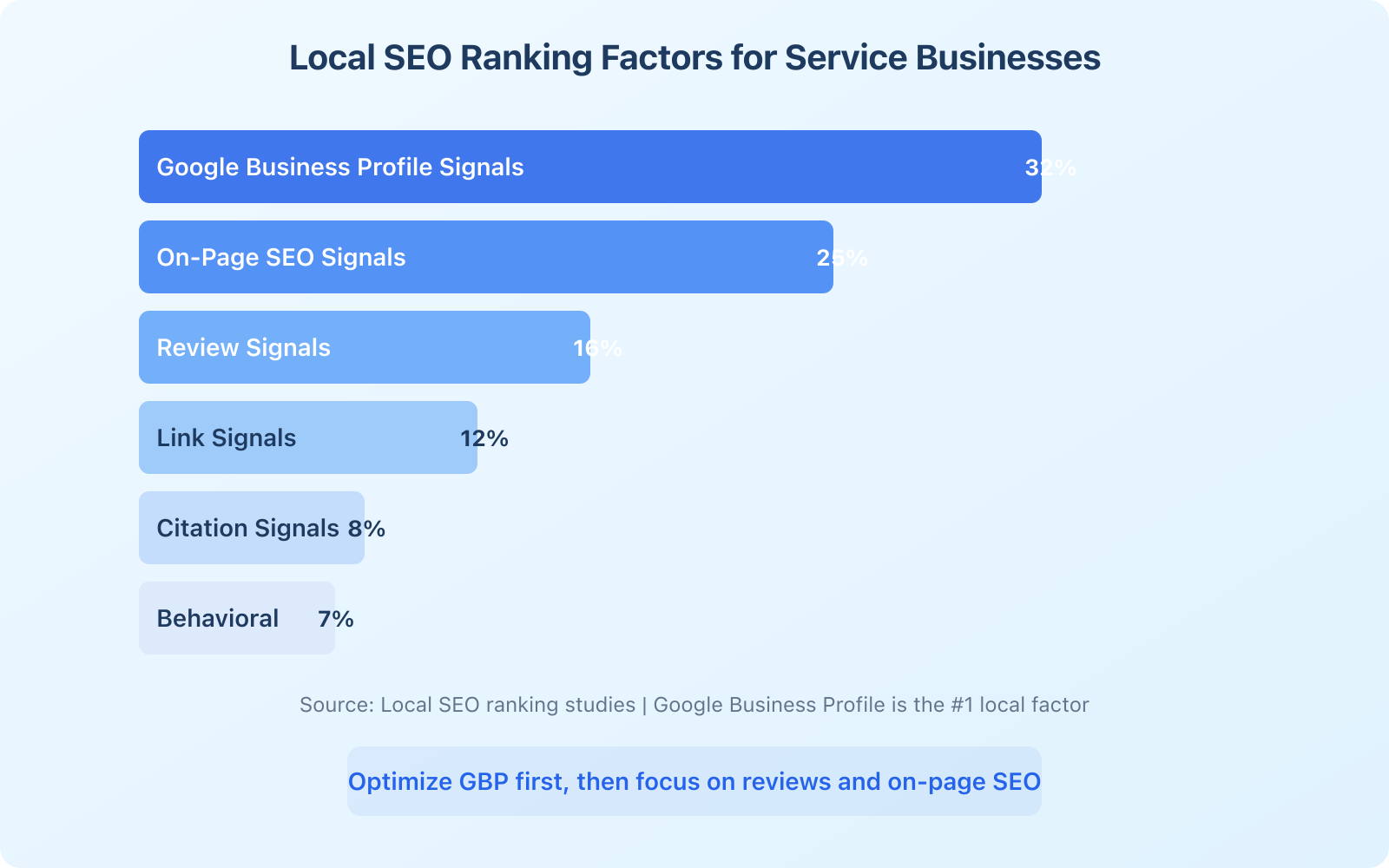
The ranking factors for local SEO break down into a few core areas: your Google Business Profile signals (32%), on-page SEO (25%), review signals (16%), link signals (12%), citation signals (8%), and behavioral signals (7%). I’ll walk you through each one.
Google Business Profile: The Foundation of Local SEO
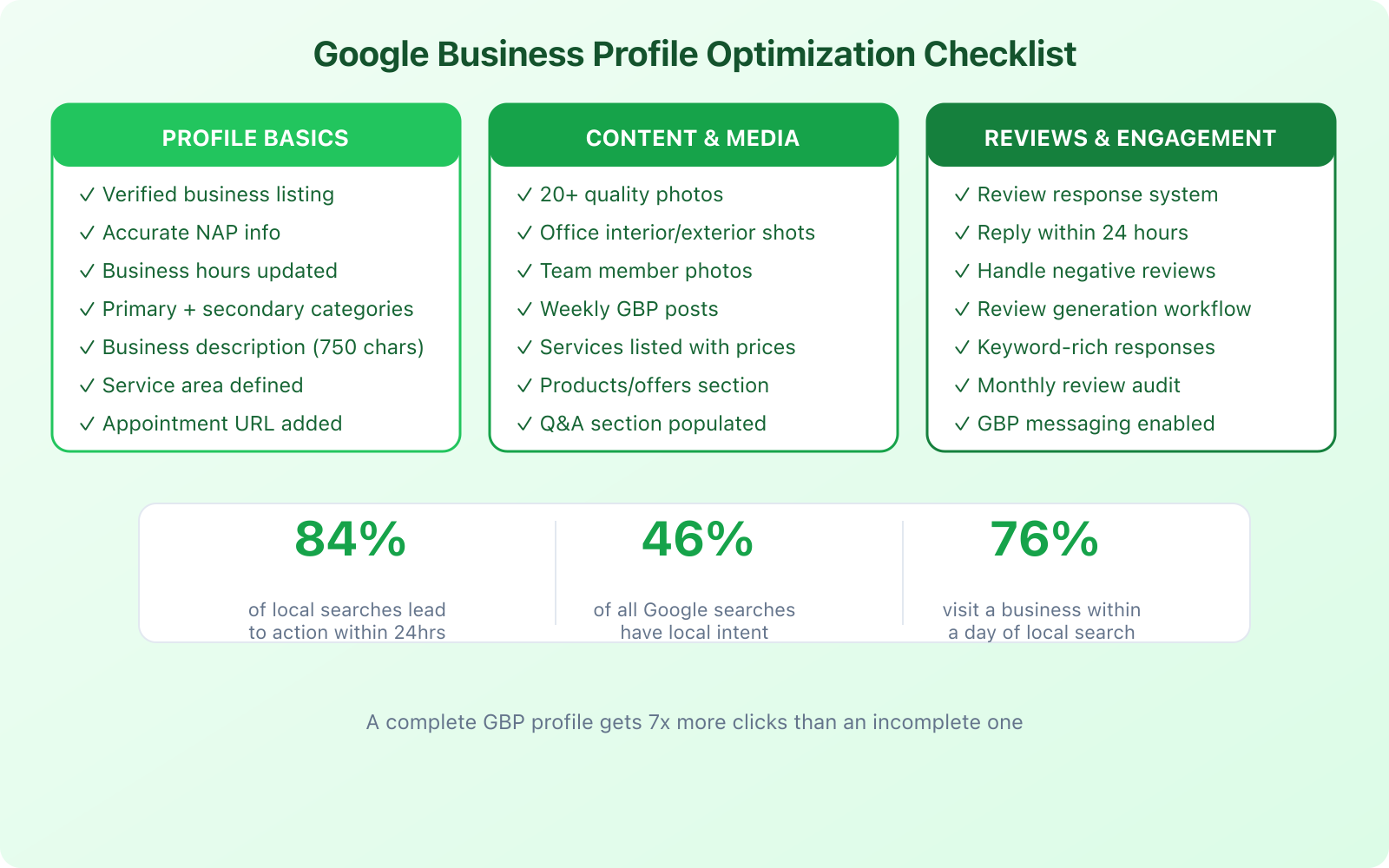
Your Google Business Profile (GBP, formerly Google My Business) is the single most important factor in local search rankings. A complete, optimized GBP gets 7 times more clicks than an incomplete one. Yet I still see dental practices and service businesses with bare-bones profiles, missing photos, and zero posts. That’s leaving money on the table.
Here’s what a fully optimized GBP looks like:
Claim and verify your listing. If you haven’t done this yet, go to business.google.com right now. Verification usually takes a few days via postcard, phone, or email. Until you’re verified, you can’t control what shows up when people search for your business.
Complete every single field. Business name (use your real name, don’t keyword stuff), address, phone number, website, hours, holiday hours, appointment URL, service areas, business description (use all 750 characters), and attributes. Google rewards completeness.
Choose the right categories. Your primary category is the most important ranking factor within GBP. For a dental practice, “Dentist” is your primary. Then add secondary categories like “Cosmetic Dentist,” “Pediatric Dentist,” or “Emergency Dental Service” based on what you actually offer. Don’t add categories for services you don’t provide.
Add photos regularly. Businesses with 100+ photos get 520% more calls and 2,717% more direction requests than the average business. Upload photos of your office interior, exterior, team members, and even before-and-after shots (with patient consent). Aim for at least 20 photos to start, then add 2 to 3 new ones every month.
Post weekly updates. GBP posts work like mini social media updates. Share promotions, new services, health tips, or community involvement. Posts expire after 7 days, so consistency matters. I’ve seen businesses climb 2 to 3 positions in the Local Pack just by posting consistently for 8 weeks.
Enable GBP messaging and Q&A. Pre-populate the Q&A section with your most common questions (like “Do you accept insurance?” or “What are your hours?”). This saves potential patients time and sends strong engagement signals to Google.
On-Page SEO for Local Service Websites
Your website needs to signal two things to Google: what services you offer, and where you offer them. If your website says “dental services” but never mentions your city, neighborhood, or service area, Google won’t know where to rank you.
Title tags and meta descriptions. Every service page should include your primary keyword plus your city. Something like “Emergency Dentist in San Francisco | Same-Day Appointments” is clear, specific, and click-worthy. Don’t stuff multiple cities into one title tag. That’s what separate landing pages are for.
Header structure. Use your H1 for the main service + location keyword. Use H2s for subtopics, procedure details, and insurance information. A clear header hierarchy helps both Google and visitors find what they’re looking for.
NAP consistency. Your business name, address, and phone number (NAP) should appear on every page of your website, typically in the footer. This must exactly match what’s on your Google Business Profile. Even small differences like “St.” vs “Street” can create confusion for search engines.
Content depth. Each service page should have at least 800 to 1,200 words of genuine, helpful content. Don’t just list your services in bullet points. Explain what patients can expect, how much procedures typically cost, how long they take, and what makes your approach different. This level of detail ranks better and converts better.
For keyword research, I recommend Semrush. Its Keyword Magic Tool lets you filter by local search volume and find long-tail keywords like “affordable teeth whitening San Francisco” or “pediatric dentist near Golden Gate Park” that have real buying intent behind them.
Local Schema Markup: Speaking Google’s Language
Schema markup is structured data that tells search engines exactly what your business is, where it’s located, what services you offer, and what your ratings look like. It’s code you add to your website that doesn’t change how the page looks to visitors but gives Google explicit information to work with.
For local service businesses, you’ll want to implement these schema types:
LocalBusiness schema (or the more specific Dentist, Plumber, LegalService types). This includes your business name, address, phone, operating hours, geo coordinates, price range, and payment methods.
Service schema. Mark up each individual service you offer with its own schema. A dental practice might have separate schema for teeth cleaning, root canals, dental implants, and orthodontics.
Review/AggregateRating schema. If you display reviews on your website, mark them up with review schema. This can result in star ratings appearing directly in search results, which dramatically improves click-through rates.
FAQ schema. If your service pages include frequently asked questions, mark them up with FAQ schema. This can earn you expanded search result snippets that take up more real estate on the results page.
The easiest way to implement schema on a WordPress site is with Rank Math. It has a built-in local SEO module that generates LocalBusiness schema automatically and lets you add FAQ schema to any page without touching code. I use it on every client site because it handles the technical side without requiring a developer.
Review Management: Your Secret Ranking Weapon
Reviews make up roughly 16% of local ranking factors, but their impact goes far beyond rankings. A business with 50+ reviews and a 4.5-star average will get more clicks than a business with 5 reviews and a perfect 5.0. Volume and recency matter more than perfection.
Here’s a review management system that actually works:
Create a review generation workflow. After every appointment or service, send a follow-up email or text with a direct link to your Google review page. The shorter the delay between the service and the ask, the higher your response rate. Aim to send the request within 1 to 2 hours.
Respond to every single review. Yes, every one. Thank positive reviewers by name and reference something specific about their visit. For negative reviews, respond professionally, acknowledge the concern, and offer to resolve it offline. Google’s guidelines say that businesses that respond to reviews are 1.7 times more trustworthy than those that don’t.
Use keywords in your responses. When you reply to a review, naturally include your service and location. Something like “Thank you for choosing us for your teeth whitening treatment here in downtown Austin” reinforces your local relevance to Google.
Don’t ignore other platforms. While Google reviews have the biggest impact on local rankings, reviews on Yelp, Healthgrades (for dentists), Avvo (for lawyers), and Facebook also contribute to your overall online reputation. Diversify your review portfolio.
Never buy or fake reviews. Google is increasingly sophisticated at detecting fake reviews. Getting caught means potential suspension of your Business Profile. It’s not worth the risk.
Building Local Landing Pages That Rank
If you serve multiple areas, neighborhoods, or cities, you need dedicated landing pages for each one. A single “Our Locations” page won’t cut it. Each service area deserves its own page with unique content.
Here’s the structure I use for local landing pages:
URL structure: yourdomain.com/service-city/ (e.g., yoursite.com/dental-implants-austin/ or yoursite.com/emergency-plumber-chicago/).
Title tag: [Service] in [City] | [Business Name].
Unique content for each page. This is where most businesses fail. They create 10 landing pages and just swap out the city name. Google sees right through that. Each page needs unique content that references local landmarks, neighborhoods, directions, parking information, and community details. Talk about the specific needs of that community.
Embedded Google Map. Embed a Google Map showing your business location (or the service area) on each landing page. This provides another local signal.
Location-specific testimonials. If you can, include reviews from customers in that specific area. “Dr. Smith has been my family dentist in the Westlake neighborhood for 3 years” is much more compelling than a generic testimonial.
Clear call to action. Every landing page should have a prominent phone number (click-to-call on mobile), an appointment booking form, and your address with directions.
Citation Building: Consistency Is Everything
Citations are online mentions of your business name, address, and phone number on other websites. They’re one of the foundational elements of local SEO. Think of them as votes of confidence that tell Google your business is real, legitimate, and located where you say it is.
The most important citation sources include:
- Google Business Profile
- Apple Maps / Apple Business Connect
- Bing Places for Business
- Yelp
- Facebook Business Page
- Industry-specific directories (Healthgrades, Zocdoc for dentists; Avvo for lawyers; HomeAdvisor for contractors)
- Local Chamber of Commerce
- Better Business Bureau (BBB)
- Data aggregators like Foursquare, Data.com, and Neustar Localeze
The critical rule: your NAP information must be identical across every single citation. Same business name, same address format, same phone number. One incorrect listing can create confusion and dilute your local ranking power. Audit your citations quarterly using a tool like Semrush’s Listing Management tool to spot inconsistencies.
Content Strategy for Local SEO
Content is what separates local businesses that rank from those that don’t. Your website shouldn’t just list your services. It should demonstrate your expertise and serve the information needs of your local community.
Create service-specific content. Write detailed pages for each service you offer. A dentist should have separate pages for teeth cleaning, teeth whitening, dental implants, root canals, emergency dental care, and pediatric dentistry. Each page should answer the questions patients actually ask: How much does it cost? Does insurance cover it? How long does it take? What’s the recovery like?
Publish local blog content. Write about topics that connect your expertise to your community. A dentist might write “How to Find Emergency Dental Care in [City] After Hours” or “Water Fluoridation in [City]: What Parents Should Know.” This kind of content is hyper-local, genuinely useful, and unlikely to have competition.
Answer questions your patients ask. Check Google’s “People also ask” section for your target keywords. Use Semrush to find question-based keywords in your niche. Every question is a potential blog post or FAQ entry.
Update content regularly. Google favors fresh content, especially for local searches. Update your service pages at least twice a year with new pricing, new procedures, or new team members. Keep your blog active with at least 2 posts per month.
Don’t overlook your content’s readability. Medical and dental topics can get jargon-heavy fast. Write at an 8th-grade reading level. Use “gum disease” instead of “periodontal disease” (or at least define it). Patients aren’t searching with clinical terminology.
Link Building for Local Businesses
Links from other websites to yours remain a significant ranking factor, even for local SEO. But the approach is different from traditional link building. For local businesses, relevance and locality matter more than raw domain authority.
Local partnerships. Partner with complementary businesses for cross-promotion. A dentist might partner with an orthodontist, a pediatrician, or a local school. These partnerships often result in links from their websites to yours.
Sponsor local events. Youth sports teams, charity runs, school fundraisers, and community events often have websites that list their sponsors with links. These are high-quality local links that also build community goodwill.
Get featured in local media. Reach out to local news websites, community blogs, and neighborhood publications. Offer expert commentary on health topics, provide free dental screening events, or share newsworthy updates about your practice. Local press mentions with links carry significant SEO weight.
Join professional associations. Your state dental association, local business association, and chamber of commerce typically list member businesses on their websites. These are authoritative, relevant links that are easy to earn.
Guest post strategically. Write articles for local business blogs, community health websites, or regional publications. Always include a link back to a relevant page on your website, not just your homepage. Check our guide on the role of guest posting for more on this approach.
Technical SEO for Local Websites
Technical SEO issues can silently kill your local rankings. Here’s what to check:
Mobile-first design. Over 60% of local searches happen on mobile devices. If your website isn’t fast and easy to use on a phone, you’re losing patients. Google uses mobile-first indexing, which means the mobile version of your site is what determines your rankings. Test your site with Google’s PageSpeed Insights and aim for a score above 80.
Page speed. A 1-second delay in page load time reduces conversions by 7%. For a local business, that can mean losing several patients per week. Compress images, use a content delivery network (CDN), enable browser caching, and minimize JavaScript. If you’re on WordPress, good hosting makes the biggest difference.
SSL certificate. Your website must use HTTPS. Google has confirmed it’s a ranking signal, and patients won’t trust a website that shows “Not Secure” in the browser bar.
XML sitemap. Submit your sitemap to Google Search Console. This helps Google discover and index all your pages, especially new local landing pages.
Fix broken links and 404 errors. Broken pages create a poor user experience and waste your crawl budget. Run a site audit monthly using Rank Math’s built-in SEO analysis or Semrush‘s Site Audit tool to catch issues early.
Measuring Your Local SEO Success
You can’t improve what you don’t measure. Here are the metrics that matter for local SEO:
GBP Insights. Check how many people found your profile through direct searches (they searched your business name) vs. discovery searches (they searched for a category or service). Discovery searches indicate how well your local SEO is working.
Phone calls and direction requests. These are your most valuable conversion actions. Track month-over-month trends. If calls are increasing, your local SEO is working.
Local keyword rankings. Track your positions for your top 10 to 20 local keywords. Use Semrush’s Position Tracking to monitor rankings at the zip code level, not just the city level.
Website traffic from organic search. Use Google Analytics to see how much traffic you’re getting from organic search, which pages they’re landing on, and what they do after landing. A high bounce rate on a service page might mean the content isn’t matching the search intent.
Review velocity. Track how many new reviews you’re getting each month. A steady stream of reviews (5+ per month for most local businesses) signals to Google that your business is active and trusted.
Common Local SEO Mistakes to Avoid
I’ve seen these mistakes tank local rankings for otherwise great businesses:
- Keyword stuffing your business name. Naming your GBP listing “Best Dentist San Francisco | Affordable Dental Care SF” instead of your actual business name violates Google’s guidelines and can get your listing suspended.
- Ignoring negative reviews. An unanswered negative review looks worse than the review itself. Always respond, always be professional.
- Duplicate listings. Multiple GBP listings for the same location confuse Google and split your review signals. Merge or remove duplicates.
- Thin location pages. Creating 20 city pages with identical content except the city name is a recipe for a Google penalty. Each page needs unique, valuable content.
- Neglecting your website after launch. A website that hasn’t been updated in 2 years sends all the wrong signals. Keep it fresh.
- Not tracking results. If you’re not measuring calls, form submissions, and keyword rankings, you’re flying blind. Set up proper tracking from day one.
Tools I Recommend for Local SEO
You don’t need 15 different tools to run effective local SEO. Here’s what I’d use:
Semrush handles keyword research, position tracking, site audits, backlink analysis, and listing management. It’s the most complete all-in-one platform for local SEO. The Listing Management tool alone is worth the price, letting you push your business information to 70+ directories from one dashboard.
Rank Math is the best WordPress SEO plugin for local businesses. Its Local SEO module generates the right schema markup automatically, handles your XML sitemap, and gives you on-page optimization suggestions for every page. The free version covers most needs, but the Pro version adds local business schema for multiple locations.
Google Search Console is free and essential. It shows you which queries bring people to your site, which pages get the most impressions, and flags technical issues that need fixing.
Google Analytics (also free) tracks your website traffic, user behavior, and conversions. Pair it with call tracking to see the full picture of how your local SEO efforts translate into actual business.
For more on getting started with SEO, check our beginner’s guide. If you want to go deeper on keyword research, we have a dedicated keyword research guide as well.
Your Local SEO Action Plan
Here’s what I’d do if I were starting local SEO for a dental practice or any service business from scratch:
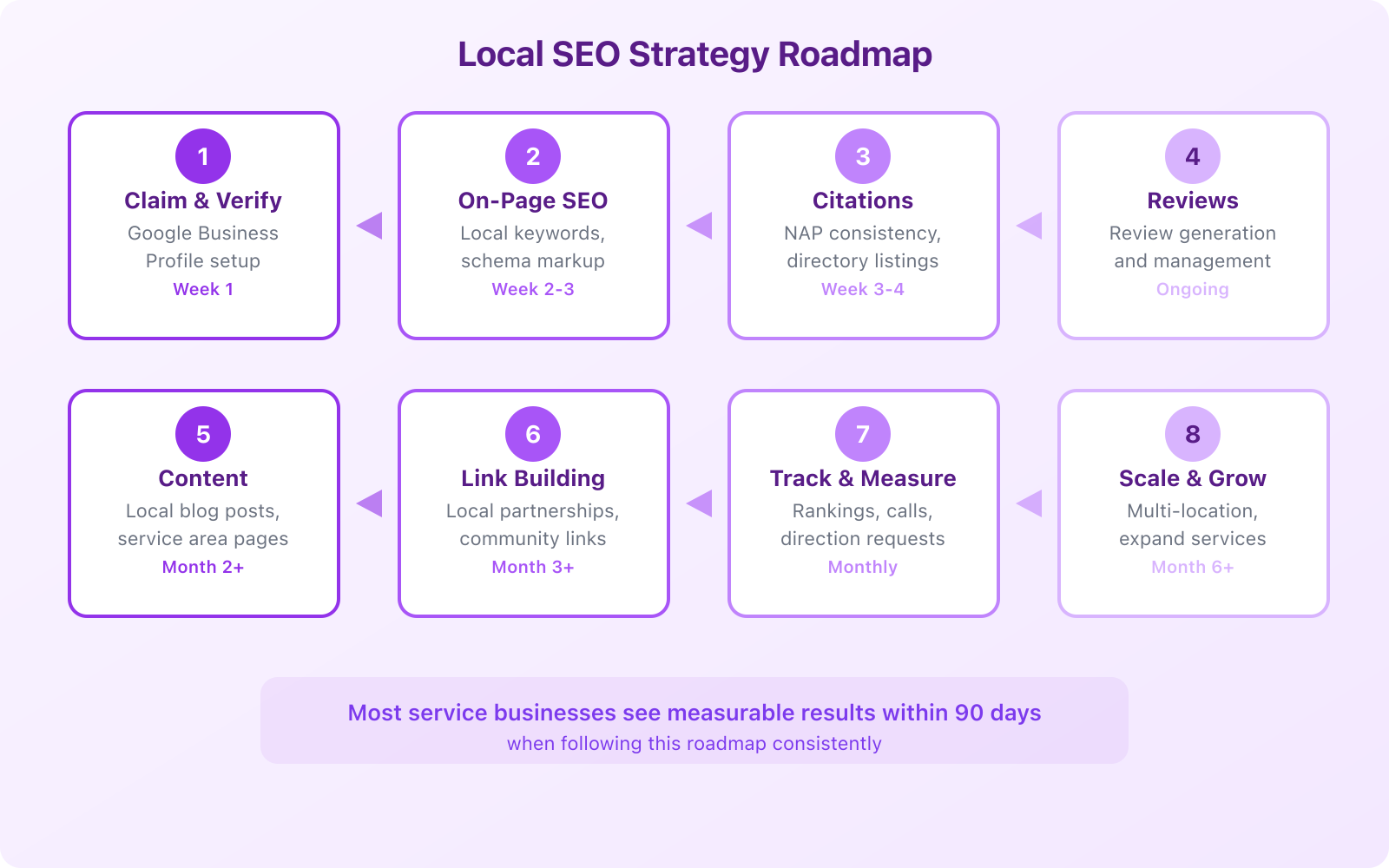
Week 1: Claim and fully optimize your Google Business Profile. Add photos, write your description, set up all services, and enable messaging.
Weeks 2 to 3: Audit your website’s on-page SEO. Fix title tags, meta descriptions, and header tags. Add NAP to the footer. Install Rank Math and configure local business schema.
Weeks 3 to 4: Build citations on the top 20 directories. Ensure perfect NAP consistency across all platforms.
Month 2: Launch a review generation system. Start publishing 2 blog posts per month targeting local keywords. Create your first local landing pages if you serve multiple areas.
Month 3 and beyond: Focus on link building through local partnerships, sponsorships, and guest posts. Continue publishing content and generating reviews. Monitor rankings weekly and adjust your strategy based on what the data shows.
Local SEO isn’t complicated. It requires consistency, attention to detail, and a genuine commitment to serving your community with great content and great service. The businesses that treat their online presence with the same care they give their patients or clients are the ones that win. Start with your Google Business Profile, get your on-page SEO right, build reviews consistently, and the rankings will follow.
Frequently Asked Questions
How long does local SEO take to show results?
Most service businesses see noticeable improvements in 90 days. Google Business Profile optimizations can show results in as little as 2 to 4 weeks, while on-page SEO and citation building typically take 2 to 3 months to fully impact rankings. Consistent review generation and content publishing compound over time, with the strongest results usually appearing around the 6-month mark.
How much does local SEO cost for a dental practice?
If you do it yourself using tools like Rank Math (free) and Semrush ($129/month), your main cost is time. Hiring a local SEO agency typically costs $500 to $2,000 per month depending on your market competition and the number of locations. For most single-location practices, $500 to $1,000 per month is a reasonable budget that should deliver measurable ROI within 3 to 6 months.
What’s more important for local rankings: reviews or backlinks?
Reviews carry slightly more weight in local search rankings (16% vs 12% for link signals), and they’re easier to actively generate. However, both matter. A strong review profile builds trust with potential patients and sends ranking signals to Google, while quality backlinks from local sources boost your overall domain authority. Focus on reviews first since they directly influence patient decisions, then invest in link building for long-term ranking strength.
Should I create separate pages for each service I offer?
Yes. Each major service should have its own dedicated page with unique, detailed content. A single ‘Services’ page listing everything won’t rank well for any individual service. Separate pages let you target specific keywords, provide detailed information patients are searching for, and add service-specific schema markup. For a dental practice, you’d want individual pages for teeth cleaning, whitening, implants, root canals, emergency care, and any specialties you offer.
Can I do local SEO without a physical office location?
Yes, if you’re a service-area business (SAB) that travels to customers, like a mobile dentist or home repair contractor. Google Business Profile allows SABs to define service areas without displaying a physical address. You can still rank in local search results for the areas you serve. The key difference is you’ll set service areas instead of a pin location, and your address won’t be publicly visible on your listing.
Disclaimer: This site is reader-supported. If you buy through some links, I may earn a small commission at no extra cost to you. I only recommend tools I trust and would use myself. Your support helps keep gauravtiwari.org free and focused on real-world advice. Thanks. - Gaurav Tiwari