
What Is Quote to Cash for Contractors
Winning work starts with trust. But the profit usually gets lost somewhere between your first quote and the last payment.
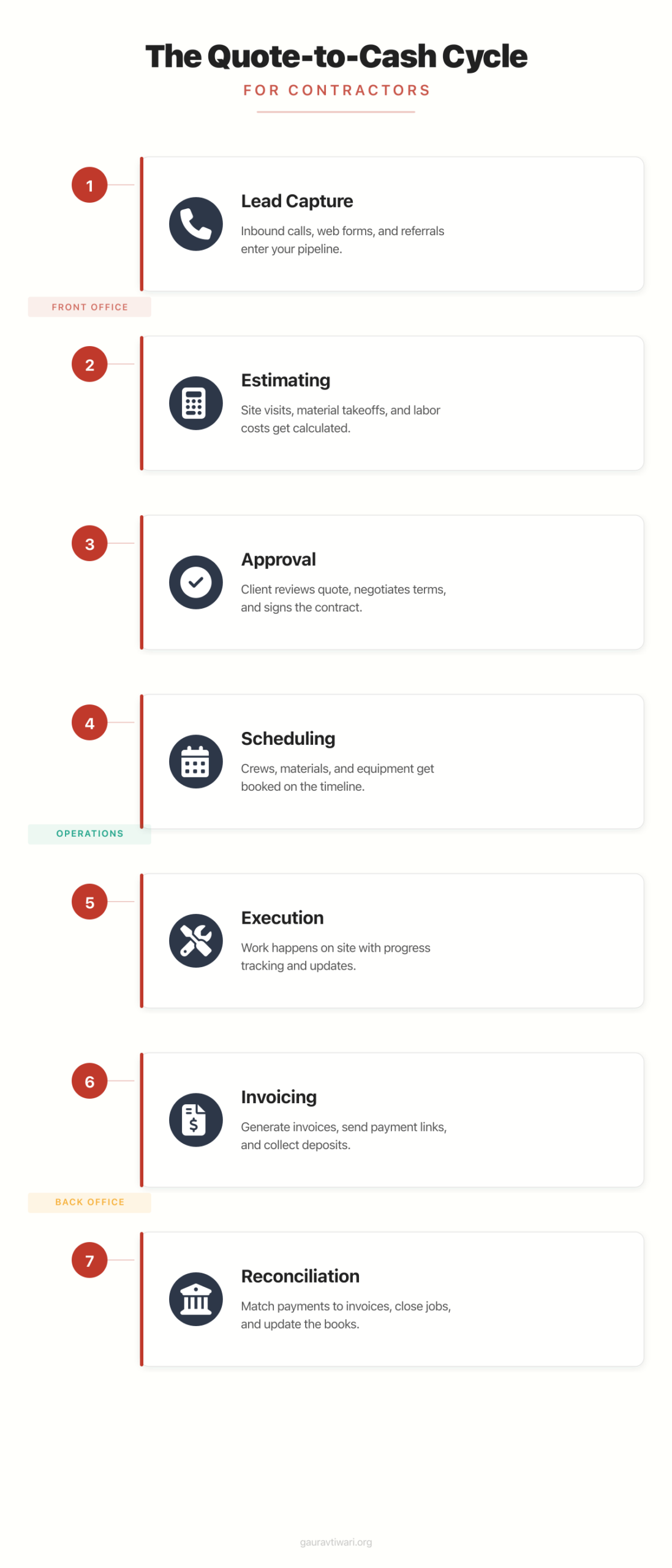
That gap is the quote-to-cash (QTC) cycle: every step from a client’s initial inquiry to the money landing in your account. Lead capture, estimates, approvals, invoicing, payment collection, reconciliation. Break one link in that chain and your working capital gets squeezed. I’ve worked with contractors who had plenty of jobs but couldn’t make payroll because their QTC cycle leaked cash at every stage.
Lead Capture
Revenue doesn’t start with an invoice. It starts the moment someone reaches out to you. To protect your firm’s income, you need to capture and engage every lead that comes in.
Every website form submission, Google Business Profile inquiry, phone call, referral, and social media message is a chance you can’t afford to miss. In competitive markets like Texas, California, Florida, or Ontario, firms that respond within five minutes win more site visits and more contracts.
Here’s what you should track at this stage:
- Lead source by geography so you know which channels bring paying clients
- Response time because five minutes vs. five hours is the difference between winning and losing
- Appointment booking rate to measure how well your intake process converts
- Cost per lead so you can cut what doesn’t work and double down on what does
Connecting your website to a responsive CRM system eliminates manual entry mistakes. One missed call can mean a lost job. Speed builds trust, and trust fills your pipeline.
Estimating
Your estimate isn’t just a price. It’s a profit forecast. In construction, miscalculating labor or materials by even 5% can wipe out your margins entirely. Material price increases over the past few years have shown how fast costs can eat into income when companies don’t revise their quotes quickly enough.
A solid estimating system needs these components:
- Comprehensive work scope that leaves no room for ambiguity
- Current supplier pricing updated weekly, not quarterly
- Labor burden calculations including benefits, insurance, and overhead
- A defined markup policy that protects your target margin
- Clear payment terms spelled out before the client signs
Use standardized templates to reduce errors. Track your estimate-to-close ratio. If you’re winning less than 30% of your bids, your pricing or targeting needs adjustment.
Digital Tools That Speed Up Cash Collection
If you’re still creating quotes in spreadsheets and emailing PDFs, you’re slowing your own cash cycle. Growth-oriented contractors now rely on estimating tools for contractors that connect quoting, invoicing, and payments into a single workflow. Platforms like Joist let clients approve estimates digitally and convert them into invoices instantly.
Online payments get you funded faster, which directly strengthens your working capital. Here’s what you gain with digital tools:
- Automated tax calculations that save hours of manual work
- Real-time payment tracking across all active jobs
- Upfront deposit requests built into the estimate approval flow
- Credit card and ACH payment options for faster collection
- Full customer payment history for dispute resolution
The gap between finishing a job and getting paid shrinks dramatically when you automate the invoicing step.
Approval and Contract Clarity: Controlling Risk
A verbal “yes” doesn’t protect your margins. Only a signed agreement does. In the United States and Canada, written contracts significantly reduce disputes, especially for remodeling and renovation work where scope creep is common.
Strong contracts define:
- Scope limits so both parties know exactly what’s included
- Change order procedures with pricing agreed before extra work starts
- Payment schedules tied to milestones, not completion
- Retention terms with clear release conditions
- Warranty details covering duration and exclusions
Digital approvals and e-signatures keep projects moving without delays. They eliminate the “I’ll sign it when I get to the office” bottleneck that can stall a project for days.
Scheduling and Job Execution: The Hidden Cash Driver
Most contractors overlook scheduling in the QTC cycle. That’s a mistake. When schedules slip, revenue slips with them. Industry research shows that project delays consistently rank among the top operational risks in construction, globally.
Connecting your CRM or estimating system to scheduling tools lets you:
- Assign crews faster based on availability and location
- Track job status in real time instead of relying on phone updates
- Trigger invoice milestones automatically when work is completed
- Forecast monthly revenue with actual data, not guesswork
Milestone billing keeps cash flowing between project start and completion. Predictable schedules create predictable revenue.
Invoicing and Payment Collection
An unbilled job is just a receivable sitting in limbo. Send your invoice the day you finish or the day a milestone is hit. Every day you delay the invoice, you delay the cash.
Make your invoices clear and specific:
- A visible due date (net 15 or net 30, not “upon receipt”)
- Accepted payment methods listed clearly
- Late fee terms so clients know the cost of delay
- A direct payment link so they can pay from their phone
Online payment portals are especially useful for plumbing, HVAC, roofing, landscaping, and electrical contractors where jobs close on-site. Measure your days sales outstanding (DSO), percentage of overdue accounts, and average payment time. These numbers tell you whether your invoicing process is working or bleeding cash.
Reconciliation and Accounting Integration
The final step in the QTC process is reconciliation: matching payments to invoices, tracking deposits, reconciling bank accounts, and syncing with your accounting system. If you use QuickBooks or Xero, integration prevents duplicate data entry and reduces errors.
The Association of Certified Fraud Examiners (ACFE) reports that small businesses lose a notable share of income to internal fraud each year. Strong reconciliation practices reduce that risk.
Keep tabs on:
- Unapplied payments that haven’t been matched to invoices
- Open change orders that affect the final billing amount
- Retainage balances and their release schedules
- Sales tax liability by jurisdiction
- Revenue by project for profitability analysis
Accurate books protect you during audits, tax season, and if you ever need to prove profitability for bonding or financing.
KPIs That Tell You If Your QTC Cycle Is Working
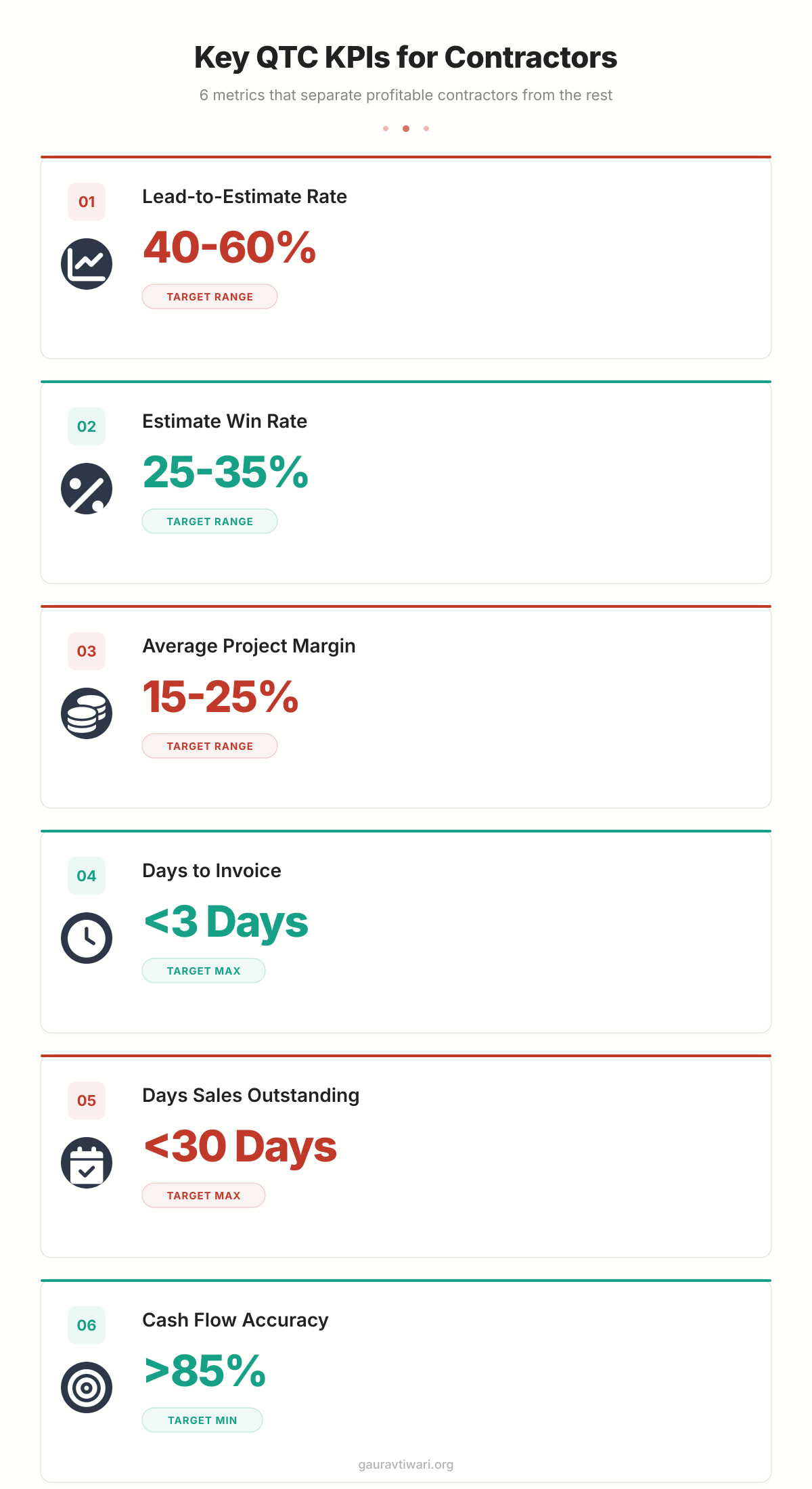
If you’re not measuring your QTC cycle, you’re guessing. These are the metrics that matter:
- Lead-to-estimate conversion rate tells you if your intake process works
- Estimate win rate shows if your pricing is competitive
- Average project margin reveals your actual profitability
- Days from approval to invoice measures how fast you bill
- Days sales outstanding tracks how quickly clients pay
- Cash flow forecast accuracy shows how well you predict revenue
Research from industry analysts consistently shows that contractors who digitize their workflows report measurable efficiency gains. When your QTC data is connected across systems, you spot problems before they become expensive.
Frequently Asked Questions
What is quote to cash in simple terms?
Quote to cash (QTC) is the entire process from when a potential client asks for a quote to when their payment clears your bank account. For contractors, it covers lead capture, estimating, contract approval, job execution, invoicing, payment collection, and reconciliation.
How long should the quote-to-cash cycle take for contractors?
For small residential jobs (plumbing, HVAC, electrical), the cycle can close in 1-2 weeks. Larger renovation or commercial projects may take 30-90 days from estimate to final payment. The goal is to shorten every gap: respond to leads within 5 minutes, send estimates within 24 hours, and invoice the same day a milestone is completed.
What tools help contractors manage quote to cash?
Platforms like Joist connect estimating, invoicing, and payments in one workflow. For CRM and lead tracking, tools like Zoho CRM or Monday.com work well. QuickBooks and Xero handle the accounting and reconciliation side. The key is connecting these tools so data flows between them without manual re-entry.
What is days sales outstanding (DSO) and why does it matter?
DSO measures the average number of days it takes to collect payment after sending an invoice. A DSO of 30 means you typically wait a month to get paid. Lower is better. Contractors with DSO above 45 days often face cash flow problems even when they have plenty of work.
How can contractors reduce payment delays?
Send invoices immediately after completing work or hitting a milestone. Include direct payment links so clients can pay from their phone. Offer credit card and ACH options. Set clear net-15 or net-30 terms with defined late fees. Request upfront deposits as part of the estimate approval process.
Is quote to cash only relevant for large contractors?
No. Solo contractors and small crews benefit the most from optimizing their QTC cycle because they have less financial buffer. A single late payment or uncollected invoice can disrupt payroll, material purchases, and scheduling for weeks.
Quote-to-cash isn’t a corporate buzzword. It’s the process that determines whether you run a profitable contracting business or just stay busy. Every step from lead capture to reconciliation either protects your margins or erodes them. Shorten the cycle, automate the repetitive parts, and measure what matters. That’s how you build a contracting business that’s ready to scale.