
GT Performance · 1.0.0-beta-2

Cache public pages. Keep private state private.

GT Performance is a WordPress performance plugin built for fast public pages, safe commerce, and one clear owner for every optimization layer.

I built it because a cache that leaks a cart, freezes an account page, or hides its decisions is not a performance win. It is a production incident waiting to happen.
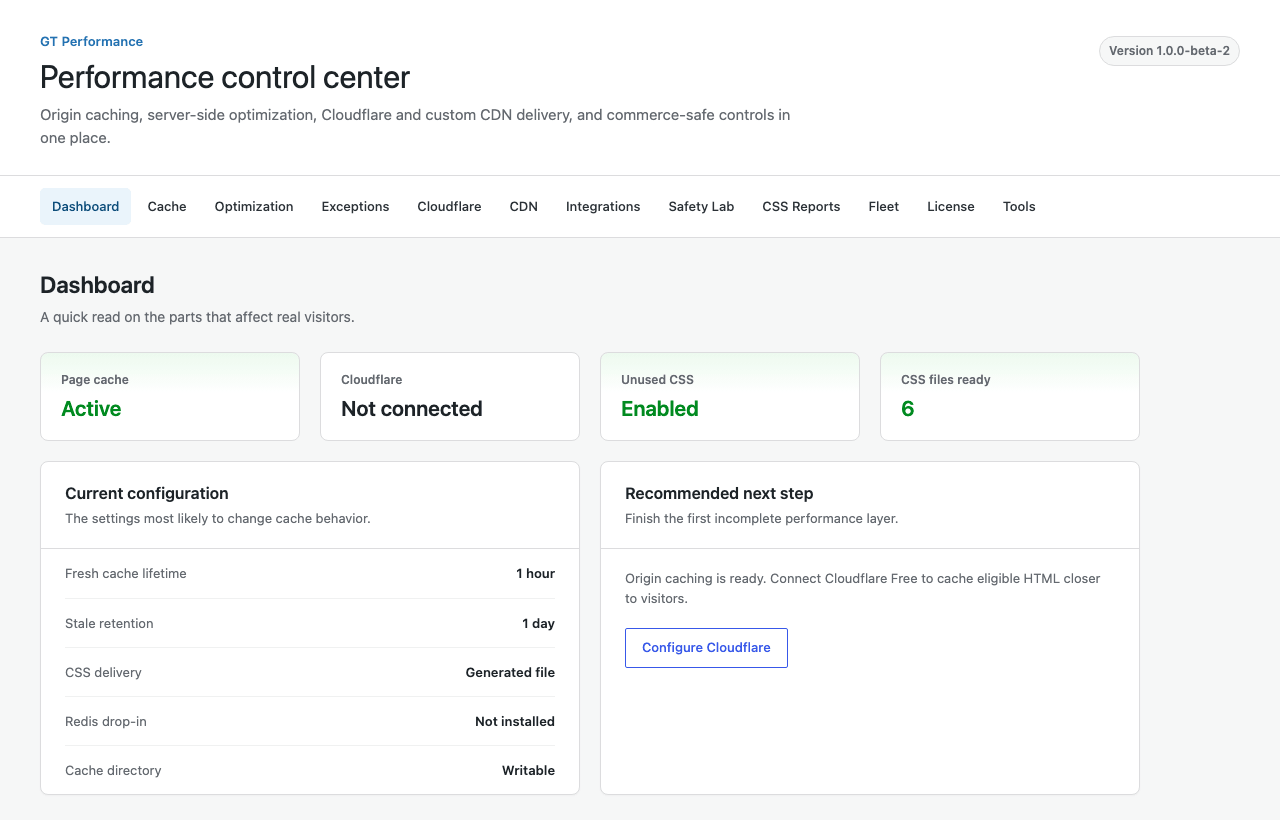
GT Performance beta 2 dashboard showing page cache, Cloudflare, unused CSS, and CSS status
The beta-2 control center shows cache ownership, Cloudflare status, used CSS, and the next safe action.
$199
One-time purchase
25 websites
One portfolio license
Lifetime
No renewal payment
Cloudflare Free
No APO or Worker required

Performance without cache roulette

Fast is not useful if checkout breaks.

GT Performance starts with cache correctness, then adds the transformations you can verify. That changes the order of operations and the outcome.

Serve shared HTML quickly
Atomic origin files, stale retention, browser-safe headers, preload, and exact invalidation reduce repeat WordPress work.
Keep sessions out of public cache
Commerce routes, customer cookies, transaction parameters, and private fragments are governed by one policy at the origin and edge.
See why a page was cached
Diagnostics expose the decision, cache key, local artifact, edge expectation, purge result, and the owner of overlapping features.

Origin page cache

Cache the HTML visitors share. Bypass everything personal.

GT Performance keeps eligible anonymous responses ready on disk and refuses to treat every request as equivalent.
Atomic cache files
Publish completed responses without leaving half-written HTML behind.
Separate lifetimes
Control fresh time, shared stale retention, stale-if-error protection, and browser max-age independently.
Deterministic bypasses
Paths, cookies, query parameters, login state, and response headers produce explainable decisions.
Warm and purge precisely
Queue sitemap-based warming, invalidate related pages, and remove exact origin and edge entries.
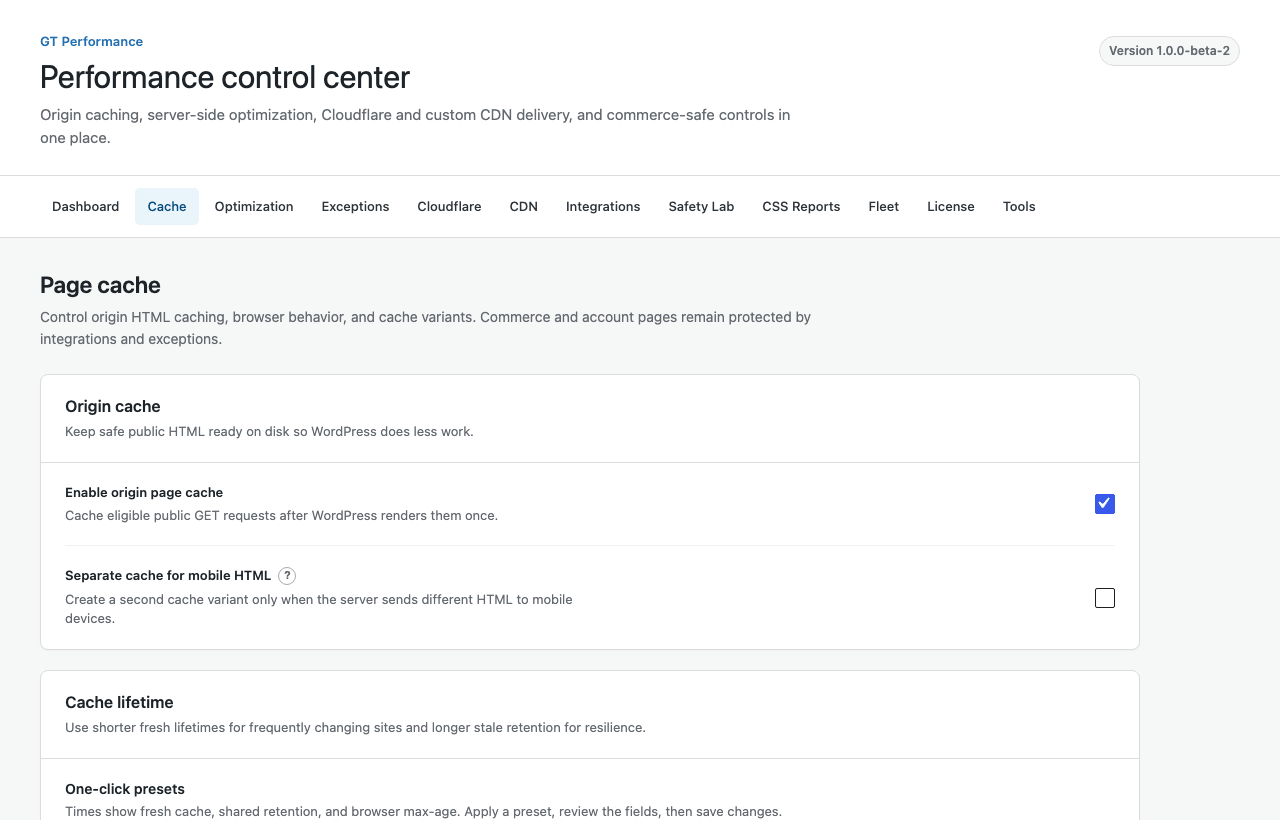
GT Performance page cache settings with cache presets and lifetime controls
Use a preset as a starting point, then tune origin and browser behavior separately.

Server-side unused CSS

Remove unused CSS without sending your site to a queue.

The final anonymous page is analyzed on your WordPress server. If collection, pruning, or delivery fails, the original stylesheets stay in place.
Three delivery modes
Use one cacheable file, inline all used CSS, or inline critical rules and load the remainder as a file.
Training Mode
Browse interactive states as an administrator, review structural selectors, and publish only what you approve.
Staged rollout
Move from 0 to 10, 25, 50, or 100 percent with deterministic URL cohorts and a rollback path.
Live reports
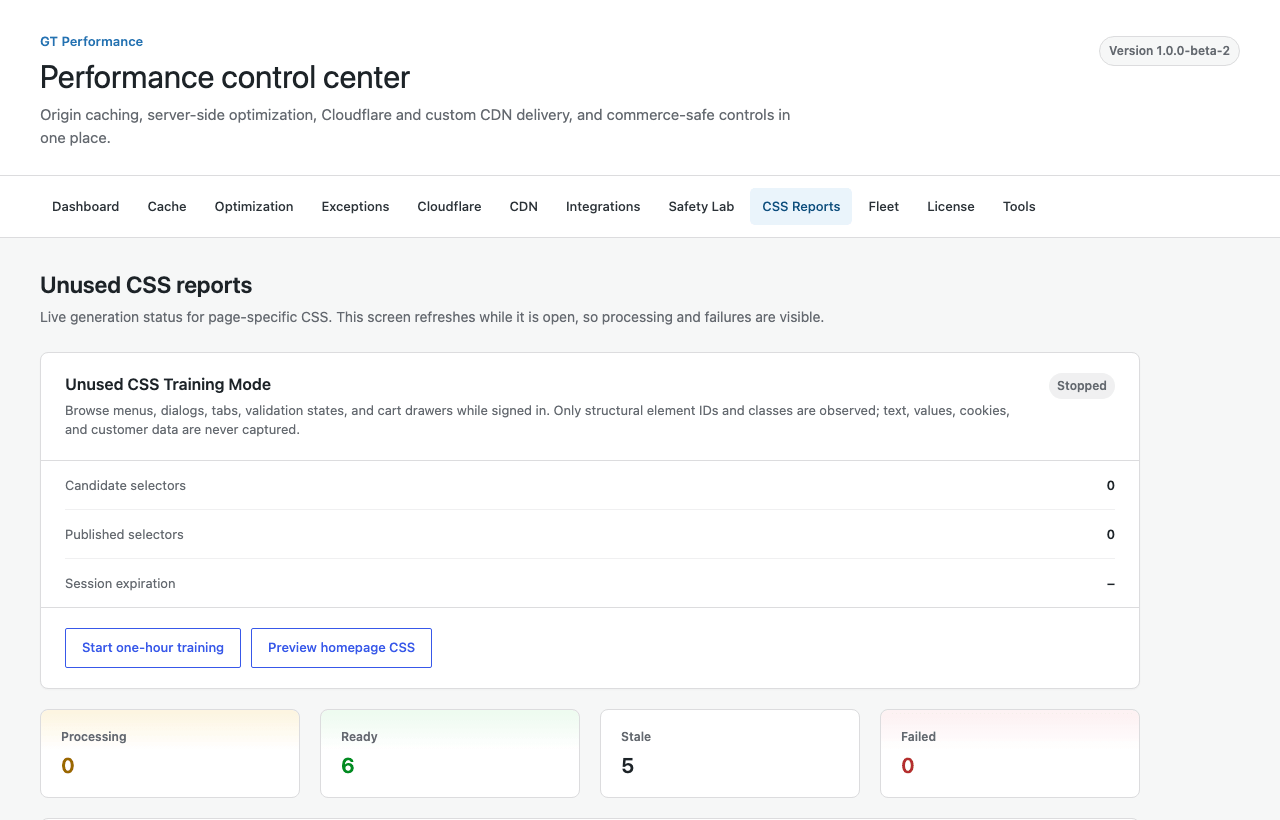
See ready, processing, stale, skipped, and failed pages with output size and delivery method.
GT Performance unused CSS training and generation reports
Training and generated-file status remain visible instead of disappearing into a remote job queue.

Commerce and diagnostics

Treat checkout as state, not just another URL.

FluentCart, Easy Digital Downloads, and WooCommerce contribute their own routes, cookies, parameters, and invalidation rules to the same cache policy.
First-class commerce adapters
Protect carts, checkout, accounts, orders, receipts, licenses, fragments, and customer sessions.
Explain This Page
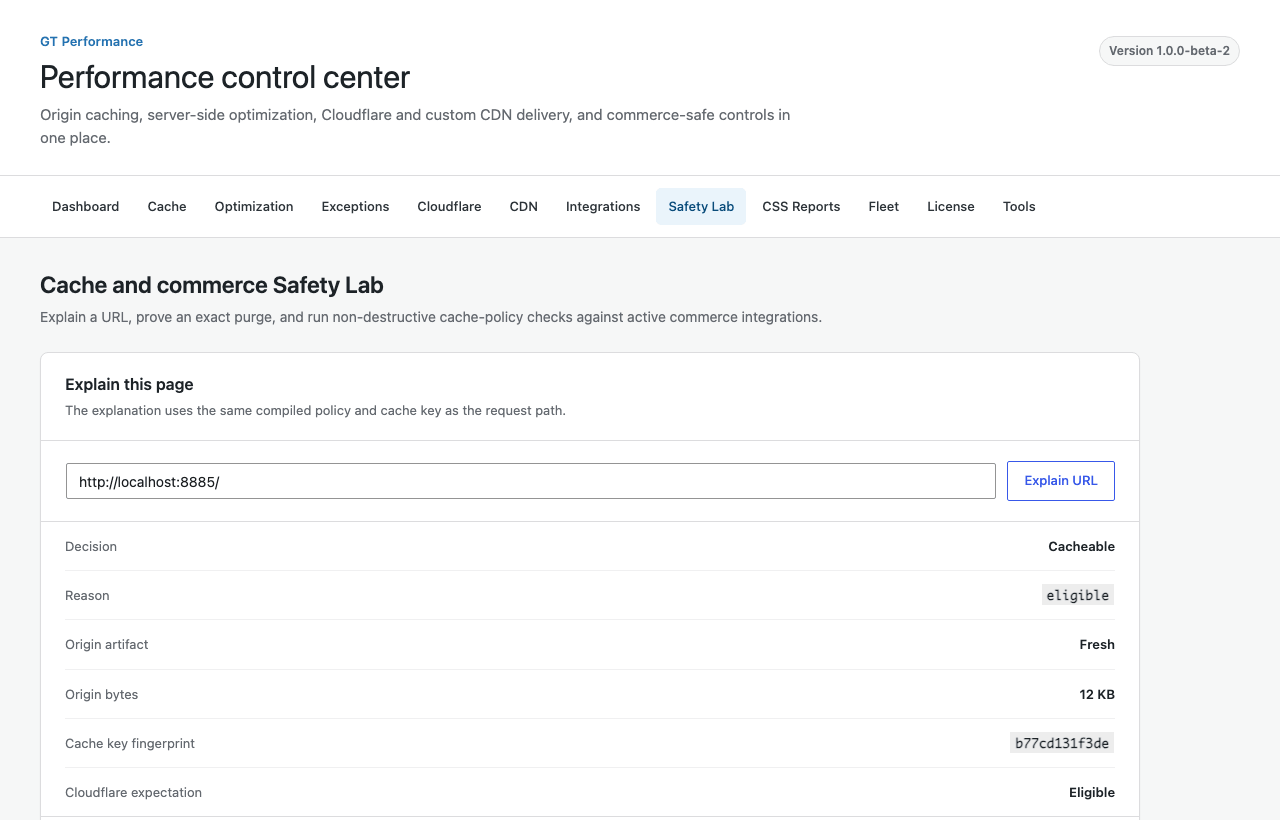
Inspect the real eligibility policy, deterministic cache key, local artifact, and expected Cloudflare result.
Verified Purge
Purge an exact URL and compare bounded response fingerprints and cache headers without storing its body.
Private Islands
Refresh explicitly registered cart and account fragments through signed private, no-store requests.
GT Performance Safety Lab explaining cache eligibility for a WordPress page
Safety Lab explains the decision before you trust the cache.

Cloudflare Free and asset CDN

Use Cloudflare for public HTML and a CDN for selected assets.

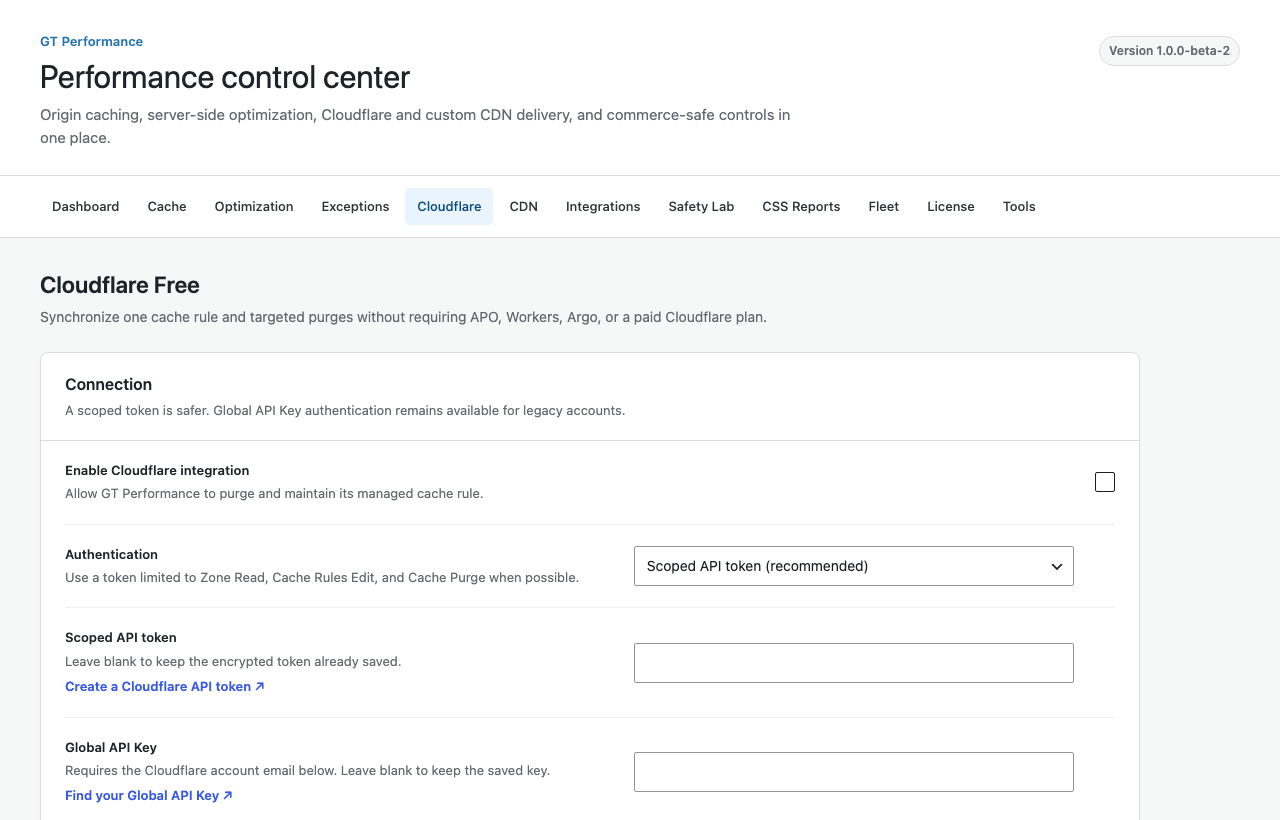
The two delivery jobs stay separate. Cloudflare can cache eligible pages while an origin-pull CDN serves the static file types you choose.
One managed Cloudflare rule
Preview its expression, operation, drift, competing rules, and remaining Free-plan rule budget before syncing.
Scoped credentials
Use a zone-limited API token, store it encrypted, and purge exact paths or the full cache.
Origin-pull CDN rewriting
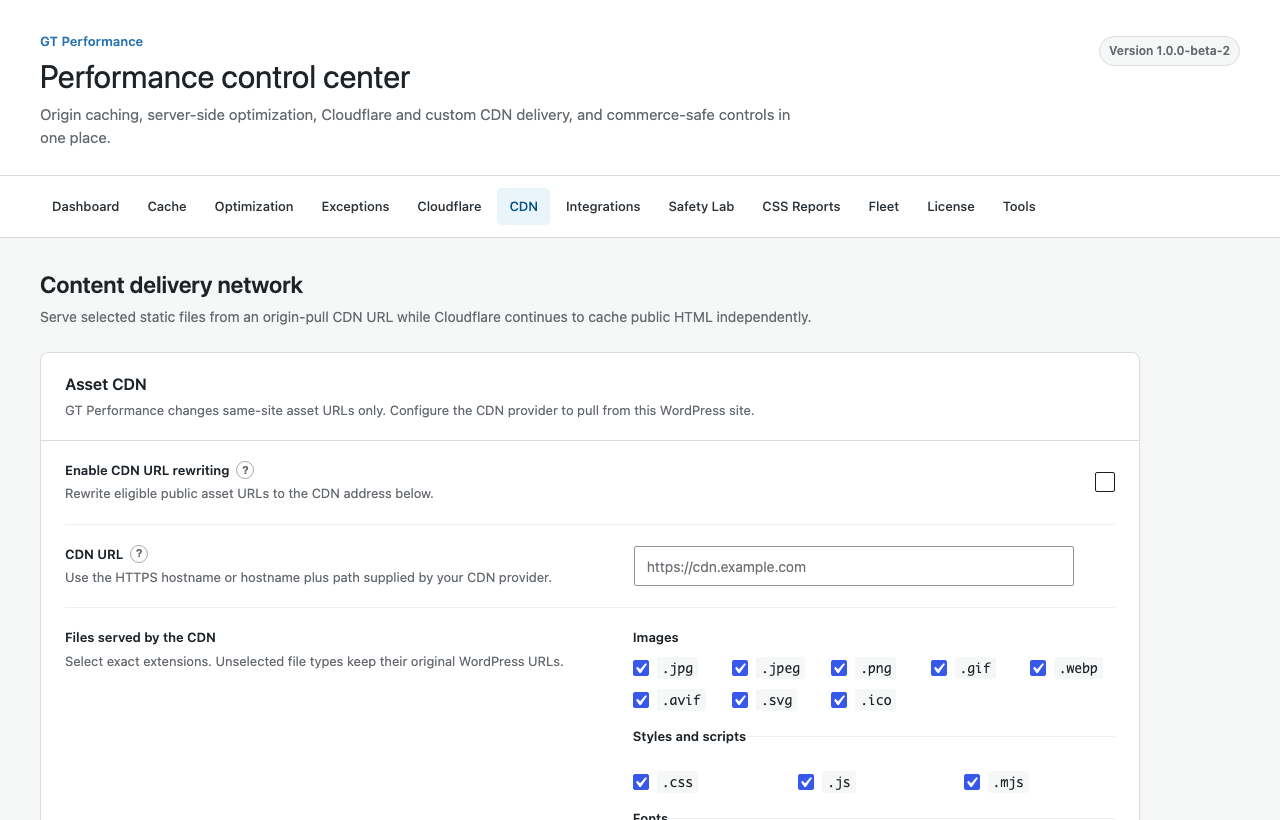
Rewrite only same-site assets with selected extensions to an HTTPS CDN hostname or path.
No bundled CDN promise
GT Performance changes URLs and cache policy. Your CDN provider still pulls and serves the files.
GT Performance Cloudflare Free configuration screen
Cloudflare Free setup.
GT Performance origin-pull CDN configuration screen
Asset CDN controls.

25-site operations

Move reviewed settings without copying secrets around.

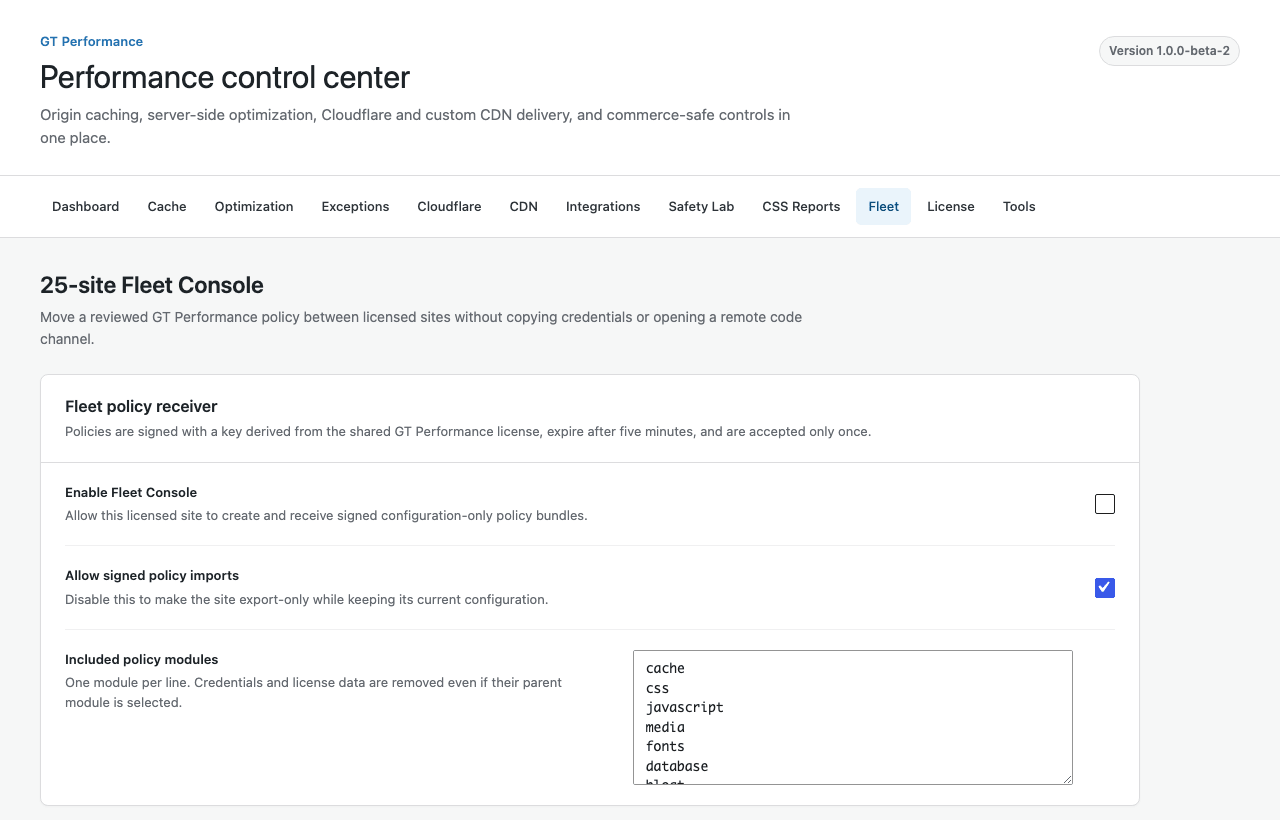
Fleet Console is a configuration handoff, not a remote command channel. That boundary is deliberate.
Short-lived policy bundles
Exports expire after five minutes and can be imported only once.
License-signed transfer
Only sites sharing a valid GT Performance license can exchange a bundle.
Secrets stripped recursively
License, Cloudflare, Redis, and updater credentials never travel with selected modules.
No code execution path
The receiver sanitizes GT Performance settings only. It cannot install plugins, upload files, or evaluate PHP.
GT Performance 25-site Fleet Console settings
A 25-site policy console with explicit receiver and import controls.

Complete feature set

Every module, and the job it does.

Use the layers you need. Aggressive transformations, automation, Redis, Cloudflare, CDN rewriting, Private Islands, and Fleet Console remain opt-in.

Page cache
  • Atomic origin HTML files
  • Fresh, stale, error, and browser lifetimes
  • ETags and conditional responses
  • Mobile variants when HTML differs
  • Preload queue and sitemap warming
  • Exact and related-page invalidation
Cloudflare Free
  • Scoped token or Global API Key
  • Zone discovery and optional Zone ID
  • Managed Cache Rule preview and sync
  • Drift and conflict reporting
  • Edge TTL and exact/full purge
  • Free-plan query-key fallback
Unused CSS
  • Server-side selector analysis
  • File, inline, and critical-plus-file delivery
  • Dynamic-state preservation
  • Safelists and stylesheet exclusions
  • Training, review, publish, and rollback
  • Deterministic staged rollout
JavaScript
  • Local script minification
  • Safe defer controls
  • Interaction or timed delay
  • URL-based exclusions
  • Transactional script protection
  • Ownership conflict controls
Images and embeds
  • Non-critical lazy loading
  • Missing width and height repair
  • Critical image priorities
  • WebP and AVIF generation
  • Generated-variant serving
  • Lightweight YouTube previews
Fonts and CDN
  • Optional local Google Fonts
  • Configurable font-display behavior
  • Origin-pull CDN URL rewriting
  • Per-extension asset selection
  • Same-site URL safeguards
  • CDN-change cache invalidation
Commerce
  • FluentCart safeguards
  • Easy Digital Downloads safeguards
  • WooCommerce safeguards
  • Route, cookie, and query bypasses
  • Product and receipt invalidation
  • Signed Private Islands
Safety Lab
  • Explain This Page
  • Deterministic cache keys
  • Origin artifact inspection
  • Expected edge behavior
  • Verified Purge receipts
  • Read-only commerce policy checks
Redis object cache
  • Guarded drop-in ownership
  • TCP, TLS, and Unix sockets
  • ACL username and password
  • Database and key prefix
  • Connection and read timeouts
  • Standard WP_REDIS constants
WordPress controls
  • Heartbeat, autosave, and revisions
  • Emoji, embeds, XML-RPC, and metadata toggles
  • REST, comments, feeds, and Maps controls
  • Manual database scan and cleanup
  • Scheduled bounded maintenance
  • Safe baseline preset
Compatibility
  • Perfmatters feature ownership
  • Foreign cache drop-in protection
  • Common cache-plugin detection
  • Akismet safeguards
  • Jetpack safeguards
  • Core Forms poll compatibility
Operations and updates
  • 25-site Fleet Console
  • Administrator-bar shortcuts
  • WP-CLI doctor and cache commands
  • Durable jobs, retries, and dead letters
  • Redacted local logs
  • Encrypted licenses and protected updates

A setup you can audit

Start safe. Then go faster.

Do not switch on every transformation at once. Verify one layer, test the private paths, then continue.

Install the owned cache

GT Performance checks the drop-in and refuses to overwrite another owner.

Verify MISS, HIT, and bypass

Prove an anonymous hit while cart, checkout, account, and personalized requests stay dynamic.

Connect the edge

Preview and synchronize the Cloudflare Free rule, then test exact purges.

Add transformations

Enable CSS, JavaScript, media, Redis, CDN, and database controls one layer at a time.

Required
WordPress 6.6 or newer, PHP 8.1 or newer, DOM and JSON, bundled Composer dependencies, and a writable wp-content directory.
Optional
Cloudflare-proxied DNS and a scoped token, PhpRedis for object caching, or an HTTPS origin-pull CDN that can fetch your WordPress assets.

One clear license

Every module. Twenty-five websites.

Pay once for the complete plugin, use one license across your WordPress portfolio, and receive protected updates through the normal WordPress update screen.

GT Performance

$199

One-time purchase. Lifetime license. No recurring renewal payment.

  • 25 WordPress websites
  • Every current GT Performance module
  • Protected updates inside WordPress
  • Cloudflare Free and commerce safeguards
Continue to secure checkout

Questions before you install

GT Performance FAQ

The short answers to the questions that affect fit, safety, and setup.

Does Cloudflare require a paid plan?

No. The baseline uses Cache Rules and targeted purges available on Cloudflare Free. APO, Workers, Cache Reserve, Argo, and Enterprise are not required.

Does unused CSS leave my server?

No. Stylesheet collection, selector analysis, pruning, artifact creation, training data, and reports remain on the WordPress server.

Can GT Performance work with Perfmatters?

Yes. Automatic feature ownership coordinates overlapping front-end optimization. You can also choose GT Performance or Perfmatters as the explicit owner.

What happens if another plugin owns a cache drop-in?

GT Performance reports the conflict and refuses to overwrite a foreign advanced-cache.php or object-cache.php file.

Does the plugin include a CDN service?

No. GT Performance can rewrite selected same-site asset URLs to an HTTPS origin-pull CDN. You still need a CDN provider that can fetch and serve those files.

Can Fleet Console control all 25 sites remotely?

It moves reviewed configuration through short-lived, one-use, license-signed bundles. It does not install plugins, upload files, expose credentials, or execute remote code.

Is the current build production ready?

It is a beta release. Use staging first, keep a backup, test cache decisions, and verify every checkout, account, receipt, and personalized flow before production.

Is the license annual?

No. The $199 purchase is a lifetime license for 25 WordPress websites with protected updates delivered through WordPress.