

A Possible Proof of Collatz Conjecture
A reader sent me something bold: a claimed proof of the Collatz Conjecture. Eswar Chellappa spent nearly ten years working on this. I present his approach, explain the key arguments,…
Delving into the world of mathematics, this section focuses on number theory, offering insights, problems, and discussions for math enthusiasts and scholars.
A reader sent me something bold: a claimed proof of the Collatz Conjecture. Eswar Chellappa spent nearly ten years working on this. I present his approach, explain the key arguments,…
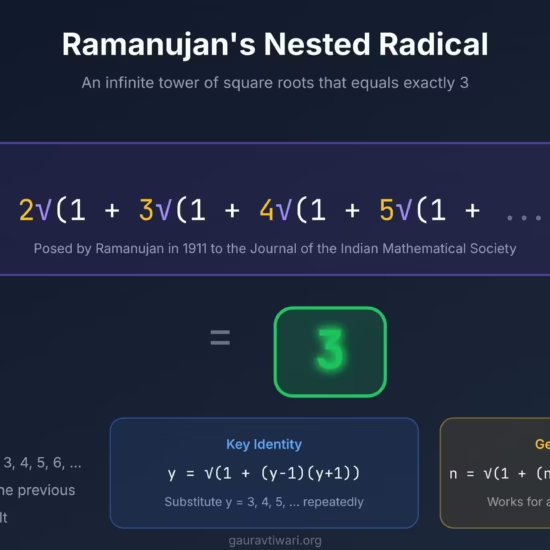
I wrote this analysis in 2010 at age 17, obsessed with Ramanujan's nested radicals while studying under the INSPIRE-SHE scholarship. Fifteen years later, the mathematics still holds up. This complete…
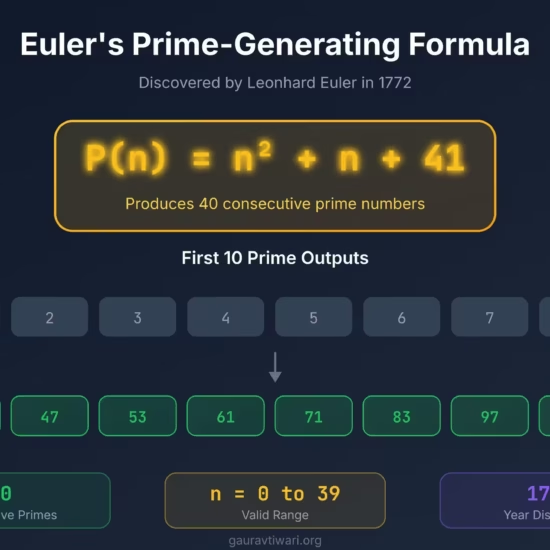
Euler discovered a simple formula that generates 40 consecutive prime numbers: n squared plus n plus 41. Plug in 0 through 39 and every output is prime. I explore why…
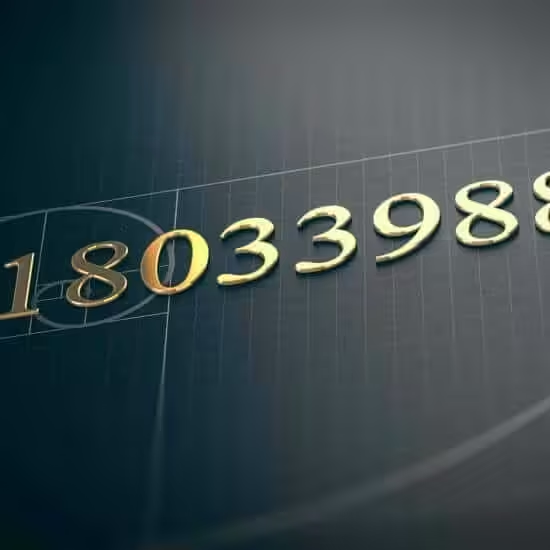
How do you prove a number is irrational? You can't check infinitely many decimal places. You need a proof. I present the classic proofs of irrationality for square root of…

You can figure out what day of the week any date falls on. No calendar needed. Just arithmetic. I'll teach you a genuine mathematical formula that works for any date…

Numbers are the alphabet of mathematics. But here's what most people never learn: all the complex numbers you encounter, from imaginary numbers to quaternions, are built from a few simple…
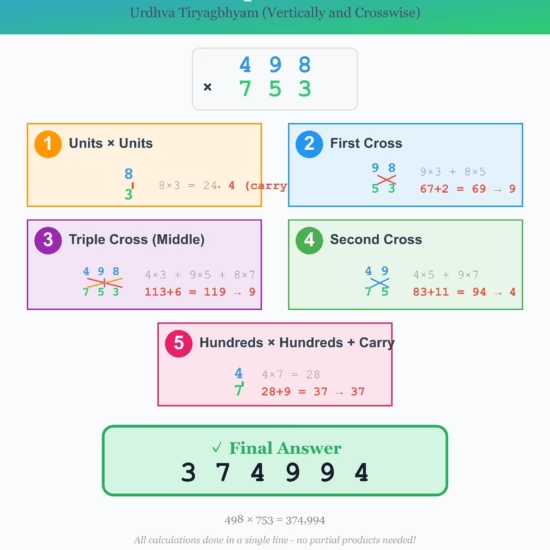
Before college, I multiplied numbers the boring way. Then I discovered Vedic multiplication in a Hindi magazine called 'Bhaskar Bhoomi.' It felt like magic. I'll teach you the crisscross method…
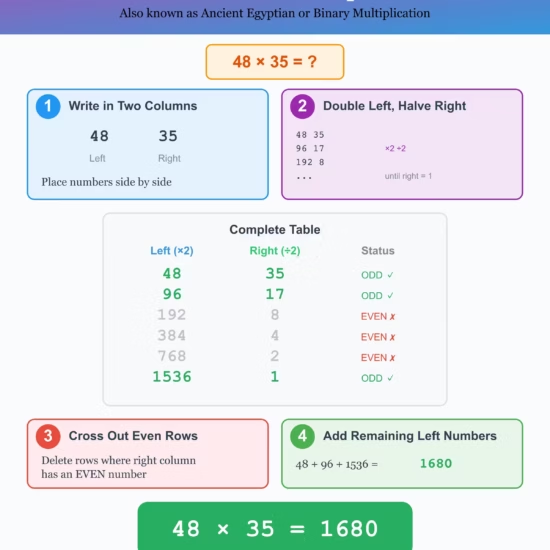
Russian Peasant Multiplication is an ancient technique that multiplies any two numbers using only doubling and halving. No multiplication tables needed. I explain the method step by step, prove why…
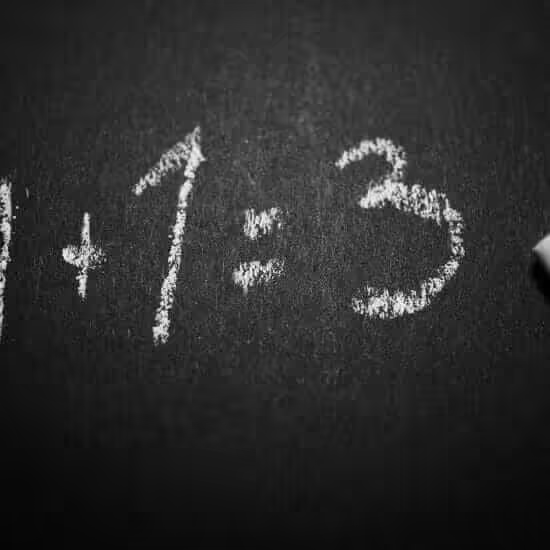
Here's a mathematical fallacy that trips up even sharp students. Can you prove that the derivative of x squared is x instead of 2x? I'll show you the flawed proof,…

Ramanujan's nested radical problem looks impossible at first glance. Infinitely many nested square roots, each multiplied by increasing integers. How do you evaluate that? I walk through the solution step…