
This chapter is a reference. Skim it now, bookmark it, and come back when you need a specific symbol. Every symbol shown here works with amsmath and amssymb loaded.
This LaTeX math symbols reference is the chapter you bookmark rather than read: sets, logic, calculus, algebra, and analysis notation, every symbol shown with its command and rendered output. Skim once now so you know what lives here, then return when you need that one arrow.
Greek Alphabet
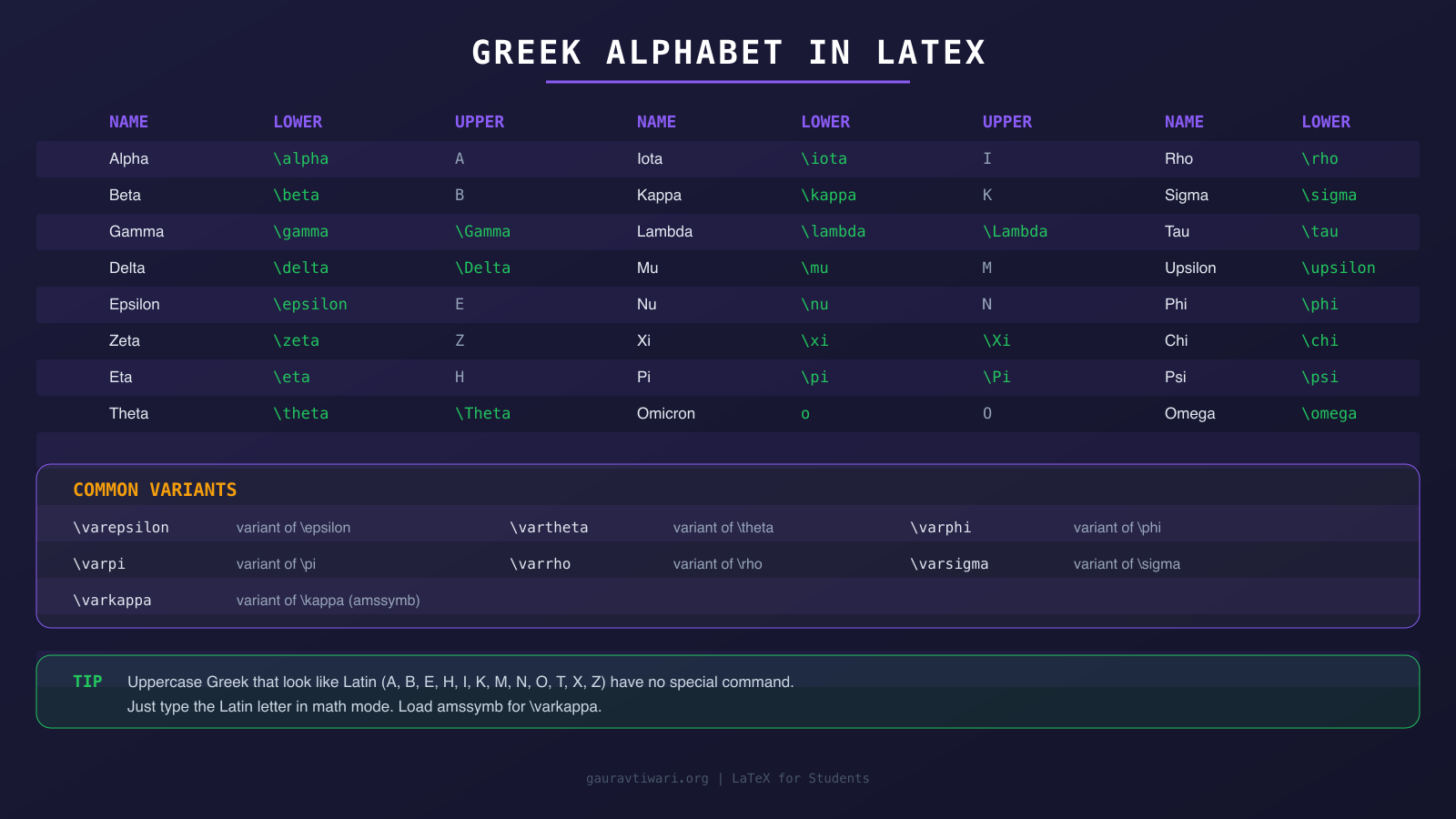
Name: Alpha | Lower:
\alpha| Output: \( \alpha \) | Upper: — | Output: \( A \) | Variant: —Name: Beta | Lower:
\beta| Output: \( \beta \) | Upper: — | Output: \( B \) | Variant: —Name: Gamma | Lower:
\gamma| Output: \( \gamma \) | Upper:\Gamma| Output: \( \Gamma \) | Variant: —Name: Delta | Lower:
\delta| Output: \( \delta \) | Upper:\Delta| Output: \( \Delta \) | Variant: —Name: Epsilon | Lower:
\epsilon| Output: \( \epsilon \) | Upper: — | Output: \( E \) | Variant: \( \varepsilon \)Name: Zeta | Lower:
\zeta| Output: \( \zeta \) | Upper: — | Output: \( Z \) | Variant: —Name: Eta | Lower:
\eta| Output: \( \eta \) | Upper: — | Output: \( H \) | Variant: —Name: Theta | Lower:
\theta| Output: \( \theta \) | Upper:\Theta| Output: \( \Theta \) | Variant: \( \vartheta \)Name: Iota | Lower:
\iota| Output: \( \iota \) | Upper: — | Output: \( I \) | Variant: —Name: Kappa | Lower:
\kappa| Output: \( \kappa \) | Upper: — | Output: \( K \) | Variant: \( \varkappa \)Name: Lambda | Lower:
\lambda| Output: \( \lambda \) | Upper:\Lambda| Output: \( \Lambda \) | Variant: —Name: Mu | Lower:
\mu| Output: \( \mu \) | Upper: — | Output: \( M \) | Variant: —Name: Nu | Lower:
\nu| Output: \( \nu \) | Upper: — | Output: \( N \) | Variant: —Name: Xi | Lower:
\xi| Output: \( \xi \) | Upper:\Xi| Output: \( \Xi \) | Variant: —Name: Omicron | Lower: \( o \) | Output: \( o \) | Upper: — | Output: \( O \) | Variant: —
Name: Pi | Lower:
\pi| Output: \( \pi \) | Upper:\Pi| Output: \( \Pi \) | Variant: \( \varpi \)Name: Rho | Lower:
\rho| Output: \( \rho \) | Upper: — | Output: \( P \) | Variant: \( \varrho \)Name: Sigma | Lower:
\sigma| Output: \( \sigma \) | Upper:\Sigma| Output: \( \Sigma \) | Variant: \( \varsigma \)Name: Tau | Lower:
\tau| Output: \( \tau \) | Upper: — | Output: \( T \) | Variant: —Name: Upsilon | Lower:
\upsilon| Output: \( \upsilon \) | Upper:\Upsilon| Output: \( \Upsilon \) | Variant: —Name: Phi | Lower:
\phi| Output: \( \phi \) | Upper:\Phi| Output: \( \Phi \) | Variant: \( \varphi \)Name: Chi | Lower:
\chi| Output: \( \chi \) | Upper: — | Output: \( X \) | Variant: —Name: Psi | Lower:
\psi| Output: \( \psi \) | Upper:\Psi| Output: \( \Psi \) | Variant: —Name: Omega | Lower:
\omega| Output: \( \omega \) | Upper:\Omega| Output: \( \Omega \) | Variant: —Binary Operators
Command:
+| Symbol: \( + \)Command:
-| Symbol: \( – \)Command:
\pm| Symbol: \( \pm \)Command:
\mp| Symbol: \( \mp \)Command:
\times| Symbol: \( \times \)Command:
\div| Symbol: \( \div \)Command:
\ast| Symbol: \( \ast \)Command:
\star| Symbol: \( \star \)Command:
\circ| Symbol: \( \circ \)Command:
\bullet| Symbol: \( \bullet \)Command:
\cap| Symbol: \( \cap \)Command:
\cup| Symbol: \( \cup \)Command:
\sqcap| Symbol: \( \sqcap \)Command:
\sqcup| Symbol: \( \sqcup \)Command:
\wedge| Symbol: \( \wedge \)Command:
\vee| Symbol: \( \vee \)Command:
\oplus| Symbol: \( \oplus \)Command:
\ominus| Symbol: \( \ominus \)Command:
\otimes| Symbol: \( \otimes \)Command:
\oslash| Symbol: \( \oslash \)Command:
\odot| Symbol: \( \odot \)Command:
\dagger| Symbol: \( \dagger \)Command:
\ddagger| Symbol: \( \ddagger \)Command:
\amalg| Symbol: \( \amalg \)Command:
\setminus| Symbol: \( \setminus \)Command:
\wr| Symbol: \( \wr \)Command:
\diamond| Symbol: \( \diamond \)Command:
\bigcirc| Symbol: \( \bigcirc \)Command:
\triangle| Symbol: \( \triangle \)Relations
Command:
=| Symbol: \( = \)Command:
\neq| Symbol: \( \neq \)Command:
<| Symbol: \( < \)Command:
>| Symbol: \( > \)Command:
\leq| Symbol: \( \leq \)Command:
\geq| Symbol: \( \geq \)Command:
\ll| Symbol: \( \ll \)Command:
\gg| Symbol: \( \gg \)Command:
\equiv| Symbol: \( \equiv \)Command:
\sim| Symbol: \( \sim \)Command:
\simeq| Symbol: \( \simeq \)Command:
\approx| Symbol: \( \approx \)Command:
\cong| Symbol: \( \cong \)Command:
\doteq| Symbol: \( \doteq \)Command:
\propto| Symbol: \( \propto \)Command:
\models| Symbol: \( \models \)Command:
\vdash| Symbol: \( \vdash \)Command:
\dashv| Symbol: \( \dashv \)Command:
\perp| Symbol: \( \perp \)Command:
\parallel| Symbol: \( \parallel \)Command:
\in| Symbol: \( \in \)Command:
\notin| Symbol: \( \notin \)Command:
\ni| Symbol: \( \ni \)Command:
\subset| Symbol: \( \subset \)Command:
\supset| Symbol: \( \supset \)Command:
\subseteq| Symbol: \( \subseteq \)Command:
\supseteq| Symbol: \( \supseteq \)Command:
\nsubseteq| Symbol: \( \nsubseteq \)Command:
\nsupseteq| Symbol: \( \nsupseteq \)Command:
\sqsubset| Symbol: \( \sqsubset \)Command:
\sqsupset| Symbol: \( \sqsupset \)Command:
\sqsubseteq| Symbol: \( \sqsubseteq \)Command:
\sqsupseteq| Symbol: \( \sqsupseteq \)Command:
\prec| Symbol: \( \prec \)Command:
\succ| Symbol: \( \succ \)Command:
\preceq| Symbol: \( \preceq \)Command:
\succeq| Symbol: \( \succeq \)Command:
\mid| Symbol: \( \mid \)Command:
\nmid| Symbol: \( \nmid \)Arrows
Command:
\leftarrow| Symbol: \( \leftarrow \)Command:
\rightarrow| Symbol: \( \rightarrow \)Command:
\leftrightarrow| Symbol: \( \leftrightarrow \)Command:
\Leftarrow| Symbol: \( \Leftarrow \)Command:
\Rightarrow| Symbol: \( \Rightarrow \)Command:
\Leftrightarrow| Symbol: \( \Leftrightarrow \)Command:
\longleftarrow| Symbol: \( \longleftarrow \)Command:
\longrightarrow| Symbol: \( \longrightarrow \)Command:
\Longleftarrow| Symbol: \( \Longleftarrow \)Command:
\Longrightarrow| Symbol: \( \Longrightarrow \)Command:
\iff| Symbol: \( \iff \)Command:
\uparrow| Symbol: \( \uparrow \)Command:
\downarrow| Symbol: \( \downarrow \)Command:
\updownarrow| Symbol: \( \updownarrow \)Command:
\Uparrow| Symbol: \( \Uparrow \)Command:
\Downarrow| Symbol: \( \Downarrow \)Command:
\Updownarrow| Symbol: \( \Updownarrow \)Command:
\mapsto| Symbol: \( \mapsto \)Command:
\longmapsto| Symbol: \( \longmapsto \)Command:
\hookrightarrow| Symbol: \( \hookrightarrow \)Command:
\hookleftarrow| Symbol: \( \hookleftarrow \)Command:
\nearrow| Symbol: \( \nearrow \)Set Notation and Logic
Command:
\mathbb{N}| Symbol: \( \mathbb{N} \) | Meaning: Natural numbersCommand:
\mathbb{Z}| Symbol: \( \mathbb{Z} \) | Meaning: IntegersCommand:
\mathbb{Q}| Symbol: \( \mathbb{Q} \) | Meaning: Rational numbersCommand:
\mathbb{R}| Symbol: \( \mathbb{R} \) | Meaning: Real numbersCommand:
\mathbb{C}| Symbol: \( \mathbb{C} \) | Meaning: Complex numbersCommand:
\emptyset| Symbol: \( \emptyset \) | Meaning: Empty setCommand:
\varnothing| Symbol: \( \varnothing \) | Meaning: Empty set (preferred)Command:
\forall| Symbol: \( \forall \) | Meaning: For allCommand:
\exists| Symbol: \( \exists \) | Meaning: There existsCommand:
\nexists| Symbol: \( \nexists \) | Meaning: There does not existCommand:
\neg| Symbol: \( \neg \) | Meaning: NegationCommand:
\land| Symbol: \( \land \) | Meaning: Logical andCommand:
\lor| Symbol: \( \lor \) | Meaning: Logical orCommand:
\implies| Symbol: \( \implies \) | Meaning: ImpliesCommand:
\impliedby| Symbol: \( \impliedby \) | Meaning: Implied byCommand:
\iff| Symbol: \( \iff \) | Meaning: If and only ifCommand:
\therefore| Symbol: \( \therefore \) | Meaning: ThereforeCommand:
\because| Symbol: \( \because \) | Meaning: BecauseCalculus and Analysis
Expression: Derivative | Output: \( \frac{df}{dx} \) | Code:
\frac{df}{dx}Expression: Partial derivative | Output: \( \frac{\partial f}{\partial x} \) | Code:
\frac{\partial f}{\partial x}Expression: Integral | Output: \( \int_a^b f\,dx \) | Code:
\int_a^b f\,dxExpression: Double integral | Output: \( \iint_D f\,dA \) | Code:
\iint_D f\,dAExpression: Triple integral | Output: \( \iiint_V f\,dV \) | Code:
\iiint_V f\,dVExpression: Contour integral | Output: \( \oint_C f\,dz \) | Code:
\oint_C f\,dzExpression: Nabla/gradient | Output: \( \nabla f \) | Code:
\nabla fExpression: Laplacian | Output: \( \nabla^2 f \) | Code:
\nabla^2 fExpression: Limit | Output: \( \lim_{x\to a} \) | Code:
\lim_{x\to a}Expression: Infinity | Output: \( \infty \) | Code:
\inftyExpression: Sum | Output: \( \sum_{n=0}^{\infty} \) | Code:
\sum_{n=0}^{\infty}Expression: Product | Output: \( \prod_{k=1}^{n} \) | Code:
\prod_{k=1}^{n}Accents and Decorations
Command:
\hat{a}| Output: \( \hat{a} \)Command:
\widehat{abc}| Output: \( \widehat{abc} \)Command:
\check{a}| Output: \( \check{a} \)Command:
\tilde{a}| Output: \( \tilde{a} \)Command:
\widetilde{abc}| Output: \( \widetilde{abc} \)Command:
\acute{a}| Output: \( \acute{a} \)Command:
\grave{a}| Output: \( \grave{a} \)Command:
\breve{a}| Output: \( \breve{a} \)Command:
\bar{a}| Output: \( \bar{a} \)Command:
\overline{abc}| Output: \( \overline{abc} \)Command:
\vec{a}| Output: \( \vec{a} \)Command:
\dot{a}| Output: \( \dot{a} \)Command:
\ddot{a}| Output: \( \ddot{a} \)Command:
\dddot{a}| Output: \( \dddot{a} \)Command:
\mathring{a}| Output: \( \mathring{a} \)Delimiters
Left:
(| Symbol: \( ( \) | | Right:)| Symbol: \( ) \)Left:
[| Symbol: \( [ \) | | Right:]| Symbol: \( ] \)Left:
\{| Symbol: \( \{ \) | | Right:\}| Symbol: \( \} \)Left:
\langle| Symbol: \( \langle \) | | Right:\rangle| Symbol: \( \rangle \)Left:
\ | **Symbol:**| \( \ | **Right:** \) | Symbol: |\ || \( \ | \)Left:
\Vert| Symbol: \( \Vert \) | | Right:\Vert| Symbol: \( \Vert \)Left:
\lfloor| Symbol: \( \lfloor \) | | Right:\rfloor| Symbol: \( \rfloor \)Left:
\lceil| Symbol: \( \lceil \) | | Right:\rceil| Symbol: \( \rceil \)Big Operators
Command:
\sum| Symbol: \( \sum \) | | Command:\prod| Symbol: \( \prod \)Command:
\coprod| Symbol: \( \coprod \) | | Command:\int| Symbol: \( \int \)Command:
\iint| Symbol: \( \iint \) | | Command:\iiint| Symbol: \( \iiint \)Command:
\oint| Symbol: \( \oint \) | | Command:\bigcup| Symbol: \( \bigcup \)Command:
\bigcap| Symbol: \( \bigcap \) | | Command:\bigsqcup| Symbol: \( \bigsqcup \)Command:
\bigvee| Symbol: \( \bigvee \) | | Command:\bigwedge| Symbol: \( \bigwedge \)Command:
\bigoplus| Symbol: \( \bigoplus \) | | Command:\bigotimes| Symbol: \( \bigotimes \)Command:
\bigodot| Symbol: \( \bigodot \) | | Command:\biguplus| Symbol: \( \biguplus \)Math Fonts
Command:
\mathrm{ABC}| Example: \( \mathrm{ABC} \) | Use: Upright RomanCommand:
\mathbf{ABC}| Example: \( \mathbf{ABC} \) | Use: Bold (vectors in some fields)Command:
\mathit{ABC}| Example: \( \mathit{ABC} \) | Use: Italic (default for variables)Command:
\mathsf{ABC}| Example: \( \mathsf{ABC} \) | Use: Sans-serifCommand:
\mathtt{ABC}| Example: \( \mathtt{ABC} \) | Use: Monospace/typewriterCommand:
\mathbb{ABC}| Example: \( \mathbb{ABC} \) | Use: Blackboard bold (number sets)Command:
\mathcal{ABC}| Example: \( \mathcal{ABC} \) | Use: Calligraphic (operators, sheaves)Command:
\mathfrak{ABC}| Example: \( \mathfrak{ABC} \) | Use: Fraktur (Lie algebras)Command:
\mathscr{ABC}| Example: \( \mathscr{ABC} \) | Use: Script (requiresmathrsfs)Command:
\boldsymbol{\alpha}| Example: \( \boldsymbol{\alpha} \) | Use: Bold GreekMiscellaneous Symbols
Command:
\aleph| Symbol: \( \aleph \)Command:
\beth| Symbol: \( \beth \)Command:
\hbar| Symbol: \( \hbar \)Command:
\ell| Symbol: \( \ell \)Command:
\wp| Symbol: \( \wp \)Command:
\Re| Symbol: \( \Re \)Command:
\Im| Symbol: \( \Im \)Command:
\partial| Symbol: \( \partial \)Command:
\infty| Symbol: \( \infty \)Command:
\angle| Symbol: \( \angle \)Command:
\triangle| Symbol: \( \triangle \)Command:
\square| Symbol: \( \square \)Command:
\surd| Symbol: \( \surd \)Command:
\nabla| Symbol: \( \nabla \)Command:
\flat| Symbol: \( \flat \)Command:
\sharp| Symbol: \( \sharp \)Tip: If you can’t find a symbol in these tables, try the Detexify tool (https://detexify.kirelabs.org): draw the symbol with your mouse, and it tells you the LaTeX command. It’s the fastest way to find obscure symbols.
For an even denser exam-time version, the symbol quick reference condenses this chapter to one screen. Symbols misbehaving? Check the top 20 errors first.
Quick answers to common questions:
How do I find a LaTeX symbol I don’t know the name of?
Detexify (detexify.kirelabs.org) lets you draw the symbol and returns the command; it’s the fastest lookup that exists. For browsing by category, this reference and the Comprehensive LaTeX Symbol List cover effectively everything.
Why does my symbol produce an ‘undefined control sequence’ error?
Many symbols live in packages: \mathbb needs amssymb, \text needs amsmath. The error means the command isn’t loaded, not that it doesn’t exist. Loading amsmath plus amssymb in every math document prevents 90 percent of these.