
Blogging Statistics for 2026: 78 Stats on Traffic, Income, and Trends
90.63% of blog posts get zero organic traffic from Google. Not a typo. Nine out of ten posts you publish will never see a single visitor from search. Ahrefs published that number, and after running blogs for 16+ years and publishing over 2,000 articles, I can confirm it tracks with what I’ve seen across 800+ client projects.
But that stat only tells you the floor. The ceiling is food bloggers pulling $9,169 per month and companies with blogs generating 67% more leads than those without. The gap between blogging failure and blogging success has never been wider.
I pulled together 78 stats from Orbit Media Studios, HubSpot, Ahrefs, RankIQ, W3Techs, and GrowthBadger to give you the full picture. Not just the cheerful stuff. The uncomfortable numbers too. Because if you’re going to invest 3 hours and 48 minutes per blog post (the 2026 average), you should know exactly what the odds look like.
Key Blogging Statistics (2026 Overview)
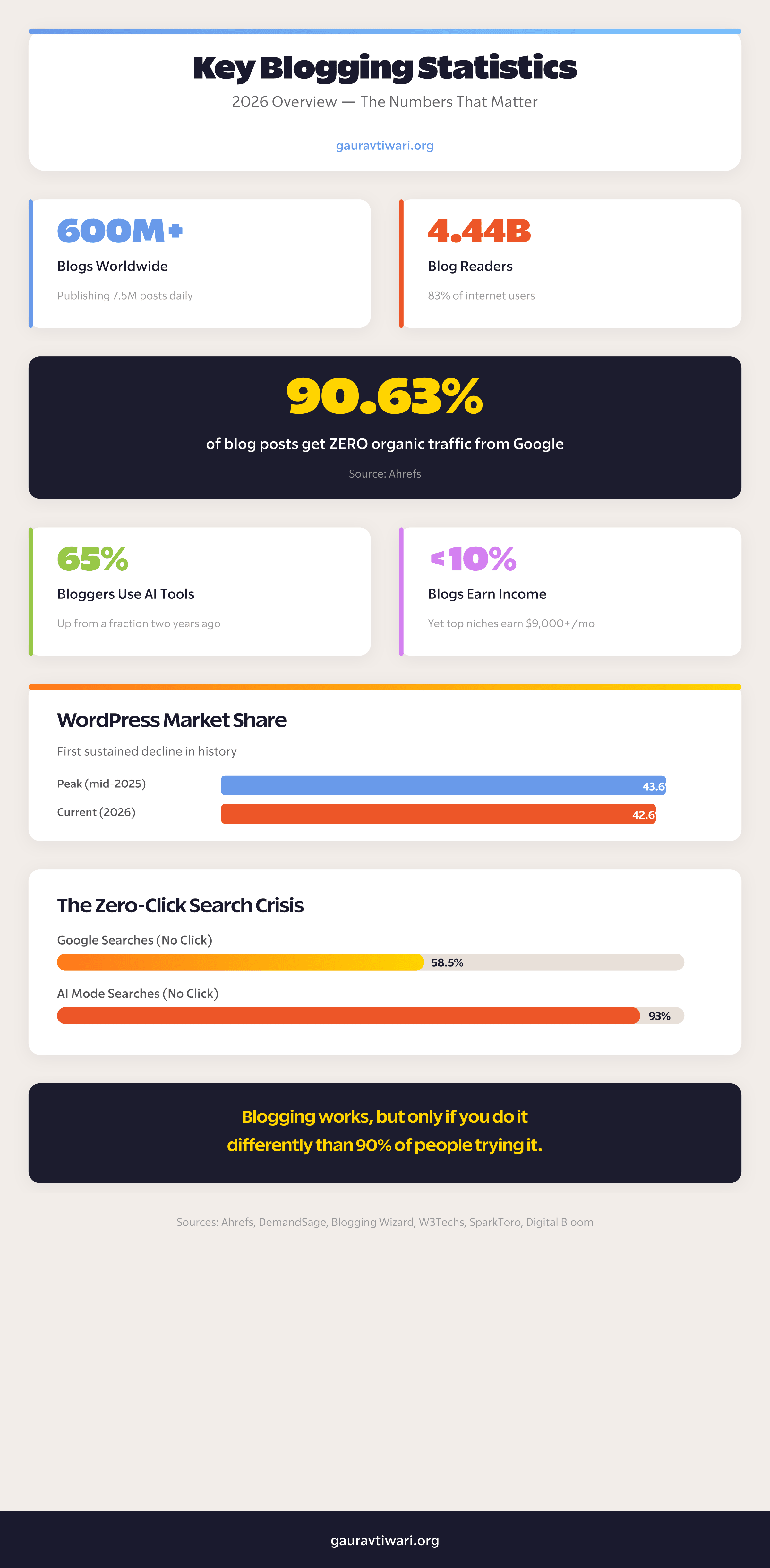
- 600 million+ blogs exist worldwide, publishing 7.5 million posts daily (Blogging Wizard)
- 83% of internet users (4.44 billion people) read blog content (DemandSage)
- 90.63% of pages get zero organic traffic from Google (Ahrefs)
- 65% of bloggers now use AI tools, up from a fraction two years ago (Blogging Wizard)
- Less than 10% of blogs generate any income at all (Blogging Wizard)
- WordPress powers 42.6% of all websites, but just recorded its first sustained market share decline (W3Techs)
- 58.5% of Google searches now end without a click, and 93% of AI Mode searches produce zero clicks (SparkToro, Digital Bloom)
These aren’t contradictory signals. They’re the same signal: blogging works, but only if you do it differently than 90% of people trying it.
How Many Blogs Exist in 2026?
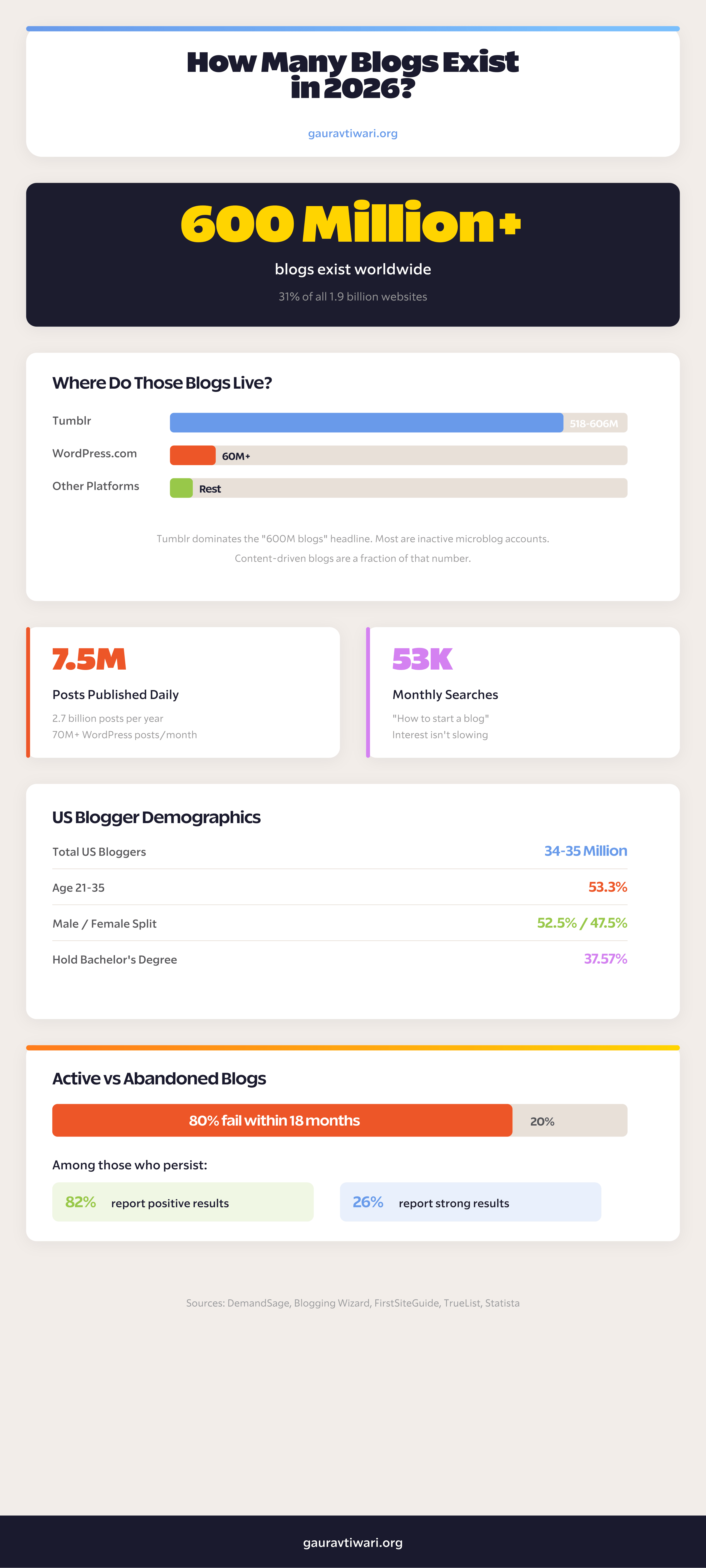
Over 600 million blogs exist on the internet in 2026, spread across roughly 1.9 billion total websites. Most of them are ghost towns.
Total Blog Count Worldwide
600 million+ blogs sit on the internet right now, making up about 31% of all websites (DemandSage). That’s one blog for every 13 people on the planet. Sounds massive… until you realize what “blog” means in that count. Abandoned WordPress installs. Tumblr accounts with three posts from 2014. Medium drafts that never got published.
Tumblr alone accounts for 518 to 606 million blogs (Blogging Wizard). So the “600 million blogs” headline is mostly social microblogging, not the content-driven sites you’re picturing.
New Blogs Created Daily
7.5 million blog posts go live every day. That’s roughly 2.7 billion posts per year (DemandSage). WordPress.com sites alone push out 70 million+ new posts every month and generate 77 million+ comments (WordPress Activity).
And the interest isn’t slowing. “How to start a blog” still pulls 53,000 monthly searches globally (FirstSiteGuide).
In the United States alone, there are 34 to 35 million bloggers (Statista). The majority (53.3%) are between 21 and 35 years old, with a near-even gender split of roughly 52.5% male and 47.5% female (TrueList). About 37.57% hold a bachelor’s degree (TrueList).
Active vs Abandoned Blogs
80% of blogs fail within 18 months (DemandSage). Nobody wants to talk about that number, but it’s real.
Yet among those who stick around, 82% report positive results. Break that down: 56% see some results, and 26% report strong results (Blogging Wizard). The biggest challenge? 49% of bloggers struggle with reader engagement (Blogging Wizard).
I’ve seen this pattern across hundreds of client projects. The blogs that fail aren’t failing because “blogging is dead.” They’re failing because they quit before compounding kicks in. And compounding usually takes 12 to 18 months of consistent publishing.
Blogging Traffic and Readership Statistics
Blog readership is massive at 4.44 billion people worldwide, but attention spans are brutal. The average reader gives your post less than 52 seconds.
How Many People Read Blogs
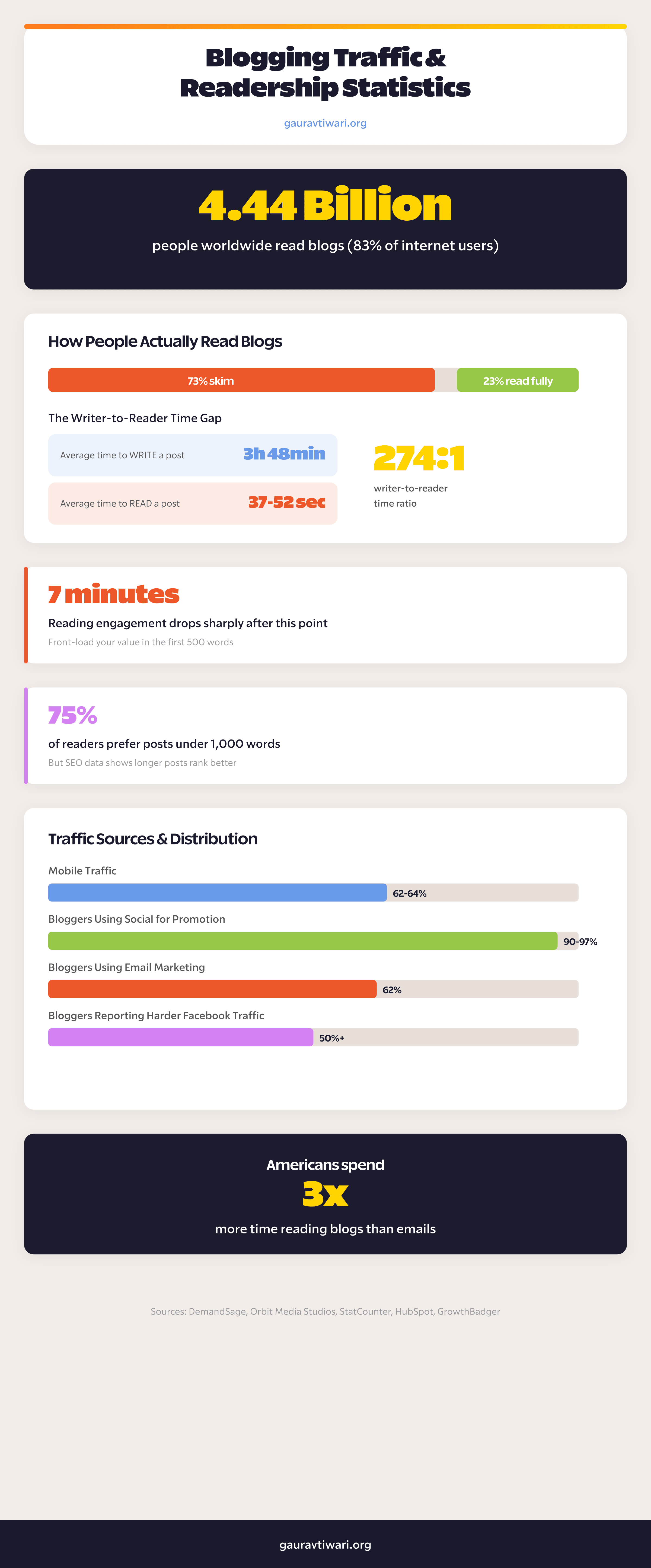
83% of internet users read blogs, which translates to roughly 4.44 billion people (DemandSage). WordPress.com alone sees 409 million unique viewers reading 20 billion+ pages per month (ryrob).
Americans spend 3x more time reading blogs than emails (Social Media Today). That stat surprised me. But when I look at my own analytics across client sites, session durations on blog content consistently outperform landing pages and product pages.
Average Blog Post Traffic
OK, this is where it gets uncomfortable.
73% of readers skim blog posts rather than reading them fully. Only 23% read the whole thing (DemandSage). The average reader spends 37 to 52 seconds on a blog post (DemandSage).
Think about that. The average blog post takes 3 hours and 48 minutes to write (Orbit Media Studios). Your reader gives it less than a minute. That’s a 274:1 writer-to-reader time ratio.
Reading engagement drops sharply after 7 minutes of reading time (DemandSage). This is why I tell every client: front-load your value. Put the best stuff in the first 500 words, not buried in section six.
75% of readers prefer blog posts under 1,000 words (DemandSage). But that conflicts with SEO data showing longer posts rank better. I’ll reconcile that tension in the content section below.
Traffic Sources
Mobile devices account for 62 to 64% of global web traffic (StatCounter). Your blog is almost certainly being read on a phone screen.
But here’s a detail most people miss: desktop users read more thoroughly and spend longer per session. So while mobile dominates volume, desktop drives deeper engagement. If you’re optimizing purely for mobile-first reading, you might be leaving your highest-value readers behind.
90 to 97% of bloggers use social media for promotion (DemandSage). 83% of marketers use social to distribute blog content (HubSpot). 62% of bloggers use email marketing for traffic (DemandSage).
But the platforms are getting stingier. Over 50% of bloggers report that Facebook traffic is harder to get than it used to be (GrowthBadger). That tracks with what I’ve seen. Organic reach on Facebook for blog content is basically dead unless you’re paying to boost.
Blog Content Statistics
The craft of blogging has changed more in the past two years than the previous ten. AI tools, longer posts, and original research are reshaping what works.
Average Blog Post Length
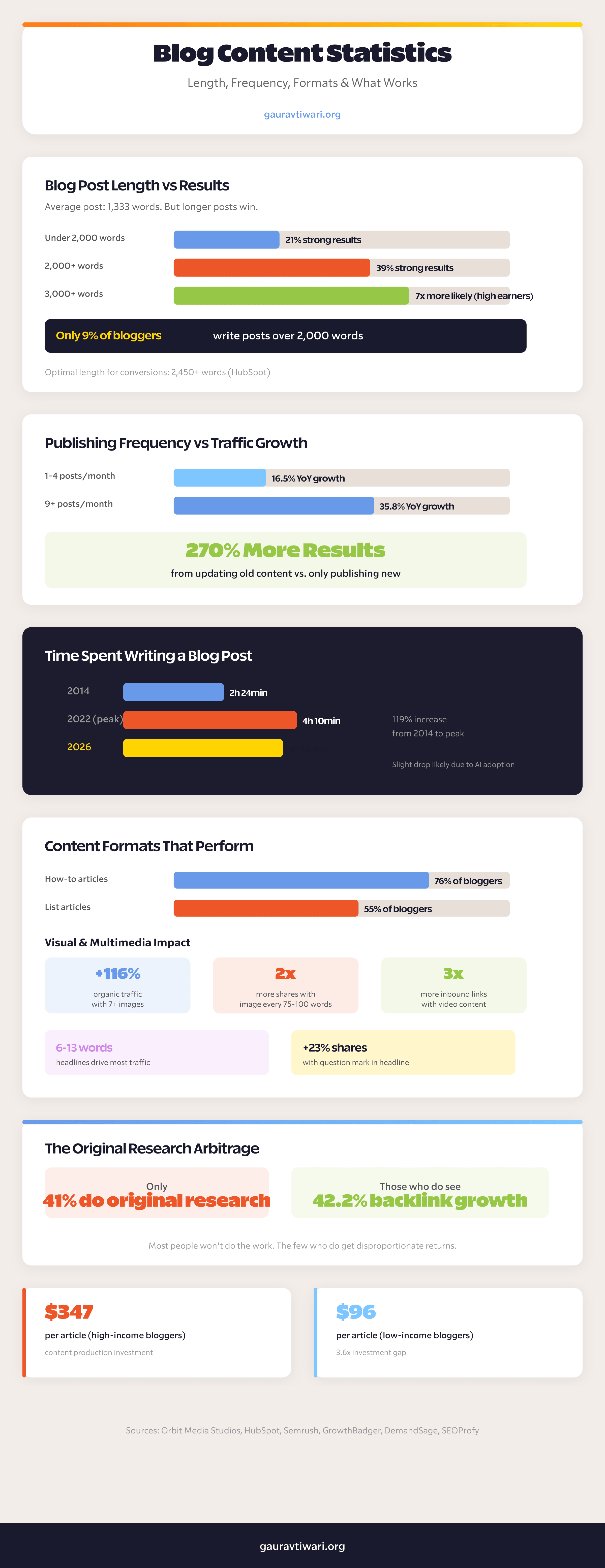
The average blog post is 1,333 words (Orbit Media Studios). But only 9% of bloggers write posts over 2,000 words (Orbit Media Studios).
And that matters. 39% of bloggers who write 2,000+ word posts report strong results, compared to just 21% for shorter posts (Orbit Media Studios). Higher-income bloggers are 7x more likely to write 3,000+ word posts (GrowthBadger).
The optimal post length for conversions? 2,450+ words according to HubSpot (DemandSage). And the average top-ranking blog post runs 1,500 to 2,500 words (Bluehost).
So readers prefer short posts, but search engines and conversions favor long ones. The resolution? Write long, structure scannable. Use headers, bullet points, and tables so the 73% who skim can still find what they need while Google indexes the depth.
How Often Bloggers Publish
39% of bloggers publish weekly or more (Orbit Media Studios). Companies blogging 9+ posts per month see 35.8% year-over-year traffic growth, compared to 16.5% for those publishing 1 to 4 posts (SEOProfy).
The frequency vs. quality debate gets settled by one stat: bloggers who update old content see 270% more results compared to those who don’t (DemandSage). In my experience, updating one existing post often beats publishing three new ones.
40% of marketers use a 50/50 mix of evergreen and timely content (HubSpot). Smart split. Evergreen builds your long-term search traffic base. Timely content captures trending queries.
Time Spent Writing a Blog Post
The average blog post now takes 3 hours and 48 minutes to write (Orbit Media Studios). That peaked at 4 hours and 10 minutes in 2022, a 119% increase from 2014 when the average was 2 hours 24 minutes (Orbit Media Studios).
The slight drop from 2022’s peak is almost certainly AI-related. Bloggers are spending less time on first drafts. Whether the final output is better or worse… different question.
Bloggers spending 6+ hours per post report strong results 35% of the time, vs 29% for those spending 2 to 3 hours (MasterBlogging). The correlation between time invested and results isn’t dramatic, but it’s there.
Only 41% of bloggers conduct original research (DemandSage). Yet websites publishing original research see 42.2% average growth in backlinks (SEOProfy). That’s the biggest arbitrage in blogging right now. Most people won’t do the work, so the few who do get disproportionate returns.
| Content Metric | Value | Source |
|---|---|---|
| Average blog post length | 1,333 words | Orbit Media Studios |
| Bloggers writing 2,000+ words | 9% | Orbit Media Studios |
| Strong results from 2,000+ word posts | 39% | Orbit Media Studios |
| Optimal length for conversions | 2,450+ words | HubSpot |
| Average writing time per post | 3h 48min | Orbit Media Studios |
| Bloggers publishing weekly+ | 39% | Orbit Media Studios |
| Results boost from updating old content | 270% more | Orbit Media / DemandSage |
| Most common format: how-to articles | 76% of bloggers | Orbit Media Studios |
| Bloggers publishing list articles | 55% | Orbit Media Studios |
| Posts with 7+ images get more organic traffic | 116% more | Semrush |
Content Formats That Perform
How-to articles remain the dominant format: 76% of bloggers produce them, and 51% of marketers rate them as the best-performing content format (Blogging Wizard, HubSpot). 55% publish list articles (Blogging Wizard).
Blog posts with 7+ images get 116% more organic traffic than posts with fewer images (Semrush). Posts with images every 75 to 100 words receive 2x more shares (ryrob).
Posts with video get 3x more inbound links vs text-only (DemandSage). Video content accounts for 82% of all internet traffic now (Cisco). If your blog strategy doesn’t include multimedia, you’re competing with one hand tied.
Headlines matter more than most bloggers realize. Headlines with 6 to 13 words drive the most traffic (OptinMonster). Longer headlines of 14 to 17 words get 77% more social shares (DemandSage). And adding a question mark increases shares by 23% (DemandSage).
68% of bloggers use only informal editing (Blogging Wizard). Higher-income bloggers invest $347 per article in content production, compared to $96 for lower-income bloggers (GrowthBadger). The quality gap in blogging is widening. And it shows in the income numbers.
Blogging Income and Monetization Statistics
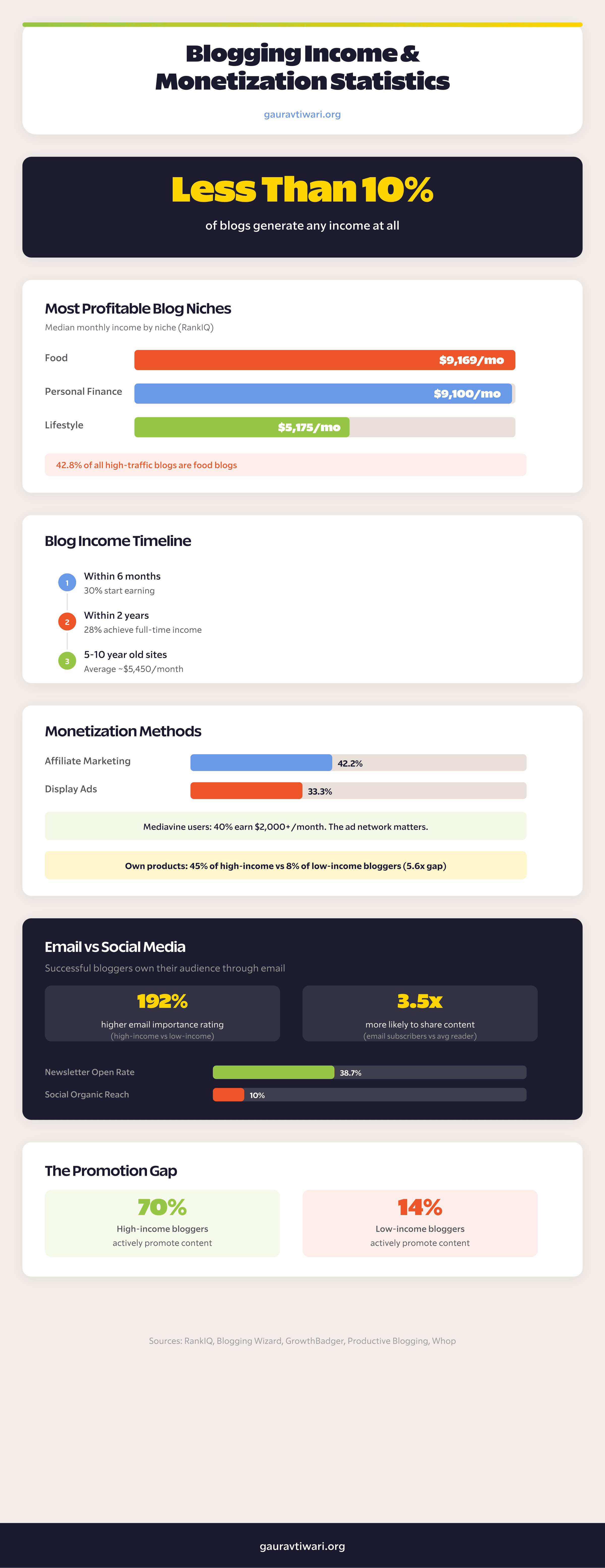
Less than 10% of blogs generate any income. But the bloggers who do earn money, particularly in food ($9,169/month) and personal finance ($9,100/month), are pulling numbers that rival solid salaries.
Average Blogger Income
Less than 10% of blogs generate any income (Blogging Wizard). That’s the baseline. For every food blogger earning five figures a month, there are dozens earning nothing.
30% of bloggers start earning within 6 months. 28% achieve full-time income within 2 years (Productive Blogging). The sweet spot? 5 to 10 year old sites earn roughly $5,450 per month on average (Productive Blogging).
That timeline is worth internalizing. You’re not going to make serious money from a blog in year one. This is a compounding game. The bloggers who earn the most have been at it for half a decade or longer.
Most Profitable Blog Niches
The income gap between niches is enormous.
| Blog Niche | Median Monthly Income | Source |
|---|---|---|
| Food | $9,169 | RankIQ |
| Personal Finance | $9,100 | RankIQ |
| Lifestyle | $5,175 | RankIQ |
Food blogs dominate high-traffic blogs too: 42.8% of all high-traffic blogs are food blogs (Blogging Wizard). Food and personal finance consistently outperform every other niche because they combine high advertiser demand with massive search volume.
If you’re choosing a blog niche, the data is clear: niches with commercial intent and recurring reader needs win.
Monetization Methods
Affiliate marketing is the top monetization method, used by 42.2% of bloggers (Blogging Wizard). Display ads come second at 33.3% (Blogging Wizard).
But the big differentiator between low-income and high-income bloggers isn’t which method they use. It’s whether they sell their own stuff. 45% of higher-income bloggers sell their own products or services, compared to just 8% of lower-income bloggers (GrowthBadger). That’s a 5.6x gap.
Bloggers using Mediavine (a premium ad network) report 40% earning $2,000+ per month (Blogging Wizard). The ad network matters. Google AdSense pays far less than Mediavine or AdThrive for the same traffic levels.
Higher-income bloggers also rate email 192% more important than lower-income bloggers (GrowthBadger). Email subscribers are 3.5x more likely to share blog content (ryrob). Newsletter open rates average 38.7%, crushing social media’s 10% organic reach (Whop).
The pattern is unmistakable: successful bloggers own their audience through email. They don’t rent attention from social media algorithms.
Higher-income bloggers are also 70% more likely to actively promote their content, compared to just 14% of lower-income bloggers (GrowthBadger). Low-income bloggers hit publish and hope. High-income bloggers hit publish and then spend equal time distributing. I’ve seen this in my own work… the articles I actively promote to my email list outperform the ones I leave to organic discovery by 3 to 5x in the first month.
Blog SEO Statistics
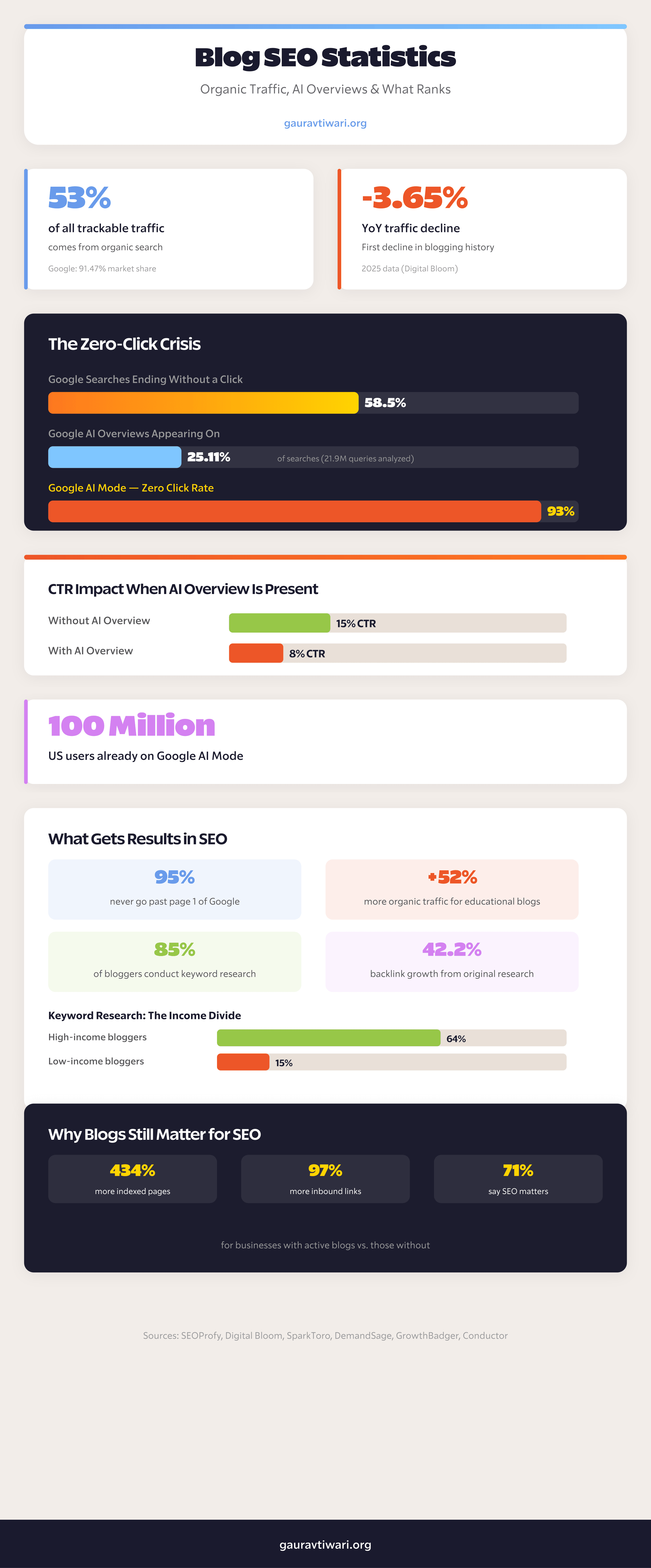
Organic search still delivers 53% of all trackable website traffic, but it declined 3.65% year-over-year in 2025. That’s a first. Google AI Overviews and AI Mode are eating into click-through rates fast.
Organic Traffic
Organic search delivers 53% of all trackable website traffic (SEOProfy). Google holds 91.47% global search engine market share (DemandSage).
But organic traffic declined 3.65% year-over-year in 2025 (Digital Bloom). For the entire history of blogging, organic traffic grew every year. Until now.
The reason? 58.5% of Google searches end without a click (SparkToro). Featured snippets, knowledge panels, and AI Overviews are answering queries right on the search page.
Google AI Overviews now appear on 25.11% of searches based on Conductor’s analysis of 21.9 million queries in Q1 2026 (Digital Bloom). When an AI Overview is present, click-through rates drop from 15% to 8% (Digital Bloom).
And then there’s Google AI Mode, which already has 100 million users in the US (Digital Bloom). In AI Mode, 93% of searches end without any click (Digital Bloom).
Look, I’ll be direct: if your entire blog strategy depends on Google organic traffic, you’re building on increasingly unstable ground. I’ve watched client sites lose 20 to 40% of their informational query traffic since AI Overviews rolled out broadly. Transactional and commercial queries are holding up better, but the “what is” and “how does” content is getting eaten alive by Google’s own AI answers.
You still need SEO. But you also need email, you need content that builds brand, and you need monetization that doesn’t require a pageview for every dollar.
Content Formats That Rank
95% of searchers never go past Google’s first page (ryrob). 71% of bloggers say SEO matters to their strategy (DemandSage). 85% conduct keyword research (DemandSage).
Educational blogs receive 52% more organic traffic than other blog types (Blogging Wizard). That aligns with Google’s push toward E-E-A-T. Content that teaches, explains, and demonstrates genuine experience gets rewarded.
Higher-income bloggers conduct keyword research 64% of the time, compared to just 15% for lower-income bloggers (GrowthBadger). The income gap in blogging isn’t about talent. It’s about process. Keyword research, content strategy, original data. The bloggers who treat it like a business earn like one.
Blogs generate 434% more indexed pages for businesses (DemandSage) and 97% more inbound links (DemandSage). Active blogs with original research see 42.2% average backlink growth (SEOProfy).
Business Blogging Statistics
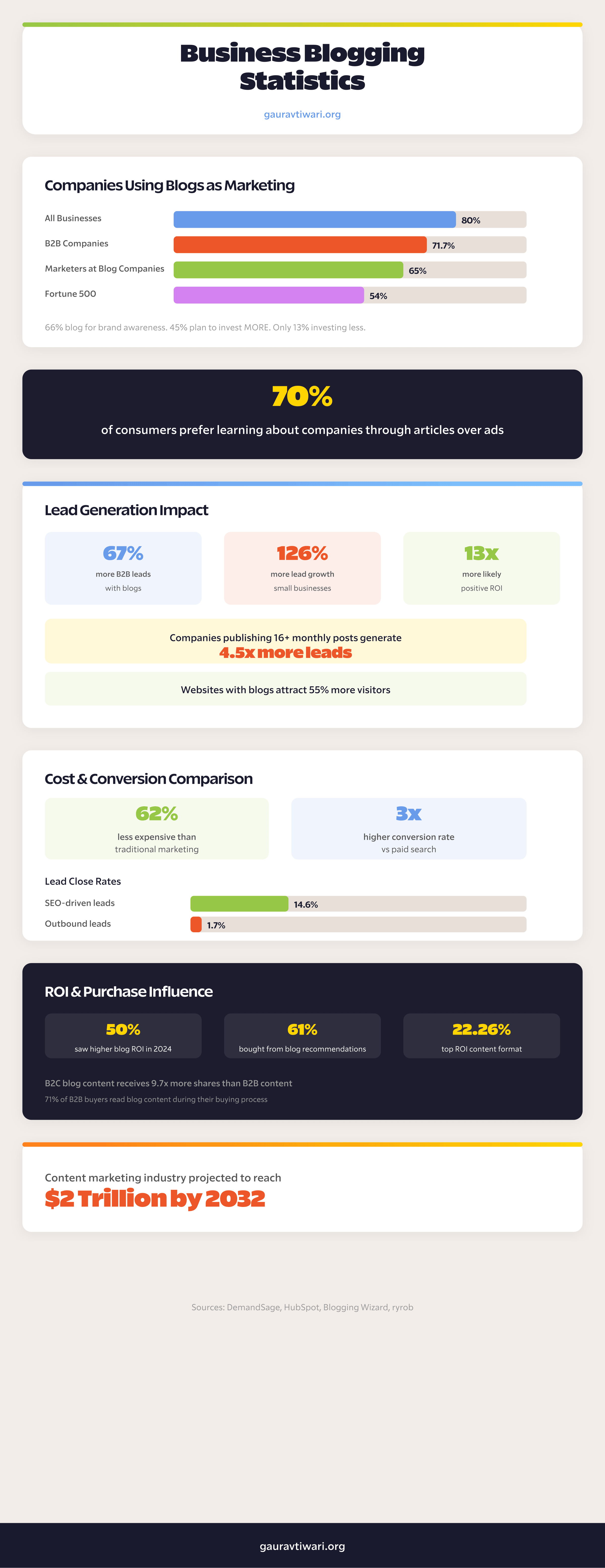
B2B companies with blogs generate 67% more leads than those without. Small businesses see 126% more lead growth. And content marketing costs 62% less than traditional marketing while converting at 3x the rate of paid search.
Companies That Blog
80% of businesses use blogs as a marketing tool (DemandSage). 71.7% of B2B businesses maintain active blogs (Blogging Wizard). Even among Fortune 500 companies, 54% have active blogs (DemandSage). 65% of marketers work at companies with blogs (HubSpot).
The primary goal? 66% of marketers blog for brand awareness (HubSpot). And 45% plan to invest more in blogging going forward, while only 13% are investing less (HubSpot).
70% of consumers prefer learning about companies through articles over ads (DemandSage). 71% of B2B buyers read blog content during their buying process (ryrob). 73% of B2B marketers use case studies as part of their content strategy (DemandSage).
Lead Generation
B2B companies with blogs generate 67% more leads (DemandSage). Small businesses with blogs see 126% more lead growth (DemandSage). Marketers who prioritize blogging are 13x more likely to see positive ROI (DemandSage).
Companies publishing 16+ monthly blog posts generate 4.5x more leads than those publishing 0 to 4 posts (DemandSage). Websites with blogs attract 55% more visitors (DemandSage).
The cost comparison tells the story: content marketing costs 62% less than traditional marketing (ryrob). Blog content has a 3x higher conversion rate than paid search (DemandSage). SEO-driven leads close at 14.6%, compared to just 1.7% for outbound leads (DemandSage).
50% of marketers said their blogging ROI was higher in 2024 compared to 2023 (HubSpot). 22.26% cite blog posts as their top ROI-driving content format (HubSpot).
61% of US consumers have made purchases based on blog recommendations (DemandSage). If you’re running a business blog, those numbers should shape your marketing budget.
B2C blog content receives 9.7x more shares than B2B content (DemandSage). If you’re in B2B, that doesn’t mean your blog isn’t working. It means your success metric should be leads and pipeline, not social shares. B2B blogs that allow comments are in the minority at just 29.4% (Blogging Wizard). Missed opportunity, honestly.
The content marketing industry overall is projected to reach $2 trillion by 2032 (Blogging Wizard). Blogging isn’t shrinking. It’s consolidating around the people who do it well.
AI and Blogging Statistics
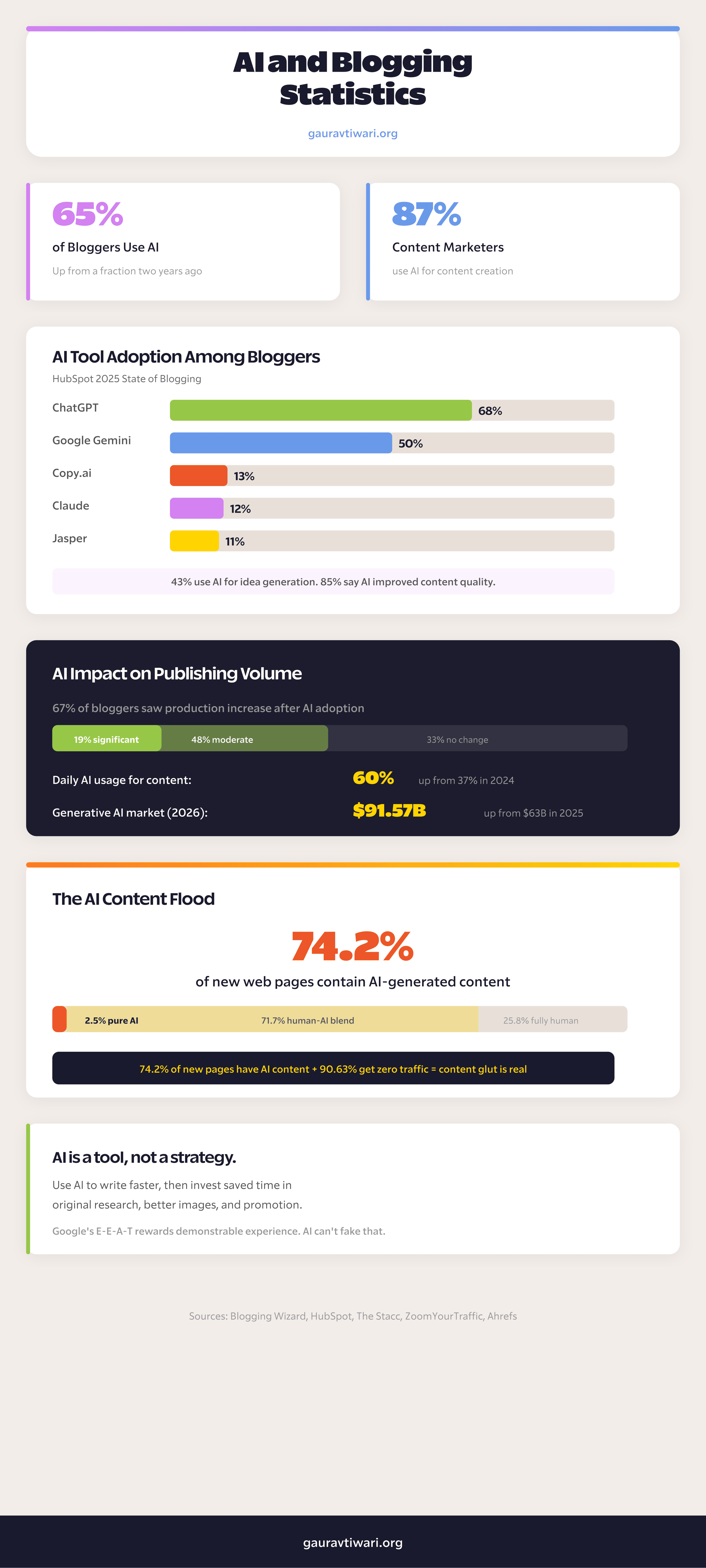
65% of bloggers and 87% of content marketers now use AI tools. ChatGPT leads at 68% adoption, followed by Google Gemini at 50% and Claude at 12%. But 74.2% of new web pages contain AI content, and 90.63% get zero traffic. The content flood is real.
Bloggers Using AI
65% of bloggers now use AI tools (Blogging Wizard). Among content marketers, that jumps to 87% (The Stacc). 60% of marketers use AI daily for content creation, up from 37% in 2024 (ZoomYourTraffic).
The tool breakdown from HubSpot’s 2025 State of Blogging: 68% use ChatGPT, 50% use Google Gemini, 13% use Copy.ai, 12% use Claude, and 11% use Jasper (HubSpot).
43% of bloggers use AI for idea generation (Blogging Wizard). 85% of content marketers say AI has improved their content quality (Blogging Wizard). That last number deserves scrutiny, though. “Improved quality” might mean “writes faster” more than “writes better.”
AI Impact on Publishing
67% of bloggers saw production volume increase after adopting AI. Within that group, 19% saw significant increases and 48% saw moderate increases (HubSpot).
Here’s the number that should concern you: 74.2% of newly created web pages now contain AI-generated content. But before you panic, only 2.5% are pure AI. The rest are human-AI blends (The Stacc).
The generative AI market hit $91.57 billion in 2026, up from $63 billion in 2025 (ZoomYourTraffic).
Now cross-reference two stats: 74.2% of new pages contain AI content, and 90.63% of all pages get zero organic traffic. The content glut is real. AI made it easy to publish. It didn’t make it any easier to rank or build an audience.
My take after 2,000+ published articles: AI is a tool, not a strategy. I use it for research synthesis and first-draft speed. But the voice, the experience, the specific numbers from real projects… that’s what separates content that ranks from content that disappears. Google’s E-E-A-T framework rewards demonstrable experience. AI can’t fake that.
The bloggers using AI to write faster and then investing the saved time into original research, better images, and promotion? They’re pulling ahead. The ones using AI to publish more generic content faster are flooding the zero-traffic pool. The tool is neutral. Your strategy determines the outcome.
Blogging Platform Statistics
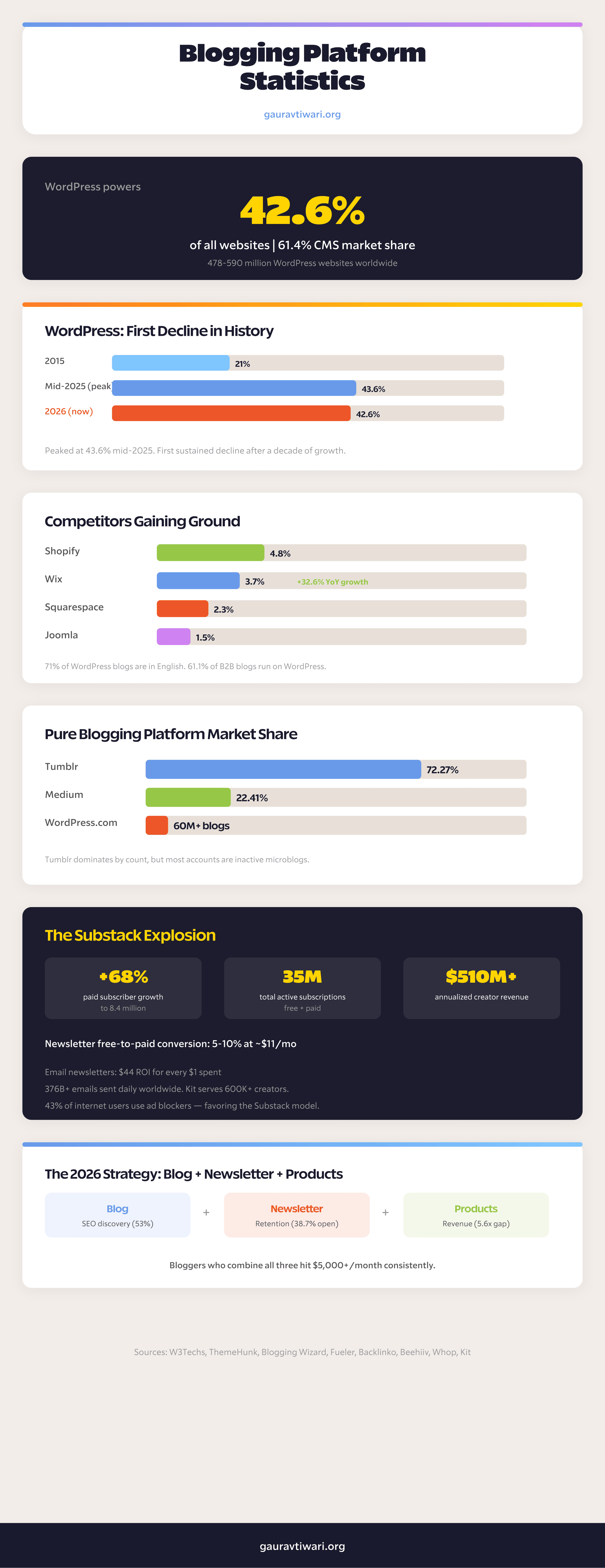
WordPress powers 42.6% of all websites but just recorded its first sustained market share decline, dropping from a peak of 43.6% in mid-2025. Wix is growing at 32.6% year-over-year, and Substack’s paid subscribers grew 68% to 8.4 million.
WordPress vs Other Platforms
WordPress powers 42.6% of all websites and holds 61.4% CMS market share (W3Techs, ThemeHunk). That’s between 478 and 590 million total WordPress websites (DemandSage).
But WordPress peaked at 43.6% in mid-2025 and has since dropped to 42.6% (W3Techs). That’s the first sustained market share decline in WordPress history. Over the past decade, WordPress grew from 21% to its peak. Now the trajectory has reversed.
The competitors gaining ground:
- Shopify: 4.8% (ThemeHunk)
- Wix: 3.7%, growing at 32.6% year-over-year (ThemeHunk)
- Squarespace: 2.3% (ThemeHunk)
- Joomla: 1.5% (ThemeHunk)
As a WordPress Core Contributor, I don’t think this means WordPress is dying. The plugin library is unmatched, and self-hosted WordPress gives you control that no hosted platform can. But the complexity gap between WordPress and platforms like Wix or Squarespace is real. For someone who just wants to write without managing hosting, updates, and plugins, the simpler platforms are winning. WordPress’s flexibility has become its weakness for casual bloggers who don’t need that power.
71% of WordPress blogs are published in English (DemandSage). WordPress supports 120+ languages (DemandSage), giving it an unmatched international footprint. 61.1% of B2B blogs run on WordPress (Blogging Wizard).
Self-Hosted vs Hosted
In the pure blogging space (not websites overall), the numbers look different:
- Tumblr: 72.27% of blogging market share (Blogging Wizard)
- Medium: 22.41% (Blogging Wizard)
- WordPress.com (hosted): 60 million+ blogs (Blogging Wizard)
The real story in 2026 is Substack. Substack’s paid subscribers grew 68% to 8.4 million (Fueler). Total active subscriptions (free and paid) hit 35 million (Backlinko). Creator revenue reached $510 million+ annualized (Fueler).
Substack represents a fundamentally different model from traditional blogging on WordPress. It’s not about SEO traffic. It’s about direct reader relationships and paid subscriptions. Newsletter free-to-paid conversion rates average 5 to 10% at roughly $11 per month (Beehiiv).
The email ecosystem backing all of this: 376 billion+ emails sent and received daily worldwide (Whop). Kit (formerly ConvertKit) serves 600,000+ creators sending 2.5 billion emails per month (Kit). Email newsletters deliver $44 ROI for every $1 spent (Whop).
43% of internet users use ad blockers (DemandSage). Another reason the Substack model is gaining traction. Paid newsletters bypass ad-dependent revenue entirely.
The smart play in 2026 isn’t choosing between a blog and a newsletter. It’s running both. Use your blog for SEO-driven discovery (53% of trackable traffic still comes from organic search). Use your newsletter to convert visitors into subscribers you own. Then monetize the relationship directly instead of depending on ad RPMs that shift with every Google algorithm update.
I’ve been building this exact system across client projects: WordPress blog for search visibility, email list for retention, product offers for revenue. The bloggers who combine all three are the ones hitting $5,000+ per month consistently.
Frequently Asked Questions
Look, the data tells two clear stories.
First: blogging works. 67% more leads for businesses. $9,000+ monthly income for top niches. 4.44 billion readers. The demand for blog content hasn’t declined.
Second: the game has changed. 90.63% of posts get zero search traffic. 93% of AI Mode searches end clickless. 74.2% of new pages contain AI content. The bar for what “works” keeps rising.
The bloggers who’ll thrive in 2026 and beyond share three traits I see consistently across my client work: they publish original research (only 41% bother), they own their audience through email (higher-income bloggers rate it 192% more important), and they sell their own products (5.6x income gap). They don’t just write content. They build systems.
If you’re starting a blog today, the odds are actually better than they look. Because 80% of your competition will quit within 18 months. The 20% who stay? They’re the ones reading articles like this and adjusting their strategy based on real numbers.
Blogging in 2026 isn’t dead. It’s just done being easy.
Disclaimer: This site is reader-supported. If you buy through some links, I may earn a small commission at no extra cost to you. I only recommend tools I trust and would use myself. Your support helps keep gauravtiwari.org free and focused on real-world advice. Thanks. - Gaurav Tiwari