
Why Field Service Businesses Are Moving Beyond Spreadsheets to Smarter Systems
Spreadsheets ran my first business. Invoicing, client tracking, scheduling — all Google Sheets. It worked fine with 8-10 active clients. Then I hit 25, and the whole system fell apart in about six weeks.
That’s the pattern I see with every service business that outgrows spreadsheets. Repair contractors, HVAC companies, handyman operations, plumbers. They all hit the same wall. And the fix isn’t just “better software.” It’s rethinking how work gets organized from the ground up.
Spreadsheets Break at 20-30 Active Jobs
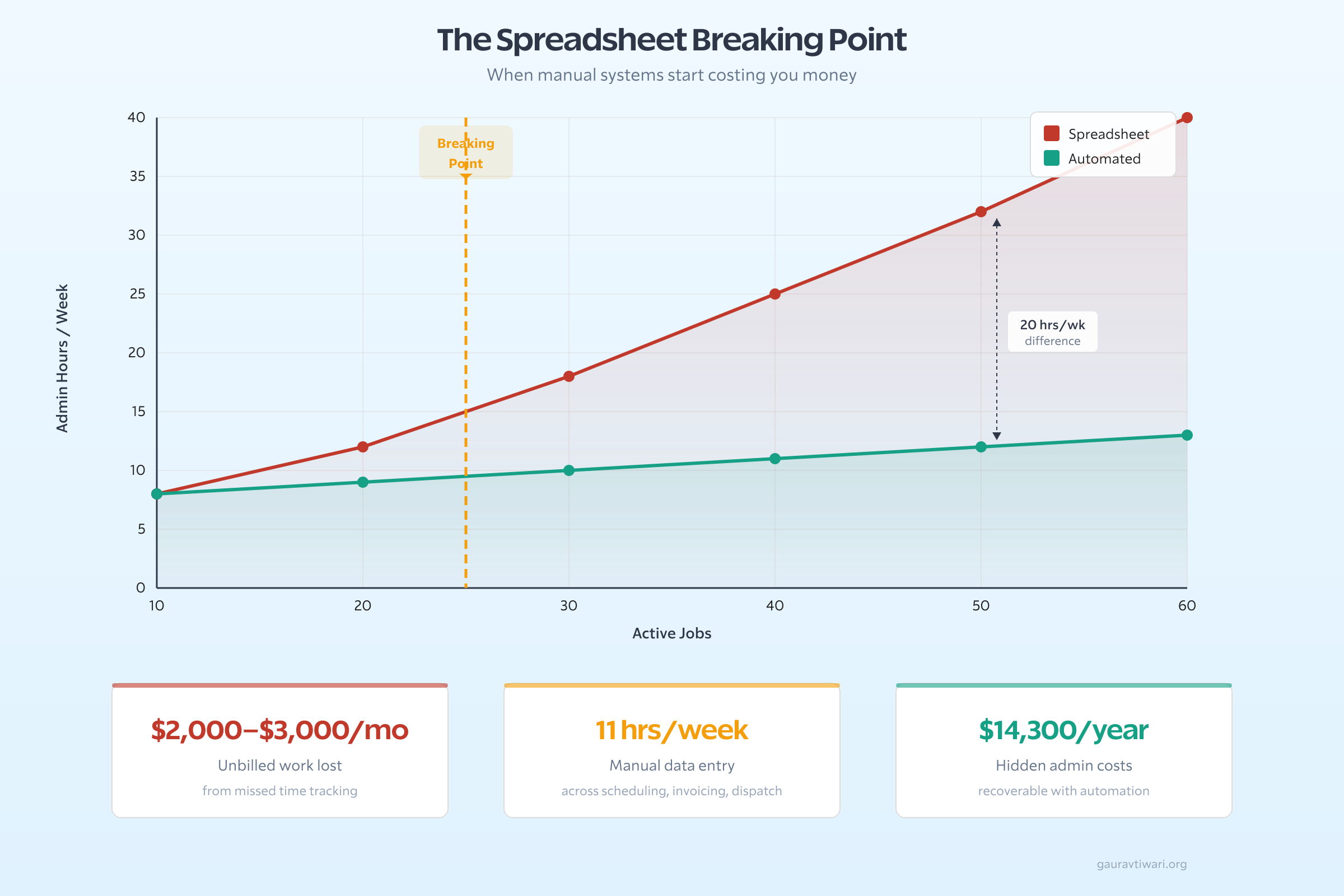
The breaking point is predictable. Around 20-30 concurrent jobs, spreadsheets stop being useful and start being dangerous.
Here’s what actually happens. You’ve got one sheet for scheduling, another for invoices, a third for customer contacts. Maybe a fourth for inventory. None of them talk to each other. Updates depend on someone remembering to type things in manually — and that stops happening the moment things get busy.
I’ve seen contractors lose $2,000-$3,000 in unbilled work per month because jobs got completed but never invoiced. The data existed… somewhere. Just not where the billing person could find it.
This is where dedicated handyman software changes things. Not because it’s fancier than a spreadsheet. Because it connects scheduling, communication, and invoicing into one system. The job gets marked complete, the invoice generates automatically, and the customer gets notified. Nobody has to remember anything.
The “Free” Tool That Costs You Thousands
Spreadsheets feel free. They’re not.
Every manual entry takes time. Every missed update creates a cascading problem. Every duplicate file — and there will be duplicate files — adds confusion that takes even more time to sort out.
I tracked this once for a client running a 12-person plumbing company on Google Sheets. Their office manager spent roughly 11 hours per week just moving data between spreadsheets, cross-referencing, and fixing errors. At $25/hour, that’s $14,300 per year on busywork that software handles automatically.
And the sneaky part? These costs don’t hit you all at once. It’s a missed invoice here, a double-booked technician there, a customer who got the wrong appointment time. Each one is small. Together, they’re bleeding the business.
Static Data Can’t Run a Moving Business
Spreadsheets are snapshots. You open them, they show you what someone typed last. That’s it.
But field service operations don’t sit still. Appointments shift. Jobs run long. Emergency calls come in. A technician calls in sick at 7 AM and the whole day’s schedule needs rebuilding.
Try doing that in a spreadsheet. You’ll spend 45 minutes reshuffling rows while customers wait for confirmation calls. I’ve watched it happen.
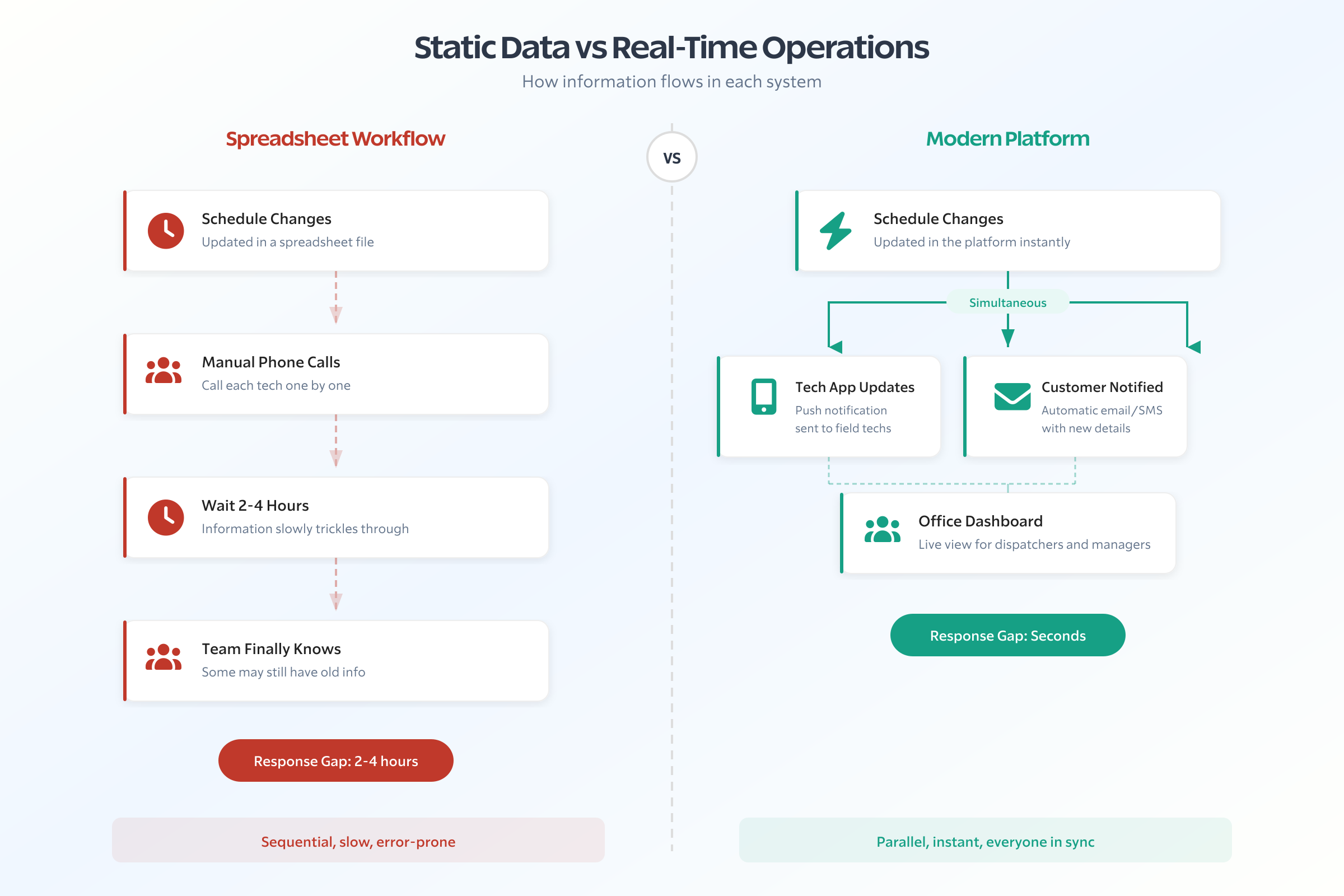
Real-time platforms — ServiceTitan, Jobber, Housecall Pro, MrTask — work differently. When a schedule changes, everyone sees it instantly. The technician’s phone updates. The customer gets a notification. The office doesn’t have to call anyone. That gap between “something changed” and “everyone knows” shrinks from hours to seconds.
Automation Isn’t Optional After 50 Clients
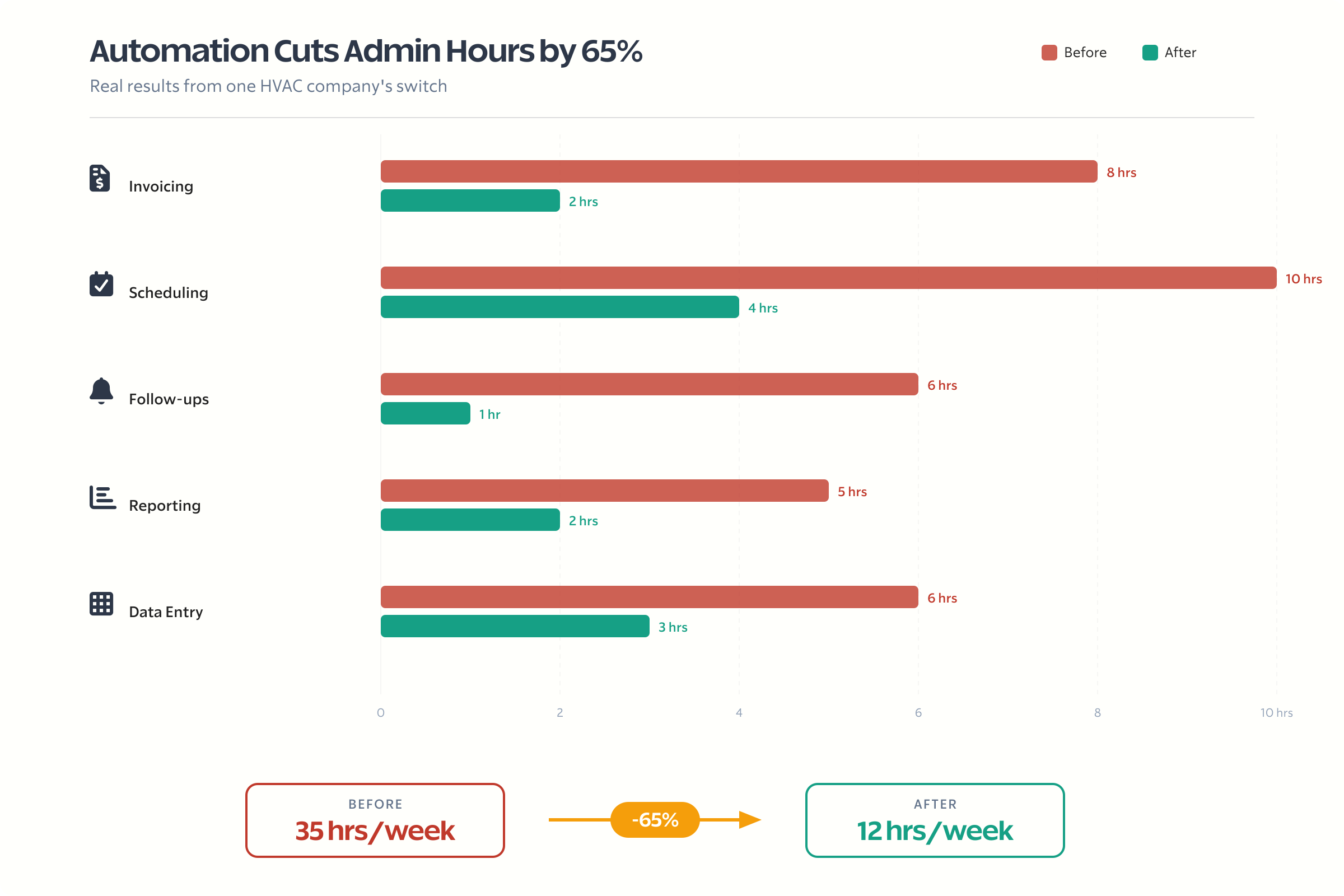
Here’s where it gets real. Invoicing, scheduling confirmations, follow-up reminders, payment processing, report generation. These tasks multiply directly with your client count.
In a spreadsheet workflow, more jobs means more manual work. It’s linear. Ten new clients means ten more entries to manage by hand, every single week.
Automation breaks that pattern. Invoices generate when jobs close. Reminders go out 24 hours before appointments. Follow-ups trigger three days after service. Reports compile overnight. None of it requires a person to remember, click, or type anything.
One HVAC company I worked with cut their administrative hours from 35/week to 12/week after switching from spreadsheets to a dedicated platform. Same number of jobs. Same team. They just stopped doing work the software could handle.
Scattered Data Kills the Customer Experience
This is the one most small business owners don’t see coming.
When your customer data lives in five different spreadsheets, communication gets sloppy. A client calls in, mentions they had a problem with last month’s repair, and your front desk has no idea what they’re talking about because that info is in a different file on a different computer.
For recurring service businesses — HVAC maintenance, property management, pest control — this is a dealbreaker. Customers expect you to know their history. Their equipment specs. What you did last time. What’s coming up next.
Tools like HVAC service platforms such as https://mrtask.com/industries/hvac solve this by creating unified customer profiles. Service history, equipment details, past communications, upcoming maintenance — all in one place. When the phone rings, you pull up the customer and you know everything before they finish explaining.
That’s not a nice-to-have. That’s the difference between a one-time job and a lifetime customer.
The “One Person Knows Everything” Problem
I see this constantly. The owner or a senior employee IS the system. They know where the files are, how the naming convention works, what the formulas mean, and which sheet has the latest version.
Then that person takes a vacation. Or gets sick. Or quits.
Suddenly nobody can find anything. The business grinds to a halt because its entire operational knowledge lives in one person’s head and a tangle of Google Sheets that only make sense if you built them.
Digital systems standardize this. Processes are documented by the software’s structure itself. New hires don’t need someone to explain where things are — the system shows them. Onboarding drops from weeks to days.
Integration Is Where the Real Gains Are
Modern service businesses don’t run on one tool. They use Stripe or Square for payments, QuickBooks or Xero for accounting, Mailchimp or SMS platforms for marketing, Google Calendar for scheduling.
Spreadsheets can’t connect to any of that. Data moves between systems by copy-paste. Manual. Error-prone. Slow.
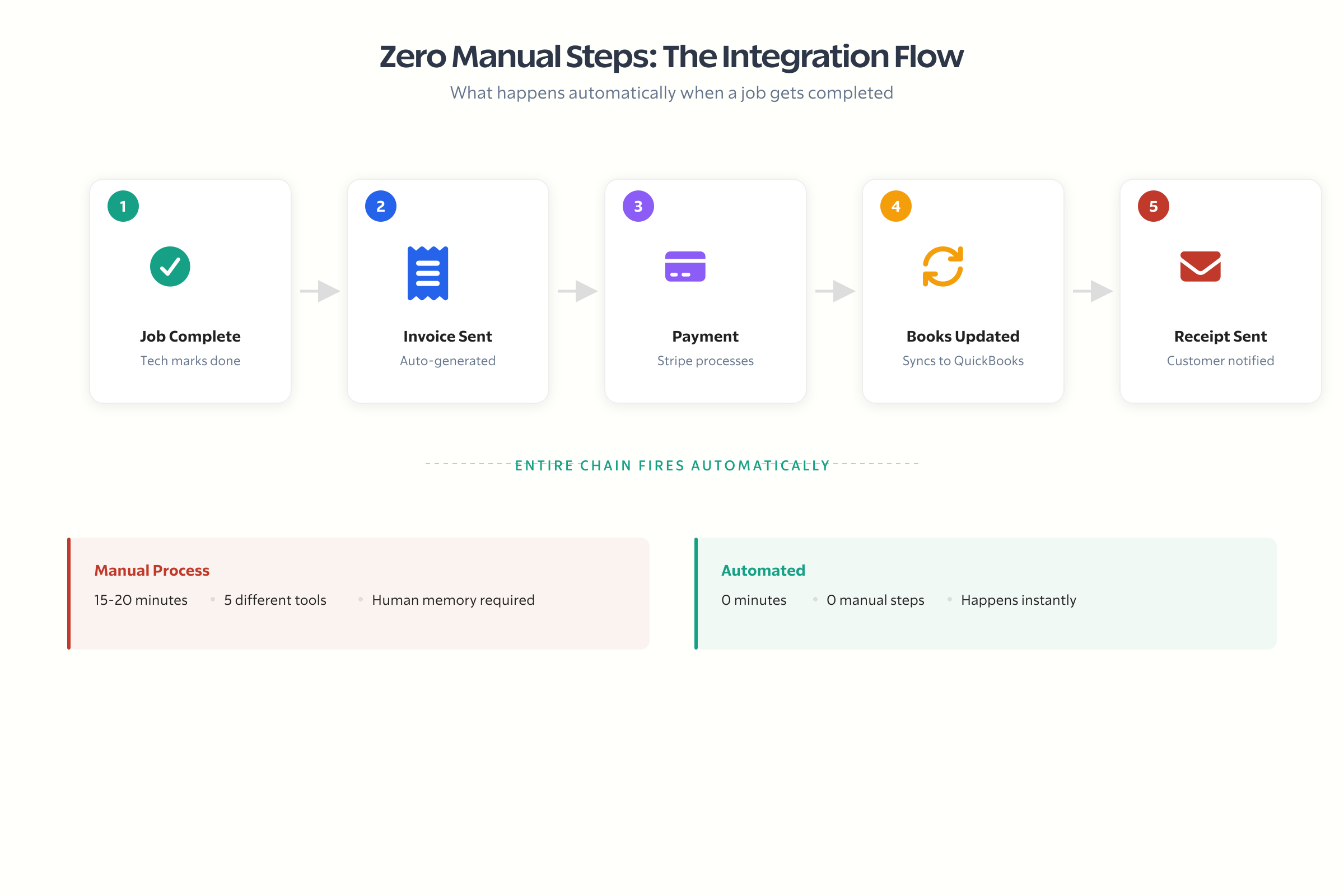
Dedicated platforms integrate natively.
A job gets completed → invoice generates → payment processes through Stripe → transaction syncs to QuickBooks → customer gets a receipt. Zero manual steps. Zero data entry. Zero “I forgot to update the spreadsheet.”
That’s not a minor efficiency gain. It’s the difference between spending your evening doing admin and actually going home.
From “What Happened” to “What’s Coming”
Spreadsheets tell you what already happened. That’s their ceiling.
Modern platforms go further. They analyze patterns. Which days are busiest? Which services generate the most revenue per hour? Which technician completes jobs fastest? Where are scheduling gaps you could fill?
Some platforms now use AI to predict demand spikes, flag potential no-shows, and suggest optimal routing. It’s early — most of these features aren’t perfect yet. But they’re already better than looking at last month’s spreadsheet and guessing.
Making the Switch Without Blowing Everything Up
The biggest reason businesses delay this move? They assume it’ll be painful.
It doesn’t have to be. Most companies I’ve worked with do it gradually. Start with one thing — usually scheduling or invoicing, whichever hurts most. Run it alongside your spreadsheets for a month. Once it’s working, move the next thing over.
Most modern platforms — Jobber, ServiceTitan, MrTask, Housecall Pro — have import tools for your existing data. You don’t lose your client history. You don’t start from zero. You move what you have into a system that actually does something with it.
The transition takes 2-4 weeks for most small teams. Not months. Not a year-long “digital transformation project.”
The Bottom Line
Spreadsheets aren’t evil. They’re just not built for running a growing service business. They were designed to store and calculate data, not to manage operations.
If you’re running under 15 active jobs at a time, sheets might still work fine. But the moment you’re losing track of invoices, double-booking technicians, or spending hours on data entry that software could eliminate — that’s your signal.
The question isn’t whether to make the switch. It’s how much you’re losing every month by waiting.