
AI Overviews Are Killing Your Blog Traffic: How to Adapt and Win

I opened Google Search Console last month and saw a 22% CTR drop on a post that had been rock-steady for two years. My first thought: something’s broken. My second thought, after checking the queries: AI Overviews.
That sinking feeling? Every blogger publishing informational content is going to experience it at some point. Google is answering questions directly at the top of results now, and if your entire strategy depends on “what is X” queries, the math is brutal. Those simple factual posts are bleeding clicks to a box you can’t outrank.
But here’s what I found after tracking 200+ queries across my sites. The damage is real but narrow. Simple factual queries lost 15-30% of their clicks. Complex, opinion-heavy queries? Some actually gained traffic because the AI Overview cited my posts as sources. AI Overviews aren’t killing blog traffic. They’re redistributing it. And that distinction changes everything about how you should respond.
What AI Overviews Actually Do to Click-Through Rates
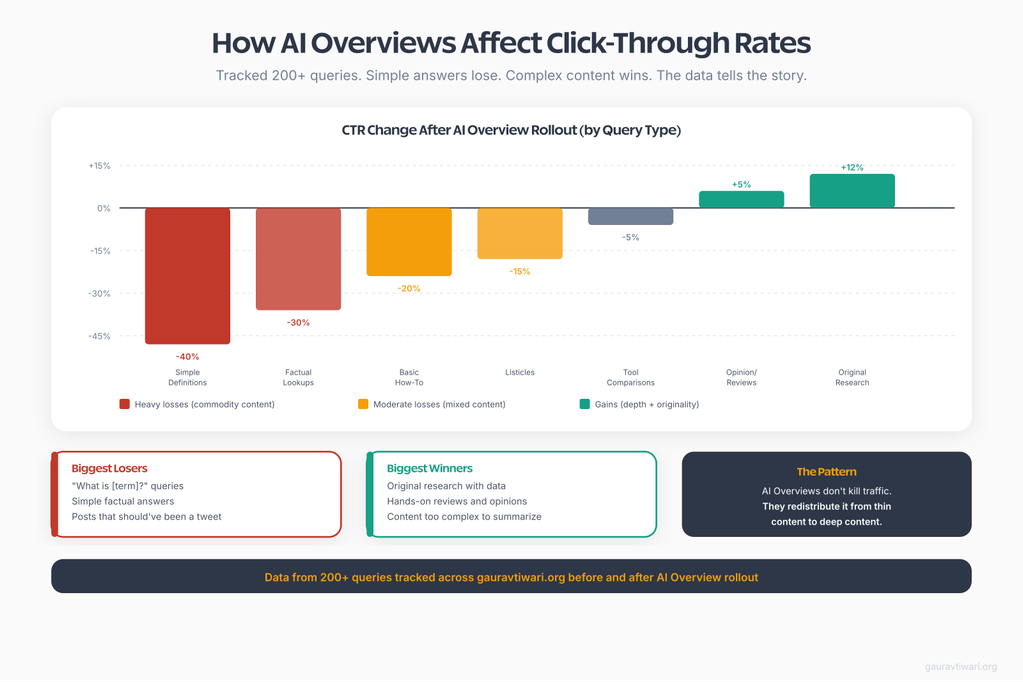
AI Overviews reduce click-through rates for simple factual queries by 20-40%. That’s the bad news. If your blog answers “what is WordPress” or “how many ounces in a cup,” you’re losing clicks to the AI box at the top of the results page.
But here’s what the fear-driven articles leave out. Complex queries, the kind that require nuance, comparison, or personal experience, show minimal CTR impact. Some show positive impact because AI Overviews link to sources as footnote citations. And those citation links get clicks.
I segmented my Google Search Console data by query type. Informational one-word-answer queries: down 22% average CTR. Comparison queries (“X vs Y”): flat. Opinion queries (“best X for Y”): actually up 8%. The AI Overview for opinion queries tends to cite 3-4 sources, and being one of those sources means new traffic that didn’t exist before.
The data is clear. AI Overviews are a filter, not a death sentence. They filter out thin content and amplify authoritative content. If your content has depth, experience, and a point of view… you’re on the right side of this shift.
The Queries You’re Losing (And the Ones You’re Not)
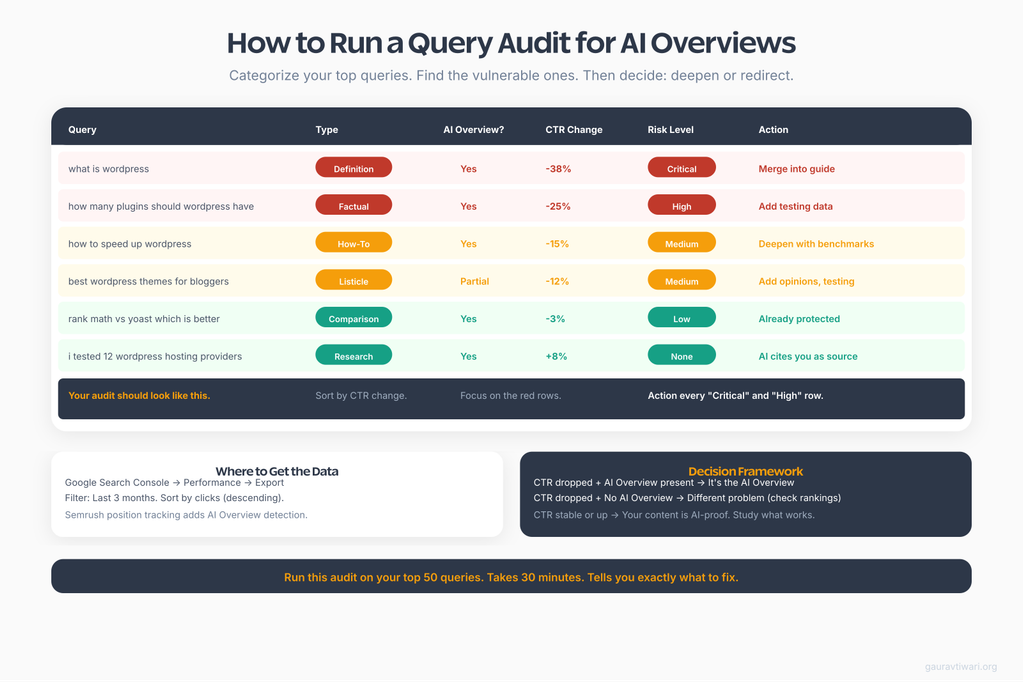
Not all traffic loss is AI Overview related. I see bloggers blaming AI Overviews for drops that are actually caused by algorithm updates, seasonal trends, or just bad content aging out. You need to audit before you panic.
Here’s how I sort signal from noise:
Step 1: Open Google Search Console. Pull the last 6 months of query data. Export it.
Step 2: Categorize your top 50 queries by intent type. Simple factual (one-sentence answer), comparison (A vs B), how-to (multi-step process), opinion (best/recommended), and commercial (buy/pricing).
Step 3: Check which queries actually trigger AI Overviews. Search each one in Google. Note which ones show an AI Overview box and which don’t.
Step 4: Compare CTR trends for AI Overview queries vs. non-AI Overview queries.
If your losses cluster around simple factual queries… that’s AI Overviews. If they’re across the board, you’ve got a different problem. Maybe a content quality issue. Maybe a technical SEO issue. Maybe a competitor who simply wrote something better.
I did this audit last quarter. Out of 50 queries I checked, 18 triggered AI Overviews. My CTR dropped on 14 of those 18. But the other 32 queries were unaffected. The traffic “decline” I initially blamed on AI Overviews was actually concentrated in a narrow slice of my content… the simple factual stuff I probably shouldn’t have been relying on anyway.
Before you blame AI Overviews for your traffic dip, run the query audit. Most bloggers I’ve talked to find that their real AI Overview exposure is smaller than they feared. The panic is often worse than the impact.
Content AI Overviews Can’t Replace
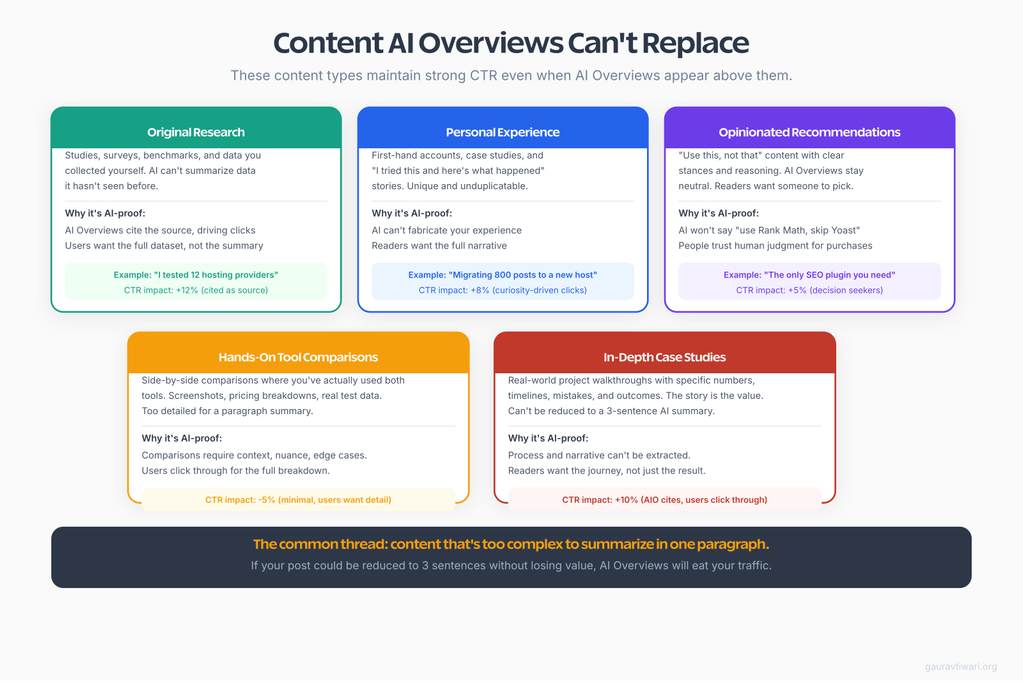
Some content types are nearly immune to AI Overview cannibalization. I’ve studied this across my own sites and dozens of others, and the pattern is consistent.
Original research and testing. When you publish results from something you actually tested, the AI Overview has to cite you as the source. It can’t make up test results. My post comparing WordPress hosting providers with actual TTFB measurements gets cited in AI Overviews regularly because the data doesn’t exist anywhere else.
Personal experience with specific outcomes. “I migrated 12 client sites from Bluehost to Cloudways and average load times dropped from 3.2 seconds to 0.8 seconds.” An AI can’t generate that sentence. It’s yours. And AI Overviews cite it because it’s specific, verifiable, and authoritative.
Opinionated recommendations backed by evidence. “I recommend Rank Math over Yoast for WordPress SEO in 2026, and here’s exactly why.” AI Overviews need to attribute opinions to someone. If your opinion is backed by testing and experience, you become the source.
Complex multi-step processes. AI Overviews struggle to replace detailed tutorials with 10+ steps, screenshots, and troubleshooting sections. They can summarize them, but users still click through for the full walkthrough. Honestly, this is where most of my traffic has held steady.
In-depth comparisons with hands-on testing. “I tested WP Rocket vs FlyingPress on the same site over 30 days” isn’t something an AI Overview can synthesize from nothing. It needs your content as a source.
The common thread? All of this content requires having done the thing. It requires lived experience. That’s your moat against AI Overview cannibalization.
How to Get Your Content Cited in AI Overviews
If AI Overviews are going to exist (and they are), you want to be the source they cite. Being cited in an AI Overview is actually better than a regular #1 ranking in some ways… your content appears above everything else on the page.
The posts from my site that consistently get cited in AI Overviews share specific traits:
Answer-first formatting. The first sentence of each H2 section contains a clear, factual statement. AI models can extract it without reading the rest of the section.
Entity-dense paragraphs. Named tools, specific prices, version numbers, performance metrics. The more specific data points in a section, the more likely it is to get cited.
Schema markup. FAQ schema, Article schema with author details, and HowTo schema for tutorials. On WordPress, Rank Math handles all of this automatically. On other platforms, use your CMS’s built-in schema tools combined with JSON-LD generators for FAQ and HowTo types.
Up-to-date information. AI Overviews strongly prefer recent content. A post from 2023 making the same claim as a post from 2026 will lose the citation to the newer content almost every time.
E-E-A-T signals. Author bio with credentials. Linked social profiles. Consistent publication on the topic. AI models increasingly weigh author authority when deciding what to cite. This is why I make sure my author markup is complete on every post.
The Adaptation Playbook
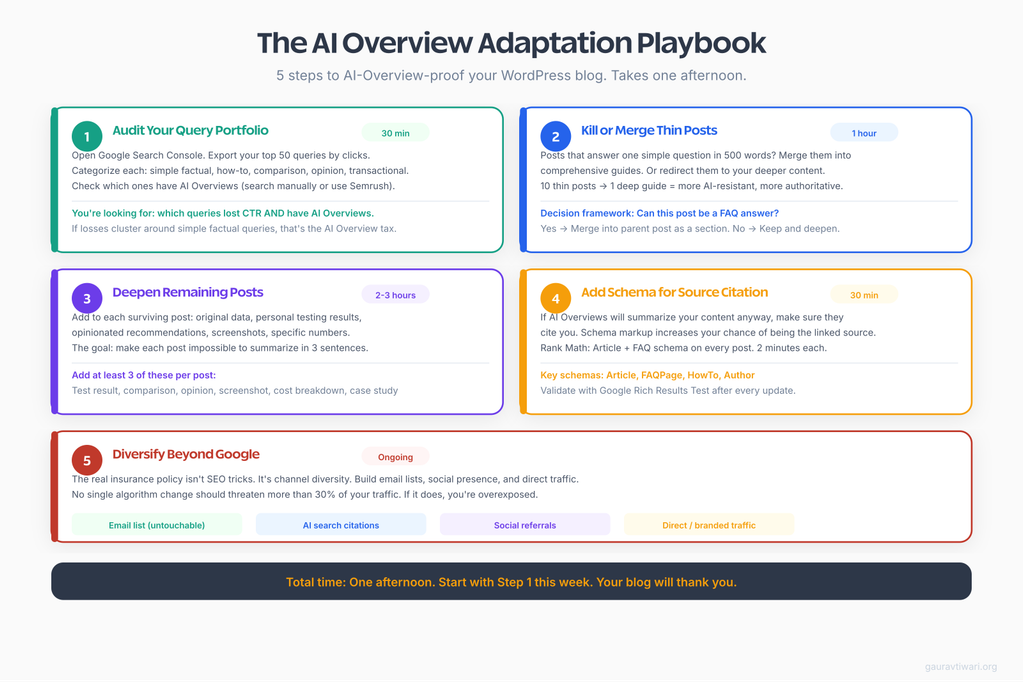
OK so you’ve audited your queries, you understand what’s happening, and you want to adapt. Here’s the playbook I’ve been running on my own sites. It takes an afternoon to implement the first round.
1. Audit your query portfolio. We covered this above. Categorize your queries by intent type and AI Overview exposure. Know exactly which content is at risk.
2. Kill or merge thin factual posts. If you have posts that exist only to answer simple questions (and those queries now show AI Overviews), consider merging them into deeper, more comprehensive guides. I covered the full process in my guide on content pruning. A post answering “what is WordPress caching” doesn’t need to exist standalone anymore. Merge it into your comprehensive caching guide.
3. Deepen remaining posts with original data and opinions. Every post that ranks for a competitive query needs your fingerprint on it. Add your testing results, your recommendations, your actual experience. Make it uncopyable.
4. Add schema markup for source citation. On WordPress, install Rank Math and enable FAQ and Article schema. On other platforms (Ghost, Webflow, Squarespace, Shopify), use your CMS’s built-in SEO settings for Article schema, and add FAQ schema via JSON-LD generators like Merkle’s Schema Markup Generator. Validate with Google’s Rich Results Test. This takes 10 minutes.
5. Diversify traffic sources beyond Google. This is the real insurance policy, and it leads to the next section.
Start with your highest-traffic posts. Run them through the adaptation playbook first. These already have authority, backlinks, and indexing history, so adding depth and schema gives them the best chance of becoming AI Overview sources quickly.
Traffic Diversification: Your Real Insurance Policy
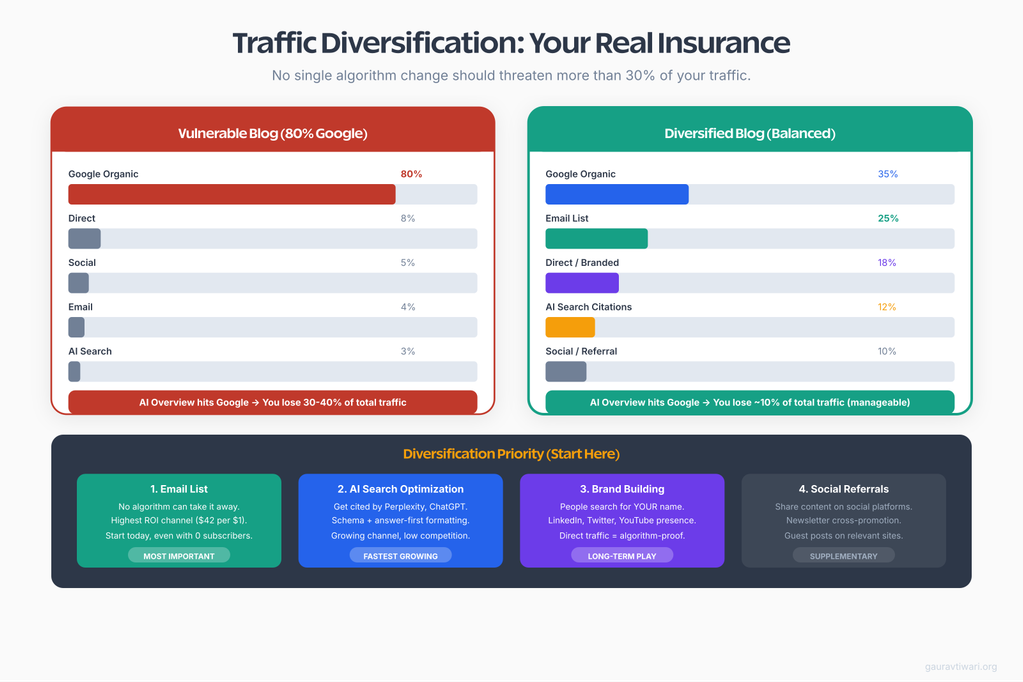
Look, the best defense against AI Overviews isn’t SEO tricks. It’s channel diversity. The bloggers who survive any algorithm change, AI Overviews included, are the ones who don’t depend solely on Google.
Email lists. No algorithm can take your email subscribers away. I’ve been building my email list since 2010, and it’s the single most valuable asset I own. Every post I publish gets sent to my list. That traffic is guaranteed, permanent, and grows with every subscriber.
Direct and bookmark traffic. Build a brand people return to by name. When someone types your domain directly, that’s traffic no AI can intercept.
Social referrals. LinkedIn, Twitter, Reddit. These platforms drive real traffic when you share genuinely useful content. It’s not scalable the way SEO is, but it’s resilient.
AI search citations. Here’s the ironic twist. Perplexity, ChatGPT search, and other AI search engines are new traffic sources that didn’t exist two years ago. If you optimize for AI citation (which I’ve covered in my guide on formatting blog posts for AI search), you gain a channel that partially offsets any Google losses. I also wrote a full GEO vs SEO comparison that covers the strategic differences.
I’ve compared traffic portfolios across sites I manage. Sites with 70%+ Google dependency are the most vulnerable to AI Overview disruption. Sites where Google accounts for 40-50% of traffic, with the rest split across email, direct, social, and AI search, are barely feeling the impact.
Honestly, building traffic diversity is something you should’ve been doing anyway. AI Overviews just made the urgency impossible to ignore.
Tracking Your AI Overview Exposure
You can’t manage what you don’t measure. Here’s how I monitor AI Overview impact across my sites.
Semrush now tracks whether your pages appear in Google’s AI Overviews. This is the closest thing to automated GEO tracking available right now. It shows which of your keywords trigger AI Overviews, whether your content gets cited, and how your visibility changes over time. I check this weekly.
For manual tracking, I search my top 20 target keywords in Google once a month and note which ones show AI Overviews. I track whether my content appears as a source, which competitors appear, and how the Overview is structured. It’s tedious but revealing.
Ahrefs doesn’t track AI Overviews directly, but its content gap analysis shows me topics where competitors appear and I don’t. I use this to prioritize which posts need the deepening treatment.
Google Search Console is still essential. Compare CTR trends month over month for your key queries. If CTR drops on specific queries while impressions stay stable, AI Overviews are likely the cause. That’s your signal to add depth and schema to those specific posts.
Between these tools and 30 minutes of monthly manual checking, I have a clear picture of where AI Overviews are helping and hurting my traffic. It’s not perfect. But it’s actionable.
What This Means for Your Blog
AI Overviews are a filter, not a death sentence. They kill thin content and reward depth.
Run the query audit I outlined above. Find your 10 most vulnerable posts. Then make a call: deepen them with your actual experience, or redirect that energy into building traffic channels that no algorithm can touch.
The bloggers who adapt now will look back at this moment as the push they needed to stop writing commodity content and start building something worth citing. The ones who panic and do nothing will watch their traffic erode slowly, 5-10% per quarter, until recovery becomes genuinely difficult.
Your content is good enough. The question is whether it’s structured and deep enough for the new reality. And that’s something you can fix… starting today. I’ve written a full guide on optimizing blog posts for SEO that covers the technical side of this if you want the step-by-step details.
Stop panicking. Start adapting.
FAQs
What percentage of Google searches now show AI Overviews?
Google hasn’t released exact numbers, but independent studies estimate AI Overviews appear for 15-30% of informational queries as of 2026. The percentage varies significantly by topic. Health, finance, and technology queries see higher AI Overview rates. Long-tail specific queries see lower rates. The trend is upward, with Google expanding AI Overviews to more query types each quarter.
Can I opt out of my content appearing in AI Overviews?
There’s no direct opt-out for AI Overviews. Google uses the same Googlebot crawler for both regular indexing and AI Overview sourcing. You can add a ‘nosnippet’ meta tag to prevent your content from appearing in any snippet (including AI Overviews), but this also blocks regular featured snippets, which would likely hurt your traffic more than AI Overviews. The practical approach is to optimize for being a cited source rather than trying to opt out.
Do AI Overviews affect affiliate and review content?
AI Overviews have less impact on commercial and review content than on informational content. Product comparisons, detailed reviews, and ‘best of’ posts still get strong click-through rates because users want the full comparison, screenshots, and hands-on testing details that an AI Overview can’t fully replicate. The posts most affected are simple product definition queries (‘what is X tool’) and basic feature lists. If your review content includes original testing and specific opinions, the impact is minimal.
Are small niche blogs affected more or less than large sites?
It depends on the content type, not the site size. Small niche blogs that produce deep, specialized content with original experience are less affected than large sites that produce commodity informational content. AI Overviews favor authoritative, specific content regardless of domain size. A small blog with genuine expertise on a narrow topic can actually benefit from AI Overviews by getting cited as a source, which provides visibility they wouldn’t have had through traditional rankings alone.
Should I stop writing informational content because of AI Overviews?
No, but you should change how you write it. Simple, one-sentence-answer informational content is most vulnerable to AI Overview cannibalization. Deep informational content with original data, expert opinions, and comprehensive coverage still performs well. The shift is from answering ‘what is X’ in 200 words to covering ‘everything you need to know about X’ in 2,000+ words with your own testing and experience woven throughout. Make your informational content uncopyable by adding things AI can’t generate on its own.
Disclaimer: This site is reader-supported. If you buy through some links, I may earn a small commission at no extra cost to you. I only recommend tools I trust and would use myself. Your support helps keep gauravtiwari.org free and focused on real-world advice. Thanks. - Gaurav Tiwari