
How to Promote Your Music in 2026: A Complete Guide for Independent Artists
You recorded something you’re proud of. Now what? Getting your music heard is harder than making it. Spotify alone adds 100,000+ new tracks every single day. TikTok’s algorithm can make you famous overnight or bury you in silence. The platforms keep changing, the rules keep shifting, and most “music marketing advice” online is either outdated or written by people who’ve never released a track.
I’ve been in digital marketing for over 16 years and worked with creators, brands, and content-driven businesses across dozens of industries. Music promotion in 2026 follows the same core principles as any content marketing: build an audience, create consistently, and pick the right distribution channels. The difference is that musicians have more free tools at their disposal than almost any other creator category.
Here’s a practical, no-fluff guide to promoting your music in 2026, whether you’re an independent bedroom producer or a band looking to grow beyond your local scene.
Pick Your Primary Platform First
The biggest mistake independent artists make is trying to be everywhere at once. You end up half-present on six platforms instead of dominant on one. Pick a primary platform based on your genre, your audience, and where you’re most comfortable creating content.
Spotify remains the largest music streaming platform with over 640 million users and 250 million paid subscribers. Getting on editorial playlists can change your career overnight. But Spotify discovery favors artists who release consistently (every 4-6 weeks), engage with Spotify for Artists analytics, and pitch tracks to editorial playlists at least 7 days before release.
TikTok is where songs go viral in 2026. Short-form video clips using your music can reach millions organically. The algorithm doesn’t care how many followers you have. It cares about watch time and engagement. If you can create 15-60 second clips that hook people, TikTok is your fastest path to discovery. Over 175 TikTok-viral artists have reached the Billboard Hot 100.
YouTube is the world’s largest music discovery platform by total hours consumed. YouTube Music, Shorts, and long-form music videos all feed into the same ecosystem. If you’re comfortable on camera or can create compelling visuals, YouTube offers the best long-term compound growth. YouTube pays $0.003-0.005 per stream, roughly double Spotify’s rate.
SoundCloud still matters for electronic, hip-hop, and experimental genres. It’s where producers share works-in-progress, remixes, and DJ sets. The community is smaller but more engaged than mainstream platforms. Billie Eilish, Post Malone, and XXXTentacion were all discovered on SoundCloud.
Bandcamp is the best platform for selling music directly to fans. No algorithm, no payola, just artists and listeners. Artists keep 82-85% of revenue. If you have a dedicated fanbase (even a small one), Bandcamp lets you keep the largest share of any platform.
Pick one. Master it. Then expand.
Distribution: Get Your Music Everywhere
Before you promote anything, your music needs to be available on all major streaming platforms. You can’t upload directly to Spotify, Apple Music, or Amazon Music. You need a digital distributor.
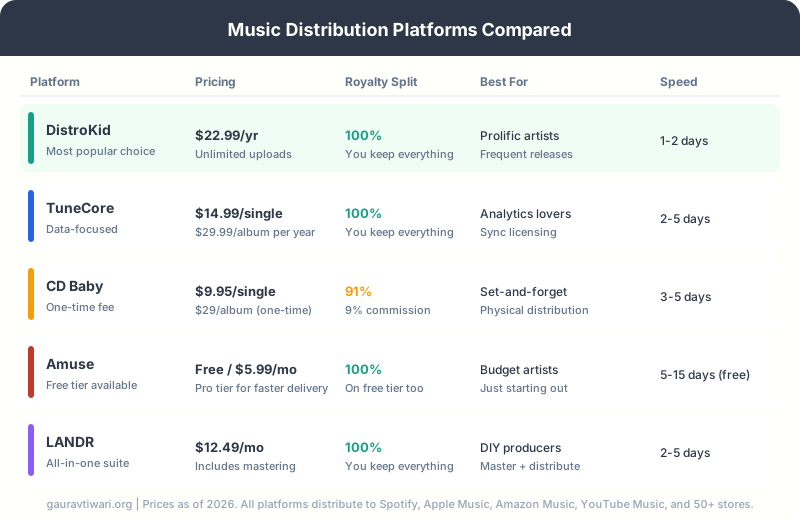
A distributor takes your finished tracks and delivers them to 150+ streaming platforms worldwide, handles royalty collection, and provides analytics. Here are the best options for independent artists in 2026:

DistroKid
- $22.99/year for unlimited uploads to 150+ streaming platforms
- Keep 100% of your royalties with no per-release fees
- Fastest delivery: music live on Spotify in 1-2 days
- Built-in tools: lyrics, release date scheduling, pre-saves
- Used by over 2 million artists worldwide
The most popular music distribution platform for independent artists. Upload unlimited songs to Spotify, Apple Music, and 150+ stores for one annual fee.
TuneCore
- Distribute to Spotify, Apple Music, Amazon, and 150+ stores
- Keep 100% of royalties with transparent per-release pricing
- Detailed analytics dashboard with audience insights
- Sync licensing marketplace for TV, film, and advertising placements
- YouTube Content ID monetization included
Music distribution with industry-leading analytics and sync licensing opportunities. Per-release pricing model ideal for artists who release fewer tracks.
CD Baby charges a one-time fee ($9.95 per single, $29 per album) plus a 9% commission on royalties. Good for artists who want a “set it and forget it” approach. They also offer physical distribution and sync licensing.
Amuse offers a free tier with basic distribution. Upgrade to Amuse Pro ($5.99/month) for faster delivery and more features. The free tier is perfect for testing the waters.
LANDR ($12.49/month) bundles distribution with AI mastering tools. If you’re mixing and mastering your own tracks, LANDR’s all-in-one approach saves money and time.
Spotify for Artists: Your Command Center
Spotify for Artists
- Free for all artists distributed to Spotify
- Pitch unreleased tracks to Spotify's editorial playlist team
- Real-time streaming data: listeners, saves, playlist adds, demographics
- Customize your artist profile with images, bio, and artist pick
- Canvas (looping visuals) and Clips for enhanced engagement
The essential free tool for every musician on Spotify. Manage your profile, pitch to editorial playlists, and track real-time streaming analytics.
If you’re on Spotify (and you should be), Spotify for Artists is the single most important free tool in your promotion arsenal. Claim your profile immediately after your first release goes live.
What Spotify for Artists lets you do:
- Pitch to editorial playlists at least 7 days before release. Write a compelling pitch describing the mood, genre, instrumentation, and story behind the track. Spotify’s editorial team reviews thousands of pitches weekly.
- Track real-time analytics: streams, listener demographics, save rates, playlist additions, and which cities your listeners are in (useful for tour planning).
- Customize your profile with header images, bio, artist pick (pin your latest release), and Canvas (looping visuals that play on mobile).
- Access Marquee and Discovery Mode (paid tools) to boost visibility for new releases among likely fans.
The artists who grow fastest on Spotify check their analytics weekly, pitch every single release, and use the data to inform their content strategy. If a track is getting saved at a high rate in Brazil, create Portuguese-language content for that audience. Data-driven promotion beats guesswork every time.
Social Media Strategy for Musicians
Social media isn’t optional for musicians anymore. It’s the primary way fans discover new artists. But posting randomly won’t get you anywhere. You need a strategy.
Content that works for musicians in 2026:
- Behind-the-scenes clips. Show your production process, recording sessions, or rehearsals. A 30-second clip of you building a beat from scratch can outperform a polished music video. Authenticity beats production value.
- Short covers and remixes. Cover trending songs or remix viral audio. This piggybacks on existing search traffic and algorithmic momentum. A cover of a trending TikTok sound can introduce your voice to millions.
- Song breakdowns. Show how you made a specific part of your track. Producers love this. Fans love this. The algorithm loves this.
- Storytelling. Share the story behind your tracks. Why did you write this song? What were you going through? Emotional context turns casual listeners into real fans.
- Gear and process content. What DAW do you use? What plugins? What’s your recording setup? This content attracts fellow musicians who become your most loyal sharers.
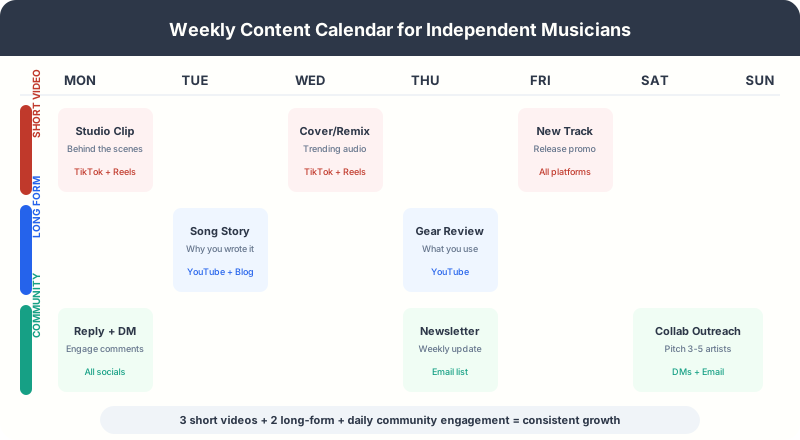
80% of your content should entertain, educate, or inspire. 20% should directly promote your releases. If every post is “stream my new track,” people will tune out. Build a relationship first. The streams follow naturally.
Build an Email List Early
This sounds counterintuitive for musicians, but your email list is the only audience you truly own. Social media platforms can change their algorithm overnight and kill your reach. Instagram’s organic reach dropped below 5% for most creators. TikTok can shadowban you without explanation.
Your email subscribers are different. They opted in. They want to hear from you. And no algorithm can get between you and their inbox.
How to build your music email list:
- Offer a free exclusive track or demo in exchange for an email signup
- Add a signup link in your Linktree, Instagram bio, and YouTube descriptions
- Use Mailchimp (free up to 500 contacts), ConvertKit, or Beehiiv
- Send a weekly or biweekly newsletter with behind-the-scenes updates, new releases, and exclusive content
- When you release new music, email your list first. They’ll stream on day one, boosting your algorithmic performance
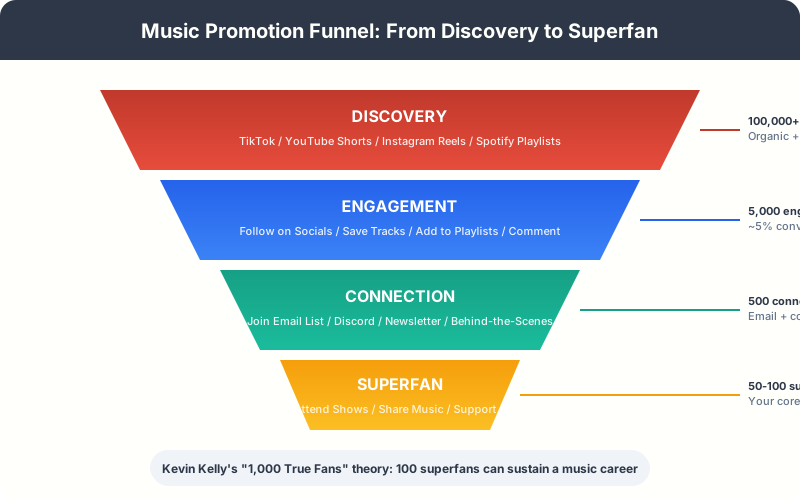
Even 200 dedicated email subscribers can generate more meaningful engagement than 10,000 passive social followers. Kevin Kelly’s “1,000 True Fans” concept applies perfectly to musicians: a small group of superfans who buy everything you release can sustain an entire career.
Playlist Pitching Strategy
Getting onto playlists is one of the fastest ways to grow streams. There are three types of playlists that matter:
- Spotify editorial playlists. Curated by Spotify’s in-house team. Pitch through Spotify for Artists (free) at least 7 days before release. Include mood, genre, tempo, and the story behind the track.
- Algorithmic playlists. Discover Weekly, Release Radar, and Daily Mix are generated by Spotify’s algorithm. High engagement (saves, shares, playlist adds) in the first 48 hours triggers algorithmic placement. This is why your email list matters: day-one streams from real fans signal quality to the algorithm.
- Independent curated playlists. Run by music bloggers, influencers, and passionate listeners. Many have 10,000-500,000+ followers. Use platforms like SubmitHub ($1-2 per submission) for organized outreach, or contact curators directly via email.
Never pay for guaranteed playlist placement. Spotify actively penalizes artists caught using paid playlist services. It can get your music removed from the platform entirely. Organic pitching takes more effort but carries zero risk and builds real relationships with curators.
SoundCloud and Bandcamp: The Indie Essentials
SoundCloud
- Free uploads for emerging artists with SoundCloud Basic
- Direct fan engagement: comments, reposts, and messaging
- SoundCloud Premier monetization for eligible artists
- Works-in-progress and DJ set sharing (not just finished tracks)
- Discovery engine launched careers of Billie Eilish, Post Malone, and XXXTentacion
The original platform for independent music discovery. Essential for electronic, hip-hop, and experimental artists who want direct community engagement.
Bandcamp
- Artists keep 82% of digital sales, 85% after $5K in revenue
- Fans can pay more than asking price (name-your-price model)
- Physical merch integration: vinyl, CDs, cassettes, apparel
- Bandcamp Fridays: platform waives its share on select days
- No algorithm: fans discover music through editorial and tags
The best platform for selling music directly to fans. Artists keep 82-85% of revenue with no algorithms or payola. Fans pay what they want.
Don’t overlook these two platforms just because they’re not as mainstream as Spotify. SoundCloud and Bandcamp serve different but equally important purposes in your promotion strategy.
SoundCloud is where you build community. Upload demos, works-in-progress, live recordings, and DJ sets. Comment on other artists’ tracks. Repost tracks you genuinely love. The SoundCloud community is tight-knit, especially in electronic, hip-hop, lo-fi, and experimental genres. Getting noticed on SoundCloud still launches careers. Check out my tips on getting noticed on SoundCloud as a new artist.
Bandcamp is where you make money directly. While Spotify pays $0.003-0.005 per stream, Bandcamp lets fans pay $1-$20+ per album with you keeping 82-85% of every sale. On Bandcamp Fridays (select days when the platform waives its revenue share), artists keep even more. If you have 500 fans who each buy a $10 album on Bandcamp, that’s $4,100-4,250 in your pocket from a single release.
Labels vs. Independence in 2026
The old model was simple: get signed, let the label handle promotion, give up most of your royalties. In 2026, the math has changed dramatically.
Independent artists now keep 80-100% of their streaming royalties. They control their masters, their release schedule, and their brand. Artists like Chance the Rapper, Russ, and PinkPantheress built massive careers without traditional label deals. The global independent music market generated $5.2 billion in 2024, growing faster than major label revenue.
That said, labels still offer real value for:
- Upfront funding for recording, music videos, and marketing campaigns
- Established relationships with radio stations, sync licensing supervisors, and press outlets
- A team that handles logistics so you can focus on creating
- Global distribution infrastructure and playlist connections that independents struggle to replicate
The smart move? Build your audience independently first. Prove you can generate streams and engagement on your own. Then negotiate from a position of strength. An artist with 100,000 monthly Spotify listeners and a growing social following will get far better terms than someone with zero leverage.
Collaboration and Networking
Collaboration is the fastest organic growth hack in music. When you feature on another artist’s track (or they feature on yours), you automatically get exposed to their entire audience. It’s a mutual audience swap that costs nothing.
Where to find collaborators:
- SoundCloud and Bandcamp communities in your genre
- Reddit: r/WeAreTheMusicMakers (2.3M members), r/MusicInTheMaking, r/Songwriting, and genre-specific subs
- Discord servers: BeatStars, Splice, and genre-specific communities have thousands of active producers
- Local scenes: open mics, music events, studio sessions in your city
- Social DMs: reach out to artists at your level on Instagram and TikTok. Don’t cold-pitch superstars. Pitch peers.
The key: collaborate with artists at your level or slightly above. Both parties benefit. Don’t chase clout. Chase genuine creative partnerships that produce music you’re both proud of.
Your Website and Electronic Press Kit
Every serious musician needs a website. Not just a Linktree (though that’s fine as a supplement). A proper website with your bio, discography, press photos, contact information, and links to all your platforms.
Your Electronic Press Kit (EPK) should include:
- A professional bio (2-3 paragraphs, third person)
- High-quality press photos (at least 3-5 images, both portrait and landscape)
- Embedded players for your best 3-5 tracks
- Notable achievements: press features, playlist placements, streaming milestones, live shows
- Contact email for booking, press, and sync licensing inquiries
- Social media and streaming platform links
- Stage plot and technical rider (if you perform live)
WordPress is still the best platform for a musician’s website. It’s flexible, affordable, and you own your content. I’ve built hundreds of WordPress sites. For musicians specifically, check out my guide on making your music website attractive.
Paid Promotion: When It Makes Sense
Organic promotion should be your foundation, but paid ads can accelerate growth when used strategically. Don’t spend money on ads until you have a released track getting some organic traction, a clear funnel, and at least $5-10/day to test with.
Best paid channels for music promotion in 2026:
- Meta Ads (Facebook/Instagram): Target by musical interest, genre, and similar artists. Video ads with a 15-30 second clip work best. Expect $0.05-0.15 per click to Spotify. Budget: start at $5/day.
- TikTok Spark Ads: Boost existing organic content that’s already performing. If a video gets 10,000+ views organically, $20-50 in Spark Ads can push it to 100,000+.
- YouTube Ads (pre-roll): Great for music videos. You only pay when someone watches at least 30 seconds. $0.01-0.03 per view.
- Spotify Ad Studio: Create audio ads that play between songs. Target by genre, playlist, and listening habits. Minimum budget $250.
- SubmitHub: Not traditional advertising, but $1-2 per submission to independent playlist curators and music bloggers. High rejection rate, but legitimate placements.
If someone guarantees a specific number of streams, followers, or playlist placements for a flat fee, it’s a scam. These services use bots that Spotify, YouTube, and TikTok all detect. Getting caught tanks your algorithmic standing and can get your music permanently removed. Stick to legitimate advertising platforms and organic outreach.
AI Tools for Music Promotion
AI is reshaping how independent artists promote their music. Here are the most useful AI tools for musicians in 2026:
- LANDR and BandLab for AI-assisted mastering. Get release-ready masters in minutes for a fraction of studio costs.
- ChatGPT and Claude for writing press releases, social media captions, playlist pitch descriptions, and EPK bios.
- Canva’s AI tools for creating cover art, social media graphics, and promotional banners without design skills.
- Descript for editing podcast interviews, behind-the-scenes videos, and creating short clips from longer content.
- Suno and Udio for generating reference tracks, exploring ideas, and creating backing tracks (use ethically and disclose).
AI won’t replace your creativity or your authentic voice. But it can handle the repetitive marketing tasks that eat into your studio time. Use it for promotion. Make the music yourself. For more on how AI is changing music, read about AI music creators and the new frontier of creativity.
Track What Works
You can’t improve what you don’t measure. Use these free analytics tools to understand what’s working:
- Spotify for Artists: streams, listener demographics, playlist placements, save rates, and city-level data
- YouTube Studio: watch time, audience retention, traffic sources, and subscriber conversion
- TikTok Analytics (Pro account, free): video performance, audience demographics, trending content
- Instagram Insights: reach, engagement rate, and which content types drive follows
- Google Analytics on your website: traffic sources, geographic data, and conversion tracking
- Chartmetric or Soundcharts (free tiers): cross-platform analytics that aggregate data from Spotify, Apple Music, YouTube, and social platforms
Check analytics weekly. Double down on what’s working. Cut what isn’t. If your TikTok behind-the-scenes clips get 10x the engagement of your polished promos, make more behind-the-scenes clips. Let data guide your strategy.
Frequently Asked Questions
How much does music promotion cost in 2026?
You can promote music effectively for free using social media (TikTok, Instagram, YouTube), playlist pitching through Spotify for Artists, email marketing (Mailchimp free tier), and community engagement on Reddit and Discord. Digital distribution costs $22.99/year with DistroKid. If you add paid ads, start with $5-10/day on Meta or TikTok ($150-300/month). A realistic budget for a serious independent artist is $50-500/month.
What is the best platform to promote music in 2026?
TikTok offers the fastest organic discovery. Over 175 TikTok-viral artists have reached the Billboard Hot 100. Spotify is essential for streaming revenue and playlist placement (640M+ users). YouTube provides the best long-term growth and pays roughly double Spotify’s per-stream rate. SoundCloud excels for electronic and hip-hop artists. The right choice depends on your genre and content style.
How do I get my music on Spotify playlists?
Use Spotify for Artists (free) to pitch unreleased tracks to editorial playlists at least 7 days before release. Write a compelling pitch describing the mood, genre, and story. For independent playlists, use SubmitHub ($1-2 per submission) or contact curators directly via email. Never pay for guaranteed playlist placement, as Spotify penalizes this and can remove your music.
Do I need a record label to succeed as a musician?
No. Independent artists keep 80-100% of royalties and have access to the same distribution platforms as signed artists. The global independent music market generated $5.2 billion in 2024. Build your audience independently first, prove you can generate streams and engagement, then negotiate with labels from a position of strength if an offer comes.
How often should I release new music?
Release a new single every 4-6 weeks for optimal algorithmic performance on Spotify. This keeps you in Release Radar and Discover Weekly rotation and gives you fresh content to promote. Quality still matters, but don’t sit on tracks for months. Many successful independent artists release 8-12 singles per year rather than waiting to drop a full album.
What is the best music distribution service?
DistroKid ($22.99/year, unlimited uploads, 100% royalties) is the best value for prolific artists. TuneCore is better for analytics-focused artists who release fewer tracks. CD Baby works for artists who prefer one-time fees. Amuse offers a free tier for beginners. LANDR bundles distribution with AI mastering. All deliver to Spotify, Apple Music, Amazon Music, and 150+ platforms.
Can AI help with music promotion?
Yes. AI tools like ChatGPT and Claude can write press releases, social media captions, and playlist pitches. LANDR provides AI mastering. Canva’s AI generates cover art and promotional graphics. Descript edits video content. AI handles repetitive marketing tasks so you can focus on creating music. Use it for promotion, but make the music yourself.
Start Now, Improve Later
The biggest mistake in music promotion isn’t picking the wrong platform or running a bad ad. It’s waiting. Waiting until the mix is perfect. Waiting until you have 1,000 followers. Waiting for the “right time.”
Every successful musician I’ve watched grow started promoting before they felt ready. They put out imperfect tracks, made cringe-worthy TikToks, and sent awkward emails to playlist curators. Then they got better.
Here’s your action plan: Pick one platform. Distribute your music everywhere through DistroKid or TuneCore. Claim your Spotify for Artists profile. Post content three times a week. Pitch to playlists before every release. Build an email list. Track your analytics weekly. Collaborate with peers.
That’s the entire playbook. The artists who execute it consistently for 12-24 months will be in a completely different position than those who spend that same time “planning.” Start now. Adjust as you go.
For more on building a content-driven career, check out getting noticed on SoundCloud, how AI music creators are changing the landscape, and the best podcast hosting platforms if you’re considering a music podcast.
Disclaimer: This site is reader-supported. If you buy through some links, I may earn a small commission at no extra cost to you. I only recommend tools I trust and would use myself. Your support helps keep gauravtiwari.org free and focused on real-world advice. Thanks. - Gaurav Tiwari