
 by
by
Your laptop keeps adding letters you didn’t type, even with an external keyboard plugged in. A stuck key can interrupt a sentence or get in the way of entering your password, so the spare keyboard hasn’t solved the problem.
Here is how to disable laptop keyboard input in Windows 11 while the external keyboard keeps working. Device Manager is where I’d start: find the built-in keyboard under Keyboards and, if Windows offers Disable device for that entry, switch it off there. When that option is missing, which happens on a lot of laptops, a PnPUtil command can ask Windows for the same change. Before either step, you need to know which entry is the built-in keyboard and have a working external keyboard and mouse, because the wrong click leaves you with nothing to type on.
If you’ve just spilled liquid on the laptop, shut it down and disconnect external power. Follow your manufacturer’s guidance on the battery and repairs before trying to use it again. Dell’s liquid-damage instructions put shutdown first. Changing drivers while it’s still switched on, or waiting a fixed 48 hours, doesn’t make a wet laptop safe to use.
Choose the Right Method
If you want to keep typing on an external keyboard, disable only the built-in keyboard. That’s the option I’d check first. A keyboard-lock app can also block the external one, which defeats the purpose of connecting it.
Disabling and uninstalling are different changes. Uninstalling removes the keyboard’s installation, but Windows can notice that the hardware is still connected and install it again immediately. That is why I wouldn’t use uninstall as a way to keep the keys off.
| Action | What It Does | The Catch | Undo |
|---|---|---|---|
| Disable device | Stops one keyboard entry from working in Windows | You must pick the right entry, and Windows doesn’t offer the option for every keyboard | Enable the same device |
| Uninstall device | Removes the keyboard’s installation | Windows can detect the connected hardware and install it again straight away, so the keys come back | Allow installation, then scan for hardware changes |
| Restrict installation | Blocks installation and driver updates for a matching device ID | Needs Group Policy on Pro, Enterprise or Education, and an already-installed device needs the retroactive option | Remove your policy entry and reverse any separate disable |
| Lock input | Freezes keyboard or mouse input for the current session | Scope and unlock shortcut depend on the app, and it can block the external keyboard too | Press the app’s unlock shortcut |
If you ever do uninstall, leave the Attempt to remove the driver for this device checkbox alone. Deleting a driver package can affect other devices that use it, as Microsoft’s device-uninstallation guidance explains, and it’s an extra change you don’t need when the aim is to turn off one keyboard.
Before You Disable the Keyboard
I want you to have a way back if you disable the wrong entry or the external keyboard stops working. You should be able to type and use the pointer without relying on the laptop’s keys:
- Connect your external keyboard and type into a blank document. Check the keys you need for your Windows sign-in too.
- Keep a working mouse or trackpad available. If the trackpad is unreliable, connect a separate mouse first.
- Open Start > Settings > Accessibility > Keyboard > On-Screen Keyboard. Click its keys with your pointer to check that it works.
- Save your work and keep the undo instructions somewhere you can reach, including on your phone.
- On a work or school laptop, ask IT before changing device state or installation policies.
You don’t need an expensive keyboard for this. If you don’t already have a working spare, a Logitech K120 wired USB keyboard is enough. The wire means no Bluetooth pairing and no battery to check. It needs a USB-A port or an adapter, so look at the laptop’s ports before buying anything, then test the keyboard before you disable the built-in one.
If you reach the sign-in screen without a working keyboard, select Accessibility > On-Screen Keyboard. You can click its keys with a mouse, so a touchscreen isn’t required. This is why keeping a working pointer matters as much as connecting the spare keyboard.
Identify the Built-In Keyboard
This is the part I’d take slowly. HID Keyboard Device is a generic name, and more than one entry can use it, so that label alone doesn’t tell you which one is the built-in keyboard. On a lot of laptops the internal keyboard shows up as Standard PS/2 Keyboard even though nothing is plugged into a PS/2 port, and that entry still needs to be checked against your laptop’s hardware before you touch it.
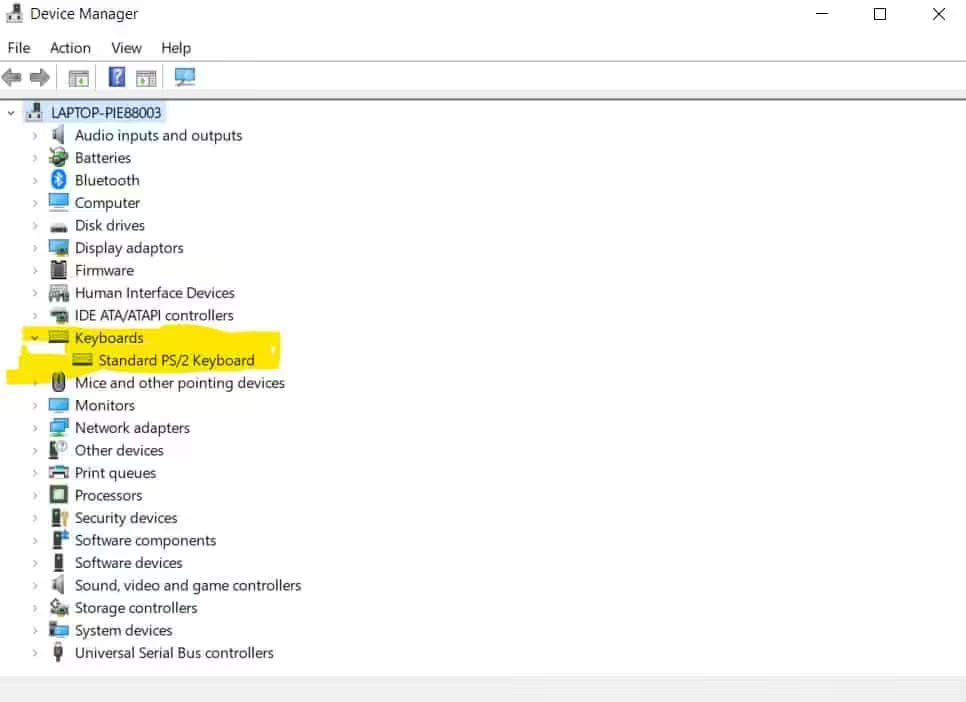
- Right-click Start and open Device Manager, then expand Keyboards.
- Right-click a candidate entry and select Properties > Details. Choose Device instance path from the Property menu and copy the complete value into your recovery note.
- Record the device name and any useful location or parent information. These help you compare entries, but a name alone isn’t proof.
- For a separately connected USB keyboard, leave the mouse connected, unplug only that keyboard and observe which entries disappear. Reconnect it to the same port and compare again. A single physical keyboard can expose several entries.
- Rule out the external keyboard’s entries. Treat whatever remains as a candidate and compare it with the laptop manufacturer’s information. Reconnect everything and test the external keyboard and mouse again before you change anything.
If your keyboard and mouse share a receiver, unplugging it will remove both. The same problem applies to a dock carrying your only pointer, so don’t use that connection for this comparison. If you still can’t identify the built-in keyboard, I’d ask the laptop manufacturer or IT for help before disabling anything.
The identifier you save matters because hardware IDs and device instance IDs don’t select the same things:
- A hardware ID can match a model or group of devices.
- A device instance ID identifies a particular device node on your system.
- A physical device can have more than one device node, so even a precise identifier needs to be matched to the right function.
Disable the Laptop Keyboard in Device Manager
Once you’ve identified the built-in keyboard, check whether Windows offers Disable device for it. That option stops the device without removing its driver, so turning it back on later is the same right-click menu.
- Right-click the identified keyboard in Device Manager.
- Select Disable device if it’s there, then confirm the warning. The same control also sits under Properties > Driver.
- Follow any restart instruction Windows gives you.
- Open a blank document and test several built-in keys. Check that your external keyboard and pointer still work.
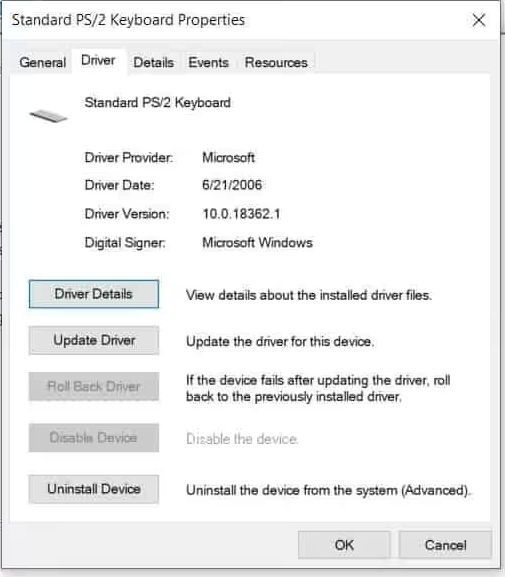
If Disable device is missing or grayed out, leave Uninstall device alone. Windows offers one without the other on plenty of laptops, usually on that PS/2 entry, and there isn’t one explanation that fits every model. The PnPUtil command below asks Windows for the same change in a different way, but it needs the right device identifier and Windows may still refuse.
To undo: return to the same device and choose Enable device. Your saved instance path helps you find the right entry again. Restarting the laptop isn’t a substitute for this step.
Use PnPUtil for a Targeted Disable
PnPUtil is the device-management command built into Windows, including Windows 11 Home, so there’s nothing to download and no Group Policy Editor involved. It can ask Windows to disable one specific keyboard entry. Windows can still refuse, so treat the command as a request rather than a guarantee.
Right-click Start > Terminal (Admin) and approve the administrator prompt. You can also use Command Prompt opened as administrator. Microsoft’s PnPUtil examples show how these commands select individual devices.
First, list connected keyboard devices. This command only reads information:
pnputil /enum-devices /connected /class Keyboard
Look for the Instance ID that matches the Device instance path you saved. That complete string selects the keyboard entry you want to change. In the commands below, replace <DEVICE_INSTANCE_ID>, including its angle brackets, with your own value and keep the surrounding quotes. Don’t copy an ID from someone else’s laptop.
Check the specific device before changing it:
pnputil /enum-devices /instanceid "<DEVICE_INSTANCE_ID>"
Save this undo command first, with your actual instance ID filled in:
pnputil /enable-device "<DEVICE_INSTANCE_ID>"
Then request the disable:
pnputil /disable-device "<DEVICE_INSTANCE_ID>"
Read what Windows prints back before assuming the keyboard is off. Restart if it asks you to, then run the instance-specific enumeration command again and check its status. Test the built-in and external keyboards in a blank document and check that the pointer still works.
- If Windows refuses the operation, stop and record the error.
- Don’t add
/force. Microsoft documents that switch as a way to disable even critical devices, and a laptop with no working input is a bigger problem than a stuck key. - Don’t broaden the command to every device in the Keyboard class or to a shared hardware ID.
- If you can’t match the identifier confidently, don’t run the disable command.
Both commands have been in Windows since Windows 10 version 2004, so any Windows 11 build has them.
Restrict Installation With Group Policy
If a normal disable already does what you need, I’d leave Group Policy alone. An installation restriction tells Windows not to install a matching device or update its driver. That can be useful when you need installation blocked, but it also becomes another setting to reverse when you want the keyboard back.
Check your Windows edition under Settings > System > About > Windows specifications. Microsoft lists this device-installation policy for Pro, Enterprise and Education, and Home isn’t on the list. If you’re on Home, stay with Device Manager or PnPUtil, or ask the manufacturer for help. I wouldn’t install a third-party gpedit.msc enabler just to attempt this.
For the keyboard entry you’ve identified, pair its Device instance path with Prevent installation of devices that match any of these device instance IDs. Read the full policy name before opening it. The option ending in device IDs uses hardware or compatible IDs and can match more than the single entry you intended.

Before you apply it, record the policy’s current state and entries, and check your external keyboard and mouse again. Applying the restriction to an already-installed device can stop that device from working when the policy takes effect. On a managed laptop, IT should handle existing organizational policies.
- Open Start, type
gpedit.mscusing your working keyboard or OSK, and open Local Group Policy Editor. - Go to Computer Configuration > Administrative Templates > System > Device Installation > Device Installation Restrictions.
- Open Prevent installation of devices that match any of these device instance IDs.
- Select Enabled, choose Show and add only the full instance path you verified. Preserve any existing entries.
- To include the currently installed matching device, select the option that also applies the policy to already-installed devices. Recheck the identifier and your recovery plan before choosing Apply.
- Follow any restart requirement, then check the matching device’s status and test your external keyboard and pointer. Don’t assume that closing the policy editor proves the restriction took effect.
Windows keeps applying the restriction as long as the policy is in effect and the identifier still matches. You can reverse it, and you should recheck it after a big Windows update or a driver change, because I wouldn’t call it a permanent, update-proof fix.
To undo: remove only the instance-ID entry you added and restore the policy’s previous configuration. If it was previously Not Configured and contained no other entries, return it to that state. Allow the policy change to take effect and restart if required. If you separately disabled the device, enable it too. If it was uninstalled, use Action > Scan for hardware changes after the restriction is removed.
Lock Input Temporarily
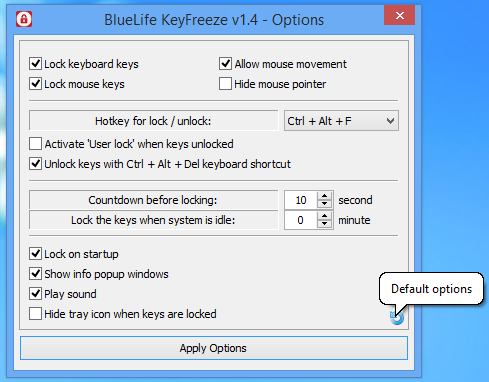
If you only want to stop accidental keypresses while a video plays, BlueLife KeyFreeze from Sordum offers a temporary input lock. It can lock keyboard and mouse input, so I’d skip it when the aim is to keep working on an external keyboard.
You should check these options before relying on the lock:
- The countdown is the delay before locking, not a timer that automatically unlocks input afterward.
- The default lock/unlock shortcut is Ctrl + Alt + F.
- Options control whether keyboard keys and mouse keys are locked. Review them, then test a lock-and-unlock cycle while your input devices are working.
- Don’t enable locking at startup until you’ve checked recovery. A stuck modifier key can also make a shortcut-based lock a poor choice.
For physical cleaning, shut down and disconnect power according to the manufacturer’s instructions. A session lock doesn’t replace those precautions.
Remapping one stuck key may look like an easier fix, but check which keyboards the change affects:
- PowerToys Keyboard Manager applies mappings across physical keyboards and doesn’t operate on password screens.
- SharpKeys writes Windows’ system scan-code mapping rather than selecting an individual keyboard.
So turning off a key through a remapper may also remove it from the external keyboard you need. I’d avoid that tradeoff when your goal is to disable only the laptop’s keys.
Troubleshoot Unexpected Results
If the keyboard still types, check which device you changed before trying another fix. Adding a policy, remapping keys and uninstalling drivers together makes it harder to tell what worked or what you need to undo.
| What Happened | What to Check Next |
|---|---|
| Disable device is unavailable | Confirm you selected the right device and that you’re signed in as an administrator. Try the PnPUtil command only if you’re sure of the instance ID, and stop if Windows refuses. |
| The keyboard appeared again | Check whether you uninstalled it instead of disabling it. Windows can rediscover connected hardware immediately. Go back to the recorded instance ID and any policy rather than uninstalling it again and again. |
| The external keyboard stopped working | Reverse the last device change using your saved identifier. Then check for a key remapper or input-lock app that applies to every keyboard. |
| The pointer stopped working | Use the external keyboard and mouse you tested earlier to undo the change. If nothing works, get another input device or IT help instead of disabling more entries. |
| Unwanted typing continues | Confirm that the right device is disabled. Check other keyboards, wireless receivers and input software. If the typing still continues, get the keyboard checked for your model instead of guessing at the ribbon cable. |
| Typing happens before Windows loads | Windows settings don’t control the keyboard before Windows loads, so a key that types in the BIOS menu is a hardware problem. Ask the manufacturer or a repair service. |
Re-Enable the Laptop Keyboard
To turn the keyboard back on, reverse the change you made. If your external keyboard has stopped working, use the On-Screen Keyboard with your mouse to enter the saved command or open the settings you need.
| Change You Made | Recovery |
|---|---|
| Device Manager disable | Select the same device and choose Enable device. |
| PnPUtil disable | Run the saved pnputil /enable-device "<DEVICE_INSTANCE_ID>" command as administrator, using your actual ID. |
| Installation restriction | Remove your specific policy entry and restore the previous configuration; then reverse any separate disable or uninstall. |
| Device uninstall | With any blocking policy removed, use Action > Scan for hardware changes. Follow Windows or the manufacturer’s driver instructions if it doesn’t return. |
| BlueLife KeyFreeze lock | Use your configured unlock shortcut, Ctrl + Alt + F by default. |
Safe Mode starts Windows with a limited set of drivers and services. It doesn’t guarantee that a disabled keyboard will work or that an installation restriction will be ignored. The recovery steps above are the ones you should keep available.
Windows 10 and MacBook Notes
On Windows 10, you still need to identify the right keyboard and keep another way to type. Also check your update coverage: normal Windows 10 support ended on October 14, 2025, and eligible Extended Security Updates arrangements are separate. Getting the keyboard working doesn’t change that support status.
MacBook
On a MacBook, Karabiner-Elements can disable the built-in keyboard while a selected external keyboard is connected. The setting belongs to the external keyboard’s entry, which is the detail to watch here. Review Karabiner’s setup and permission requirements before using it.
- Connect and test the external keyboard.
- Open Karabiner-Elements Settings > Devices and find that external keyboard.
- Enable Disable the built-in keyboard while this device is connected.
- Test both keyboards. To reverse the setting, switch it off; its documented condition also ends when that selected external device disconnects.
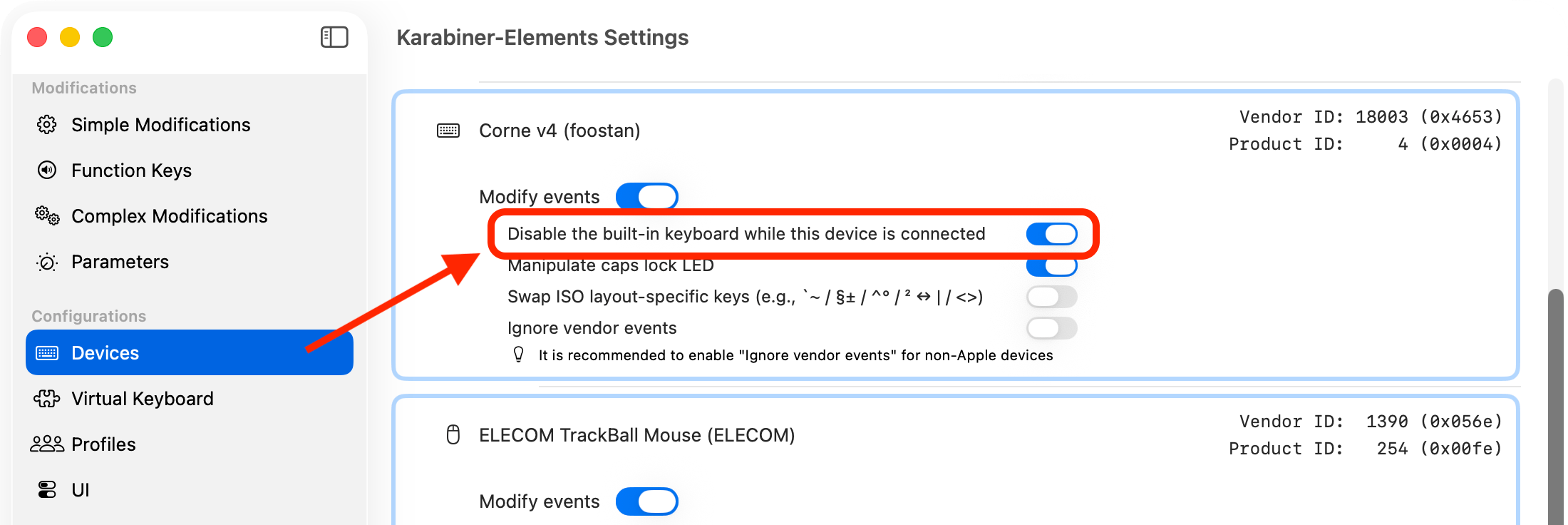
The setting depends on Karabiner running, so don’t rely on it to stop input before the app is active. If you’re short of ports for a wired keyboard and mouse, you can check the connections in my USB-C hubs for MacBook guide.
Frequently Asked Questions
Will plugging in an external keyboard disable the built-in keyboard?
You shouldn't rely on it doing that. The external keyboard gives you another way to type, but the built-in one may still send unwanted input. Check for a manufacturer setting that disables it, or use a change aimed at the correct keyboard device when Windows permits it.
Can I disable the laptop keyboard on Windows 11 Home?
Yes. Device Manager and PnPUtil are both part of Windows 11 Home, so the Disable device option and the pnputil /disable-device command work there whenever Windows allows the change. Only the Group Policy installation restriction needs Pro, Enterprise or Education.
Will the laptop keyboard stay disabled after a restart?
Normally, yes. A device you disable in Device Manager or with PnPUtil stays disabled until you enable it again, and a restart doesn't change that on its own. Check once after the first restart anyway, and check again after a big Windows update or a driver reinstall, because either can bring the entry back.
Does disabling the keyboard also turn off the touchpad?
No. The touchpad is a separate device, listed under Mice and other pointing devices or Human Interface Devices, so disabling the keyboard entry leaves it alone. Keep it that way, because the pointer is what you'll use to undo the change.
Is there an Fn shortcut to turn off a laptop keyboard?
Check your laptop's manual. Fn combinations vary by model, and a shortcut for the keyboard backlight or touchpad doesn't switch off keyboard input. There isn't one combination you can rely on across laptops.
Will disabling the keyboard affect my warranty?
Check your manufacturer's warranty and service terms before opening the laptop. A reversible software setting, liquid damage and a physical repair raise different questions. Ask about your particular fault before taking the machine apart.
Check the Result
Before you get back to work, open a blank document and check that the built-in keys no longer send input while your external keyboard and pointer still work. If you need the change to last through a restart, check that too, with the undo instructions and spare keyboard ready.
Once a normal disable gives you the result you need, I’d stop changing settings. Keep the recovery note, and arrange an assessment if the keyboard is damaged. A software workaround doesn’t repair the hardware, and it doesn’t make a liquid-damaged laptop safe to use.
Tell Google you want more of this.
Add Gaurav Tiwari as a preferred sourceOne tap, and this site shows up more often in your own Top Stories, AI Overviews and AI Mode. Remove it any time.
Disclaimer: This site is reader-supported. If you buy through some links, I may earn a small commission at no extra cost to you. I only recommend tools I trust and would use myself. Your support helps keep gauravtiwari.org free and focused on real-world advice. Thanks. - Gaurav Tiwari