
How to Solve Math Problems: Polya’s Method and Beyond
Most students think solving math problems is about memorizing formulas. It’s not. It’s about recognizing structure.
In 1945, George Polya published How to Solve It, a slim book that became one of the most influential texts in mathematical pedagogy. Polya was a Hungarian mathematician who had worked alongside Hadamard and Hardy, contributed to combinatorics, number theory, and analysis, and spent decades at Stanford watching students struggle with problems that had clean solutions… if only they knew where to look.
His central insight was simple: problem solving is a skill, not a talent. It can be taught. And it follows a pattern.
After years of teaching mathematics at various levels, I’ve found that Polya’s four-step framework still holds. The students who internalize it solve problems faster and with more confidence than those who just stare at the page waiting for inspiration. Here’s the framework, how it works in practice, and what I’d add to it from experience.
Polya’s Four Steps
The method is deceptively simple. Four steps. Each one does more work than it appears to.
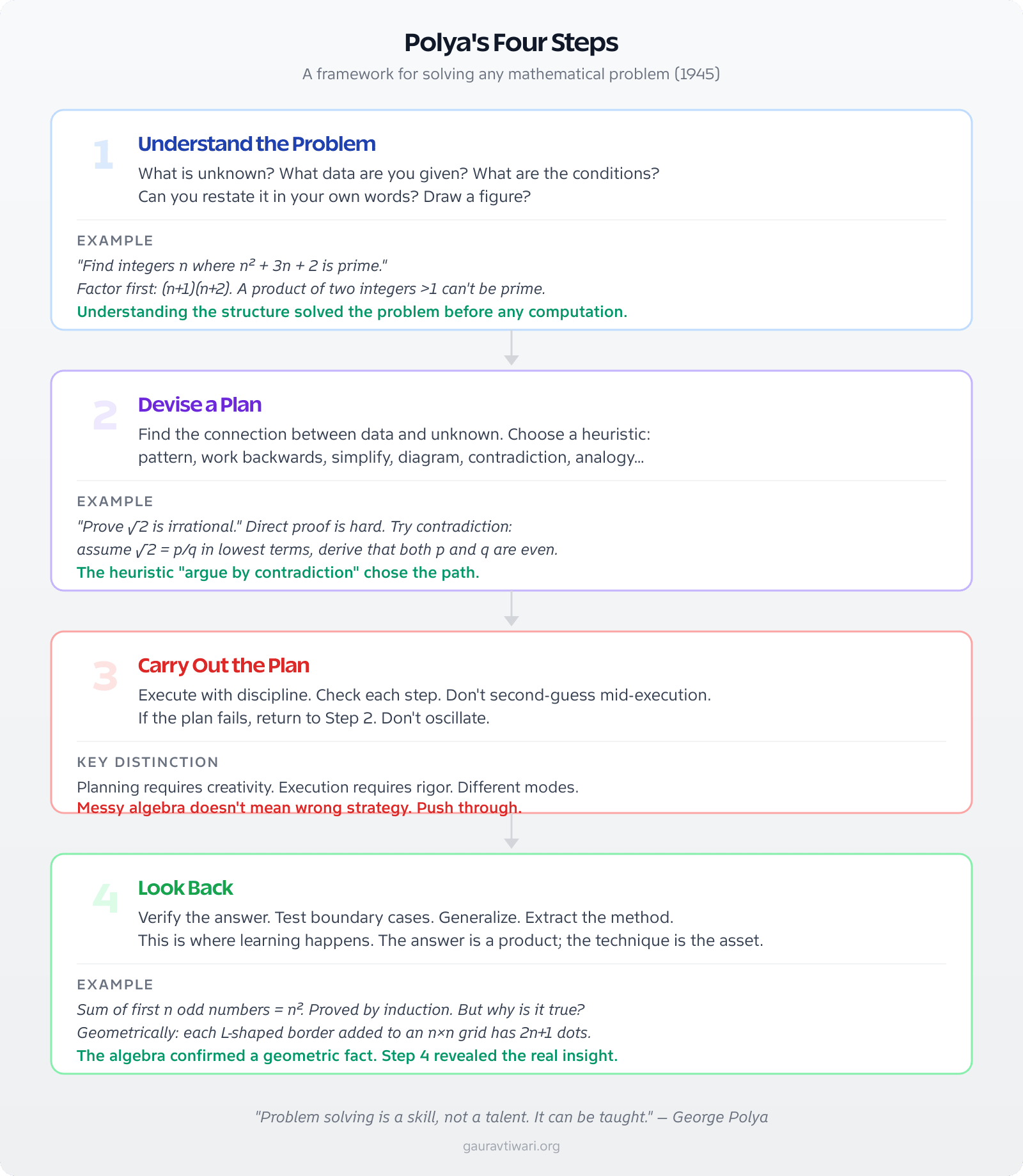
Step 1: Understand the Problem
This is the step everyone skips. And it’s the step where most failures originate.
Understanding the problem means more than reading it once. It means identifying precisely what is given, what is unknown, and what conditions connect them. Polya suggested asking yourself:
- What is the unknown? What are you actually asked to find or prove?
- What data are you given? What constraints exist?
- Can you restate the problem in your own words?
- Can you draw a figure, write the notation, or separate the conditions?
- Is the condition sufficient to determine the unknown? Or is it insufficient? Or redundant? Or contradictory?
That last question is the one that separates careful thinkers from everyone else. Before you solve anything, you should know whether the problem can be solved with what you’ve been given.
Example. “Find all integers \( n \) such that \( n^2 + 3n + 2 \) is prime.” Before reaching for techniques, understand the structure. Factor: \( n^2 + 3n + 2 = (n+1)(n+2) \). A product of two integers greater than 1 cannot be prime. So we need one factor to equal 1 or -1. That means \( n = 0 \) or \( n = -3 \), giving values 2 and 2. The answer is \( n = 0 \) and \( n = -3 \). The solution came from understanding, not computation.
Step 2: Devise a Plan
This is where problem solving becomes strategic. You need to find the connection between the data and the unknown. Polya catalogued a set of heuristics, mental tools that experienced mathematicians use almost unconsciously:
- Look for a pattern. Compute small cases. Does a regularity emerge?
- Work backwards. Start from the desired conclusion and ask what would imply it.
- Solve a simpler related problem. Reduce dimensions, remove constraints, try a special case.
- Draw a diagram. Geometry problems become obvious with the right picture. So do many combinatorial ones.
- Introduce auxiliary elements. Add a line to a geometry proof. Define a new variable. Reformulate using a substitution.
- Argue by contradiction. Assume the opposite and derive something impossible.
- Consider the contrapositive. Instead of proving “if P then Q,” prove “if not Q then not P.”
- Use analogy. Have you solved a problem with a similar structure? Can you use the same method?
The key insight Polya emphasized: if you can’t solve the proposed problem, find a related problem you can solve. Then ask whether that solution, or the method behind it, transfers.
Example. Prove that \( \sqrt{2} \) is irrational. Direct proof is difficult… what can you prove instead? Try contradiction. Assume \( \sqrt{2} = p/q \) in lowest terms. Then \( 2q^2 = p^2 \), so \( p^2 \) is even, so \( p \) is even, say \( p = 2k \). Then \( 2q^2 = 4k^2 \), so \( q^2 = 2k^2 \), so \( q \) is even. Contradiction: both \( p \) and \( q \) are even, but we assumed lowest terms. The heuristic “argue by contradiction” cracked it open.
Step 3: Carry Out the Plan
Execute your strategy. Check each step. Can you see clearly that each step is correct?
This sounds obvious, but Polya made an important distinction: devising the plan requires creativity and flexibility. Carrying it out requires discipline and rigor. They’re different cognitive modes. When executing, don’t keep second-guessing your strategy. Commit to the plan and follow it through. If it fails, you go back to Step 2, not keep oscillating between planning and executing.
Common failure mode: students abandon a correct approach midway because the algebra gets messy. Messy algebra doesn’t mean wrong strategy. Push through, simplify later.
Step 4: Look Back
The most underused step. You have an answer. Now what?
- Verify. Substitute your answer back. Does it satisfy the original conditions?
- Check dimensions and units. If your answer to a geometry problem has the wrong units, something went wrong.
- Test boundary cases. Does your formula work for \( n = 0 \)? For \( n = 1 \)? For large \( n \)?
- Generalize. Can you solve a more general version of this problem? What would change?
- Extract the method. What heuristic worked here? File it away for next time.
This is where learning actually happens. Solving the problem gives you an answer. Looking back gives you a technique you can reuse.
Polya himself wrote: “Even fairly good students, when they have obtained the solution of the problem and written down neatly the argument, shut their books and look for something else. Doing so, they miss an important and instructive phase of the work.”
Beyond Polya: What Experience Adds
Polya’s framework is necessary but not sufficient. Here’s what I’d add from experience with students and my own mathematical work.
Build Your Problem Vocabulary
Every solved problem adds a pattern to your mental library. The more problems you’ve seen, the faster you recognize structure. This is why mathematicians like Fields Medal winners often describe problem solving as “pattern matching” rather than “creative insight.” The insight comes from having a deep library of patterns.
Terence Tao, one of the most gifted problem solvers alive, writes on his blog that mathematical talent is overrated and mathematical practice is underrated. The best problem solvers aren’t necessarily the smartest. They’ve just solved more problems.
Get Comfortable with Being Stuck
Research mathematics is mostly being stuck. Andrew Wiles spent seven years in isolation working on Fermat’s Last Theorem. Most of that time was confusion, dead ends, and incremental progress that didn’t feel like progress.
The difference between students who develop mathematical maturity and those who don’t isn’t intelligence. It’s tolerance for confusion. If being stuck for 30 minutes makes you give up, you’ll never solve problems that matter. If being stuck for 30 minutes makes you curious about why you’re stuck, you’ll develop the instincts that no textbook can teach.
Write Clearly, Even for Yourself
Sloppy notation leads to sloppy thinking. When I see a student write “\( f(x) = x^2 \)” and then two lines later treat \( f \) as a different function, the error isn’t mathematical. It’s communicational. They confused themselves.
Write your solutions as if someone else will read them. Define your variables. State your assumptions. Label your steps. This discipline catches errors before they propagate and it forces you to understand what you’re actually doing at each stage.
A Worked Example: All Four Steps
Let’s walk through Polya’s method on a problem that’s simple enough to follow but rich enough to illustrate the framework.
Problem: Prove that the sum of the first \( n \) odd numbers equals \( n^2 \).
Step 1: Understand. The first \( n \) odd numbers are \( 1, 3, 5, \ldots, (2n-1) \). We need to show their sum is \( n^2 \). Let’s verify small cases: \( 1 = 1^2 \). \( 1 + 3 = 4 = 2^2 \). \( 1 + 3 + 5 = 9 = 3^2 \). Checks out.
Step 2: Plan. The pattern holds for small cases. This is a “for all \( n \)” statement, so mathematical induction is the natural strategy.
Step 3: Execute. Base case: \( n = 1 \). Sum = 1 = \( 1^2 \). Holds. Inductive step: assume the sum of the first \( k \) odd numbers is \( k^2 \). Adding the next odd number: \( k^2 + (2k + 1) = k^2 + 2k + 1 = (k+1)^2 \). Done.
Step 4: Look back. The proof works. But can we see why it’s true, not just that it’s true? Think geometrically: arrange \( n^2 \) dots in a square grid. Each new “L-shaped” border you add to grow from an \( n \times n \) square to an \( (n+1) \times (n+1) \) square contains exactly \( 2n + 1 \) dots, the next odd number. The algebra confirms a geometric fact. That’s the kind of insight Step 4 gives you.
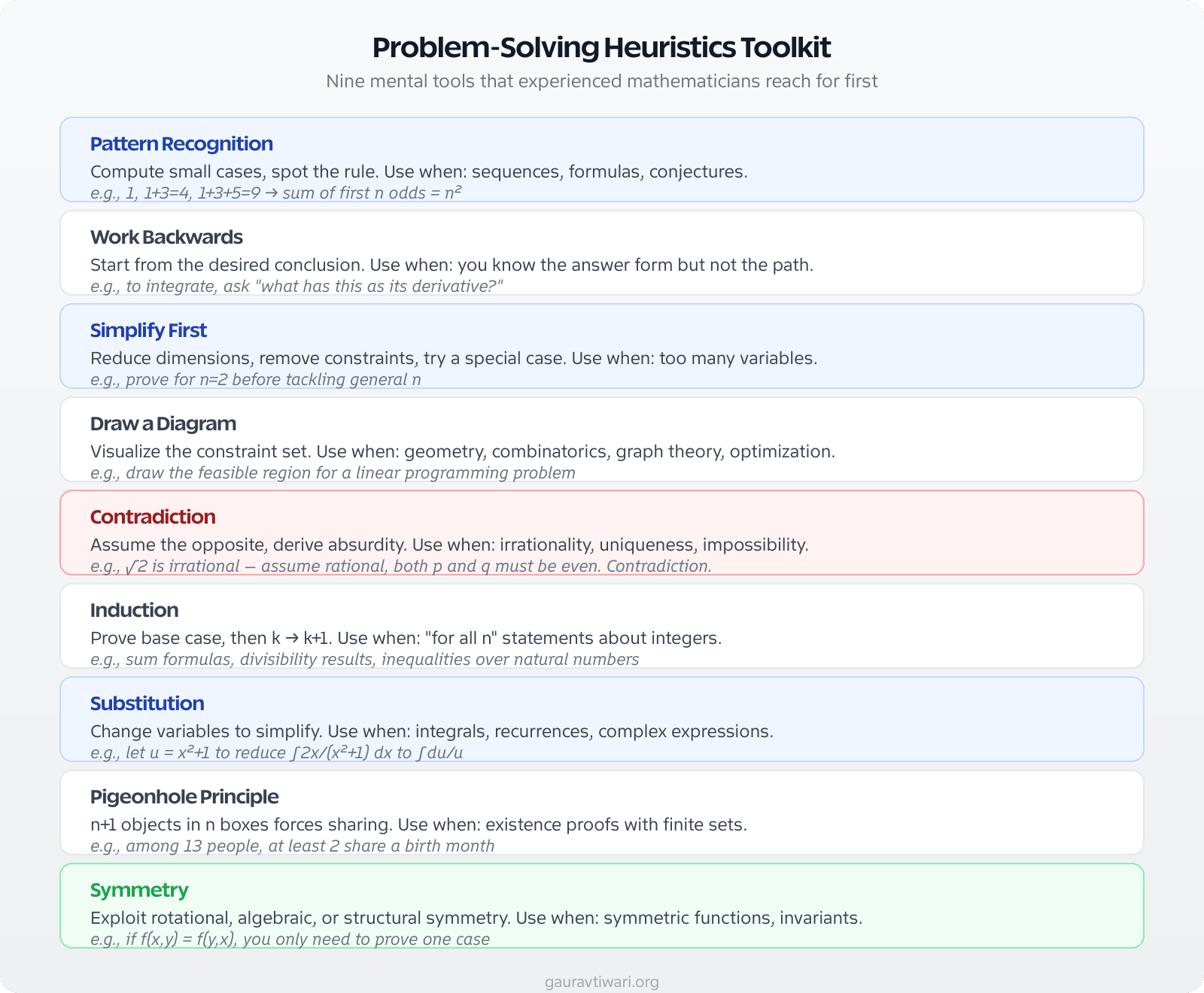
Quick Reference: Problem-Solving Heuristics
| Heuristic | When to Use | Example |
|---|---|---|
| Pattern recognition | Sequence or formula problems | Compute small cases, spot the rule |
| Working backwards | You know the answer form but not the path | Integration by knowing the derivative |
| Simplify the problem | Too many variables or constraints | Prove for n=2 first, then generalize |
| Draw a diagram | Geometry, combinatorics, graph theory | Visualize the constraint set |
| Contradiction | Existence/uniqueness proofs, irrationality | Assume the opposite, derive absurdity |
| Induction | “For all n” statements | Sum formulas, divisibility, inequalities |
| Substitution | Simplify expressions or change perspective | Let u = f(x) to reduce complexity |
| Pigeonhole principle | Existence proofs with finite sets | n+1 objects in n boxes forces sharing |
| Symmetry | Problem has rotational or algebraic symmetry | Symmetric functions, invariant arguments |
Resources for Going Deeper
If Polya’s framework resonates with you, here’s where to go next:
- George Polya, How to Solve It (1945) — the original. Still the best introduction to mathematical problem-solving heuristics. Short, readable, and dense with insight.
- George Polya, Mathematics and Plausible Reasoning (1954) — the deeper follow-up. Two volumes on induction, analogy, and patterns of plausible inference in mathematics.
- Terence Tao’s career advice — practical guidance from one of the best living mathematicians
- Best Algebra Books — for building the foundational toolkit
- Must-Read Math Research Papers — for seeing how professionals solve hard problems
- Examination Strategies and Tactics — for applying problem solving under time pressure
- A Problem from Bhaskaracharya’s Lilavati — a beautiful example of historical problem solving
- Princeton Companion to Mathematics: Advice to Younger Mathematicians
Problem solving is a craft. Like any craft, it improves with deliberate practice, not passive repetition. Solve problems that are slightly too hard for you. Get stuck. Use Polya’s steps to get unstuck. Look back at what worked. Build your library of patterns. That’s the whole method.