
Most blogs die in silence. Not because the writing is bad. Not because the topic is wrong. They die because nobody ever sees them.
I’ve run a blog since 2008. I’ve watched thousands of bloggers publish great content and quit within 18 months because traffic never showed up. The pattern is always the same: write, publish, share once on social media, wait, get discouraged, repeat until burnout wins.
The bloggers who survive and eventually thrive? They figured out marketing. And I don’t mean the sleazy kind. I mean the systematic work of getting the right content in front of the right people, building trust over time, and turning that trust into income. That’s what this book is about.
The Publish-and-Pray Problem
Here’s the uncomfortable math. WordPress alone sees over 70 million new posts every month. That’s not a typo. Seventy million. Your latest article is competing with 2.3 million other posts published the same day.
“Write great content and they will come” is the biggest lie in blogging. It sounds nice. It feels fair. It’s completely wrong.
I’ve seen bloggers with genuinely useful content, well-researched and well-written, sitting at 200 pageviews a month after two years. I’ve also seen mediocre content pulling 50,000 monthly visitors because the blogger understood distribution. The difference isn’t talent. It’s strategy.
The Distribution Gap
Most bloggers spend 90% of their time creating content and 10% distributing it. The ratio should be closer to 50/50, especially in the first two years.
Here’s what distribution actually means:
- SEO that matches search intent, not just keywords
- Internal linking that keeps readers moving through your site
- Email capture that builds an audience you own
- Strategic repurposing across platforms where your readers already hang out
- Relationships with other bloggers in your space
None of this is glamorous. None of it feels as satisfying as hitting publish on a new post. But it’s the difference between a hobby blog and a business.
The Volume vs. Visibility Trap
I’ve made this mistake myself. Between 2009 and 2012, I published over 400 posts on one of my sites. Traffic was flat. I thought publishing more would fix it. It didn’t.
The problem wasn’t volume. It was that I had no system for getting those posts found. No keyword strategy. No internal linking plan. No email list. I was just throwing content at the wall and hoping something would stick.
When I finally stopped publishing for three months and focused entirely on distribution (updating old posts, building links, starting an email list), traffic doubled. I’d been solving the wrong problem for years.
Marketing vs. Promotion (They’re Not the Same)
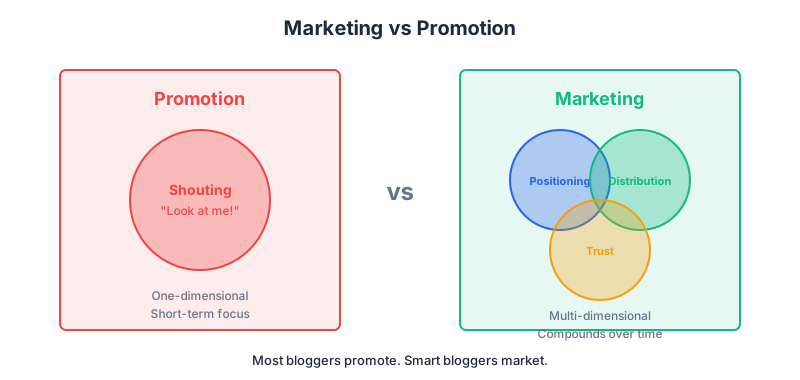
Promotion is announcing what you made. Marketing is the entire system that makes your blog visible, trustworthy, and profitable.
Here’s the difference:
Promotion looks like:
- Sharing your new post on Twitter
- Dropping a link in a Facebook group
- Asking friends to share
- One-time announcements that fade in hours
Marketing looks like:
- Positioning your blog so readers know exactly what you offer
- Building a content system that compounds over time
- Creating trust signals that make readers choose you over alternatives
- Developing relationships that lead to ongoing visibility
- Building owned channels (email) so you’re not dependent on algorithms
Promotion is a tactic. Marketing is a system. You need both, but the system matters more.
The Blogger Who Promotes vs. The Blogger Who Markets
I’ve watched two bloggers start in the same niche at the same time.
Blogger A publishes consistently, shares every post on social media, engages in comments, and stays active. After two years, they’re at 5,000 monthly pageviews. Not bad, but not enough to generate real income.
Blogger B publishes less frequently but spends significant time on keyword research before writing. They build an email list from day one. They reach out to other bloggers for guest posts and collaborations. They update old content when it starts ranking. After two years, they’re at 40,000 monthly pageviews and making $2,000/month from affiliates.
Same amount of total effort. Radically different results. Blogger A promoted. Blogger B marketed.
Why This Distinction Matters for Monetization
If you’re reading this book, you probably want your blog to make money. The monetization priority I’ll teach you (affiliate first, then sponsored posts, then backlinks, then services) only works if you have traffic and trust.
Promotion can get you spikes of attention. Marketing gets you consistent traffic. And consistent traffic is what makes affiliate income predictable, sponsors interested, and services viable.
The Two Outcomes That Matter
Everything in blog marketing comes down to two things: attention and trust.
Attention means getting found. It’s the top of the funnel. SEO, social media, referrals, email opens. Without attention, nothing else matters. You could have the best product recommendations and the most helpful tutorials, but if nobody sees them, you make zero.
Trust means getting believed. It’s what converts attention into action. When a reader trusts you, they click your affiliate links, open your emails, consider your recommendations, and eventually buy what you suggest.
You can’t shortcut either one. Attention without trust leads to high bounce rates and no conversions. Trust without attention means you have 50 loyal readers who love you but can’t sustain a business.
How Attention and Trust Compound
Here’s where it gets interesting. Attention and trust don’t just add up. They multiply.
Let’s say you have 1,000 monthly visitors and a 2% affiliate conversion rate. That’s 20 conversions per month. If average commission is $30, you’re making $600/month.
Now, imagine you double your attention (2,000 visitors) while keeping trust constant. You get 40 conversions and $1,200/month.
But if you improve trust instead (keeping visitors at 1,000 but improving conversion to 4%), you also get 40 conversions and $1,200/month.
The real magic happens when you improve both. 2,000 visitors at 4% conversion equals 80 conversions and $2,400/month. That’s 4x your original revenue from doubling two metrics.
This is why marketing matters so much. You’re not just trying to get more eyeballs. You’re building a system where attention and trust reinforce each other.
Trust Is Harder to Build Than Attention
Getting attention is a solved problem. There are proven tactics: SEO, social media, paid ads, collaborations. They take work, but they’re repeatable.
Trust is different. Trust requires consistency over time. It requires honesty even when it costs you money (like telling readers when a product isn’t worth the affiliate commission). It requires showing up regularly with content that actually helps.
I’ve seen bloggers destroy years of trust with a single dishonest product recommendation. The affiliate payout wasn’t worth it. It never is.
Throughout this book, I’ll show you how to build both attention and trust. But I want you to understand from the start: trust is the asset. Attention is just how you fill the top of the funnel.
The Compounding Timeline Nobody Talks About
Blogging rewards patience. But nobody tells you what the actual timeline looks like.
I’ve been doing this since 2008. I’ve launched multiple blogs, helped hundreds of clients, and watched the industry evolve through algorithm changes, platform shifts, and monetization trends. Here’s what I’ve learned about realistic timelines.
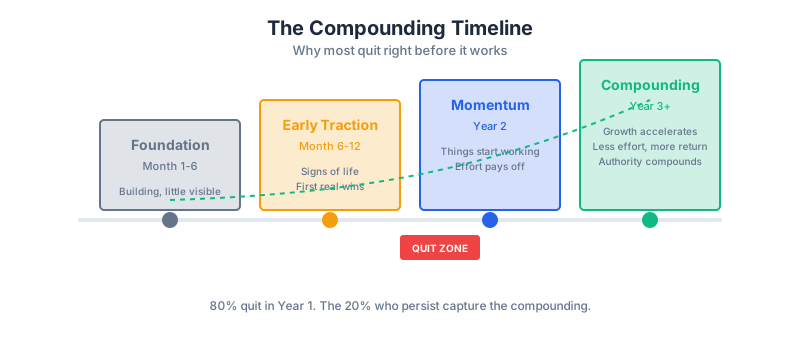
Months 1-6: Foundation Building
This is the hardest phase because you’re putting in effort with almost no visible return.
During this period, you’re:
- Publishing your first 20-30 posts
- Learning what resonates (and what doesn’t)
- Building your email list from 0 to a few hundred subscribers
- Getting indexed by search engines
- Making zero to almost zero money
Most bloggers quit during this phase. They compare themselves to established bloggers making $10,000/month and feel like failures. They’re not failures. They’re just early.
If you’re in months 1-6 right now, your only job is to keep going. Publish consistently. Build your email list. Learn from what performs. Don’t worry about revenue yet.
Months 6-12: Early Traction
This is when you start seeing signs of life.
Organic traffic begins climbing. Your email list hits 500-1,000 subscribers. Some posts start ranking on page 2 or even page 1 for low-competition keywords. Affiliate income trickles in, maybe $100-500/month.
The danger here is getting distracted by what’s working. You see one post get traffic and want to write ten more just like it. That’s sometimes right, but often wrong. Stay focused on your content pillars rather than chasing random wins.
Year 2+: Compounding Kicks In
This is where marketing efforts start paying off exponentially.
Old posts that were sitting on page 3 climb to page 1 after you update them and build internal links. Your email list grows faster because you have more content to attract subscribers. Affiliate income becomes more predictable because you have multiple posts driving conversions.
I didn’t make serious money from blogging until year 3. By year 5, it was generating more than my freelance income. By year 8, it had funded an agency and multiple other projects.
The bloggers who make it to year 2 almost always make it to year 5. The compounding is real. But you have to survive years 1 and 2 first.
Why Most Quit Right Before It Works
There’s a painful pattern I’ve seen dozens of times.
A blogger works hard for 14 months. Traffic is growing slowly. Income is minimal. They get discouraged and quit. Six months later, their abandoned blog is ranking for keywords they targeted, getting traffic they’ll never see, and could have been making money if they’d just kept going.
The gap between “this isn’t working” and “this is working” is often only 3-6 months. But it feels like forever when you’re in it.
I’m not saying every blog will succeed if you just persist. Some niches are too competitive. Some strategies are wrong. Some content isn’t good enough. But many blogs that could have worked don’t because the blogger quit during the dip instead of through it.
What This Book Will (and Won’t) Teach You
I want to be clear about what you’re getting into.
What’s Covered
Positioning and audience: How to define who your blog is for (and who it’s not for) so your content actually resonates. This is Chapter 2 and 3.
Content strategy: How to choose topics that build authority and drive traffic without burning you out. Chapter 4 and 5.
Conversion: How to turn readers into email subscribers and customers without being sleazy. Chapter 6.
Monetization systems: The full stack, affiliate marketing first (Chapters 7-8), then sponsored posts (Chapter 9), backlinks (Chapter 10), and services (Chapter 11).
Compounding assets: Email lists, retargeting, and analytics that matter. Chapters 12-13.
Ethics and longevity: How to build trust that lasts and make decisions you won’t regret. Chapter 14.
What’s Not Covered
Technical SEO deep-dives: I’ll cover SEO strategy, but I won’t teach you how to audit your site’s crawlability or fix canonical tag issues. That’s a different book.
Paid advertising mastery: I’ll mention retargeting briefly, but building Facebook ad funnels or Google Ads campaigns is outside our scope.
Social media tactics: I won’t tell you the best time to post on Instagram or how to grow a TikTok following. We’ll touch on social as a distribution channel, but this isn’t a social media playbook.
Platform-specific tricks: Algorithm hacks and platform exploits change constantly. I’m teaching principles that work regardless of which platform is trending.
The Priority Order
The monetization approach in this book follows a specific order:
- Affiliate marketing first: Lowest barrier, aligned incentives, works at almost any traffic level.
- Sponsored posts second: Requires established audience, higher per-post revenue.
- Backlink selling third: Gray area, requires domain authority, used carefully.
- Services fourth: Highest margin, highest time investment, converts authority into premium income.
This isn’t the only valid order. But it’s the one I’ve seen work most consistently for content-focused bloggers who want sustainable income without massive startup costs.
Chapter Checklist
Before moving to Chapter 2, make sure you can answer these questions:
- [ ] Do I understand the difference between promotion and marketing?
- [ ] Can I identify my current distribution channels and how effective each one is?
- [ ] Do I know my current traffic numbers and where most visitors come from?
- [ ] Have I set realistic expectations for my blogging timeline?
- [ ] Am I clear on what this book will and won’t teach?
Chapter Exercise
Task: Map your current content distribution system.
Time required: 30-45 minutes
Deliverable: A simple grid showing:
- Every channel where you currently share or distribute content
- How often you use each channel
- A 1-10 rating for how effective each channel is at driving traffic
- A 1-10 rating for how much effort each channel requires
Example:
- Channel: Organic search | Frequency: Always on | Traffic Effectiveness (1-10): 7 | Effort Required (1-10): 8
- Channel: Email newsletter | Frequency: Weekly | Traffic Effectiveness (1-10): 6 | Effort Required (1-10): 4
- Channel: Twitter | Frequency: Daily | Traffic Effectiveness (1-10): 3 | Effort Required (1-10): 5
- Channel: Pinterest | Frequency: 2x/week | Traffic Effectiveness (1-10): 5 | Effort Required (1-10): 3
- Channel: Guest posting | Frequency: Monthly | Traffic Effectiveness (1-10): 6 | Effort Required (1-10): 9
Once you’ve mapped this, identify: - Which channel has the best ratio of effectiveness to effort?
- Which channel are you underinvesting in?
- Which channel should you probably stop wasting time on?
This exercise gives you a baseline. By the end of this book, you’ll rebuild this system from the ground up.