
If you can’t explain what your blog does in one clear sentence, neither can anyone else. And if people can’t explain you, they can’t recommend you, remember you, or choose you over the other 600 million blogs online.
Positioning is the foundation everything else builds on. Your content strategy, your monetization, your email marketing, your brand. All of it flows from a clear answer to one question: what is this blog actually about, and why should I care?
This chapter is about nailing that answer. One sentence. No fluff. No “I write about my passions.” Just clarity that makes readers think, “This is exactly what I was looking for.”
What Positioning Actually Means
Positioning isn’t a tagline. It’s not a mission statement. It’s not your “about” page copy.
Positioning is the specific space you own in your reader’s mind. It’s the mental category they file you under. When they think “WordPress speed optimization,” does your blog come to mind? When they think “budget travel for families,” do they think of you?
The Space You Own
Every successful blog owns a mental category. Not “business advice” but “business advice for freelance writers.” Not “food blog” but “30-minute weeknight dinners for busy parents.” Not “tech reviews” but “honest laptop reviews for students on a budget.”
The more specific the space, the easier it is to own. “Business advice” is a crowded category with established giants. “Business advice for freelance writers” has fewer competitors and a more focused audience.
Here’s the test: when someone in your target audience has a question about your topic, do they think of you? If not, your positioning isn’t clear enough.
What Positioning Is Not
Not a tagline. Taglines are marketing copy. They can be clever or catchy. Positioning is strategic clarity. It doesn’t have to be clever. It has to be true and specific.
Not a mission statement. Mission statements are internal documents about values and purpose. “We believe in democratizing knowledge.” Great. But that doesn’t tell me what you write about or who it’s for.
Not your bio. “I’m a freelance writer who loves coffee and travel.” That’s about you, not about what your blog offers the reader.
Not your niche. Your niche is your general topic area. Your positioning is how you approach that topic differently than others.
Positioning vs. Branding
People confuse these constantly.
Branding is how you look, sound, and feel. Colors, fonts, voice, personality. It’s the aesthetic and emotional experience.
Positioning is what you are. The category you compete in. The problem you solve. The audience you serve.
You need both. But positioning comes first. You can’t build a brand if you don’t know what you’re branding. I’ve seen bloggers spend weeks on logo design and color palettes while their positioning is a mess. That’s like decorating a house before you’ve built the foundation.
Get positioning right first. Branding follows.
The Positioning Formula
Here’s a simple formula that works for most blogs:
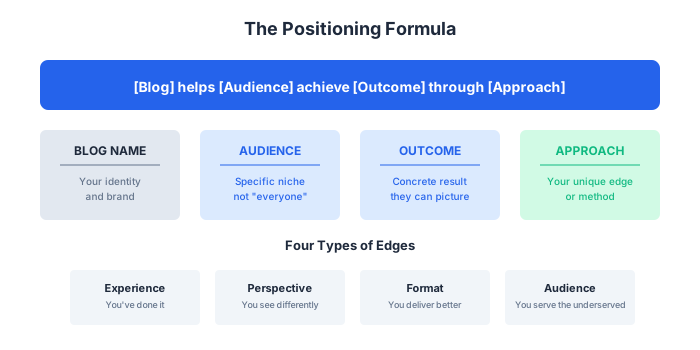
[Blog name] helps [specific audience] [achieve specific outcome] through [your unique approach].
Let’s break down each component.
Specific Audience
This connects directly to the reader profile you built in Chapter 2. Who, specifically, is this blog for?
Weak: “Bloggers” or “small business owners” or “people interested in health”
Strong: “WordPress bloggers who want to turn their site into a business” or “solo consultants making $50-150K who want to scale without hiring” or “busy parents who want to eat healthier without spending hours cooking”
The more specific, the better. Specific doesn’t mean small. It means clear.
Specific Outcome
What transformation does your blog help readers achieve? What’s different after they’ve consumed your content?
Weak: “Learn about marketing” or “get healthy” or “improve their business”
Strong: “Build a blog that generates $3,000/month in affiliate income” or “lose 20 pounds without giving up the foods they love” or “land their first $10K consulting client”
Outcomes should be concrete and desirable. Readers should be able to picture what success looks like.
Unique Approach
This is your edge. What’s different about how you approach the topic?
Weak: “Comprehensive guides” or “quality content” or “practical advice” (everyone says this)
Strong: “Step-by-step systems tested on 50+ client sites” or “recipes that take under 30 minutes with under 10 ingredients” or “strategies I’ve used to scale from $0 to $200K in consulting revenue”
Your unique approach is usually one of four things: experience, perspective, format, or audience. We’ll cover these in detail next.
Examples of Strong Positioning Statements
Food blog: “Budget Bytes helps home cooks who want to eat well on a tight budget create delicious meals for under $10 through tested recipes with cost breakdowns for every ingredient.”
Marketing blog: “Copyblogger helps content marketers who want to drive business results write content that attracts and converts through proven copywriting frameworks and real-world examples.”
Personal finance: “Mr. Money Mustache helps high-income professionals who want to retire early build wealth through aggressive saving, index investing, and questioning conventional spending.”
Tech blog: “WPBeginner helps WordPress beginners who feel overwhelmed by the platform build their first website through simple tutorials with screenshots for every step.”
Notice the pattern: specific audience + specific outcome + unique approach. These blogs are instantly understandable. You know immediately if they’re for you.
Finding Your Edge
Your positioning needs an edge. Something that makes you different from the other blogs covering similar topics.
There are four types of edges. Most successful blogs have one dominant edge and maybe a secondary one.
Experience Edge
You’ve done what you teach. You have results. You can back up your advice with proof.
“I’ve built 800+ WordPress sites for clients. Here’s what I’ve learned about what works.”
“I paid off $127,000 in debt in 4 years. Here’s exactly how I did it.”
“I’ve grown my blog to 100,000 monthly visitors. Here’s the strategy.”
Experience edges are powerful because they’re credible and hard to fake. They also attract readers who want to learn from someone who’s actually done the thing.
How to develop: Document your results. Track your progress. Be specific with numbers. If you don’t have impressive results yet, start building them and share the process.
Perspective Edge
You see the topic differently. You have contrarian views. You challenge conventional wisdom.
“Everyone says you need to post daily on social media. I think that’s a waste of time. Here’s why.”
“Most productivity advice is written by people who don’t have kids. I’m writing for parents who have 2 hours a day, max.”
“The standard advice about retirement is designed for employees. Here’s what it looks like for entrepreneurs.”
Perspective edges attract readers who are frustrated with mainstream advice. They create loyal audiences because readers feel like you “get” them when others don’t.
How to develop: Question the common advice in your niche. What do you disagree with? What do you think everyone’s getting wrong? What’s missing from the standard approach?
Format Edge
You deliver information better than others. Your content is easier to consume, more actionable, or presented in a unique way.
“Every tutorial includes a video walkthrough, written steps, and downloadable checklist.”
“I break down complex tax topics into 5-minute explanations.”
“Every recipe includes a cost breakdown, nutrition info, and scaling instructions.”
Format edges work because they make your content more useful even if the underlying information is similar to competitors.
How to develop: Look at how competitors present information. What’s frustrating about it? What’s missing? What would make it 2x more useful?
Audience Edge
You serve an underserved group within a larger market. You’re the specialist for a specific subset.
“WordPress hosting advice specifically for WooCommerce stores”
“Fitness content for people over 50 who’ve never exercised”
“Investing strategies for freelancers with irregular income”
Audience edges work because readers feel like the content was made specifically for them. Generic advice always feels like it needs translation to apply to your situation. Audience-specific advice already speaks your language.
How to develop: Look for gaps. Who in your broader niche is underserved? Who do the big players ignore? What subset of your audience has unique needs that aren’t being addressed?
Combining Edges
The strongest positioning usually combines two edges:
- Experience + Perspective: “I’ve grown 3 businesses to $1M+ and I think most startup advice is wrong”
- Format + Audience: “Simple video tutorials for WordPress beginners”
- Experience + Audience: “SEO strategies from an agency owner, specifically for local service businesses”
Don’t try to have all four. That’s not positioning, that’s listing features. Pick your strongest edge and lean into it.
Testing Your Positioning
A positioning statement is only useful if it’s actually true and actually resonates. Here’s how to test it.
The “So What?” Test
Read your positioning statement out loud. Then ask, “So what? Why should I care?”
If you can’t answer that immediately, your outcome isn’t compelling enough.
Fails the test: “I help bloggers create better content.” (So what? What does “better” mean? What’s the result of better content?)
Passes the test: “I help bloggers create content that ranks on Google and drives affiliate sales.” (Clear outcome. I can see why I’d want that.)
Keep asking “so what?” until you hit something concrete and desirable.
The “Who Else Does This?” Test
Search for your positioning. Are there 50 other blogs saying the same thing?
If yes, you need to narrow further. Either narrow your audience, sharpen your outcome, or find a unique approach that differentiates you.
Fails the test: “I help small business owners with marketing.” (Thousands of blogs say this)
Passes the test: “I help Etsy sellers get their first 100 sales through Pinterest marketing.” (Specific enough that you can count the competitors on two hands)
This doesn’t mean you need zero competitors. Competition validates the market. But you need to be different enough that readers can see why they’d choose you.
The “Can I Prove It?” Test
Can you back up your positioning with evidence?
If you claim an experience edge, do you have the results to show?
If you claim a perspective edge, have you actually tested your contrarian approach?
If you claim a format edge, is your format actually better (not just different)?
Fails the test: “I help businesses 10x their revenue.” (Can you prove you’ve done this? Even once?)
Passes the test: “I help WordPress sites load in under 2 seconds. Here are 23 case studies.” (Verifiable, specific, backed by evidence)
Positioning without proof is just marketing claims. Readers are skeptical. They’ve heard big promises before. Proof is what makes positioning believable.
Positioning Across Monetization Models
Your positioning affects how you monetize. Different positioning statements work better for different revenue streams.
Positioning for Affiliate Trust
Affiliate marketing requires trust. Readers need to believe your recommendations are honest, not just commission-driven.
Strong affiliate positioning includes:
- Evidence you’ve actually used the products
- Willingness to criticize products when deserved
- Clear expertise in evaluating options
- Specific results from using the tools you recommend
“I’ve tested every major WordPress caching plugin on real client sites. I’ll show you which ones actually deliver and which ones are overrated.”
This positioning builds trust because it’s clear you have experience and you’re willing to give honest opinions, not just push the highest commissions.
Positioning for Sponsored Appeal
Sponsors want reach, credibility, and audience alignment. They’re paying to access your audience.
Strong sponsored positioning includes:
- Clear audience definition (sponsors need to know who they’re reaching)
- Demonstrated engagement (comments, shares, email opens)
- Professional presentation
- Relevant niche that matches their products
“I reach 50,000 WordPress site owners monthly who are actively investing in tools to grow their businesses.”
This positioning attracts sponsors because it’s clear who the audience is and that they’re buyers, not just browsers.
Positioning for Service Authority
Services require the strongest credibility. You’re asking people to pay premium prices for your expertise.
Strong service positioning includes:
- Demonstrated results (case studies, testimonials)
- Clear specialization (generalists can’t charge premium rates)
- Proof of experience (portfolio, client names, numbers)
- Specific outcomes you deliver
“I help WordPress sites pass Core Web Vitals through performance optimization. I’ve fixed 200+ sites with a 100% success rate.”
This positioning commands premium pricing because it’s specific, proven, and outcome-focused. Clients know exactly what they’re getting.
Your Positioning Should Support Your Monetization Priority
If your priority is affiliate marketing (as I recommend for most bloggers), your positioning should emphasize expertise and trust in evaluating products.
If you’re moving toward sponsored content, your positioning should emphasize audience size and engagement.
If services are your goal, your positioning should emphasize results and credentials.
Build your positioning to support where you want to go, not just where you are today.
Chapter Checklist
- [ ] Can I explain what my blog does in one clear sentence?
- [ ] Have I identified my primary edge (experience, perspective, format, or audience)?
- [ ] Does my positioning pass the “so what?” test?
- [ ] Does my positioning pass the “who else does this?” test?
- [ ] Does my positioning pass the “can I prove it?” test?
- [ ] Does my positioning support my monetization goals?
Chapter Exercise
Task: Write 5 positioning statements for your blog and test each one.
Time required: 60-90 minutes
Deliverable: One final positioning statement that passes all three tests.
Process:
-
Write 5 different positioning statements using the formula: [Blog name] helps [specific audience] [achieve specific outcome] through [your unique approach].
-
For each statement, identify which edge you’re emphasizing (experience, perspective, format, or audience).
-
Test each statement:
- Does it pass the “so what?” test?
- Does it pass the “who else does this?” test?
- Does it pass the “can I prove it?” test?
-
Eliminate any statements that fail multiple tests.
-
For remaining statements, ask: which one best supports my monetization goals?
-
Pick your final statement. Write it somewhere you’ll see it before every piece of content you create.
Example process:
Statement 1: “WordSpeedPro helps WordPress site owners load their sites faster through performance optimization tutorials.”
Tests: Fails “who else does this?” (too many competitors). Weak on “can I prove it?” (no specific results mentioned).
Statement 2: “WordSpeedPro helps WordPress bloggers making under $1,000/month get better ad revenue through proven speed fixes that improved RPMs for 40+ sites I’ve personally optimized.”
Tests: Passes “so what?” (clear benefit: better ad revenue). Passes “who else does this?” (specific audience + specific results). Passes “can I prove it?” (40+ sites is verifiable).
Winner: Statement 2. Supports affiliate monetization (trust through proven results) and service positioning (demonstrated expertise).
Your final positioning statement becomes the foundation for everything in the next chapters. Get it right before moving on.