
The fastest way to grow a blog is to shrink your audience. That sounds backwards, but I’ve watched it play out hundreds of times.
Bloggers who try to help everyone end up helping no one. Their content is too generic to rank, too broad to resonate, and too unfocused to build real authority. Meanwhile, bloggers who pick a specific reader and ignore everyone else build loyal audiences, rank for targeted keywords, and actually make money.
This chapter is about making that choice. It’s uncomfortable. You’ll feel like you’re leaving opportunity on the table. You’re not. You’re clearing away the noise so the right readers can find you.
The “Everyone” Trap
I fell into this trap early. My first blog covered “technology and lifestyle.” That meant I wrote about smartphones, productivity apps, travel tips, and occasionally recipes. The logic was simple: more topics meant more potential readers.
The result was a mess. Search engines couldn’t figure out what my site was about. Readers who found my smartphone review had no interest in my travel content. My email list was a random collection of people with nothing in common. And I couldn’t build authority in any single area because I was spreading myself across a dozen.
Why Broad Appeals Fail
When you write for everyone, you write for no one in particular. And content for no one in particular doesn’t rank, doesn’t convert, and doesn’t build a business.
Here’s what happens with broad content:
SEO suffers. Google rewards topical authority. A site with 100 posts about WordPress hosting will outrank a general tech site with 5 posts about hosting, even if those 5 posts are better. Search engines trust specialists.
Readers don’t stick. If someone finds your blog through a post about email marketing, then sees your recent posts are about gardening and cryptocurrency, they leave. They wanted an email marketing resource. You showed them a random collection.
Monetization breaks. Affiliate marketing works when you can recommend products to a specific audience with specific needs. If your audience is “people who use the internet,” good luck finding products that fit.
The Math of Attention
Think about it this way. Would you rather have:
- 10,000 monthly visitors who are vaguely interested in “business topics”
- 2,000 monthly visitors who are actively looking for WordPress performance advice
The second group is worth more. Way more. They have a specific problem. They’re further along the buying cycle. They’re more likely to trust your recommendations because you’re clearly an expert in their exact area.
I’ve seen niche blogs with 5,000 monthly visitors make $3,000/month from affiliates. I’ve seen general blogs with 50,000 monthly visitors struggle to make $500. Traffic volume matters less than traffic quality.
Case Study: Two Blogs, Same Start
In 2018, I helped two bloggers launch sites in adjacent niches. Both started from zero at roughly the same time.
Blogger A chose “digital marketing” as their topic. Broad. Competitive. They wrote about SEO, social media, email, content marketing, paid ads. A little bit of everything.
Blogger B chose “email marketing for course creators.” Narrow. Specific. Every post focused on that exact intersection.
After 18 months:
- Blogger A had 3,200 monthly visitors and was making about $200/month from affiliates
- Blogger B had 8,500 monthly visitors and was making $1,400/month from affiliates
Blogger B wrote less content. But every post attracted exactly the right reader, built authority in a specific space, and recommended products that audience actually needed.
Reader Archetypes for Bloggers
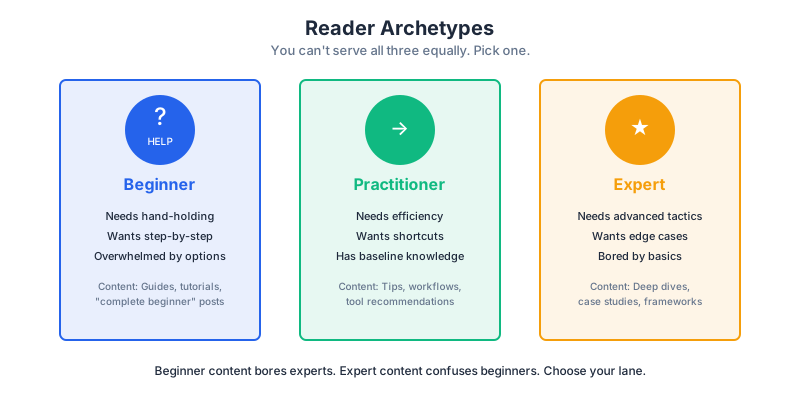
Not all readers want the same thing. Understanding the different types helps you choose who to focus on.
The Beginner
Beginners are just starting. They don’t know the terminology. They need hand-holding. They’re often overwhelmed and looking for someone to simplify things.
What they need: Step-by-step guides, glossaries, “start here” content, reassurance that they can do this.
What they don’t need: Advanced tactics, assumed knowledge, jargon-heavy content.
Monetization potential: Lower per-reader, but high volume. Beginners often buy courses and entry-level tools. They’re less likely to buy expensive software or services.
The Practitioner
Practitioners have been at it for a while. They know the basics. They’re looking for efficiency gains, better tools, and tactics to improve what they’re already doing.
What they need: Comparisons, reviews, workflow improvements, time-saving techniques, specific solutions to specific problems.
What they don’t need: Beginner explanations, basic definitions, motivation.
Monetization potential: Highest for affiliate marketing. Practitioners actively buy tools and are willing to pay for better solutions. They trust expert recommendations.
The Expert
Experts have seen it all. They’re looking for cutting-edge tactics, contrarian perspectives, or very deep technical content. They’re often other bloggers or professionals in your space.
What they need: Original research, advanced strategies, industry analysis, opinions that challenge conventional wisdom.
What they don’t need: Anything they could find on the first page of Google.
Monetization potential: High for services and high-ticket products. Lower volume but higher value per reader. They’re also more likely to share your content and build your reputation.
Why You Can’t Serve All Three
Here’s the problem. Content that works for beginners bores practitioners. Content that excites experts confuses beginners. You can’t write one post that serves all three audiences well.
Some bloggers try to solve this with “comprehensive guides” that start basic and get advanced. These rarely work. Beginners get lost in the advanced sections. Experts skip to the end and find it’s not deep enough. You’ve written 5,000 words that satisfy no one.
Pick one primary audience. You can occasionally write for the others, but 80% of your content should serve your core reader.
My recommendation for most bloggers: focus on practitioners. They have money, they’re actively looking for solutions, and they share content with their networks. Beginners are high-maintenance and low-conversion. Experts are rare and hard to impress.
Pain Levels and Awareness Stages
Beyond archetypes, readers exist at different stages of awareness about their problems and potential solutions. This matters for content strategy and monetization.
The Awareness Ladder
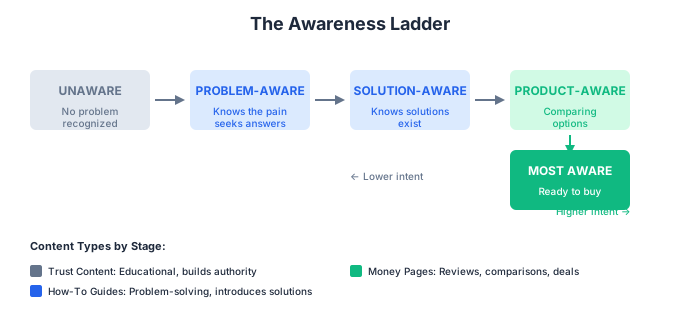
Eugene Schwartz defined five stages of awareness in his classic book on advertising. They apply perfectly to blogging:
Unaware: Reader doesn’t know they have a problem. They’re not searching for solutions because they don’t realize anything is wrong.
Problem-aware: Reader knows something is wrong but doesn’t know solutions exist. They’re searching for answers to questions like “why is my website slow?”
Solution-aware: Reader knows solutions exist but doesn’t know about specific products. They’re searching “how to speed up WordPress.”
Product-aware: Reader knows about specific products but hasn’t decided. They’re searching “WP Rocket vs FlyingPress” or “best caching plugin.”
Most aware: Reader knows exactly what they want. They’re searching “FlyingPress discount code” or “buy WP Rocket.”
Mapping Content to Awareness Stages
Different content serves different stages:
Problem-aware content: Educational posts that name and explain problems. “Why Your WordPress Site Is Slow (And Why It Matters).” These build trust but aren’t immediately monetizable.
Solution-aware content: How-to guides that explain approaches. “5 Ways to Speed Up Your WordPress Site.” Some monetization potential, but readers are still early in their decision.
Product-aware content: Comparisons and reviews. “WP Rocket vs FlyingPress: Which Is Better?” High monetization potential. Readers are actively deciding what to buy.
Most-aware content: Deal pages, discount roundups, “where to buy” posts. Highest conversion rate but lowest volume. Only works if you rank for branded terms.
The Affiliate Content Sweet Spot
For affiliate marketing, product-aware content is the sweet spot. These readers:
- Already know they need a solution
- Are actively comparing options
- Are ready to buy soon
- Trust recommendations that help them decide
Most bloggers make the mistake of writing too much unaware and problem-aware content. That content is important for building authority and trust, but it doesn’t directly drive revenue. You need both, but the ratio matters.
I aim for roughly:
- 30% problem-aware and solution-aware content (trust builders)
- 50% product-aware content (money pages)
- 20% practical tutorials and updates (engagement)
This ratio shifts based on your niche and traffic levels, but it’s a reasonable starting point.
The “Who This Is For” Filter
One of the most powerful things you can do in your content is explicitly state who it’s for. And more importantly, who it’s not for.
Opening Every Post with Clarity
Here’s a pattern I use constantly:
This guide is for WordPress site owners who are getting 10,000+ monthly visitors and want to improve their Core Web Vitals. If you’re just starting out and getting under 1,000 visitors, focus on content first. Speed optimization can wait.
In three sentences, I’ve:
- Told the right readers they’re in the right place
- Told the wrong readers to leave (and given them somewhere else to go)
- Established that I know the difference
This feels counterintuitive. Why would you tell people to leave? Because the people who stay are far more likely to trust you, engage with your content, and eventually buy.
Repelling the Wrong Readers
Repelling readers isn’t failure. It’s strategy.
When the wrong reader lands on your site and bounces, that’s a win. They weren’t going to convert anyway. Their bounce tells Google your content is for a specific audience, which helps with relevance signals.
When the wrong reader stays, reads your content, and leaves confused or disappointed, that’s a loss. They might leave a negative comment. They definitely won’t share. And they’ve wasted your server resources and their own time.
I’d rather have 500 perfect-fit readers than 2,000 mismatched ones.
Examples of Effective Reader Filters
Too weak: “This post is about email marketing.”
Better: “This post is for bloggers who have at least 1,000 email subscribers and want to improve their open rates.”
Too weak: “A guide to WordPress hosting.”
Better: “This guide is for WordPress site owners spending $20-100/month on hosting who are frustrated with slow speeds. If you’re on a $5/month shared host and happy with it, this probably isn’t for you.”
Too weak: “How to make money blogging.”
Better: “This is for bloggers who’ve been publishing for at least a year, have consistent traffic, and want to add affiliate income. If you’re just starting out, check out my beginner guide first.”
The pattern: specific criteria + acknowledgment of who shouldn’t read + alternative for those people.
Building Your Reader Profile
Abstract audience definitions don’t help much. “My audience is small business owners” is too vague to guide content decisions. You need a specific reader profile.
Demographics That Matter
Demographics are the basics: age, location, job, income. They matter, but less than most people think.
Useful demographic info:
- Geographic location (affects product availability, pricing, language)
- Income level (affects what products you can recommend)
- Job role (affects problems they face)
- Tech comfort level (affects how you explain things)
Less useful demographic info:
- Exact age (a 28-year-old and 42-year-old blogger face the same problems)
- Gender (usually irrelevant for most blog niches)
- Education level (what matters is their knowledge of YOUR topic)
Psychographics That Matter More
Psychographics are beliefs, attitudes, and behaviors. These drive content decisions far more than demographics.
Questions to answer:
- What keeps them up at night related to your topic?
- What have they already tried that didn’t work?
- What do they believe that’s actually wrong?
- What would success look like for them?
- What’s stopping them from getting there?
- Where do they hang out online?
- Who else do they trust in this space?
When I write, I imagine a specific person with specific frustrations. Not “bloggers” but “a blogger who’s been publishing for 2 years, gets 5,000 monthly visitors, makes a little affiliate income but wants more, is overwhelmed by all the conflicting SEO advice, and just wants a clear system to follow.”
That person has a face in my mind. When I write, I write to them.
The One-Page Reader Profile
Here’s a template you can fill out:
Name: (Give them a name. It helps.)
Quick bio: (2-3 sentences about their situation)
Primary goal: (What are they trying to achieve?)
Biggest obstacle: (What’s stopping them?)
Current approach: (What are they doing now that isn’t working?)
Beliefs: (What do they believe about your topic? Include some wrong beliefs.)
Trusted sources: (Who else do they follow/read?)
Objections: (What would make them NOT follow your advice?)
Trigger phrases: (What words/phrases would make them stop scrolling?)
Fill this out for your ideal reader. Refer to it before writing every piece of content. Ask yourself: “Would [name] find this useful? Would [name] click on this headline? Would [name] trust this recommendation?”
Chapter Checklist
- [ ] Have I identified whether my current blog is too broad?
- [ ] Can I name my primary reader archetype (beginner, practitioner, or expert)?
- [ ] Do I understand the awareness stages and which ones I’m targeting?
- [ ] Am I using “who this is for” filters in my content?
- [ ] Have I created a specific reader profile I can reference?
Chapter Exercise
Task: Write a one-page ideal reader profile.
Time required: 45-60 minutes
Deliverable: A completed profile using the template above, with specific details about your ideal reader’s situation, goals, obstacles, beliefs, and objections.
Process:
- Start by listing 5-10 real people who’ve engaged with your content (commenters, email subscribers, clients). What do they have in common?
- If you don’t have an existing audience, look at comments on competitor blogs. What problems do readers mention most often?
- Fill out each section of the template with specific details. Avoid generic statements.
- Give your reader a name and, if it helps, find a stock photo to represent them.
- Print this profile or keep it visible when you write.
Example snippet:
Name: Sarah
Quick bio: Sarah is a food blogger who’s been at it for 3 years. She gets about 15,000 monthly pageviews, mostly from Pinterest. She makes $300-500/month from display ads and occasional sponsored posts but feels like she should be earning more given her traffic. She’s heard about affiliate marketing but doesn’t know where to start.
Primary goal: Turn her blog into a $3,000/month income so she can quit her part-time job.
Biggest obstacle: Doesn’t understand how to incorporate affiliate links naturally. Worried about looking “salesy” to her audience.
Keep going until every section is filled with this level of detail. This profile will guide your content for the next several chapters.
Disclaimer: This site is reader-supported. If you buy through some links, I may earn a small commission at no extra cost to you. I only recommend tools I trust and would use myself. Your support helps keep gauravtiwari.org free and focused on real-world advice. Thanks. - Gaurav Tiwari