
Business Statistics for 2026: 109 Stats on Startups, Revenue, Ecommerce, and Growth
36.2 million small businesses operate in the US right now. They employ 62.3 million people, generate 43.5% of GDP, and filed 5.6 million new applications last year alone. Those aren’t small numbers. Those are the backbone of the economy doing what it does every year while everyone argues about big tech earnings calls.
I’ve worked with 800+ businesses over 16 years, from solo WordPress consultants to funded SaaS startups. The patterns in the data match what I’ve seen in real client projects: most businesses survive year one, half don’t make it to year five, and the ones that do share specific traits you can spot in the numbers.
These 109 statistics cover small business fundamentals, startup survival, revenue benchmarks, funding, ecommerce, marketing costs, AI adoption, remote work, and business demographics. Every stat is sourced and linked.
Key Business Statistics (2026 Overview)
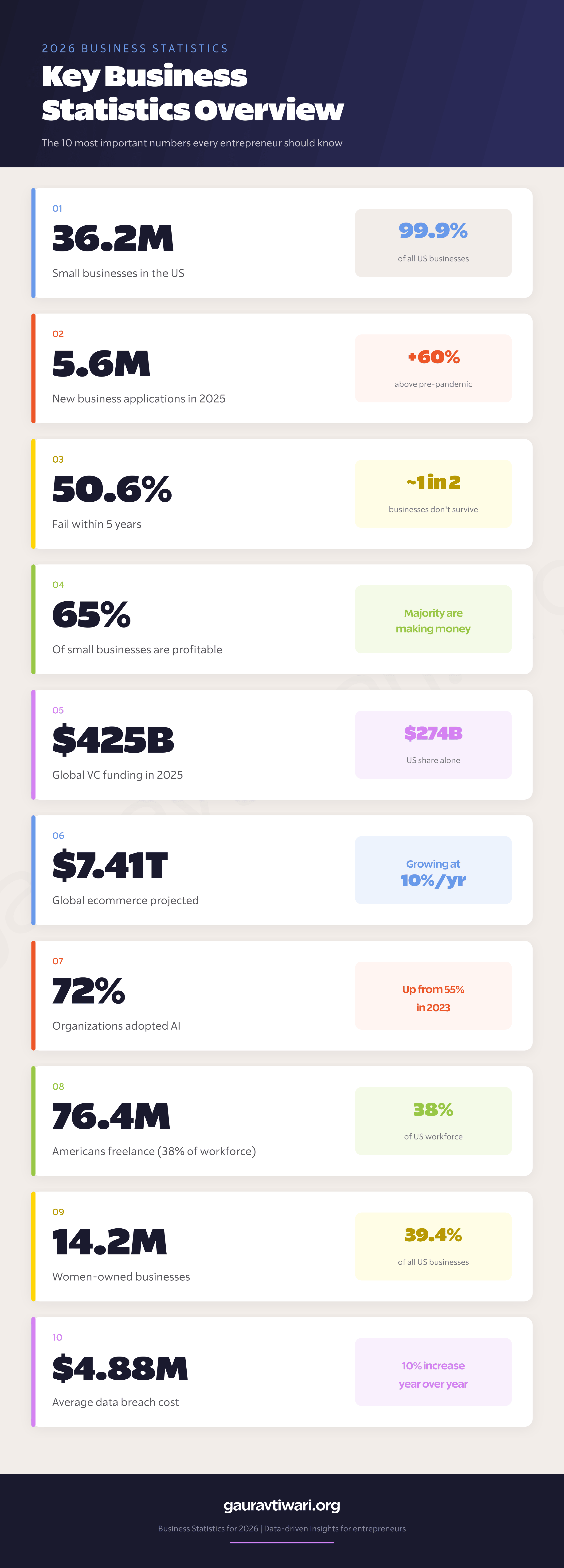
- 36.2 million small businesses operate in the US, making up 99.9% of all businesses (SBA Office of Advocacy)
- 5.6 million new business applications were filed in 2025, 60% above pre-pandemic averages (US Census Bureau)
- 50.6% of businesses fail within five years. Just 34.7% survive a decade (BLS)
- 65% of small businesses are profitable, but 30% of owners don’t take a salary (Guidant Financial)
- $425 billion in global VC funding was deployed in 2025, up 30% year-over-year (Crunchbase)
- $7.41 trillion is the projected global ecommerce market size for 2026 (eMarketer)
- 72% of organizations have adopted AI in at least one business function (McKinsey)
- 76.4 million Americans freelance, making up 38% of the US workforce (Upwork)
- 14.2 million women-owned businesses operate in the US, growing at 2x the rate of all businesses (SBA; American Express)
- $4.88 million is the average cost of a data breach globally (IBM)
These aren’t just numbers. They’re the benchmarks you measure your business against.
Small Business Statistics
Small businesses aren’t a niche. They ARE the economy. When politicians talk about “helping businesses,” this is what that actually looks like in the data.
How Many Small Businesses Exist
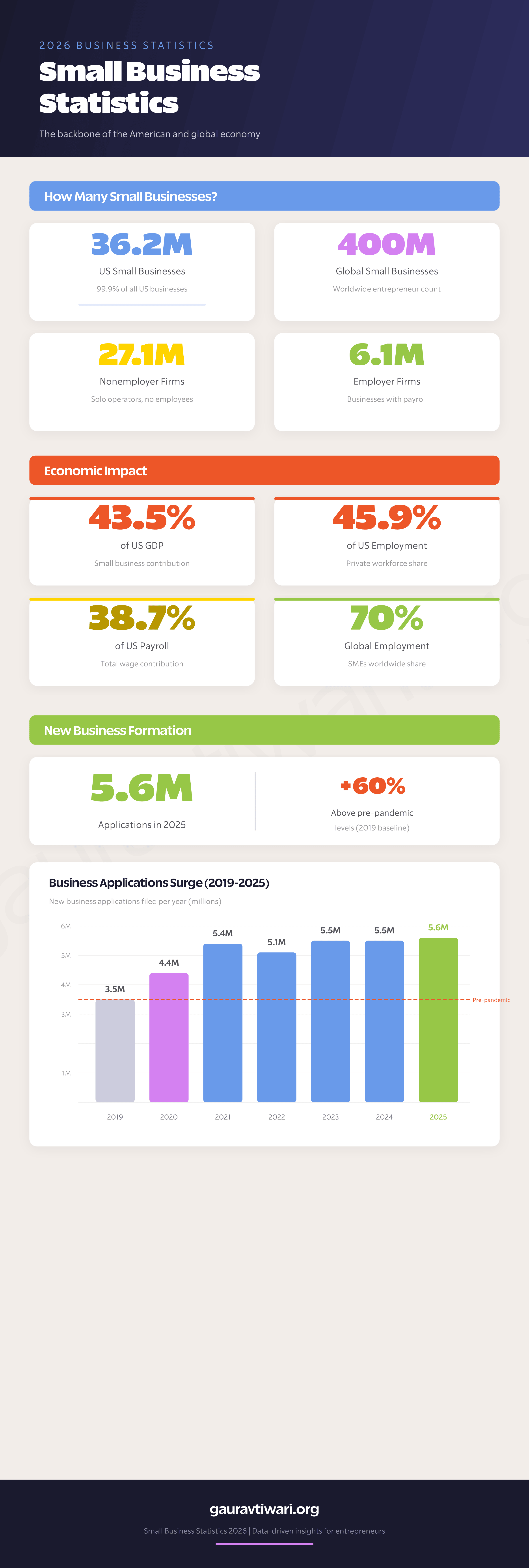
- 36.2 million small businesses operate in the United States, representing 99.9% of all US businesses (SBA Office of Advocacy, 2026).
- 27.1 million are nonemployer firms (solo operations with no employees), making up 81% of all businesses (US Census Bureau).
- ~6.1 million are employer firms with at least one employee on payroll (SBA Office of Advocacy).
- 400 million SMEs exist globally, representing 90% of all businesses worldwide (World Bank).
- 24.3 million SMEs operate in the European Union, representing 99.8% of all EU businesses (European Commission).
Small Business Economic Impact
- Small businesses generate 43.5% of US GDP (SBA Office of Advocacy, 2026).
- They employ 62.3 million workers, accounting for 45.9% of private-sector employment (SBA Office of Advocacy).
- Small businesses account for 38.7% of private-sector payroll (SBA Office of Advocacy).
- Globally, SMEs contribute roughly 50% of GDP in most economies and up to 40% in emerging markets (OECD).
- SMEs provide 70% of total employment worldwide (World Economic Forum).
New Business Formation
- 5.6 million new business applications were filed in 2025, a 6.5% increase year-over-year (US Census Bureau; Wolters Kluwer).
- That’s 60% above the pre-pandemic average of ~3.5 million applications per year (Wolters Kluwer).
- The UK registered roughly 900,000 new companies in 2023-2024 (Companies House, UK Government).
- India’s Udyam MSME registrations exceeded 40 million by 2024 (Ministry of MSME, India).
- “How to start a business“ Google searches remain elevated, with the post-2020 entrepreneurship surge showing no sign of reverting (Google Trends).
The pandemic didn’t just cause a temporary spike in business formation. It permanently reset the baseline. We’re not going back to 3.5 million applications per year.
Startup Survival and Failure Statistics
The survival data is brutal and honest. Most businesses survive year one. Half don’t survive year five. And the reasons for failure are remarkably consistent across industries and decades.
Survival Rates by Year
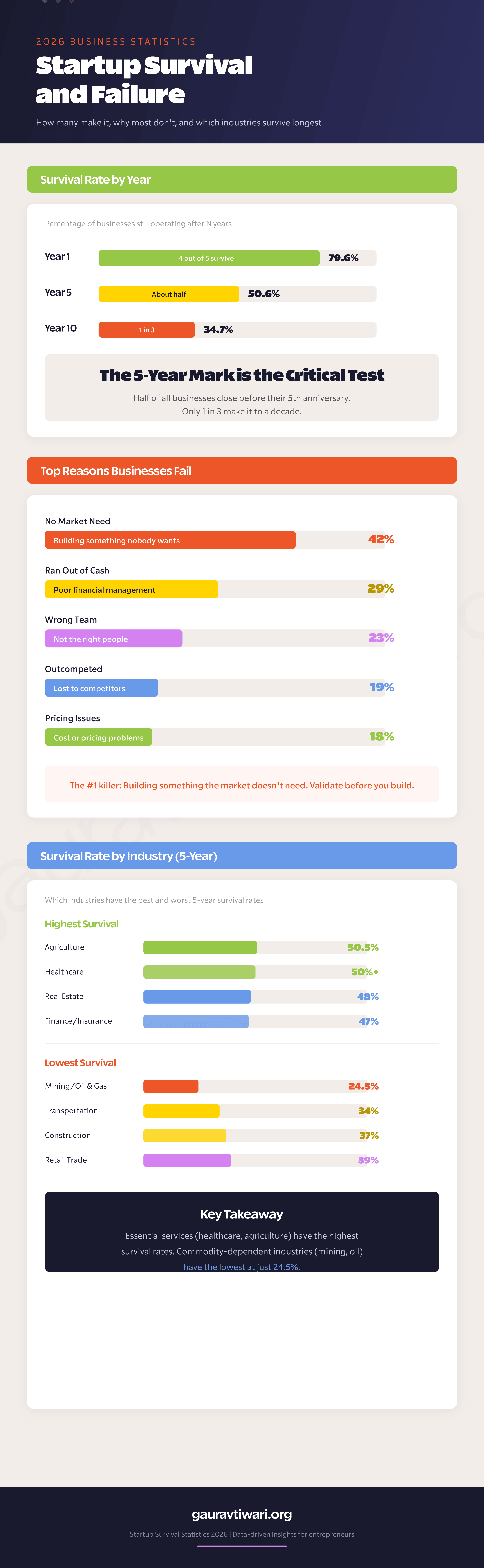
- 79.6% of businesses survive year one (BLS Business Employment Dynamics).
- 50.6% survive to year five (BLS).
- 34.7% survive to year ten (BLS).
- 90% of startups fail overall when you extend the time horizon. 75% of venture-backed startups never return cash to investors (Startup Genome; Harvard Business School).
- 70% of tech startups fail between years 2 and 5 (CB Insights).
Why Businesses Fail
- No market need: 42% of startups fail because they build something nobody wants (CB Insights).
- Ran out of cash: 29% (CB Insights).
- Wrong team: 23% (CB Insights).
- Outcompeted: 19% (CB Insights).
- Pricing or cost issues: 18% (CB Insights).
- 82% of small businesses that fail cite poor cash flow management as a factor (US Bank).
These percentages add up past 100% because most failures have multiple causes. The one that keeps showing up in my client work? Cash. Businesses don’t die because they have bad ideas. They die because they run out of money before the good idea finds its market.
Survival by Industry
- Agriculture has the highest 10-year survival rate at 50.5% (BLS).
- Healthcare 5-year survival: 50%+ (DemandSage).
- Information sector has the highest 1-year failure rate at 25.8% (BLS).
- Construction startups fail at roughly 90% over a 10-year period (GrowthList).
- Mining/oil-gas has the lowest 10-year survival rate at 24.5% (BLS).
Business Revenue and Profitability Statistics
Revenue benchmarks are some of the most requested data I get from clients. Everyone wants to know: am I normal? The answer depends entirely on your business size and industry.
Revenue Benchmarks
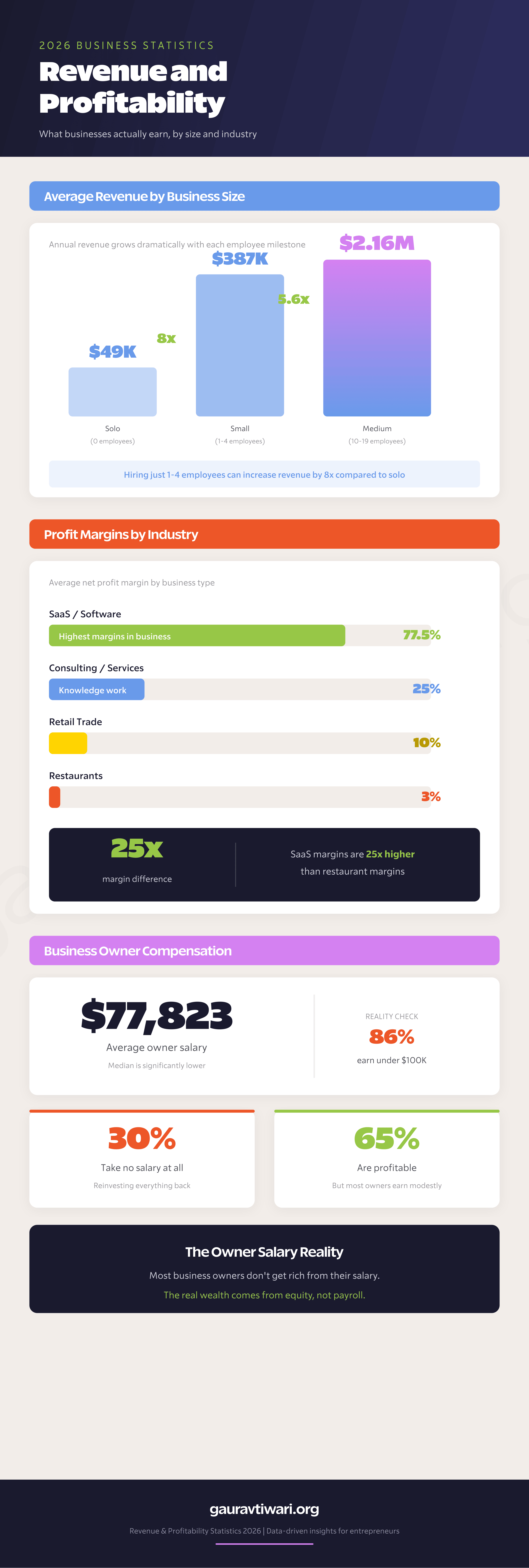
- 65% of small businesses are profitable (Guidant Financial, 2025).
- 34% of small businesses generate revenue under $50,000 per year (altLINE).
- 9% of small businesses generate revenue over $1 million (altLINE).
- 78% of solo businesses make under $50K/year (altLINE).
- Average small business revenue scales with employees: solo at $49,489, 1-4 employees at $387,000, 10-19 employees at $2.16 million (Census Bureau via Vena Solutions).
- 79% of small business owners expect revenue growth in 2026, projecting an average increase of 7.9% (Bank of America).
Profit Margins by Industry
- Average net profit margin across all industries: 7.71% (NYU Stern Damodaran).
- Average gross profit margin: 36.56% (NYU Stern Damodaran).
- Restaurant net margins: 2.8-4% (NYU Stern).
- Retail net margins: 8-12% (NYU Stern).
- SaaS gross margins: 70-85% (NYU Stern).
- Consulting net margins: 20-30% (NYU Stern).
- Businesses at $1-5M revenue hit a sweet spot with 11.4% net margins (Vena Solutions).
Owner Compensation
- Average small business owner salary: $77,823 (PayScale).
- Median range: $69,119-$80,562 (Comparably).
- 86% of owners pay themselves under $100K (Patriot Software).
- 30% of owners don’t take a salary at all (Patriot Software).
That 30% number is wild until you’ve lived it. I know it firsthand. In the early years of building Gatilab, every dollar went back into the business. That’s not a failure stat. That’s a reinvestment stat. But it’s also why cash flow kills more businesses than bad products.
Business Funding and Investment Statistics
VC funding bounced back hard in 2025 after two lean years. AI is eating most of the capital. And the gap between funded and bootstrapped survival rates tells its own story.
Venture Capital
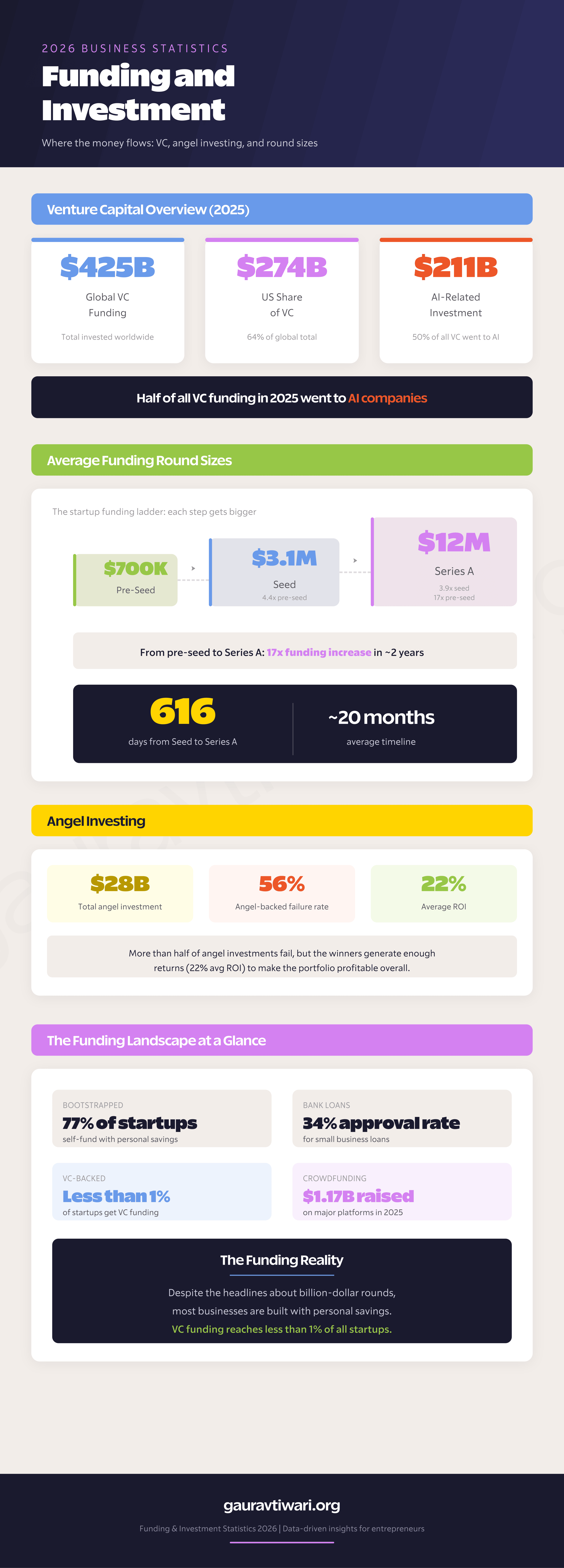
- $425 billion in global VC funding was deployed in 2025, up 30% year-over-year (Crunchbase).
- US VC funding: $274 billion in 2025, representing 64% of global total (Crunchbase).
- Q1 2026 set a record at ~$300 billion globally, nearly 70% of all 2025 spending in a single quarter (Crunchbase).
- AI venture funding: $211 billion in 2025, up 85% year-over-year and consuming roughly half of all VC dollars (PitchBook).
- Average VC deal size: $20.1 million in 2025, up from $14.1M in 2024 (Crunchbase).
Round Sizes
- Median pre-seed round: $700,000 (Metal.so).
- Median seed round: $3.1 million (AI startups: $4.6M) (Pitchwise).
- Median Series A: ~$12 million (Pitchwise).
- Time from seed to Series A: 616 days median (Pitchwise).
Angel Investment
- US angel investment total: $28 billion across 70,000 deals in 2025 (CoinLaw).
- Angel-funded startup failure rate: 56% (CoinLaw).
- Average angel investment ROI: 22% (CoinLaw).
- $1.6+ billion has been invested across 315 funding rounds in affiliate marketing technology alone (Crunchbase / Hostinger).
Ecommerce Business Statistics
Ecommerce just crossed the $7 trillion mark globally. That’s not a trend anymore. That’s the default way people buy things.
Global Ecommerce Market
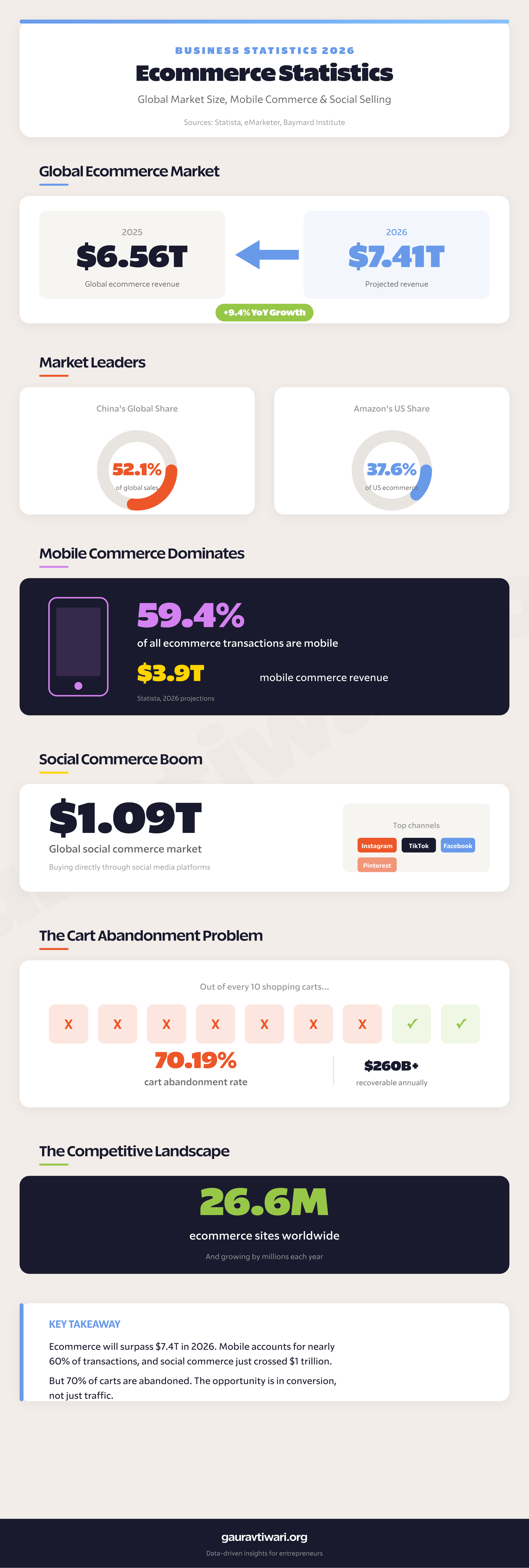
- Global ecommerce market: $6.56 trillion in 2025, projected $7.41 trillion in 2026 (eMarketer).
- US ecommerce sales: $1.22 trillion in 2025 (US Census Bureau / eMarketer).
- Ecommerce as percentage of total retail: 22.7% in the US, 24.5% globally projected for 2026 (eMarketer).
- Global ecommerce growth rate: 9.4% year-over-year (eMarketer).
- Number of ecommerce sites worldwide: 26.6 million (Oberlo / BuiltWith).
- China holds 52.1% of global ecommerce market share (eMarketer).
- Amazon controls 37.6% of US ecommerce (eMarketer).
Mobile and Social Commerce
- Mobile commerce share: 59.4% of all ecommerce sales globally (Statista).
- Mobile commerce revenue: $3.9 trillion worldwide in 2025 (Statista).
- Social commerce: $1.09 trillion in global sales (Statista).
- Cross-border ecommerce: $2.1 trillion market (Juniper Research).
- Average cart abandonment rate: 70.19% (Baymard Institute).
Seven out of ten carts get abandoned. That’s not a bug. That’s the baseline. If you run an ecommerce store, your optimization work starts from this number.
Marketing and Customer Acquisition Statistics
Customer acquisition costs have been climbing for five years straight. The businesses that win are the ones who know their numbers and play the channels with the best ROI.
Customer Acquisition Costs
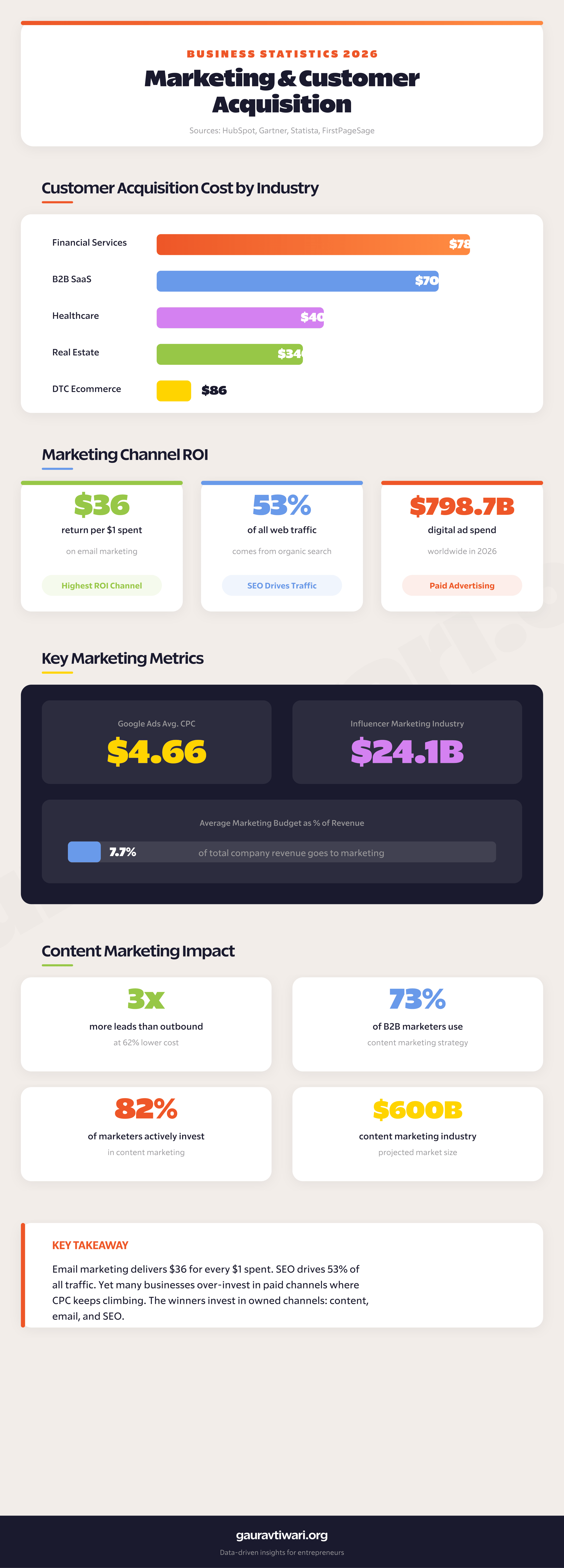
- B2B SaaS average CAC: $702 (FirstPageSage).
- DTC ecommerce CAC: $86 (FirstPageSage / Shopify).
- Financial services CAC: $784 (FirstPageSage).
- Customer acquisition costs increased 60% over the past five years (Genesys Growth).
- Healthy LTV:CAC ratio minimum: 3:1 (FirstPageSage).
Marketing ROI by Channel
- Email marketing ROI: $36 per $1 spent (Litmus).
- SEO drives 53% of all trackable website traffic (BrightEdge).
- Global digital ad spend: $798.7 billion in 2025 (Statista).
- Google Ads average CPC: $4.66 (WordStream).
- 91% of B2B marketers use content marketing (Content Marketing Institute).
- Influencer marketing market: $24.1 billion in 2025 (Influencer Marketing Hub).
- Marketing budgets average 7.7% of company revenue (Gartner).
AI and Technology Adoption in Business
AI went from “interesting experiment” to “operational tool” faster than any technology I’ve tracked. The adoption curve is steep and the spending numbers are staggering.
AI Adoption
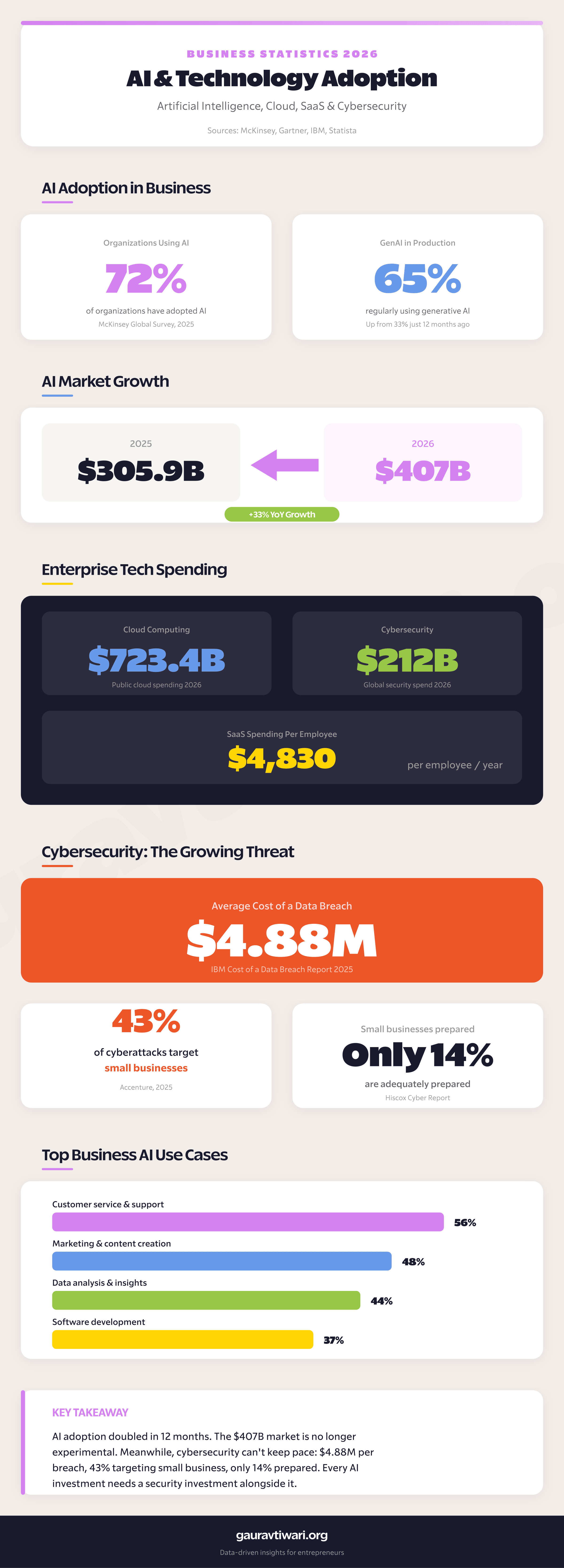
- 72% of organizations have adopted AI in at least one function (McKinsey).
- 65% of companies use generative AI in production (McKinsey).
- 67% of SaaS companies integrated AI/ML features by end of 2024, up from 48% in 2023 (McKinsey).
- Global AI market: $305.9 billion in 2025, projected $407 billion in 2026 (IDC / Statista).
- 36% of job postings now mention AI skills, up from 17% in 2023 (LinkedIn).
Technology Spending
- Global cloud spending: $723.4 billion in public cloud services (Gartner).
- Global cybersecurity spending: $212 billion in 2025 (Gartner).
- Average cost of a data breach: $4.88 million (IBM).
- 43% of cyberattacks target small businesses, but only 14% are prepared to defend themselves (Verizon DBIR).
- Average organization uses 130 SaaS applications, spending $4,830 per employee per year on SaaS (Productiv).
That last number is the one that surprises people. $4,830 per employee per year on SaaS alone. For a 20-person company, that’s nearly $100K annually just on software subscriptions.
Remote Work and Workforce Statistics
The remote work debate is over. The data settled it: hybrid won. Pure remote is shrinking, pure office is shrinking, and hybrid is the new default.
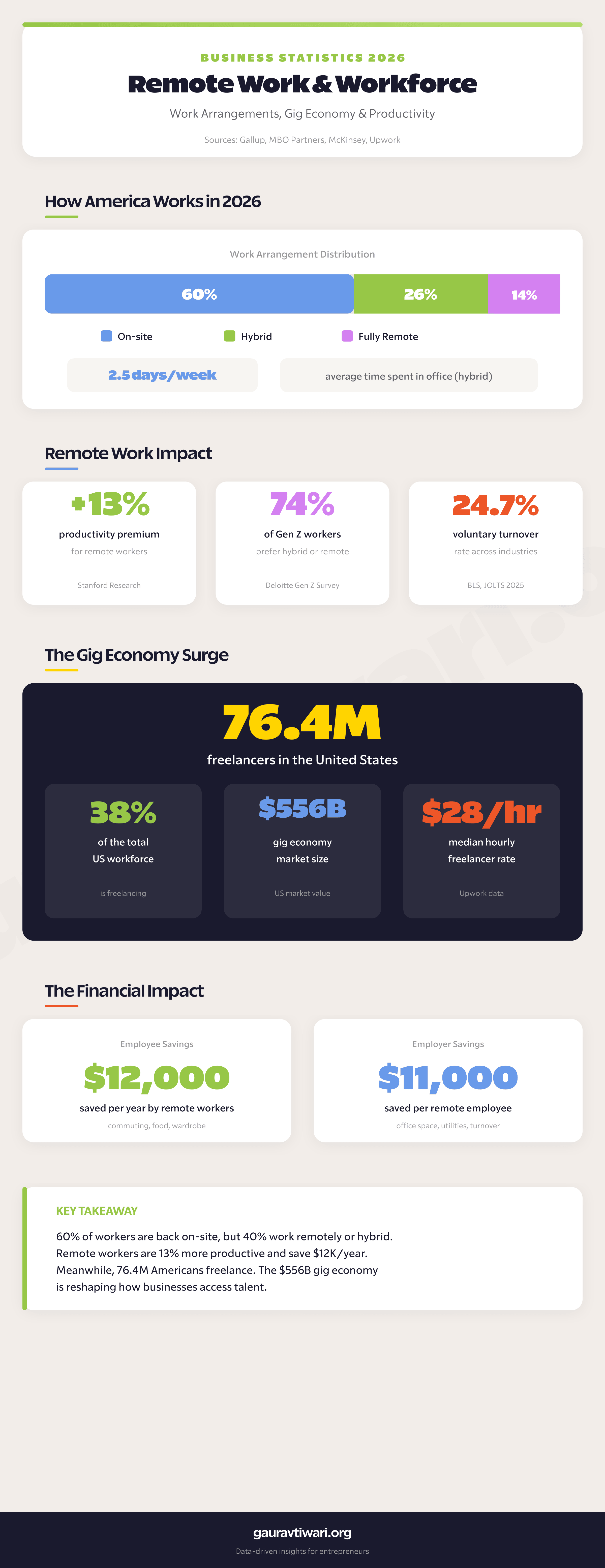
- 14% of US workers are fully remote, 26% hybrid, 60% fully on-site (Stanford WFH Research).
- 76.4 million Americans freelance, making up 38% of the US workforce (Upwork).
- Global gig economy: $556 billion market (Statista).
- 63% of companies now offer hybrid work options (Gallup).
- Hybrid workers average 2.5 days per week in office (Scoop Technologies / Flex Index).
- Remote workers are 13% more productive than in-office peers (Stanford / Bloom et al.).
- 74% of Gen Z prefer hybrid or remote work (Deloitte).
- Voluntary turnover rate: 24.7% in the US (BLS / Work Institute).
Business Demographics Statistics
The face of business ownership is changing faster than most people realize. Women-owned businesses are growing at 2x the rate. Immigrants found more than half of unicorn startups. And the average first-time founder is 42, not 22.
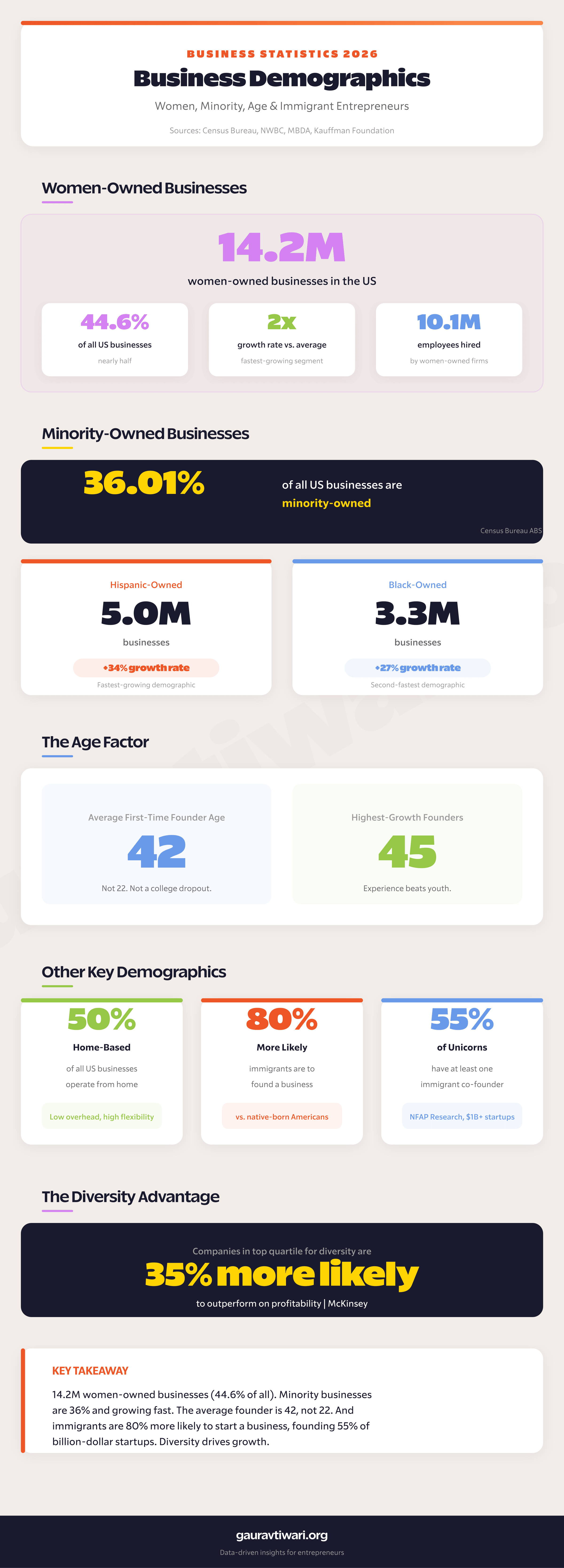
- 14.2 million women-owned businesses in the US, representing 44.6% of all small businesses (SBA; Census Bureau).
- Women-owned businesses grew at 2x the rate of all businesses from 2019-2024 (American Express).
- 36.01% of small businesses are minority-owned (SBA Office of Advocacy).
- 5.0 million Hispanic-owned businesses, the fastest-growing demographic at 34% growth since 2019 (Stanford Latino Entrepreneurship Initiative).
- 3.3 million Black-owned businesses, a 27% increase since 2019 (Census Bureau; Federal Reserve).
- Average age of a first-time entrepreneur: 42. Founders of the highest-growth startups average 45 (MIT / Census Bureau; Kauffman Foundation).
- ~50% of small businesses are home-based; among solo operations, that exceeds 60% (SBA).
- Immigrants are 80% more likely to found a business than native-born Americans and founded 55% of US unicorn startups (NBER; New American Economy).
Frequently Asked Questions
How many small businesses are there in the US?
36.2 million small businesses operate in the United States as of 2026, representing 99.9% of all US businesses. Of those, 27.1 million are nonemployer firms (solo operations) and roughly 6.1 million are employer firms with at least one employee. Small businesses employ 62.3 million workers (45.9% of private-sector employment) and generate 43.5% of US GDP. Source: SBA Office of Advocacy, 2026.
What percentage of businesses fail in the first 5 years?
About 49.4% of businesses fail within 5 years, according to Bureau of Labor Statistics data. The survival rate breaks down as: 79.6% survive year one, 50.6% survive to year five, and 34.7% survive to year ten. The top reason for failure is no market need (42%), followed by running out of cash (29%) and having the wrong team (23%). These percentages overlap because most failures have multiple causes.
What is the average small business revenue?
Average small business revenue varies enormously by size. Solo entrepreneurs earn about $49,489 per year. Businesses with 1-4 employees average $387,000. Those with 10-19 employees average $2.16 million. About 34% of small businesses generate under $50,000 in revenue, and only 9% exceed $1 million. The average net profit margin across all industries is 7.71%, according to NYU Stern data.
How much does it cost to acquire a customer?
Customer acquisition cost (CAC) varies widely by industry. B2B SaaS averages $702 per customer. DTC ecommerce averages $86. Financial services averages $784. A healthy business should maintain at least a 3:1 lifetime value to CAC ratio. Customer acquisition costs have increased 60% over the past five years across industries, making retention and organic channels increasingly important.
What is the average profit margin for a small business?
The average net profit margin across all industries is 7.71%, with an average gross margin of 36.56% (NYU Stern Damodaran data). Margins vary significantly by industry: restaurants operate at 2.8-4% net, retail at 8-12%, SaaS at 70-85% gross margin, and consulting at 20-30%. Businesses in the $1-5 million revenue range tend to hit a sweet spot at 11.4% net margins.
How big is the global ecommerce market?
The global ecommerce market reached $6.56 trillion in 2025 and is projected to hit $7.41 trillion in 2026, growing at 9.4% year-over-year. US ecommerce sales alone hit $1.22 trillion. Ecommerce now represents 22.7% of total US retail and 24.5% globally. Mobile commerce accounts for 59.4% of all ecommerce sales. There are approximately 26.6 million ecommerce sites worldwide.
What percentage of businesses use AI?
72% of organizations have adopted AI in at least one business function, according to McKinsey’s State of AI report. 65% of companies now use generative AI in production, up from a small fraction just two years ago. 67% of SaaS companies have integrated AI or machine learning features into their products. The global AI market is worth $305.9 billion in 2025, projected to reach $407 billion in 2026.
The Numbers That Actually Matter
121 statistics and they all point to the same story: starting a business has never been easier (5.6 million applications), surviving has never been harder (half die by year five), and the ones that make it share two traits.
They know their numbers. And they act on them before it’s too late.
The best stat in this entire article isn’t a market size or a failure rate. It’s this: 79% of small business owners expect revenue growth in 2026. That’s not naivety. That’s the people who survived the first filter, learned to read their own data, and built something sustainable.
If you’re building a business right now, don’t just read these stats. Benchmark against them. Know where you stand on survival probability, revenue percentiles, CAC ratios, and profit margins. The businesses that make it to year ten aren’t the ones with the best products. They’re the ones who saw the numbers coming and adjusted.