
10 Types of IT Services Your Business Can Provide
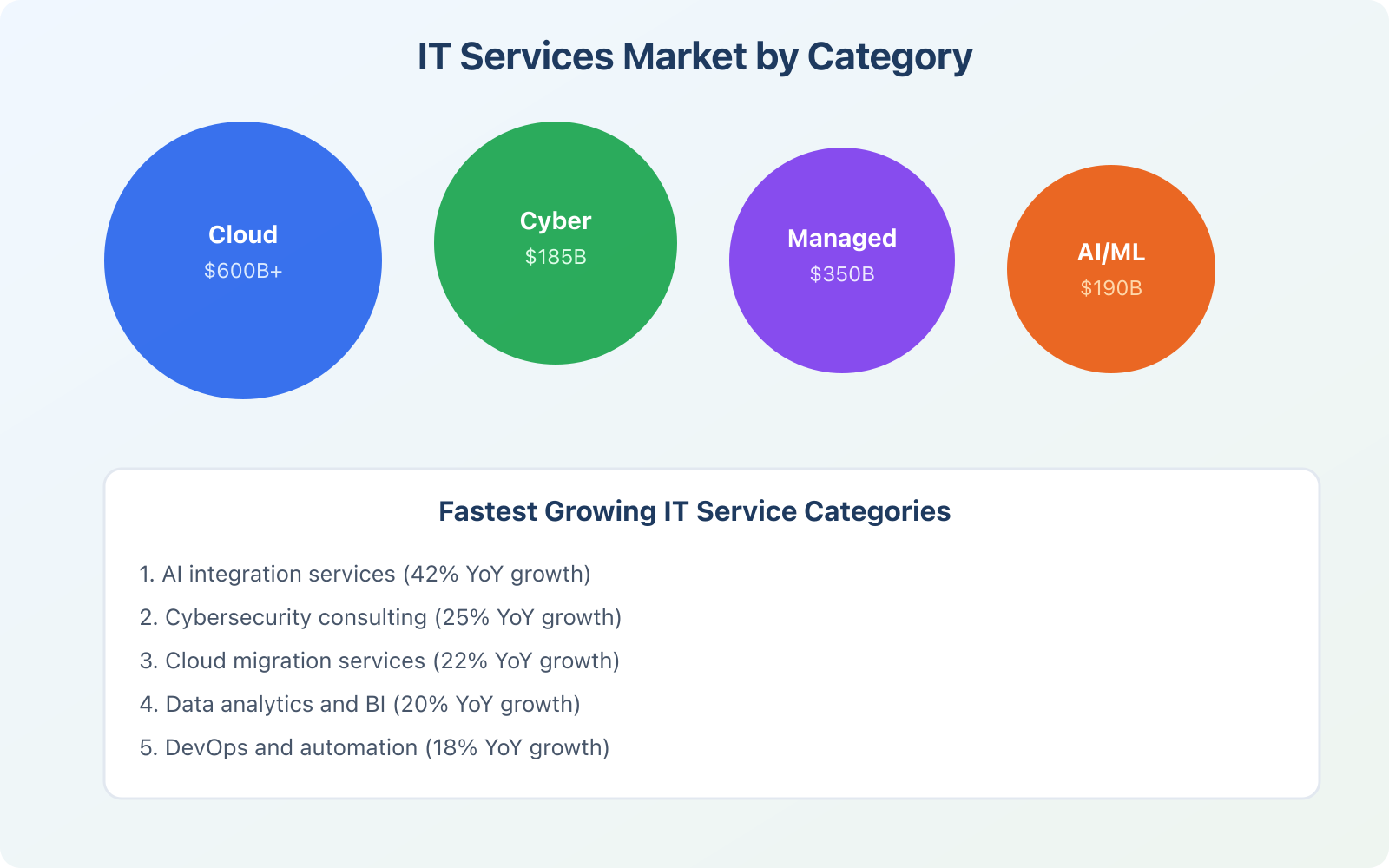
The IT services market hit $1.2 trillion globally in 2024, and it’s still growing at roughly 8% per year. If you’re looking to start an IT services business or expand your existing offerings, the opportunity is massive. But not all IT services are equally profitable or equally in demand. Some niches are saturated, while others are growing so fast that providers can’t keep up with client requests.
I’ve worked with IT service providers as both a client and a consultant. I know which services consistently generate recurring revenue, which ones have the highest margins, and which ones are hardest to differentiate. This guide covers the most profitable IT services you can offer in 2026, with real pricing data and practical advice on getting started.
Web Design and Development Services
Web development remains one of the most accessible IT services to start. Every business needs a website, and most businesses need someone to build, maintain, and improve it. The demand is constant and crosses every industry.
What’s changed is the type of development work clients need. Static brochure sites are commoditized. Clients can build those on Squarespace or Wix for $20/month. The money is in custom web applications, e-commerce platforms, WordPress development with advanced functionality, and web app development using modern frameworks.
Pricing ranges from $3,000 for a basic WordPress site to $50,000+ for custom web applications. Maintenance retainers ($500-$5,000/month) add predictable recurring revenue. The sweet spot is building a client’s site and then managing it on an ongoing basis, creating a relationship that lasts years rather than ending at launch.
Margins run 30-50% depending on whether you use in-house developers or subcontractors. If you’re a solo developer doing the work yourself, margins can exceed 70%.
Managed IT Support and Helpdesk Services
Managed IT support is the bread and butter of most IT service businesses. You take over a client’s entire IT operation: hardware, software, network, security, and user support. They pay a flat monthly fee, and you keep everything running.
The beauty of managed IT is the recurring revenue model. Once you onboard a client, they stay for years. Average client retention for managed service providers (MSPs) is 3-5 years. Monthly fees range from $25-$150 per user, depending on the scope of services included.
A 50-person company paying $100/user/month generates $5,000/month in recurring revenue. Sign 20 clients of that size and you’re running a million-dollar business. The math works, which is why MSPs are one of the fastest-growing segments of the IT services market.
The challenge is onboarding. Migrating a client’s IT infrastructure to your management platform takes 2-4 weeks and requires significant upfront effort. But once you’re through onboarding, the ongoing work is largely automated through remote monitoring and management (RMM) tools.
Start with a per-user pricing model rather than a per-device model. Users are easier to count, predict, and scale. Most MSPs who switch from per-device to per-user pricing see a 15-25% revenue increase because companies always have more devices than employees.
Cybersecurity Services
Cybersecurity is the fastest-growing and highest-margin IT service category. Every data breach headline creates new demand. Every compliance regulation creates new requirements. And most small to mid-size businesses don’t have the internal expertise to handle cybersecurity on their own.
The services under this umbrella include security audits and assessments ($2,000-$25,000 per engagement), penetration testing ($5,000-$50,000), security monitoring and incident response ($1,000-$10,000/month), compliance consulting (HIPAA, PCI-DSS, SOC 2), and security awareness training ($500-$5,000/year per company).
Margins in cybersecurity range from 35-50%, among the highest in IT services. The reason is straightforward: the consequences of a breach are catastrophic, so clients don’t negotiate as aggressively on price. A $10,000 security audit that prevents a $500,000 breach is an easy sell.
If you’re starting a new IT services business, adding cybersecurity to your managed IT offering is the fastest path to higher per-client revenue. Most MSPs bundle basic security (antivirus, firewall management, patch management) into their standard offering and upsell advanced security (SIEM, EDR, compliance auditing) as premium add-ons.
Cloud Migration and Management
Cloud services represent the biggest shift in IT infrastructure since the internet itself. Companies are moving from on-premises servers to AWS, Azure, and Google Cloud. But the migration isn’t simple, and the ongoing management requires specialized skills.
Cloud migration projects range from $5,000 for simple email and file migrations to $100,000+ for full infrastructure moves. The real money, though, is in ongoing cloud management: monitoring, optimization, security, and cost management. Monthly management fees of $1,000-$10,000 per client create steady recurring revenue.
Cloud cost optimization alone is a compelling service. Most businesses overspend on cloud resources by 20-40% because they don’t know how to right-size instances, use reserved pricing, or clean up unused resources. An IT provider who saves a client $3,000/month on their AWS bill can easily charge $1,000/month for the service.
The growth trajectory here is strong. Gartner projects cloud spending will continue growing at 20%+ annually through 2027. Every dollar spent on cloud creates demand for IT services to manage that cloud infrastructure.
AI Integration and Automation Services
This is the hottest IT service category in 2026, and it will be for the next several years. Every business wants to use AI, but most don’t know how. They’ve seen ChatGPT and think AI can solve all their problems, but they need someone to identify realistic use cases, build integrations, and train their teams.
AI integration services include chatbot implementation (connecting tools like Tidio or custom GPT agents to business workflows), document processing automation, AI-powered analytics dashboards, and workflow automation using tools like Zapier, Make, and n8n.
Project fees range from $5,000 for a basic chatbot setup to $50,000+ for custom AI integrations with existing business systems. Margins are the highest in the IT services industry at 40-60%, because the expertise is scarce and the value delivered is immediately measurable.
You don’t need a PhD in machine learning to offer AI services. Most business AI use cases involve connecting existing AI tools (OpenAI API, Claude API, Google AI) to existing business systems (CRM, helpdesk, accounting software). The skill is in understanding both the AI capabilities and the business requirements, then bridging the gap.
Data Backup and Disaster Recovery
Every business needs data backup. It’s not exciting, and it’s not glamorous. But it’s non-negotiable, which makes it excellent recurring revenue. Clients sign up and stay indefinitely because the cost of switching providers isn’t worth the risk of losing data during a transition.
Modern backup services go beyond simple file copies. You’re offering comprehensive disaster recovery: daily automated backups, off-site redundancy, encryption at rest and in transit, regular recovery testing, and documented recovery procedures. Monthly pricing ranges from $200-$2,000 per client depending on data volume and recovery time requirements.
The tools are largely commoditized. Veeam, Acronis, and Datto handle the technical heavy lifting. Your value is in the configuration, monitoring, testing, and recovery services wrapped around those tools. Margins of 25-40% are typical.
Bundle backup with managed IT and cybersecurity for the highest client value. A client who uses you for all three is extremely sticky and generates $3,000-$15,000/month in combined revenue.
Email and Productivity Setup
Microsoft 365 and Google Workspace migrations seem simple on the surface. They’re not. Moving a 100-person company from on-premises Exchange to Microsoft 365 involves email migration, calendar transfers, permissions mapping, security configuration, mobile device management, and user training.
Project fees for productivity platform migrations range from $500-$5,000 depending on company size and complexity. Ongoing management adds $5-$15 per user per month. At 100 users and $10/user/month, that’s $1,000/month in recurring revenue from a single client.
The real opportunity is in optimization. Most businesses use less than 20% of their Microsoft 365 or Google Workspace features. Helping clients set up Teams channels, SharePoint sites, Power Automate workflows, or Google Workspace add-ons creates additional project revenue and positions you as an ongoing advisor.
Microsoft and Google both offer partner programs with referral fees, co-marketing funds, and discounted licenses. Becoming a certified partner for either platform adds credibility and creates an additional revenue stream from license reselling margins of 10-20%.
Social Media and Digital Marketing Services
Digital marketing overlaps with IT services more than people realize. Social media management, email marketing automation, SEO, and paid advertising all require technical implementation alongside creative strategy.
IT service providers who add digital marketing to their portfolio create a compelling one-stop-shop for small businesses. Instead of hiring separate companies for their website, IT support, and marketing, clients get everything from one provider. Monthly retainers for combined IT and marketing services range from $2,000-$15,000.
The most natural cross-sell is from web development to SEO. You built the client’s website, so you understand its structure and content. Offering ongoing SEO services ($1,000-$5,000/month) is a logical extension that leverages your existing technical knowledge of the site.
Social media consulting specifically runs $500-$3,000/month per client. It includes content strategy, scheduling, community management, and analytics reporting. If you’re not comfortable doing this in-house, partner with a freelance social media manager and add a 20-30% margin.
Network Infrastructure and Hardware
Setting up and maintaining office networks, server rooms, structured cabling, and hardware remains a solid IT service. It’s the most “traditional” category on this list, but the demand is steady. Every office expansion, every new location, and every hardware refresh cycle creates project work.
Network infrastructure projects range from $2,000 for a small office setup to $50,000+ for multi-site deployments. Hardware reselling adds 10-25% margins on equipment. Ongoing network monitoring and maintenance adds $500-$3,000/month per location.
WiFi optimization is a surprisingly lucrative sub-niche. With remote work and IoT devices, businesses need robust wireless networks. A WiFi survey and optimization project runs $1,000-$5,000 and often leads to hardware upgrade sales and ongoing management contracts.
IT Consulting and Strategy
IT consulting sits at the top of the value chain. Instead of doing the work, you’re advising clients on which technologies to adopt, how to structure their IT investments, and how to align technology with business goals. Consulting rates range from $150-$400/hour.
The most common consulting engagements include technology assessments (evaluating current infrastructure and recommending improvements), vendor selection (helping clients choose software and service providers), digital transformation planning (creating roadmaps for modernizing legacy systems), and compliance auditing (ensuring IT practices meet regulatory requirements).
Consulting works best as an add-on to your other services. It’s hard to build a business purely on consulting unless you’re targeting enterprise clients. But offering strategic consulting to your managed IT clients positions you as a trusted advisor rather than a vendor, which increases retention and justifies higher pricing across all your services.
IT Service Pricing Models
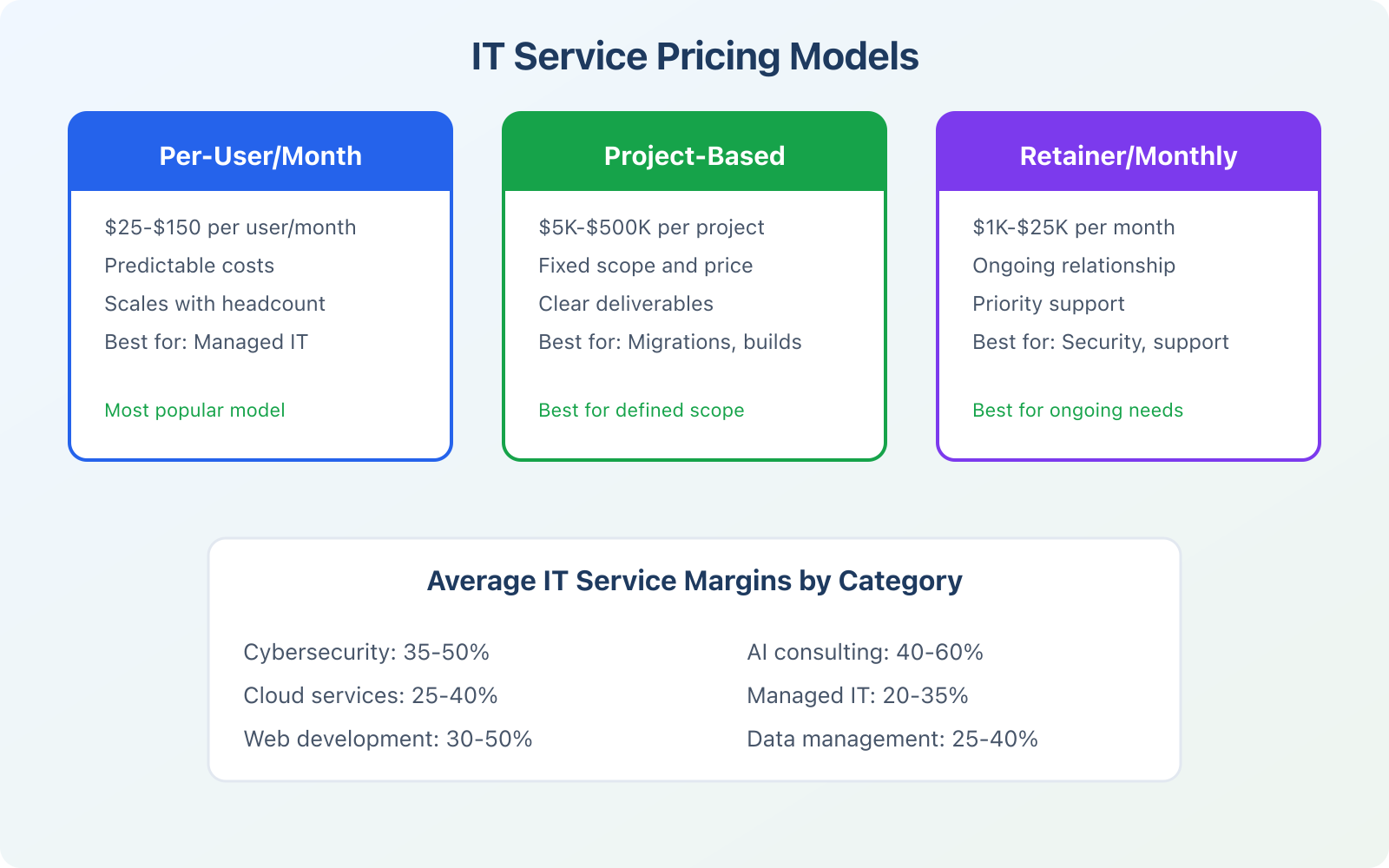
Choosing the right pricing model matters as much as choosing the right services. Here are the three models that work best:
Per-user monthly pricing ($25-$150/user/month) is the most predictable and scalable model. It’s easy for clients to understand, grows naturally as they hire, and creates stable recurring revenue. This works best for managed IT, cybersecurity, and cloud management services.
Project-based pricing ($5,000-$500,000 per project) gives you clear scope and defined deliverables. Use this for web development, cloud migrations, network installations, and AI integration projects. Always include a change order process for scope creep.
Monthly retainer pricing ($1,000-$25,000/month) works well for ongoing relationships where work volume varies. This suits digital marketing, consulting, and application maintenance. Set clear expectations about what’s included and what triggers additional billing.
The most successful IT service businesses use a combination: project-based pricing for initial setup, per-user pricing for ongoing managed services, and retainer pricing for consulting and marketing.
Getting Started: A Realistic Growth Path
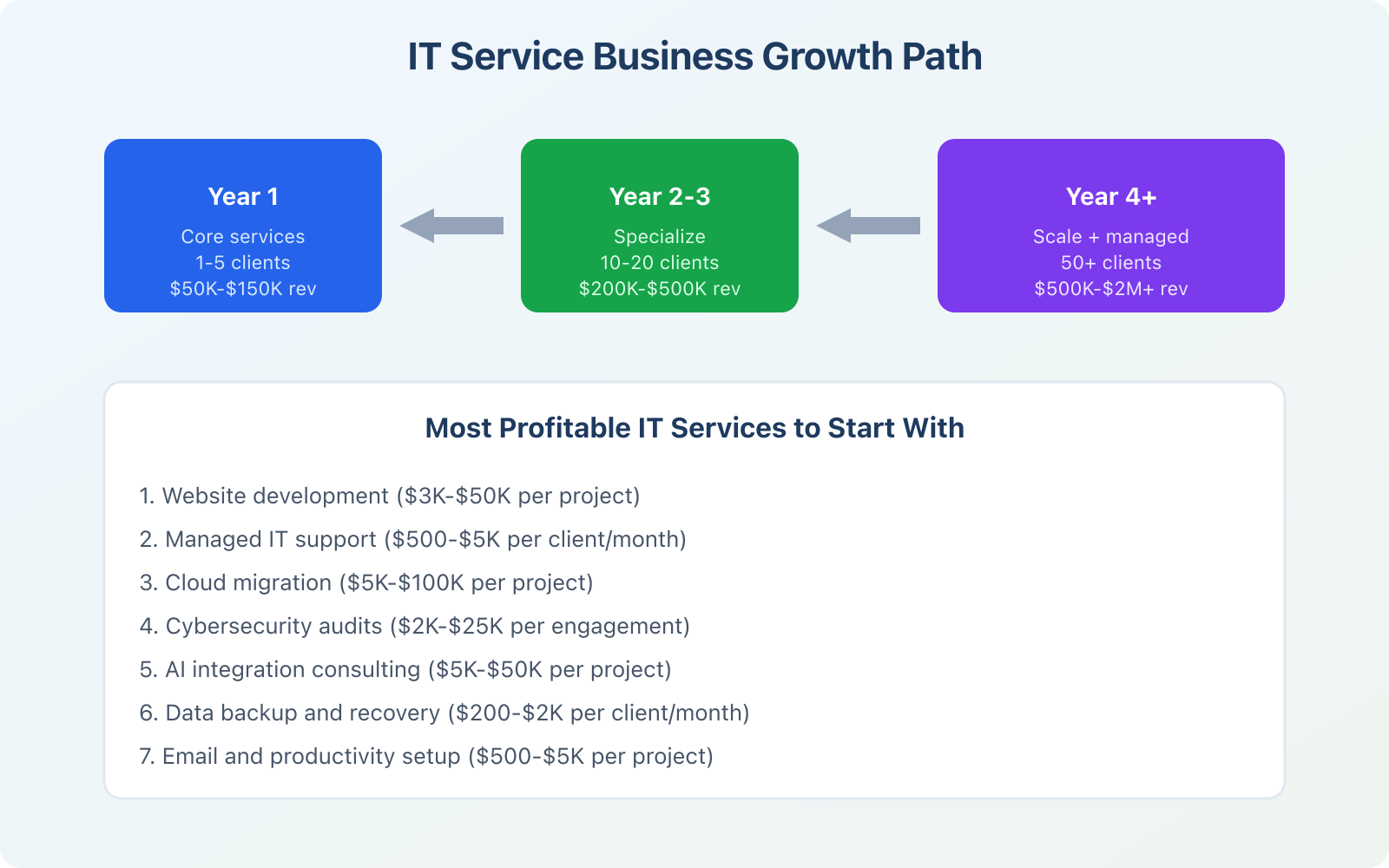
Building an IT services business from scratch follows a predictable path. Year one is about establishing core services, landing your first 1-5 clients, and generating $50,000-$150,000 in revenue. Focus on two or three services maximum. Trying to offer everything from day one stretches you too thin.
Years two and three are about specialization. Pick a niche (cybersecurity for healthcare, managed IT for law firms, cloud services for manufacturing) and become known for it. Specialized providers command 20-40% higher prices than generalists. Revenue should reach $200,000-$500,000 with 10-20 clients.
Year four and beyond is about scaling. Hire technicians, invest in automation, add complementary services, and grow your client base beyond 50 accounts. Revenue targets of $500,000-$2,000,000+ are realistic for well-run MSPs at this stage.
The businesses that grow fastest are the ones that focus relentlessly on client retention. It costs 5-7x more to acquire a new client than to keep an existing one. Deliver excellent service, communicate proactively, and expand your relationship with each client over time.
Frequently Asked Questions
What is the most profitable IT service to offer?
AI integration consulting and cybersecurity services have the highest margins in the IT services industry. AI consulting runs 40-60% margins because expertise is scarce and demand is high. Cybersecurity services run 35-50% margins because the consequences of not having them are severe, which reduces price sensitivity. For recurring revenue, managed IT support at $25-$150 per user per month provides the most predictable income stream.
How much does it cost to start an IT services business?
You can start a basic IT services business for $5,000-$15,000. This covers business registration, insurance, a professional website, essential tools (RMM software, ticketing system, backup platform), and initial marketing. If you’re a solo operator doing the technical work yourself, overhead stays low. Adding employees significantly increases costs, with the first technician typically costing $50,000-$70,000 in salary plus benefits.
Do I need certifications to offer IT services?
Certifications aren’t legally required for most IT services, but they significantly boost credibility and client confidence. The most valuable certifications include CompTIA A+ and Network+ (general IT), Microsoft certifications (for M365 and Azure services), AWS Solutions Architect (for cloud services), and CISSP or CompTIA Security+ (for cybersecurity). Some clients, especially in regulated industries, require their IT providers to hold specific certifications.
What pricing model works best for IT services?
Per-user monthly pricing is the most successful model for managed IT services. It’s predictable for both you and your client, scales naturally with their business, and creates stable recurring revenue. For project work like web development or cloud migration, use fixed-price project billing with clearly defined scope. The most successful IT businesses combine both: project pricing for initial setup and per-user pricing for ongoing management.
How do I get my first IT services clients?
Start with your existing network. Former colleagues, local business contacts, and personal connections are the fastest path to your first clients. Join your local chamber of commerce and business networking groups (BNI is popular for IT providers). Create a professional website showcasing your services and expertise. Offer a free IT assessment to local businesses as a lead generation tool. Most IT service businesses get their first 5-10 clients through referrals and networking rather than advertising.
The IT services market isn’t slowing down. Every business needs technology support, and the complexity of that technology keeps increasing. Whether you start with web development, managed IT, cybersecurity, or AI integration, the key is picking your niche, delivering excellent service, and building long-term client relationships.
Don’t try to offer all ten service types from day one. Pick two or three that align with your skills and your target market. Master those first. You can always expand your service portfolio as you grow, hire specialists, and develop new expertise.