
Complete Notes for UPSC · Free PDF & ePub
Laxmikanth is a textbook. This is what you actually revise from.
A textbook teaches you polity once. Two weeks before Prelims you don’t need teaching, you need Article numbers that are correct, case holdings you can state in one line, and a last-mile box per unit.
Free 463-page A4 PDF plus ePub · 24 units, 144 MCQs, 29 Mains questions · no payment, no email wall
Reached #27 in Public Law on Amazon · the 921-page Kindle edition is free to read on Kindle Unlimited
Read it as:
Why these notes
Most polity marks are lost on precision, not understanding.
You knew the concept. You wrote the wrong Article number. A textbook is built to teach a subject once, and revision material is built to be re-entered forty times, in decreasing amounts of time.
Revising from a textbook
the default- Prose built for first reading. Excellent in month one, unusable in the last fortnight.
- Cases mentioned in passing. You remember the name and not the holding, which is the part that scores.
- Your own margin notes. Made months ago, of variable accuracy, and impossible to trust under pressure.
- Prelims and Mains separately. The same unit gets learned twice, in two different shapes.
- No mapped questions. You don’t find out how a unit is actually asked until the mock.
- Nothing on common errors. You repeat the same confusion between similar Articles all year.
Complete Notes for UPSC
this book- Written as revision notes. Every unit leads with what the examiner rewards, not with background.
- Exact Articles and holdings. Article numbers, amendment details, and landmark judgments from Kesavananda Bharati to S.R. Bommai.
- Tables and glossaries. Comparison tables, flow diagrams, and key-term glossaries for faster passes.
- Prelims and Mains together. Factual accuracy and GS-II answer structure in the same unit.
- Questions mapped in. 144 real and practice MCQs with explanations, plus 29 Mains questions with frameworks.
- Mistakes named. A last-mile revision box and a common-errors list closing every unit.
What’s inside
Twenty-four units, in four parts.
The classic teaching sequence: constitutional foundations, then rights and duties, then the machinery of government, then federalism, local government, and the constitutional bodies.
Part I · Constitutional foundations
- Historical background and making of the Constitution
- Preamble, salient features, and sources
- Union and its territory
- Citizenship
- Basic structure doctrine and landmark cases
Part II · Rights, duties, and policy
- Fundamental Rights, Article by Article
- Directive Principles of State Policy
- Fundamental Duties
- Amendment of the Constitution
- Emergency provisions
Part III · Government and institutions
- President, Vice-President, and the Union Executive
- Parliament: structure, procedure, and privileges
- Supreme Court and judicial review
- State Executive and State Legislature
- High Courts and subordinate judiciary
- Centre-State legislative and administrative relations
Part IV · Federalism and constitutional bodies
- Finance Commission and fiscal federalism
- Local government: Panchayati Raj and municipalities
- Election Commission
- UPSC, CAG, and Attorney General
- NCSC, NCST, and other constitutional bodies
- Statutory and quasi-judicial bodies
- Special provisions for states
In every unit: a last-mile revision box, a common-mistakes list, comparison tables and flow diagrams, a key-term glossary, and mapped previous-year and practice questions.
Before you buy anything else
Covering polity properly is not a year-long project.
Most of the material you’re stacking up, you don’t need. Four things aspirants buy or build that this replaces outright.
You don’t need a second textbook
One standard text plus revision-grade notes beats two textbooks. The second one costs months and adds almost no new marks.
You don’t need a coaching notes bundle
The whole syllabus is here in one sequence, with the cases and Article numbers checked, and the PDF is free.
You don’t need a separate PYQ book for this subject
144 MCQs with explanations and 29 Mains questions are mapped into the units they belong to.
You don’t need to pay to read it
The complete PDF and ePub are free on this site. Kindle is only for people who prefer reading that way.
Wait, what?
Why is the full book free on this site and paid on Kindle?
Because they’re different jobs, and I’d rather you had it.
The free PDF and ePub
Free here, permanently, with no email wall. That’s the version most aspirants want, because polity revision happens on a laptop with a highlighter and a printout.
The paid Kindle edition
The Kindle edition costs money because Amazon doesn’t do free. What you’re paying for there is sync across devices, adjustable type, search, and reading it on a phone in a queue. Same book, different delivery. Buy it only if that’s genuinely how you revise.
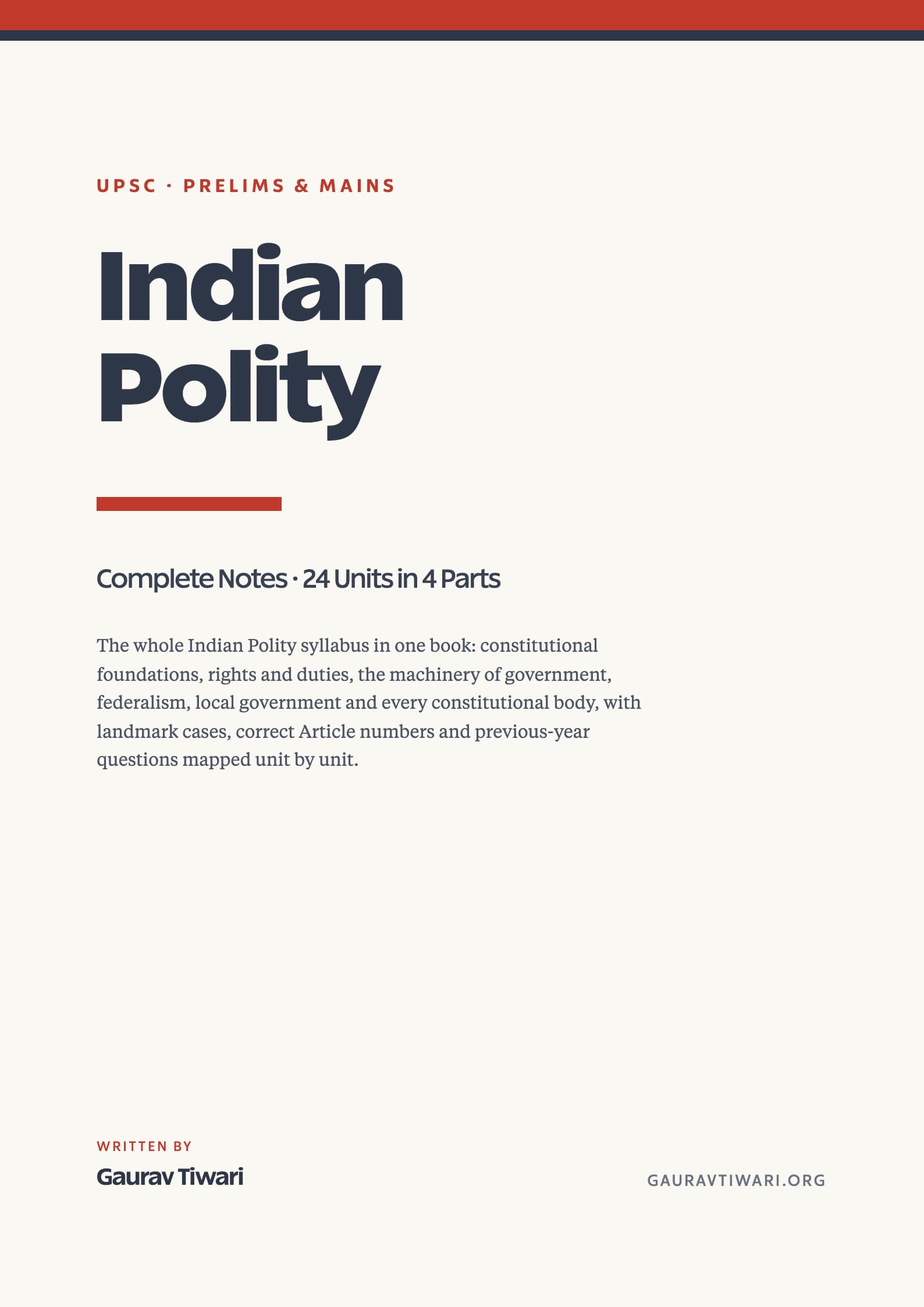
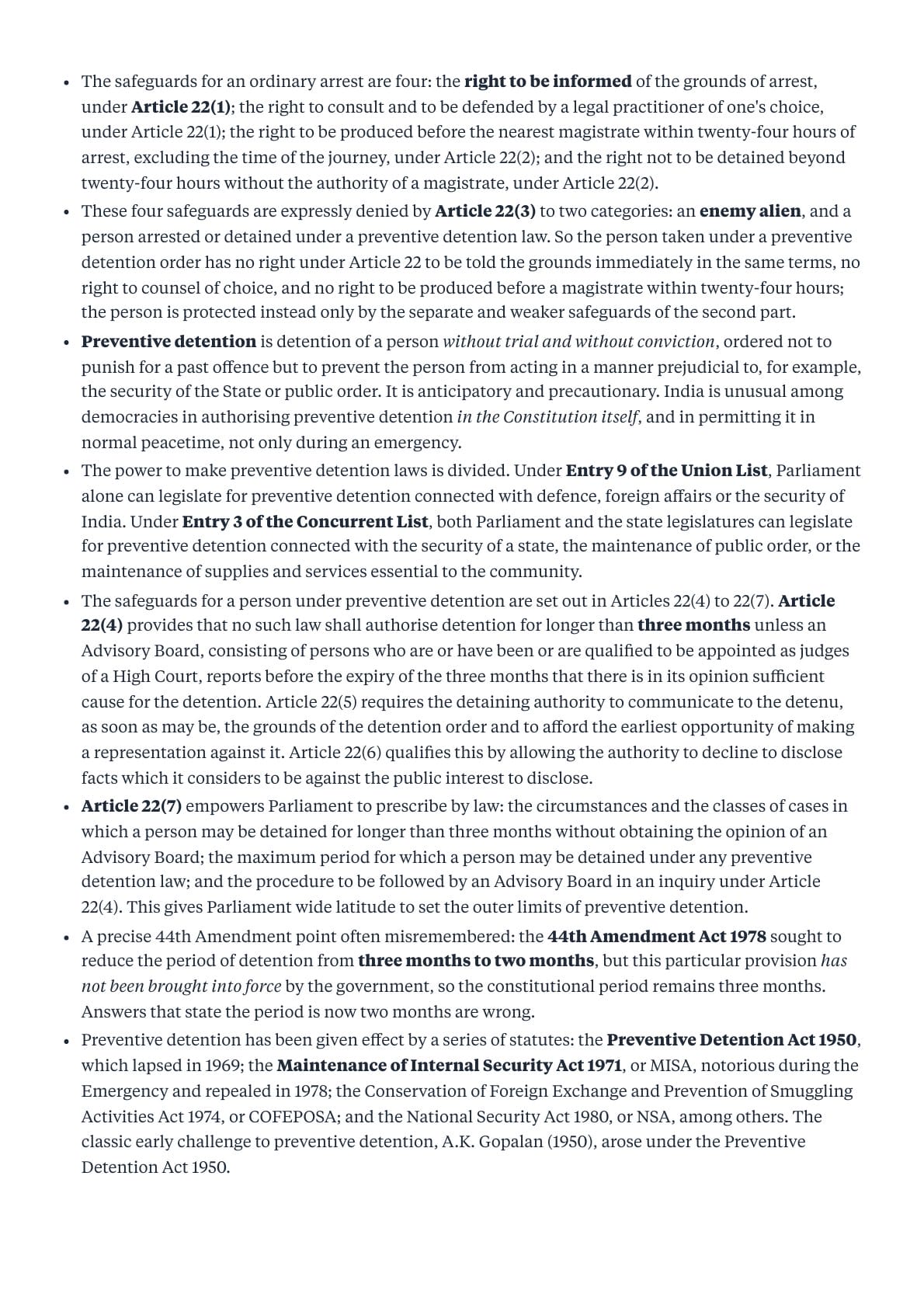
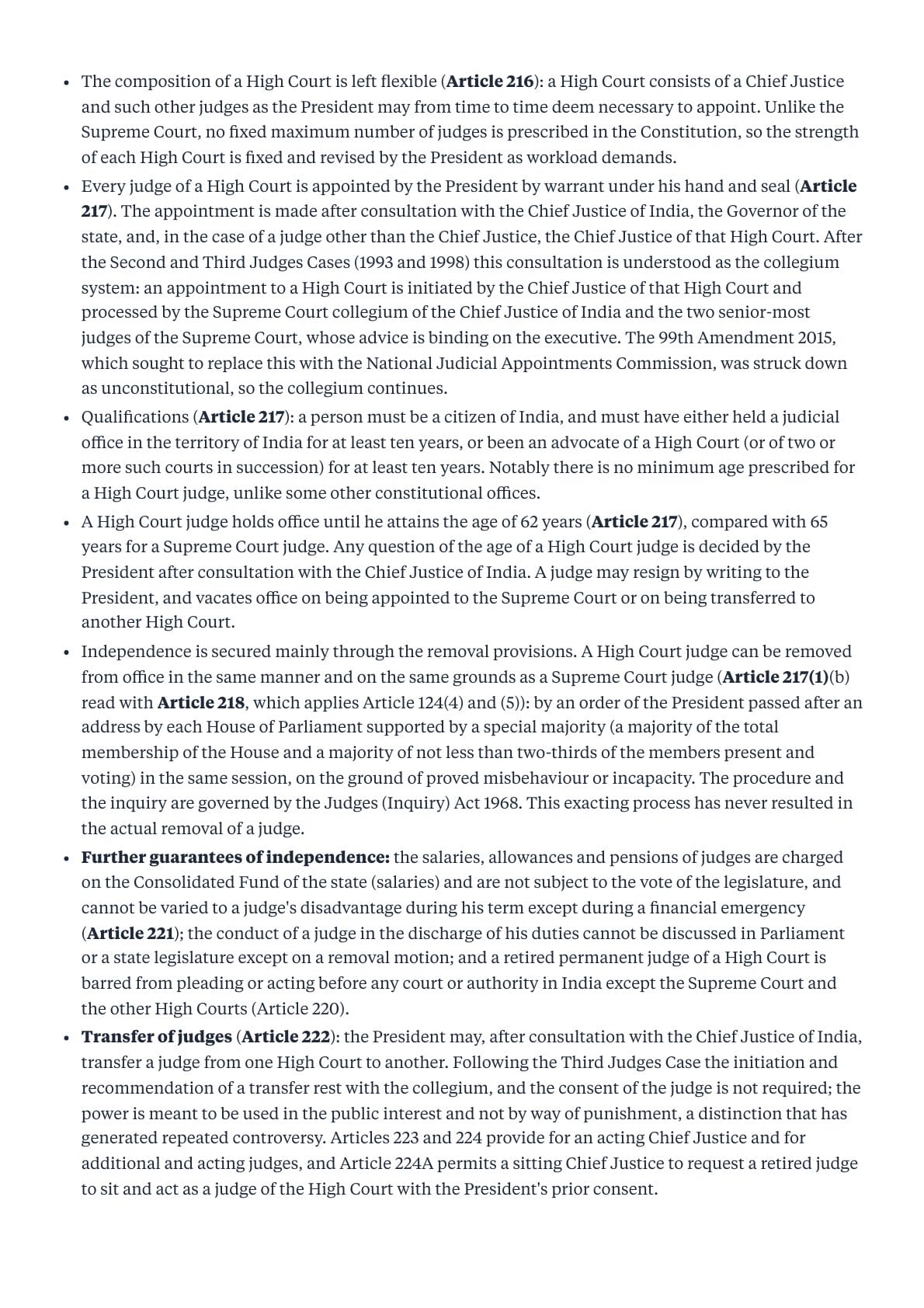
Look inside the book.
Preview the writing, structure, and page layout before you decide.
Get the book
Indian Polity: Complete Notes for UPSC (Prelims & Mains)
Free
463 pages as an A4 PDF, plus ePub · published 20 July 2026 · no payment, no email wall
- State an Article number and what it actually says, without second-guessing yourself
- Give the name, year, and holding of every landmark judgment the syllabus expects
- Revise a full unit in the last fortnight from its revision box alone
- Structure a GS-II Mains answer using the frameworks given with the 29 mapped questions
- Spot the confusions between similar Articles that cost marks every single year
- Do a complete final pass over all 24 units without opening a textbook
Prefer Kindle? The 921-page Kindle edition is on Amazon.com and Amazon.in, and it’s free to read on Kindle Unlimited. Same book, different delivery. Kindle page count and Kindle Unlimited status checked on Amazon, July 27, 2026. Amazon links are affiliate links, so I earn a small commission at no extra cost to you.
No payment. Checkout creates your download link instantly.
How to actually use it
Notes are for re-entry, not for a single read.
Use them on a cycle.
1. Download the free PDF
463 pages as A4, plus ePub. No payment and no email wall, so there’s nothing to decide yet.
You leave with: the whole book, at no cost.2. Read a part alongside your textbook
Use the units to structure the subject and to catch the details the textbook narrates past.
You leave with: an accurate first pass.3. Work the mapped questions
Do the MCQs and the Mains questions in place, unit by unit, with the explanations beside them.
You leave with: a real sense of how each unit is asked.4. Revise from the boxes only
In the last fortnight, run the revision boxes and the common-mistakes lists across all 24 units.
You leave with: a complete final pass in days, not weeks.Questions aspirants ask
Asked before downloading, answered straight.
Is this a substitute for Laxmikanth?
No. A textbook teaches you polity once, and you should still read one. These notes are for every pass after that: the Article numbers, the holdings, and the last-mile boxes you actually revise from.
Does it cover Prelims or Mains?
Both, in the same unit. You get factual accuracy for Prelims and GS-II answer structure for Mains, so the same unit doesn’t get learned twice in two different shapes.
How do the mapped questions work?
144 real and practice MCQs with explanations, plus 29 Mains questions with frameworks, sit inside the units they belong to instead of being stacked at the back of the book.
Do I have to give an email to download it?
No. The PDF and ePub are free on this site permanently, with no email wall. Checkout exists only to create your download link, and it does that instantly.
What formats does it come in?
A free 463-page A4 PDF plus ePub here, and a 921-page Kindle edition on Amazon that is free to read on Kindle Unlimited.
Will it get me more marks?
Nobody selling UPSC material can promise that, and you should be suspicious of anyone who does. What I can tell you is that the Article numbers, amendment details, and case holdings have been checked.
What I’m not going to claim
This is not a substitute for reading the Constitution or a standard textbook once. It’s revision-grade material, which means it’s compressed on purpose. If polity is completely new to you, read a textbook first and use this to structure and revise it.
It also can’t promise you marks. Nobody selling UPSC material can, and you should be suspicious of anyone who does. What I can tell you is that the Article numbers, amendment details, and case holdings have been checked, and that where I’m summarizing a judgment I say what was held rather than what it’s popularly taken to mean.
One more thing worth being blunt about. The full book is free here as a PDF and ePub. The Kindle edition is paid because Amazon has no free tier. If the PDF suits how you revise, take the PDF. I’d rather you used it than paid for it.

Hey, I’m Gaurav 👋
I taught competitive-exam and NDA students before I built anything on the web, and the thing that stayed with me is how much of a candidate’s loss is precision rather than understanding. They knew what judicial review meant. They wrote the wrong Article. Every design decision in this book comes from watching that happen.
I write and publish study material at anantamias.com alongside my main work, and this book came out of material that was already being used. It’s published under Gaurav Tiwari Publications, and the PDF stays free because the aspirants who need it most are the ones least able to keep buying material.
The numbers, since you probably won’t read a full bio:
- 18 years building on the web, and a WordPress core contributor
- 2,000+ articles published since 2008, teaching material included
- 850+ clients, all built on the same instinct: state the thing precisely, name the trap, and don’t pad
Free download
Download the free PDF now, or put it on your Kindle if that’s where you read.
463 pages as an A4 PDF, plus ePub, with no payment and no email wall. The Kindle edition is on Amazon if a phone in a queue is where your revision happens.
Free PDF & ePub · 24 units, 144 MCQs, 29 Mains questions · Kindle edition on Amazon
Disclaimer: This site is reader-supported. If you buy through some links, I may earn a small commission at no extra cost to you. I only recommend tools I trust and would use myself. Your support helps keep gauravtiwari.org free and focused on real-world advice. Thanks. - Gaurav Tiwari