
Operator Edition · free PDF
Write, edit, publish. The hard part is proving the page deserves to exist.
Most content checklists stop at the three obvious verbs. They don’t tell you how to match the search format, verify the public result, or decide what to improve next.
65-page tagged PDF · US Letter portrait · free, no payment · no account or special software needed after download
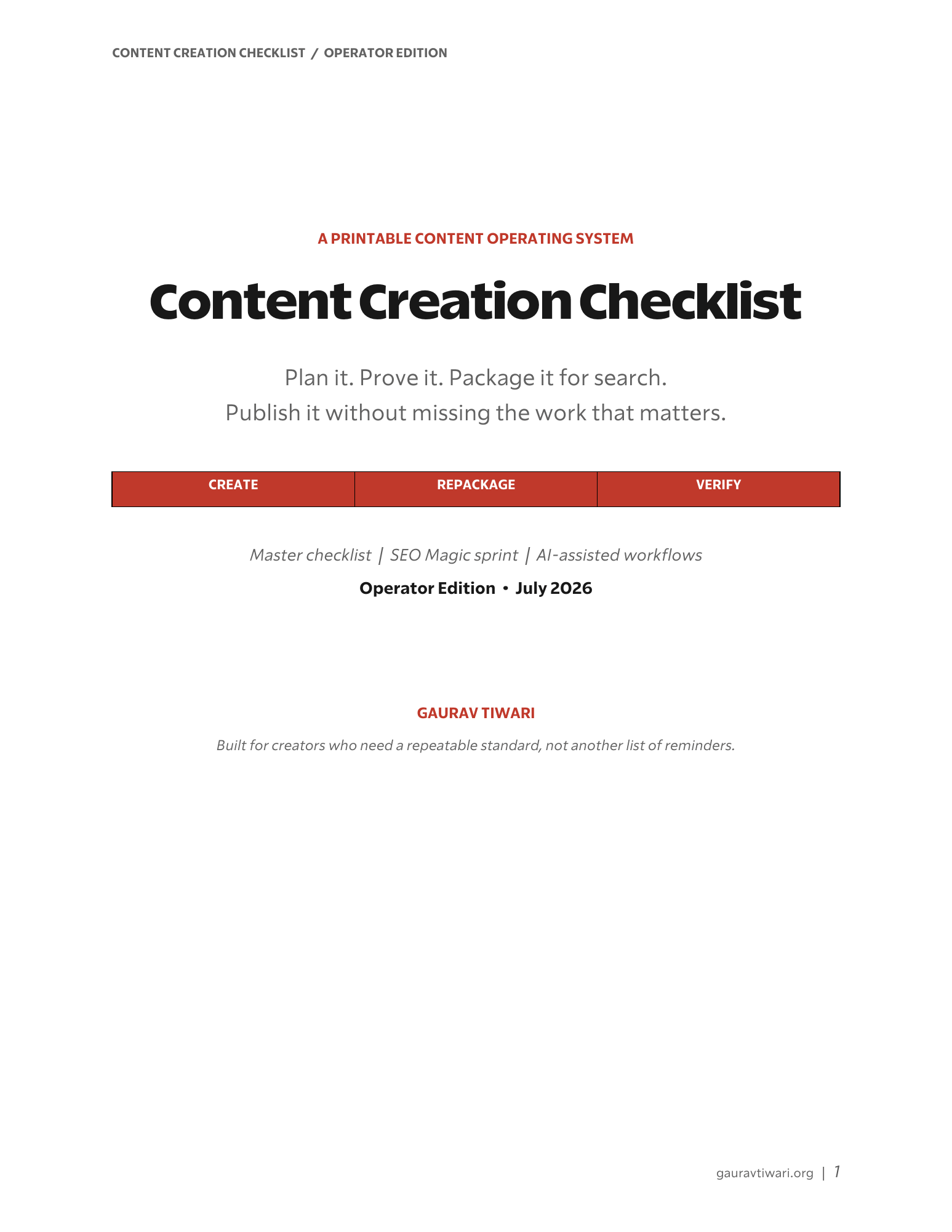
What’s in the file:
Why this one
A checked box should mean the work was verified.
Useful content often underperforms because the answer is packaged badly, not because it’s thin. A checklist that only tracks tasks can’t catch that.
What most content checklists cover
the default- Write it. A task list of stages, with nothing that tests the decision behind them.
- Edit it. No check on whether the page earns its place against what already ranks.
- Publish it. No format match against what the search result actually rewards.
- No public verification. Nothing on checking the rendered page, the metadata, or the indexing.
- No next move. Nothing that tells you what to improve after it’s live.
What this one does
the operator edition- 55 checks across five gates. Planning, production, editing, publishing, and measurement.
- A failed gate stops the line. Fix the decision before it spreads into the next stage.
- A repackaging sprint. Six operator worksheets that start from the live search result.
- 28 reference chapters. The reasoning and the tradeoffs a worksheet cannot hold.
- Five appendices. Content brief, editorial calendar, prompt library, tool directory, glossary.
- Printable. Checkboxes, worksheets, tables, notes, warnings, and examples, on paper or on screen.
What’s inside
Five production gates, then a sprint for pages already live.
Use the checklist while you work, then open the relevant chapter when a decision needs more context.
Gate A, Pre-Production
- Reader, query, intent
- SERP and thesis
- Proof ledger and brief
- Deadline and distribution
Gate B, Production
- First-screen answer
- Heading structure and first-party proof
- Visuals and metadata
- AI extractability, links, formatting
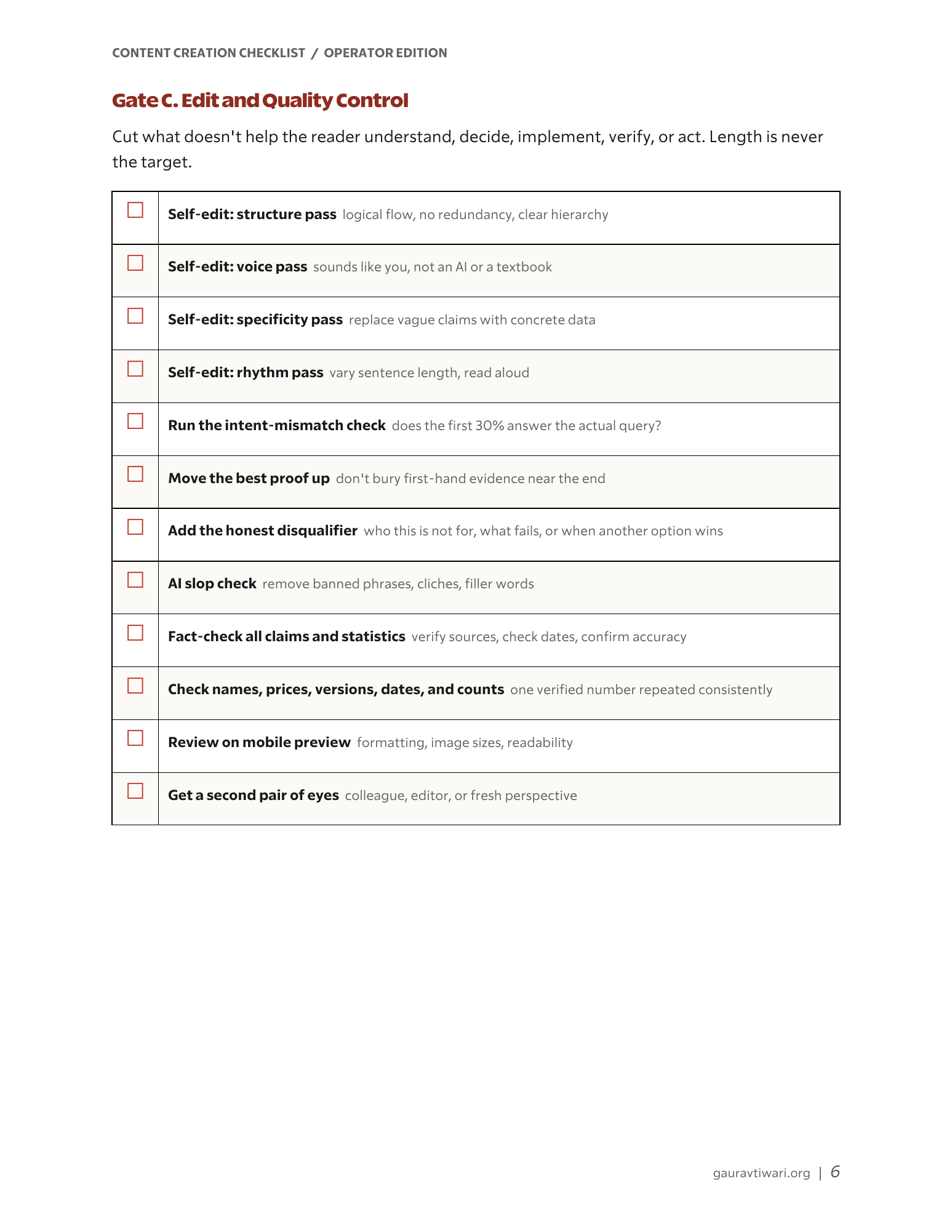
Gate C, Edit and QC
- Structure, voice, specificity, rhythm
- Intent mismatch and proof placement
- Factual accuracy
- Mobile review and a second review
Gate D, Publish and Distribute
- Media, SEO surfaces, schema
- Canonical and internal links
- Public rendering
- Distribution and indexing
Gate E, Measure and Improve
- Crawlability and behavior
- Query movement and conversions
- Feedback and evidence checks
- Lessons and repurposing
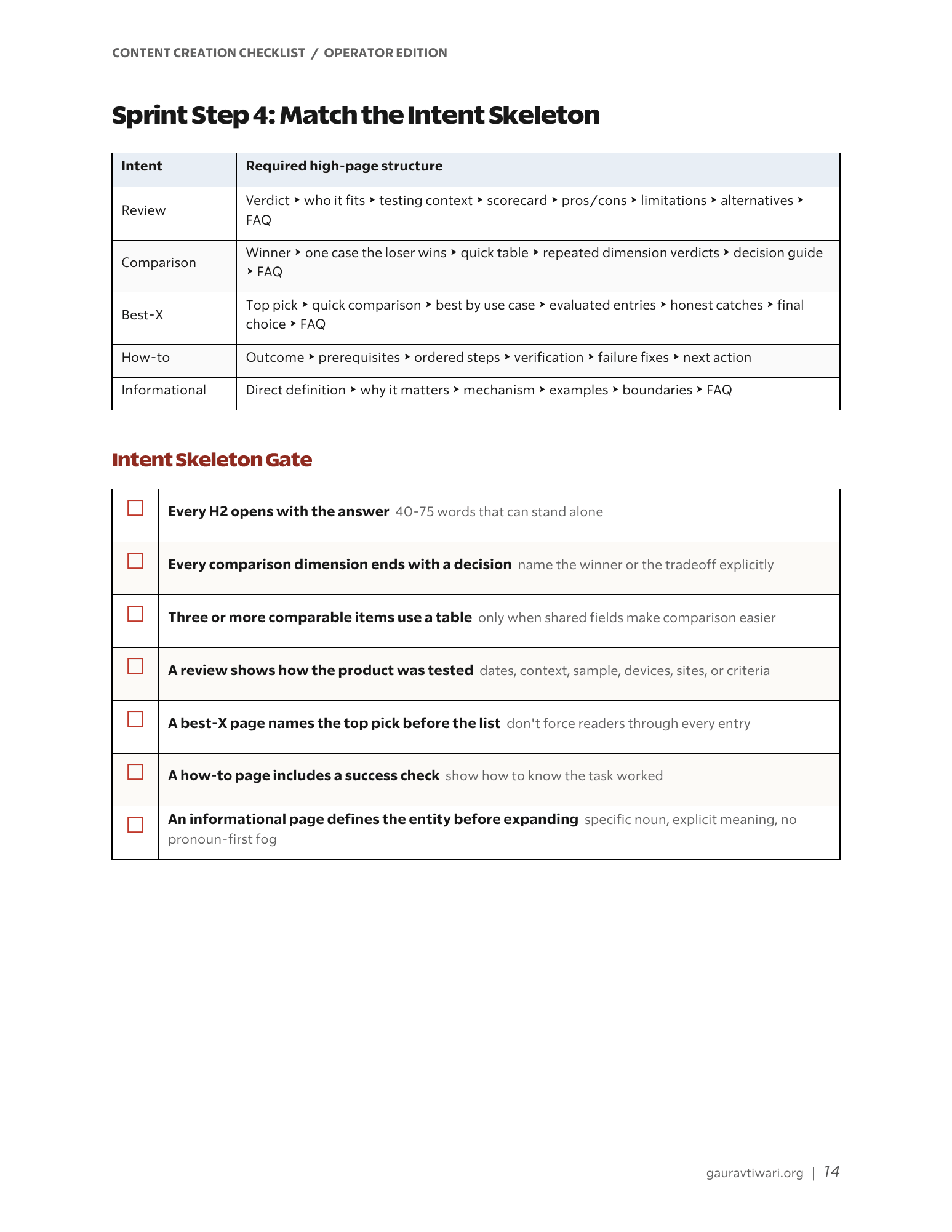
SEO Magic sprint
- Read the live SERP
- Diagnose the mismatch
- First-screen surgery
- Match the intent structure
- GEO citation pass
- Publish, verify, measure
55 production checks across five printable gates, plus an eight-page sprint built around a query card and six operator worksheets.
Behind the checks
The checklist handles execution. The chapters explain the calls.
Twenty-eight reference chapters and five appendices, for the moments a worksheet says do this and you need to know why.
Classic methods
Ideation, audience research, strategy, writing, storytelling, editing, and visual design.
Modern methods
Search intent, on-page SEO, GEO, social content, video, email, distribution, analytics, and repurposing.
AI-assisted work
Claude, ChatGPT, Gemini, research, fact-checking, voice matching, workflow design, disclosure, and quality control.
Specialized formats
Long-form guides, product reviews, comparisons, case studies, white papers, landing pages, and documentation.
See the framework.
These visual references show how the material is organized before you use it.
Get the checklist
Content Creation Checklist: 65-Page Operator Edition
Free
65 pages · tagged PDF · US Letter portrait · download link issued at checkout
- 55 production checks across five printable gates, from planning to measurement
- An eight-page SEO Magic sprint: one query card plus six operator worksheets
- 28 reference chapters covering writing, SEO, distribution, analytics, AI workflows, and content formats
- Five appendices: content brief, editorial calendar, prompt library, tool directory, and glossary
- Printable checkboxes, worksheets, tables, notes, warnings, and examples
- Tagged PDF with embedded Really Sans brand fonts, and no account or special software needed after download
This isn’t a course and it isn’t an automated audit. It’s the standard you run yourself, on the work you were going to publish anyway.
No payment. Checkout creates your download link instantly.
How to actually use it
Print the gate you’re standing in, not the whole file.
1. Print one gate
Each gate is a page you can put next to the keyboard. Start at Gate A before you write anything, not after.
You leave with: the decisions made before the draft.2. Stop at a failed gate
A checked box means the work was verified. If a gate fails, fix the decision there before the problem spreads into the next stage.
You leave with: errors caught where they’re cheap.3. Run the sprint on a page that underperforms
Start at the live search result, find the highest-cost mismatch, and fix the visible decision before adding more copy.
You leave with: a repackaged page instead of a longer one.4. Open the chapter behind the call
When a check needs judgment, the matching reference chapter carries the tradeoffs the worksheet can’t.
You leave with: the reasoning, not just the rule.Questions before you download
Download Questions
What’s included in the Content Creation Checklist?
65 pages: five printable production gates, a six-step SEO Magic repackaging sprint, 28 reference chapters, five appendices, templates, prompts, tool recommendations, and a glossary.
What format is the download?
A tagged, print-ready US Letter PDF. It uses Really Sans Large for display text and Really Sans Small throughout the body. It isn’t an A4 or fillable-form edition.
What is the SEO Magic Repackaging Sprint?
An eight-page worksheet sequence for improving an existing page without defaulting to a full rewrite. It covers query and intent locking, live SERP analysis, an eight-signal mismatch diagnostic, first-screen surgery, intent structure, GEO citation checks, publishing, and verification.
Do I need paid SEO or AI tools?
No. Search Console, a browser, your CMS, and a spreadsheet are enough for the core workflow. Paid tools can speed up research, but they aren’t required.
Who is this checklist for?
Bloggers and solo creators who want one repeatable publishing standard, freelance writers and editors who need a reliable client checklist, content marketers responsible for SEO and measurement, and small teams training writers without turning every review into a meeting.
Does it really cost nothing?
Nothing. Checkout is there to create your download link, and no payment is taken.
What I’m not going to claim
This is not a course, not an automated SEO audit, and not a substitute for first-hand evidence. It won’t invent a useful opinion, test a product for you, or make weak source material credible. It gives you a system for doing and verifying that work.
It’s also a US Letter PDF, not an A4 or fillable-form edition. If you print outside the US, the layout still works, it just isn’t sized for your paper.
And a checked box only means something if you were honest when you checked it. A gate you wave through is worse than no gate, because now you think the page was verified.

Hey, I’m Gaurav 👋
The articles of mine that failed almost never failed at the writing. They failed at a decision made before the writing, or at a packaging call made after it, and I kept rediscovering the same lesson because it lived in my head instead of on a page. This is that page, printable, with the checks in the order they bite.
The numbers, since you probably won’t read a full bio:
- 18 years building on the web, and a WordPress core contributor
- 2,000+ articles published since 2008, which is where these 55 checks came from
- 850+ clients, most of them shipping content on a schedule
It stays free here. A publishing standard that only one site follows isn’t worth much as a standard.
Use it on the next piece
Run one article through all five gates and you’ll see where yours leaks.
Print Gate A before the next draft. Run the sprint on the page that gets traffic and no clicks. Both fit in an afternoon.
65-page tagged PDF · free, no payment · download link issued at checkout