
Medieval Indian Mathematics · Free PDF
Twelfth-century mathematics, rebuilt in modern notation.
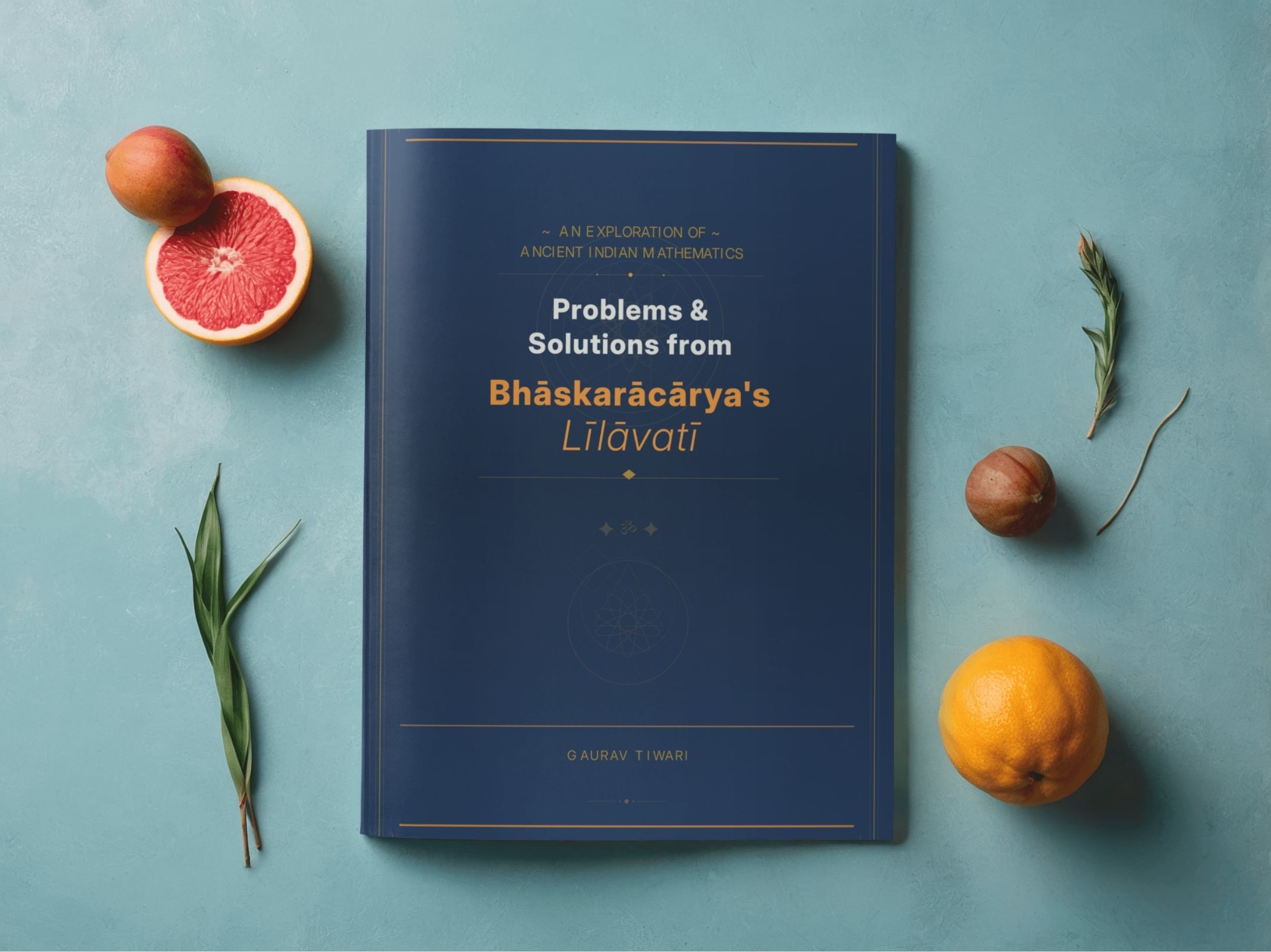
Bhaskara II composed Lilavati in the 12th century. This 29-page educational companion maps its arithmetic topics, works through 11 story problems in modern notation, adds four practice problems, and separates the companion material from the original text.
Free PDF · instant download · no payment at checkout
Format:
What’s inside
A 13-topic map, 11 worked problems, and four practice problems.
Each worked problem states the setup and follows it with a modern symbolic solution.
The 13-topic map
- Definitions and basic operations, fractions, zero and negative numbers
- Square and cube roots
- Arithmetic and geometric progressions
- Plane and solid geometry, and the shadow of the gnomon
- Combinations and permutations
The famous problems
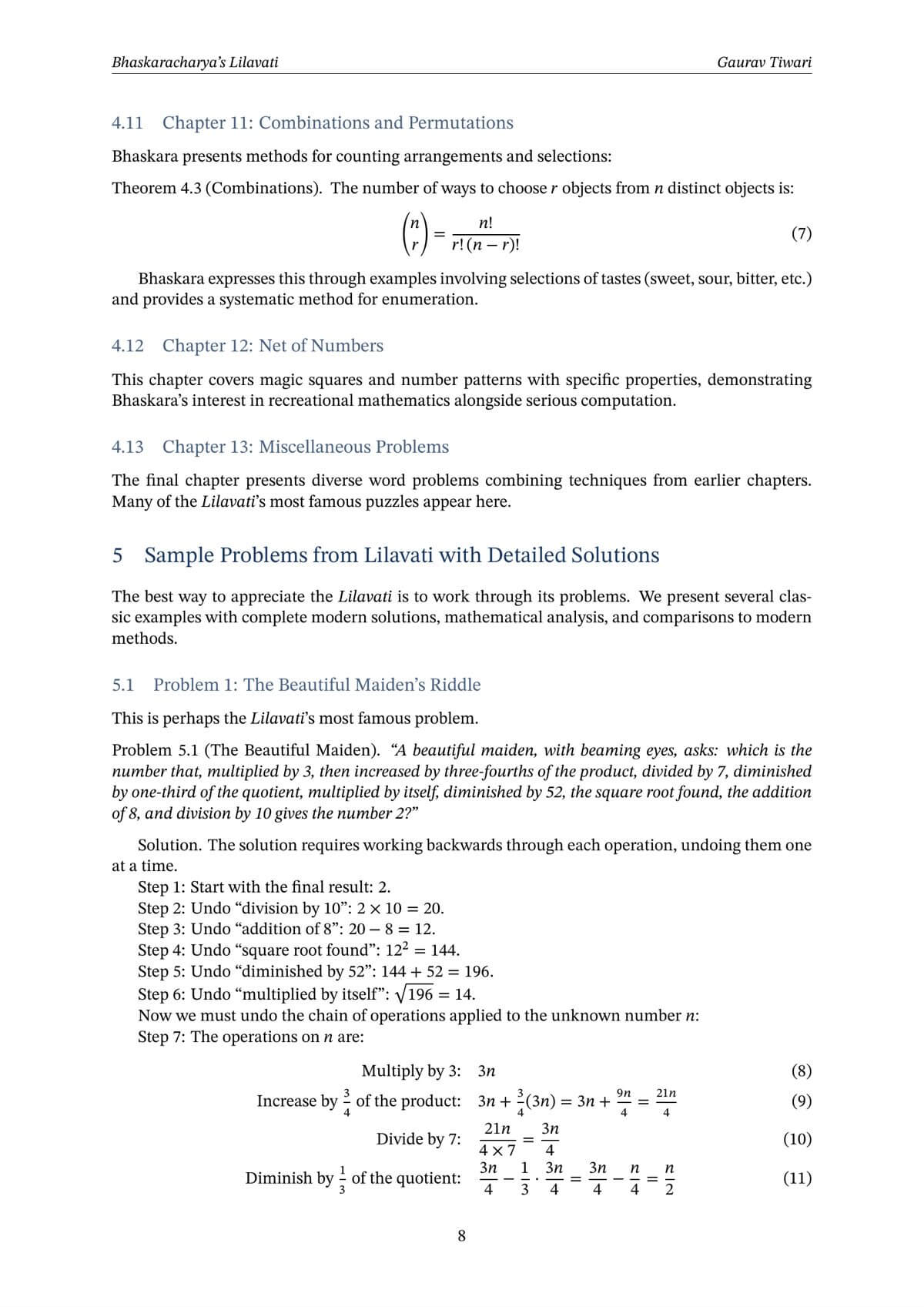
- The Beautiful Maiden’s Riddle
- The Peacock and the Snake
- The Bees and the Lotus
- The Broken Bamboo
- 11 word problems in all, each solved step by step
The methods
- The Rule of Three
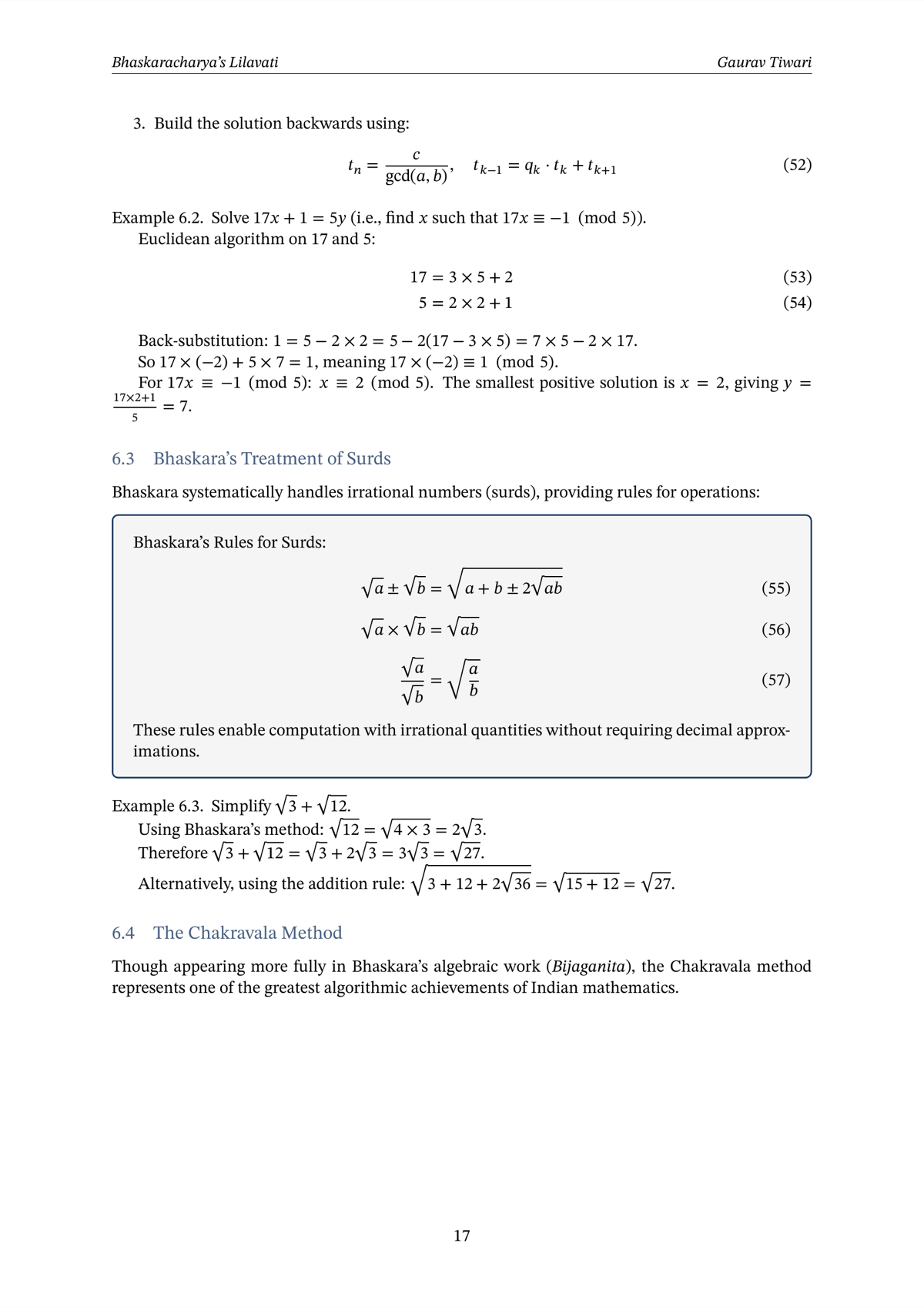
- The Kuttaka (pulverizer) for indeterminate equations
- Bhaskara’s treatment of surds
- The Chakravala method as companion material from the wider Indian mathematical tradition
The context
- A cautious note on rate-of-change ideas in Bhaskara’s astronomical work
- Comparison with Greek and Chinese mathematical traditions
- A timeline of Indian mathematics, from the Sulba Sutras to Ramanujan
The PDF also includes ten references, a timeline, and two mathematical appendices.
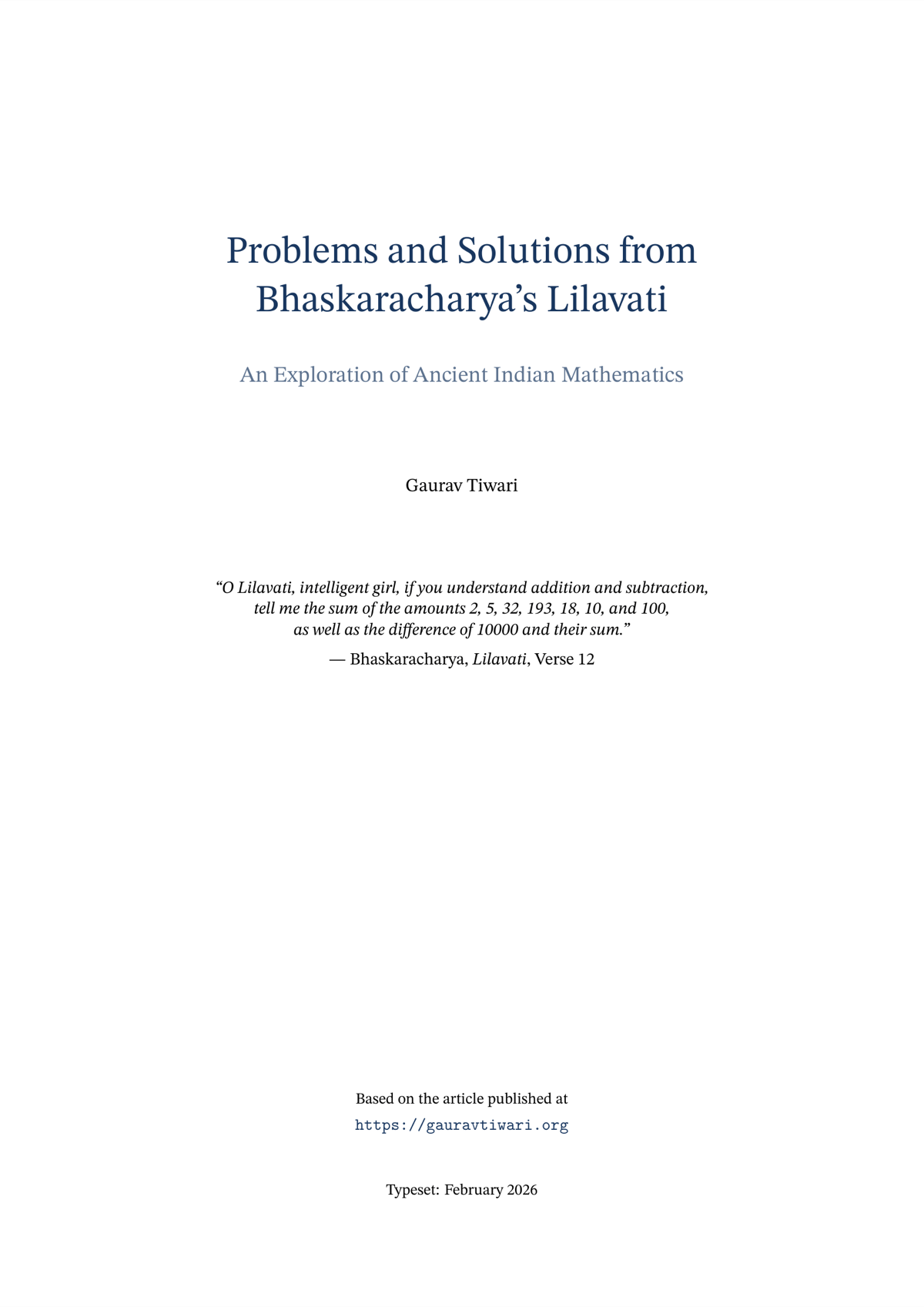
Look inside the book.
Preview the writing, structure, and page layout before you decide.
Get the book
Bhaskaracharya’s Lilavati: Ancient Indian Mathematics
Free
29-page A4 PDF · 1,138,545 bytes · instant download after a free checkout
- Read a 13-topic map of arithmetic, progressions, geometry, combinatorics, and related methods
- Work through 11 named problems with modern symbolic solutions
- Study the Rule of Three, Kuttaka, surds, and Chakravala as clearly labeled method notes
- Try four unsolved practice problems after the worked set
- Check claims against a ten-item reference list
- Use a timeline and two appendices for additional context
No payment. Checkout creates your download link instantly.
Questions readers ask
Asked before downloading, answered straight.
Is it actually free?
Yes. There’s no payment anywhere in the flow. The checkout creates your order and your download link instantly.
Do I need Sanskrit or a history background?
No. The PDF uses English and modern notation. It is an educational companion, not a Sanskrit edition or a line-by-line scholarly translation.
Is this a history book or a mathematics book?
Mathematics first. The context is there, a comparison with Greek and Chinese traditions and a timeline from the Sulba Sutras to Ramanujan, but the core of the book is working through the problems and the methods.
What is the Chakravala method?
Chakravala is a cyclic method associated with the wider Indian tradition of indeterminate equations. The PDF treats it as companion material, alongside Kuttaka, rather than claiming that every method discussed belongs to Lilavati itself.
Why is there a checkout for a free PDF?
The download is delivered through my store rather than a raw file link. The free checkout creates your download link instantly, with no payment details anywhere.
What I’m not going to claim
There are no ratings to show you. It’s a free PDF, and I’d rather be plain about that than decorate the page.
This is a reconstruction in modern notation, not a scholarly translation of the Sanskrit. If you want philology, you need a different book. If you want to actually solve the problems, this is the version you can work through.
The center is Lilavati, but the PDF includes clearly labeled companion notes on methods and astronomical work outside its narrow arithmetic scope. Do not use it as a substitute for a critical edition or specialist history.

Hey, I’m Gaurav 👋
I taught mathematics before I built websites, and the Lilavati problems were my answer whenever a student decided math was joyless. Bhaskara asks about bees, peacocks, and broken bamboo, and somewhere in the middle of the story you’re doing real mathematics.
I have been publishing online for 18 years. That is context, not proof. The book is deliberately inspectable:
- 29 PDF pages, including cover and front matter
- 11 worked problems and 4 practice problems
- 10 references, a timeline, and two appendices
Free download
Solve a problem that’s 900 years old tonight.
The Broken Bamboo has been waiting since the 12th century. The download takes a click.
Free PDF · instant download · no payment at checkout