
Why Outsource SEO Content to perfect your writing requirements?
A 2,500-word blog post takes the average business owner 6 to 8 hours to research, write, and edit. If your time is worth $100/hour, that’s $600-800 per article in opportunity cost. You’re not writing content. You’re burning money you could spend closing deals, building product, or managing your team. And the worst part? You still need to publish 8-12 articles per month to compete for any meaningful organic traffic in 2026.
Every week you don’t publish is a week your competitors do. They’re putting out 3-4 articles while you’re stuck on paragraph three of a single post. Google’s crawlers don’t care about your busy schedule. Neither does Perplexity, Claude, or ChatGPT when they’re deciding which sources to cite. The gap between you and your competitors widens with every missed publishing week, and closing it later costs 3x more than staying consistent now.
I’ve managed content production across 800+ client projects over 16 years. I’ve written thousands of articles myself, outsourced to freelancers on every major platform, and tested every AI writing tool worth testing. What I’ve learned is that the question isn’t “should I outsource?” It’s “what should I write, what should I outsource, and where does AI fit in?” This guide gives you the decision framework, the platform comparisons, the cost breakdowns, and the exact workflow I use to produce 20+ articles per month without sacrificing quality.
The Real Cost of Writing Content Yourself
Most business owners dramatically underestimate what their content actually costs. They think it’s “free” because they’re not paying a writer. That’s like saying cooking at home is free because you didn’t visit a restaurant. Your time has a dollar value, and you need to calculate it honestly.
Here’s the math I run with every client who tells me they prefer writing their own content:
- Research and outline: 1.5-2 hours per article
- Writing the first draft: 3-4 hours for 2,000+ words
- Editing and proofreading: 1-1.5 hours
- SEO optimization, image sourcing, formatting: 45-60 minutes
- Total per article: 6-8 hours minimum
If your hourly rate is $75 (conservative for most business owners), each article costs you $450-600 in time. Multiply that by 10 articles per month and you’re looking at $4,500-6,000 in opportunity cost. A freelance writer would charge you $2,000-4,000 for those same 10 articles, and you’d get your 60+ hours back to spend on revenue-generating work.
That said, there are times when writing yourself is the right call. If the content requires deep personal experience, if it’s thought leadership that builds your brand, or if it’s a YMYL topic where your credentials matter for E-E-A-T, write it yourself. The key is being intentional about which articles deserve your time and which don’t.
When AI Writing Tools Are Good Enough (And When They Produce Garbage)
AI writing tools like Jasper, ChatGPT, and Claude can generate a passable first draft in 10-15 minutes. For certain content types, that’s genuinely useful. For others, it’s a fast track to thin, generic content that Google will ignore and readers will bounce from.
I’ve tested AI-generated content across 40+ articles on different sites over the past 18 months. The results are clear: AI works for some things and fails at others.
Where AI Content Works
- Product descriptions and comparison tables: Structured, factual content where voice matters less than accuracy
- FAQ sections: Straightforward answers to common questions
- Social media posts and email subject lines: Short-form content where you need volume and variety
- Internal documentation: SOPs, process guides, meeting summaries
- Content outlines and research summaries: AI is excellent at organizing information
Where AI Content Fails
- YMYL content (health, finance, legal): AI hallucinations in these niches can cause real harm and destroy credibility
- Thought leadership and opinion pieces: AI doesn’t have opinions. It produces the average of what it’s seen
- Case studies and original research: AI can’t test products, interview customers, or run experiments
- Content targeting GEO and SEO simultaneously: AI search engines cite sources with original data and first-party evidence. AI-generated content has neither
The distinction is simple: if the content requires experience, testing, or a genuine perspective, AI alone won’t cut it. If the content is mostly organizing existing information into a useful format, AI can handle the heavy lifting.
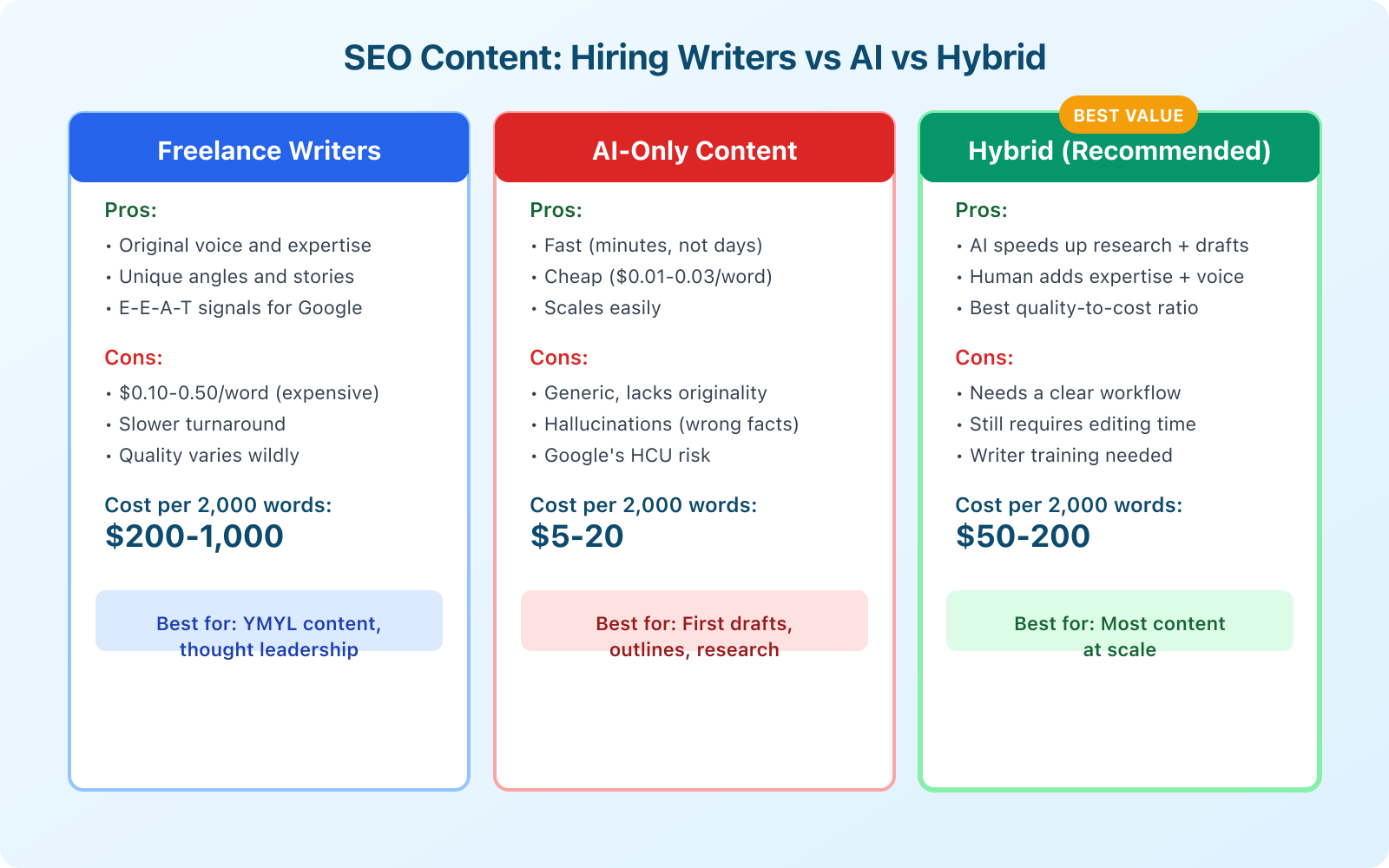
How to Hire SEO Writers: Platform Comparison
Finding a competent SEO writer is harder than it sounds. I’ve hired over 50 writers across every major platform. Some delivered exceptional work. Most delivered something between “needs significant editing” and “completely unusable.” The platform you use affects the quality floor, the vetting process, and what you’ll pay.
WriterAccess
WriterAccess is my top recommendation for businesses that need consistent, vetted SEO content. Every writer on the platform is tested and rated on a star system. You can filter by industry expertise, SEO knowledge, and past performance. Their AI-powered writer matching saves you hours of vetting.
Pricing: $0.04-0.10/word for standard writers, $0.10-0.30/word for premium 5-star and 6-star writers. A 2,000-word article runs $80-600 depending on the writer tier. Monthly plans start at $39/month for access to the platform.
Best for: Businesses publishing 8+ articles per month that need reliable quality without managing individual freelancers.
Upwork
Upwork has the largest pool of writers, which means both the best and worst writers you’ll ever encounter. Filter aggressively: Top Rated writers only, $50+/hour minimum rate, 90%+ job success score. Read portfolio samples. Ignore the ones who list “SEO content” as a skill but have no ranking articles to show.
Pricing: $0.08-0.50/word depending on the writer. Upwork charges a 5% client fee. Expect $160-1,000 per 2,000-word article.
Best for: Finding specialized niche writers (SaaS, medical, finance) who you’ll build a long-term relationship with.
Contently and nDash
Contently and nDash are premium content platforms where writers pitch you rather than the other way around. The quality floor is higher, but so are the prices. Both platforms work best for enterprise teams that need managed content workflows.
Pricing: $300-1,000+ per article. Enterprise plans with dedicated strategists run $3,000-10,000+/month.
Best for: Companies with $5,000+/month content budgets that want white-glove service and editorial management.
Fiverr Pro
Fiverr Pro has improved significantly. The “Pro” designation means writers are hand-vetted by Fiverr’s team. Skip regular Fiverr entirely for content work. The Pro tier has legitimately good writers, though availability for niche topics can be limited.
Pricing: $150-500 per 2,000-word article from Pro writers.
Best for: One-off projects or testing writers before committing to a platform subscription.
The best writer I ever hired came from Upwork. The worst writer I ever hired also came from Upwork. The platform matters less than your vetting process.
Quality Benchmarks for Outsourced Content
You can’t just publish whatever a writer sends back. Every piece of outsourced content needs to clear specific quality bars before it goes live. I evaluate outsourced content on 6 criteria, and if an article fails any of them, it goes back for revision or gets rejected.
E-E-A-T Signals
Google’s quality raters look for Experience, Expertise, Authoritativeness, and Trustworthiness. Your outsourced content needs to demonstrate at least two of these. That means the writer should include specific examples from real use (“I tested this on 12 sites”), reference verifiable data with sources, and avoid vague claims like “experts agree.” Content that formats well for AI search engines needs even higher E-E-A-T signals because AI citations favor authoritative, entity-rich sources.
Original Research and First-Party Data
The single biggest differentiator between content that ranks and content that doesn’t is original data. Screenshots of real results. Numbers from actual tests. Comparisons based on hands-on experience. If your writer’s article could have been written by someone who never used the product or tested the strategy, it’s not good enough.
Factual Accuracy
Verify every statistic, pricing claim, and factual statement. Writers (both human and AI) frequently cite outdated numbers, misattribute quotes, and present opinions as facts. I spot-check at least 5 claims per article. If more than 2 are wrong, the article gets rejected.
SEO Fundamentals
Primary keyword in the title, H1, first paragraph, and 3-5 times naturally throughout. Proper heading hierarchy (H2 > H3, never random). 3-5 internal links with natural anchor text. Meta description that includes the keyword and compels a click. If your writer doesn’t know these basics, they’re not an SEO writer.
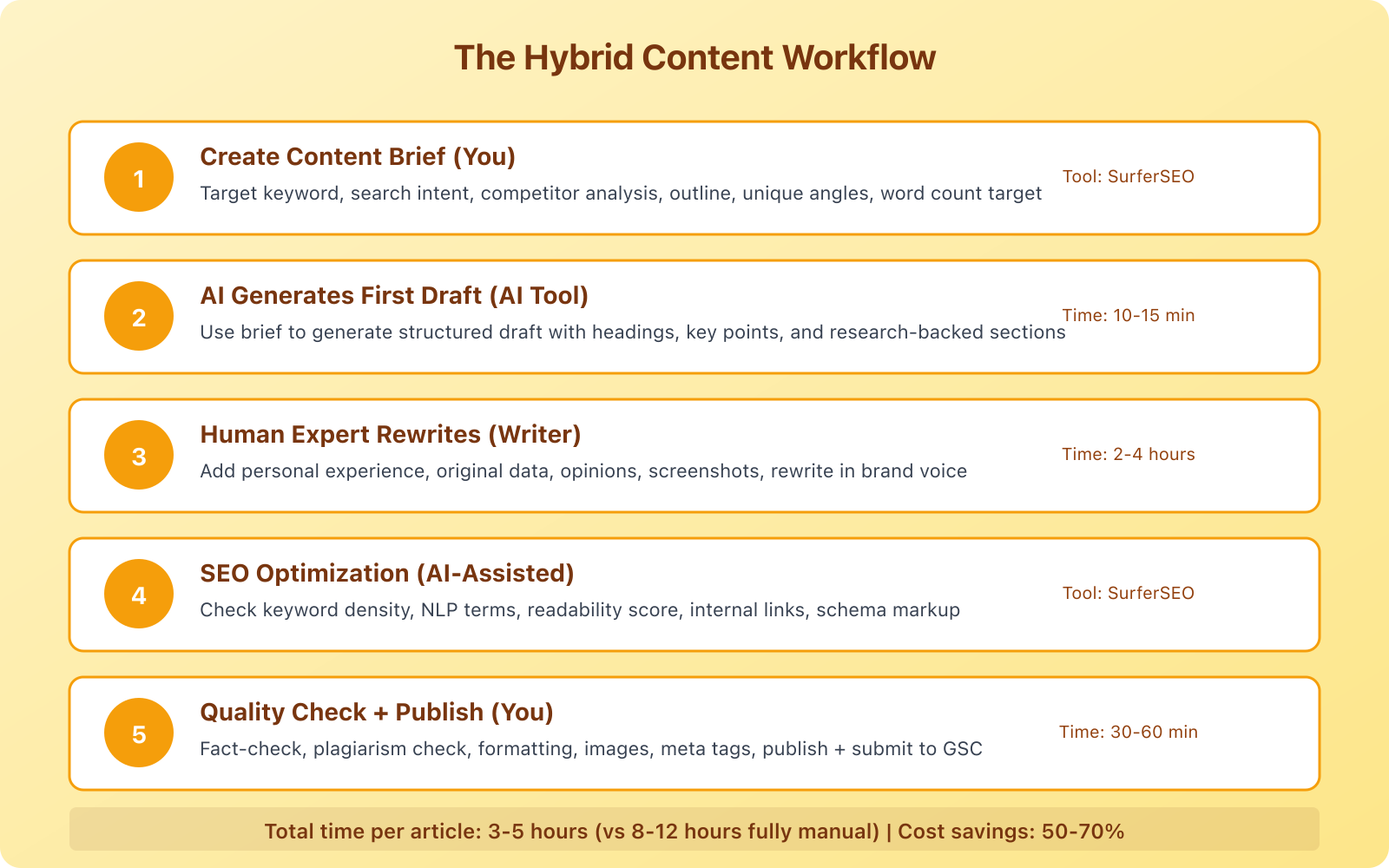
The Hybrid Model: AI Draft + Human Editor + SME Review
The hybrid model is what I recommend for 80% of businesses producing content in 2026. It combines AI speed with human quality at a cost that makes sense. I’ve refined this workflow over 18 months of testing, and it consistently produces content that ranks, reads well, and passes every quality check.
Here’s the exact 5-step process:
- Create a detailed content brief (30 minutes): Target keyword, search intent, competitor gaps, required headings, unique angles, internal links, and tone guidelines. The brief is the most important step. A bad brief produces bad content regardless of who writes it.
- AI generates the first draft (15 minutes): Feed the brief to Jasper or Claude. The AI handles research synthesis, structure, and the initial 2,000+ word draft. Don’t expect perfection here. Expect a solid starting point.
- Human writer rewrites with expertise (2-3 hours): A skilled editor adds personal experience, replaces generic claims with specific data, injects brand voice, and restructures sections that feel robotic. This step is where 80% of the value gets added.
- Subject matter expert review (30-45 minutes): Someone with domain expertise fact-checks the claims, adds nuance, and flags anything that feels inaccurate. For YMYL topics, this step is non-negotiable.
- SEO optimization and publish (30 minutes): Run through Sapling for grammar, optimize keyword placement, add schema markup, set internal links, and publish.
Total time per article: 3.5-5 hours across your team. Total cost: $100-250 per article (writer fee + tool subscriptions). Compare that to $400-800 for a fully outsourced article or 6-8 hours of your own time. The math works.
AI handles the research and structure. Humans add the experience, opinion, and accuracy. Together they produce content that’s better than either could produce alone, at a fraction of the cost.
Cost Comparison: DIY vs. Freelancer vs. Agency vs. AI-Assisted
I’ve tracked my content production costs across every method for the past 3 years. These numbers come from real projects, not industry averages. The table below shows what you’ll actually spend to produce 10 articles per month at 2,000 words each.
| Method | Cost Per Article | Monthly Cost (10 articles) | Quality Score | Your Time Required |
|---|---|---|---|---|
| Write Yourself | $450-800 (opportunity cost) | $4,500-8,000 | 9/10 | 60-80 hours |
| Content Agency | $400-1,000 | $4,000-10,000 | 7/10 | 5-10 hours (review) |
| Freelance Writers | $200-600 | $2,000-6,000 | 6-8/10 | 10-15 hours (brief + review) |
| Hybrid (AI + Human Edit) | $100-250 | $1,000-2,500 | 7-8/10 | 15-20 hours (brief + edit + review) |
| AI Only | $5-20 | $50-200 | 3-4/10 | 5-10 hours (editing) |
The hybrid approach hits the sweet spot for most businesses. You’re getting 7-8/10 quality at 60-70% less cost than freelancers and freeing up 40+ hours per month compared to writing everything yourself. For a small business publishing 10 articles per month, that’s the difference between $1,500 and $6,000. Over a year, that’s $54,000 in savings.
If you need help building a content strategy that accounts for these costs, I’ve broken down the full planning process in my guide on building a content marketing plan.
How do you produce most of your blog content?
Managing a Content Team: Calendars, Style Guides, and Revision Workflows
Outsourcing one article is easy. Outsourcing 10-20 articles per month consistently while maintaining quality requires a system. Without one, you’ll spend more time managing writers than you saved by not writing yourself.
Editorial Calendar
Plan content 4-6 weeks ahead. I use Notion to manage editorial calendars because it lets me create database views that show articles by status (brief, assigned, draft received, editing, published), by writer, by topic cluster, and by publish date. Monday is another solid option if you prefer a more visual board layout.
Each calendar entry includes: target keyword, assigned writer, brief link, draft deadline, publish date, and current status. Batching brief creation at the start of each month (all 10-12 briefs in one sitting) is 3x more efficient than creating them week by week.
Style Guide
Create a one-page style guide and share it with every writer. Mine covers: brand voice (conversational, opinionated, uses “I” and “you”), formatting preferences (short paragraphs, H2/H3 hierarchy, bullet points for lists), words to avoid (no “leverage,” “utilize,” “robust,” or “seamless”), and 3 examples of articles that represent the target quality. Update the guide every time you notice a recurring issue in drafts.
Revision Workflow
Set clear expectations upfront: every article includes 1 round of revisions. Additional rounds cost extra. Provide specific, actionable feedback (“Add a real example in section 3” not “make it better”). Time-box the revision cycle to 3 business days. If a writer consistently needs 3+ revision rounds, they’re not the right fit. Tracking content marketing KPIs like revision rounds per article helps you identify which writers deliver clean drafts and which drain your editing time.
Tools That Make Content Outsourcing Easier
The right tools reduce your management overhead by 50% or more. I’ve tested dozens of tools for content production, and these are the ones I actually use daily.
For AI-Assisted Drafting
Jasper remains the most capable AI writing tool for long-form SEO content. Its brand voice training, SEO mode, and template library save significant time on first drafts. At $49/month for the Creator plan, it pays for itself if you publish 2+ articles per month.
For Grammar and Style Checking
Sapling catches grammar errors, awkward phrasing, and style inconsistencies that standard tools miss. It’s particularly useful for content written by non-native English speakers or AI tools. I run every article through Sapling before publishing, whether I wrote it or a freelancer did.
For Project Management
Notion handles the editorial calendar, content briefs, style guides, and writer databases in one workspace. Its database views let you track articles from brief to publish. I switched from Trello to Notion 2 years ago and haven’t looked back. If your team prefers something more structured, Monday offers better automation and timeline views.
For Finding Writers
WriterAccess is the fastest path from “I need content” to “I have a vetted writer assigned.” Their AI matching, quality ratings, and managed workflow tools eliminate most of the friction in hiring freelancers. For businesses publishing 8+ articles per month, the time savings alone justify the platform fee.
When to Write Yourself vs. When to Outsource: The Decision Matrix
Not every article should be outsourced. Not every article should be written by you. The smart move is matching each content type to the production method that maximizes quality while minimizing your time investment.
| Content Type | Best Approach | Why |
|---|---|---|
| Thought leadership / personal brand | Write yourself | Your voice, experience, and opinions can’t be replicated |
| YMYL topics (health, finance, legal) | Write yourself or hire certified expert | E-E-A-T requirements demand real credentials |
| Case studies with your own data | Write yourself | Only you have the first-party data and context |
| Product comparisons and roundups | Hybrid (AI + human edit) | Structured content where AI excels at organizing |
| How-to tutorials | Hybrid or freelancer | Needs accuracy but doesn’t need your personal voice |
| Industry news and updates | AI-assisted | Time-sensitive, factual, low E-E-A-T requirement |
| Glossary and definition pages | AI-assisted | Informational, structured, minimal voice needed |
| Pillar content and cornerstone guides | Freelance expert or write yourself | High-stakes content that needs to rank for years |
I write about 20% of my content myself (thought leadership, personal experience, controversial opinions), outsource 30% to freelancers (specialized topics, guest expert perspectives), and produce 50% through the hybrid AI + human model (tutorials, comparisons, roundups, how-to guides). This split keeps my publishing volume at 15-20 articles per month while keeping my personal writing time under 15 hours per week.
How to Create a Content Brief That Eliminates Revisions
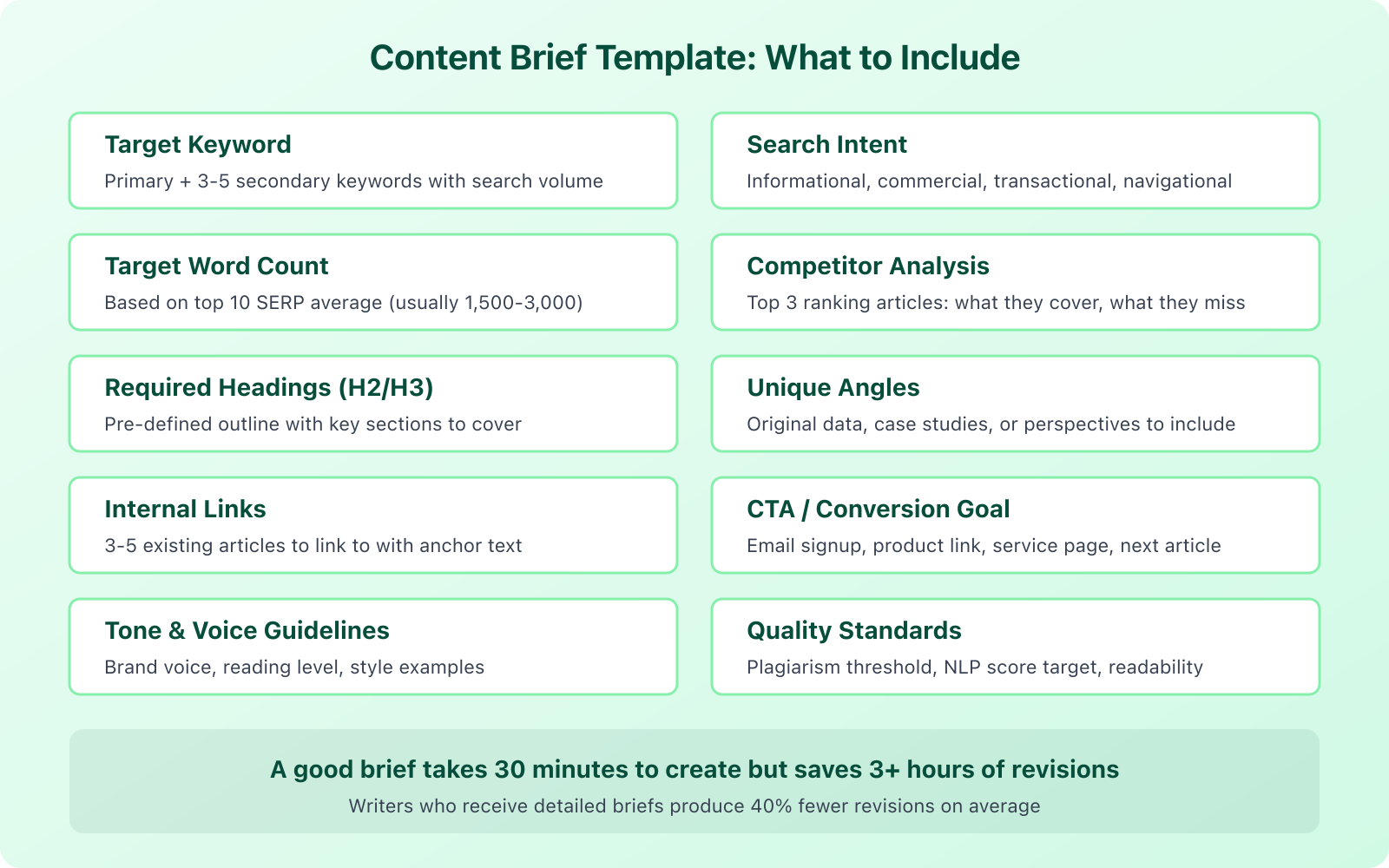
The quality of outsourced content is directly proportional to the quality of your brief. A vague brief (“write about CRM software”) produces vague content. A detailed brief produces content that needs minimal revision. I’ve tracked this across 200+ outsourced articles: detailed briefs reduce revision rounds by 40% and cut turnaround time by 2 days on average.
Every content brief I create includes these 10 elements:
- Primary keyword with monthly search volume and keyword difficulty
- 3-5 secondary keywords to include naturally
- Search intent (informational, commercial, transactional, navigational)
- Target word count based on top-ranking competitors
- Required headings with specific sections and angles for each H2/H3
- Competitor analysis (top 3 articles: what they cover well, what they miss, your differentiation angle)
- Unique data or examples the writer should include (screenshots, test results, case studies)
- Internal links (3-5 existing articles to link to, with suggested anchor text)
- CTA and conversion goal (what should the reader do after reading?)
- Voice and tone guidelines with 2-3 example articles from your site
A good brief takes 30-45 minutes to create. That investment saves 3+ hours of revisions and back-and-forth. Writers who receive detailed briefs consistently produce better first drafts. That’s not an opinion. It’s a pattern I’ve seen across hundreds of outsourced articles.
Frequently Asked Questions
How much should I pay for outsourced SEO content in 2026?
For competent SEO writers, expect $0.10-0.30 per word for general topics and $0.25-0.75 per word for specialized niches like medical, legal, SaaS, or finance. A 2,000-word article typically costs $200-600 from a freelancer. Content agencies charge $400-1,000+ per article. If a writer charges less than $0.08/word, they’re likely using AI without disclosure or producing low-quality content that will hurt your rankings.
Should I use AI instead of hiring writers?
Not as a complete replacement. AI tools like Jasper and ChatGPT are excellent for research, outlines, and first drafts. But AI-only content lacks originality, personal experience, and the E-E-A-T signals that Google values for ranking. The hybrid approach (AI draft + human rewrite + expert review) costs 60-70% less than hiring writers from scratch while maintaining the quality and originality that search engines reward.
How do I know if outsourced content is good enough to publish?
Run every article through a 6-point quality check: fact-check all statistics and claims, run a plagiarism check with Copyscape, verify keyword placement in the title and first paragraph, ensure 3-5 internal links are included, check readability at 8th-grade level, and read it out loud to catch robotic phrasing. Use Sapling to catch grammar issues. If the content wouldn’t pass as something you’d put your name on, send it back for revision.
Where can I find good SEO content writers?
WriterAccess is the fastest option with pre-vetted, rated writers and AI matching. Upwork has the largest pool but requires more vetting (filter by Top Rated, $50+/hour, 90%+ success rate). Contently and nDash serve enterprise teams with premium, managed services. Fiverr Pro has improved significantly for one-off projects. Always start with a paid test article before committing to any writer long-term.
How many articles per month should I outsource?
For steady organic growth, target 8-12 articles per month. For aggressive growth in competitive niches, 15-20 articles. Start with 4-6 articles to test your workflow and writers, then scale as quality stabilizes. Consistency matters more than volume. Four high-quality articles per week will outperform twelve mediocre ones every time.
What’s the difference between an SEO writer and a traditional writer?
A traditional writer crafts engaging prose. An SEO writer crafts content that ranks. SEO writers understand keyword placement, heading hierarchy, search intent matching, internal linking strategy, NLP optimization, and featured snippet formatting. When interviewing writers, ask them to explain their process for a specific keyword. If they can’t discuss search intent, competitor analysis, or on-page optimization, they’re a traditional writer, not an SEO writer.
Can I use AI content for YMYL topics like health or finance?
I strongly advise against it. AI tools hallucinate facts, especially with medical dosages, financial regulations, and legal requirements. YMYL content needs verified accuracy from someone with real credentials. Use AI for research and structure if you want, but the writing and fact-checking must come from a qualified human. Google’s quality raters specifically evaluate YMYL content for author expertise and accuracy.
How do I build a style guide for outsourced content?
Keep it to one page. Cover: your brand voice (conversational, formal, technical), formatting preferences (paragraph length, heading structure, list usage), words and phrases to avoid, 2-3 example articles that represent your target quality, and any SEO requirements (keyword density, internal linking rules, meta description format). Share this with every writer and update it whenever you notice recurring issues in drafts. A good style guide eliminates 80% of voice-related revisions.
Outsourcing SEO content isn’t about finding a magic writer who reads your mind. It’s about building a system: clear briefs, vetted writers, quality checks, and the right tools. Whether you write yourself, hire freelancers, use AI, or combine all three depends on your budget, your expertise, and how much time you can realistically invest in content production. Start with the hybrid model, track your costs and quality metrics, and adjust from there. The businesses that win at content marketing in 2026 aren’t the ones who write the most. They’re the ones with the best system for producing quality content consistently.
Disclaimer: This site is reader-supported. If you buy through some links, I may earn a small commission at no extra cost to you. I only recommend tools I trust and would use myself. Your support helps keep gauravtiwari.org free and focused on real-world advice. Thanks. - Gaurav Tiwari