
How to Learn Faster and Better?
You bought a $200 online course last month. You watched 14 hours of video. You highlighted a bunch of notes. And three weeks later, you can’t remember a single framework from Module 3. I know because I’ve done this exact thing at least a dozen times. The course wasn’t the problem. Your learning strategy was.
Here’s what nobody tells you: most people lose 75% of new information within six days. That’s not a guess. Hermann Ebbinghaus proved it in 1885, and modern research keeps confirming it. You’re fighting your brain’s natural wiring every time you sit down to study. The good news? Neuroscience has given us specific techniques that flip that equation. I’ve spent 16 years learning complex skills (programming languages, marketing frameworks, business strategy) and testing every method I could find. The techniques in this guide cut my learning time roughly in half while making knowledge stick for years.
I’ll walk you through the actual science, the tools that work in 2026, and a practical system you can start using today. No motivation posters. No generic advice. Just what’s backed by research and confirmed by real-world use.
The Forgetting Curve: Why You Lose What You Learn
Your brain forgets most new information within 24 hours. That’s not a flaw. It’s a feature. Hermann Ebbinghaus documented this in his 1885 forgetting curve research: without reinforcement, you lose roughly 56% of new material within one hour, 66% within a day, and 75% within six days. Your brain is ruthlessly efficient at pruning connections it doesn’t use.
Every time you learn something, your neurons form new connections called synapses. The more you activate those connections, the stronger they become. This is neuroplasticity in action. But the reverse is also true. Stop activating a connection, and your brain prunes it to conserve energy. It’s not that you’re bad at learning. Your brain just has no reason to keep information you only encountered once.
This is why cramming before an exam works for the test but fails for actual knowledge. You’re building weak connections that dissolve within days. The techniques in this guide work because they build strong, durable neural pathways through strategic reinforcement.
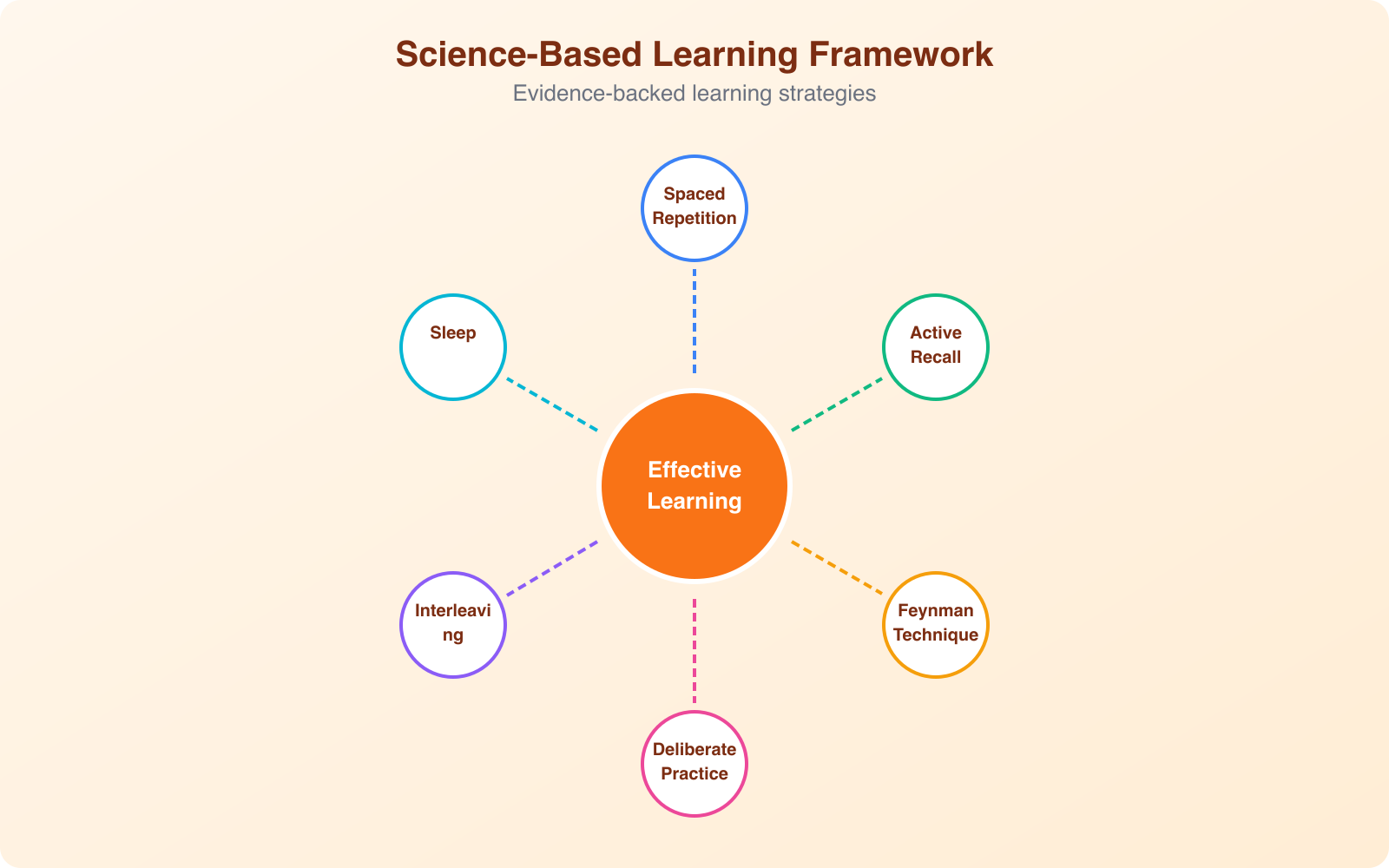
Spaced Repetition: The Most Powerful Memory Technique
Spaced repetition is the single most effective technique for long-term retention, backed by over 100 years of cognitive science. Instead of reviewing material once and hoping it sticks, you review it at increasing intervals: day 1, day 3, day 7, day 14, day 30. Each review strengthens the neural pathway and pushes the memory further from the pruning threshold.
Piotr Wozniak, creator of SuperMemo, showed that spaced repetition improves long-term retention by 200-400% compared to massed study (cramming). That’s not a marginal improvement. It’s a completely different outcome.
I use Anki for spaced repetition, and it’s been the single biggest upgrade to my learning process. When I was learning JavaScript, I created flashcards for every method, design pattern, and concept. Anki’s algorithm automatically schedules reviews at the optimal time. Cards I know well show up less frequently. Cards I struggle with appear daily. After 6 months, I could recall 95% of what I’d studied.
The best spaced repetition schedule looks like this:
- Day 1: First review (within 24 hours of learning)
- Day 3: Second review
- Day 7: Third review
- Day 14: Fourth review
- Day 30: Fifth review (now in long-term memory)
The best spaced repetition tools in 2026 include Anki (free, open source, highly customizable), RemNote (combines note-taking with spaced repetition), Mochi (Markdown-based, great for technical learners), and Readwise (resurfaces highlights from books and articles at optimal intervals). Even 15 minutes of daily review produces remarkable results over months. Consistency matters far more than intensity.
Active Recall: The Single Most Effective Study Technique
Active recall means retrieving information from memory without looking at the source material. It’s the most effective study technique according to a landmark 2013 meta-analysis by Dunlosky et al. published in Psychological Science in the Public Interest. Out of 10 learning techniques tested, active recall (practice testing) ranked #1 for effectiveness.
Here’s why it works: every time you force your brain to retrieve information, you strengthen the neural pathway to that memory. Reading your notes doesn’t do this. Highlighting doesn’t do this. Only retrieval practice triggers this strengthening effect.
Practical implementation steps:
- Close the book. After reading a section, close it and write down everything you can remember
- Use blank page recall. Take a blank sheet and recreate diagrams, frameworks, and key concepts from memory
- Self-test before re-reading. Try to answer questions about the material before checking your notes
- Teach without notes. Explain the concept to someone (or a rubber duck) without any reference material
- Use flashcards actively. Generate the answer before flipping the card. Don’t peek
I tested this personally when learning WordPress development. I split a technical book into two halves. For the first half, I read and highlighted. For the second half, I used active recall after each chapter. Three weeks later, I could remember roughly 25% from the highlighted section and 70% from the active recall section. Same book. Same time investment. Wildly different results.
If you take only one technique from this entire article, make it this one. Active recall transforms learning from something that feels productive into something that actually is.
The Feynman Technique for Deep Understanding
The Feynman Technique exposes gaps in your understanding that passive reading hides. Richard Feynman was a Nobel Prize-winning physicist famous for explaining quantum mechanics in plain English. His method forces you to process information actively instead of just consuming it.
Here’s the four-step process:
- Choose a concept you want to learn and write it at the top of a blank page
- Explain it in simple language as if teaching a 12-year-old. No jargon. Use analogies and everyday examples
- Identify the gaps where your explanation breaks down or gets complicated. These are the spots where your understanding is weakest
- Go back to the source material, fill the gaps, then simplify your explanation again
I use this technique constantly. When I was learning DNS and how domain names work, I tried explaining it in simple terms. I quickly realized I couldn’t explain the difference between A records and CNAME records without jargon. That gap sent me back to study more deeply. Now I actually understand it well enough to explain it to a client in 30 seconds.
The modern version of this is even more powerful: use ChatGPT or Claude as your “student.” Explain a concept to the AI, then ask it to identify any gaps, inaccuracies, or oversimplifications in your explanation. It’s like having a patient, knowledgeable study partner available 24/7.
If you can’t explain something to a 12-year-old, you don’t understand it well enough. The Feynman Technique works because you can’t hide behind jargon when you’re forced to be simple.
AI as a Learning Accelerator
AI tools have fundamentally changed how fast you can learn complex topics. I’m not talking about asking ChatGPT to write your essays. I’m talking about using AI as an interactive tutor that adapts to your knowledge level, answers follow-up questions instantly, and never gets impatient.
Here’s how I use different AI tools for learning in 2026:
ChatGPT for concept breakdowns. When I encounter a complex topic, I ask ChatGPT to explain it at three levels: beginner, intermediate, and advanced. Then I identify which level matches my current understanding and work from there. I also use it for the Feynman Technique. I explain a concept, and it tells me where my explanation breaks down.
Claude for analyzing research papers. Academic papers are dense. I paste the abstract and methodology into Claude and ask for a plain-English summary of the key findings, limitations, and practical implications. What used to take me 2 hours per paper now takes 20 minutes.
Perplexity for research. When I need to understand the current state of a field, Perplexity gives me cited answers with links to primary sources. It’s replaced my habit of opening 30 browser tabs and trying to synthesize information manually.
Google NotebookLM for documents. I upload PDFs, textbooks, and course materials, then have a conversation with the content. NotebookLM generates study guides, quizzes, and even audio summaries from your uploaded documents. It’s particularly good for professional development when you have a stack of industry reports to digest.
Learning Techniques Ranked by Effectiveness
Not all study methods produce equal results. The Dunlosky meta-analysis tested 10 common learning techniques and rated their effectiveness. Here’s a simplified ranking based on that research, supplemented by more recent studies, that matches my personal experience:
| Rank | Technique | Effectiveness | Why It Works |
|---|---|---|---|
| 1 | Active recall (practice testing) | High | Forces retrieval, strengthens memory pathways |
| 2 | Spaced repetition | High | Reviews at optimal intervals before forgetting |
| 3 | Interleaving (mixing topics) | High | Forces brain to differentiate and categorize |
| 4 | Teaching others | High | Exposes gaps, requires deep processing |
| 5 | Elaborative interrogation | Moderate | Asking “why” and “how” deepens understanding |
| 6 | Self-explanation | Moderate | Connecting new info to existing knowledge |
| 7 | Summarization | Low | Passive processing, minimal retrieval |
| 8 | Highlighting/underlining | Low | Creates illusion of learning without retrieval |
| 9 | Rereading | Low | Familiarity confused with understanding |
The bottom three are what most people default to. Highlighting feels productive. Rereading feels thorough. But they’re the least effective methods available. If you replace highlighting with active recall and rereading with spaced repetition, you’ll learn faster with less total study time.
Interleaving deserves special attention. Instead of studying Topic A for 3 hours, then Topic B for 3 hours, you mix them: 45 minutes of A, 45 minutes of B, back to A, back to B. It feels harder and slower in the moment, but research consistently shows 20-40% better retention compared to blocked study.
Personal Knowledge Management: Your Second Brain
The best learners don’t just acquire knowledge. They build systems to organize, connect, and retrieve it. Tiago Forte calls this a “second brain,” and after implementing one myself, I can’t imagine going back to the old way of taking scattered notes across 15 different apps.
A personal knowledge management (PKM) system has four functions:
- Capture: Save interesting ideas, highlights, and insights as you encounter them
- Organize: File information where you’ll find it when you need it
- Distill: Summarize and compress information into actionable notes (progressive summarization)
- Express: Use your collected knowledge to create, decide, and teach
I use Notion as my primary PKM tool. Every book I read gets a page with key takeaways, quotes, and action items. Every course gets a summary page. Every project gets linked to the knowledge that informed it. When I need to write about a topic, I search my Notion workspace and find years of organized thinking ready to use.
Obsidian is another excellent option, especially if you prefer local-first storage and bidirectional linking between notes. The key advantage of Obsidian is that your notes are plain Markdown files on your computer. No vendor lock-in. No subscription required for basic features.
Progressive summarization is the technique that makes PKM actually useful. When you first capture a note, you save the full text. On your second pass, you bold the key sentences. On your third pass, you highlight the bolded sentences that are truly essential. Each pass compresses the information further until you have the core insight in a few sentences.
- Databases with linked relations for connecting knowledge
- Web clipper saves articles and highlights automatically
- AI assistant summarizes and searches your notes
- Free plan covers most individual learning needs
The 20-Hour Rule and Deliberate Practice
Josh Kaufman’s 20-hour rule is the most practical framework for learning new skills quickly. His research shows that 20 hours of focused, deliberate practice gets you to basic competency in almost any skill. That’s about 45 minutes a day for a month. The catch? Those 20 hours need to be deliberate practice, not naive practice.
The difference matters enormously. Playing the same easy songs on guitar for 10 years won’t make you a great guitarist. That’s naive practice. Deliberate practice, developed by psychologist Anders Ericsson, has four specific characteristics:
- It targets weaknesses. You work on the parts you’re worst at, not the parts you enjoy
- It involves immediate feedback. You need a way to know if you’re doing it right, whether from a mentor, a test, or a measurable outcome
- It’s mentally demanding. If you’re comfortable while practicing, you’re probably not improving
- It’s structured with specific goals. “Practice guitar for an hour” isn’t deliberate. “Master the chord transition from G to C at 120 BPM” is
Dan Coyle, author of “The Talent Code,” suggests the two-thirds rule: spend one-third of your time studying and two-thirds practicing. Learning to cook? 20 minutes reading recipes, 40 minutes in the kitchen. Learning a language? 10 minutes studying vocabulary, 20 minutes having conversations. Your brain learns through doing, not consuming.
Here’s how I applied this when learning CSS. I identified my weakest areas (flexbox alignment and responsive layouts), set specific daily targets (build one responsive component per day), and got feedback by testing across device sizes. In 20 hours spread over three weeks, I went from constantly Googling basic properties to building layouts from memory.
Speed Reading Debunked: Comprehension Beats Speed
Speed reading courses promise you’ll read 1,000+ words per minute. It’s mostly nonsense. Research from the University of California, San Diego, published in Psychological Science in the Public Interest, found that speed reading techniques sacrifice comprehension for speed. You can’t skip subvocalization (the inner voice that reads along) without losing understanding.
Here’s what actually works for reading faster and better:
Strategic skimming is legitimate. Before reading a book, skim the table of contents, introduction, and conclusion. Read the first and last paragraph of each chapter. This gives you a mental map that makes detailed reading 30-40% faster because your brain already knows the structure.
Not every book deserves full attention. I use a triage system: books get sorted into “skim” (just need the key ideas), “read” (worth full attention), and “study” (will use active recall and notes). Most business books fall in the “skim” category. They have one good idea padded to 300 pages. Grab the idea and move on.
Comprehension compounds. The more you know about a subject, the faster you read new material about it. Your first book on neuroscience will be slow. Your fifth will be fast because you already have the framework. This is why building a strong reading habit pays increasing returns over time.
According to reading research, the average adult reads about 250 words per minute. Elite readers reach 400-500 wpm with full comprehension. Claims above that consistently show comprehension dropping below 50%. You’re better off reading at 300 wpm and remembering 80% than “reading” at 1,000 wpm and remembering 15%.
The Book-to-Action Pipeline
Reading without implementation is entertainment, not learning. I’ve read over 200 books on business, marketing, and technology. The ones that actually changed my work all followed the same pattern: I extracted specific ideas and implemented them within 48 hours.
Here’s my book-to-action pipeline:
- Capture 3 implementable ideas per book. Not 20. Not 10. Three. If a book gives you three things you can actually use, it was worth reading. Most books have one or two real insights. Three is generous
- Write each idea as a specific action. Not “use better systems” but “create a Notion database for client projects with status, deadline, and priority fields by Friday”
- Implement within 48 hours. Knowledge has a half-life. The longer you wait between reading and doing, the less likely you are to act. The 48-hour window is your best shot at turning insight into behavior
- Review at 30 days. Check which actions stuck and which didn’t. Double down on what worked
This pipeline works because it treats books as input for action, not as standalone accomplishments. Reading 50 books a year means nothing if you didn’t change a single behavior. Reading 12 books and implementing 36 ideas will transform your work.
The person who reads one book and implements everything in it will outperform the person who reads 50 books and implements nothing. Knowledge without action is just trivia.
Using Video and Audio Content for Learning
Video courses and podcasts are powerful learning channels when used correctly. Research from the University of Iowa found that people who use multiple learning modalities retain 75% more information after a week compared to single-modality learners. The problem isn’t the format. It’s passive consumption.
Here’s how to extract maximum value from video and audio learning:
For video courses on Skillshare or similar platforms: Watch at 1.25-1.5x speed for familiar topics. Pause and take notes after each module (active recall). Complete the hands-on project before moving to the next section. Most people binge courses like Netflix. Don’t. One module per day with practice beats five modules in one sitting.
For podcasts and YouTube: TubeOnAI generates AI-powered summaries of videos and podcasts, giving you the key takeaways without watching the full 90-minute episode. I use it to triage content. If the summary contains ideas worth exploring, I watch the full video. If not, I saved 90 minutes.
For visual learners: Visual learning techniques like mind maps, sketchnotes, and diagrams encode information in the format your brain naturally prefers. After watching a lecture, create a one-page visual summary. This forces active processing and creates a reference you can review later.
- Thousands of classes in design, business, tech, and writing
- Every class has a hands-on project for active learning
- Short format (15-60 min) fits daily learning habit
- Offline viewing for learning during commute
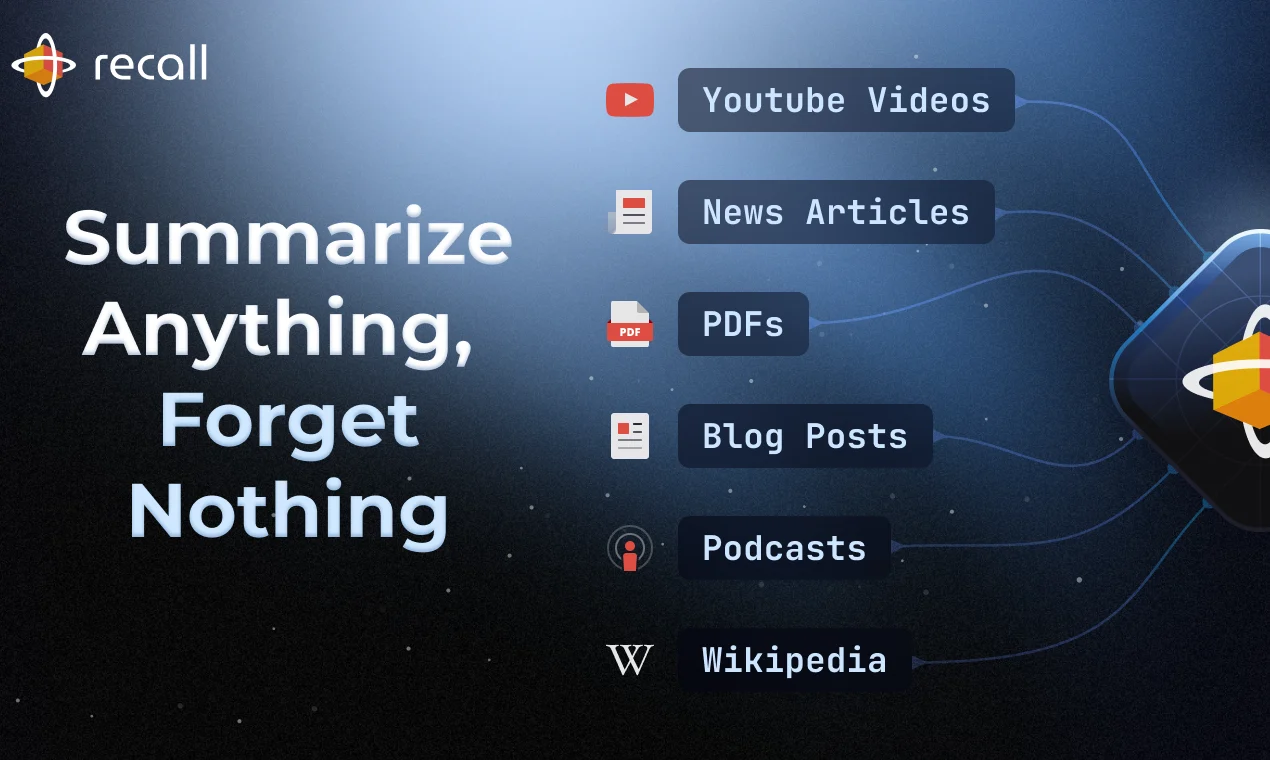
- Summarizes videos and podcasts in seconds
- Generates timestamped key points for quick navigation
- Supports YouTube, Apple Podcasts, and web articles
- Export summaries to Notion, Obsidian, or plain text
Physical Factors That Affect Your Brain
Your brain is biological hardware. No learning technique compensates for poor maintenance. Here’s what the research says about keeping your brain in peak learning condition.
Sleep is non-negotiable. During sleep, your brain consolidates memories from short-term to long-term storage through a process called memory consolidation. Studies at Harvard Medical School showed students who slept after studying retained 35% more information than those who stayed up. Your brain literally replays and strengthens the day’s learning while you sleep. 7-9 hours. Every night. No exceptions.
Exercise boosts learning capacity. A study in the British Journal of Sports Medicine found that just 15 minutes of moderate exercise improves memory and cognitive function for up to two hours. Cardio increases blood flow to the hippocampus, your brain’s memory center. I schedule my hardest learning sessions right after morning exercise, and the difference in focus and retention is noticeable.
Nutrition fuels your neurons. Omega-3 fatty acids (salmon, walnuts, chia seeds) directly support brain function. Blueberries contain antioxidants that improve memory. Avoid sugar crashes by eating protein-rich snacks instead of candy bars during study breaks. Dehydration as mild as 1-2% impairs concentration and slows cognitive processing. Keep water at your desk.
Meditation sharpens focus. Research from Johns Hopkins University found that meditation improves concentration, working memory, and impulse control. 10 minutes daily with a guided app produces measurable cognitive benefits within two weeks. I use it before study sessions when my mind is scattered.
Putting It All Together: A 30-Day Learning System
Here’s the practical framework I use whenever I’m learning something new. It combines every technique in this article into a structured 30-day system.
Days 1-3: Research and decompose. Break the skill into sub-skills. Identify the 80/20 fundamentals by asking practitioners which 20% they use 80% of the time. Find 2-3 quality resources. Set a specific, measurable goal for day 30. Set up your PKM system (Notion or Obsidian) with a dedicated project page.
Days 4-10: Foundation sprint. Study core fundamentals intensely using the two-thirds rule: 30% study, 70% practice. Create Anki flashcards for key concepts as you go. Use AI tools to clarify confusing concepts. Apply the Feynman Technique to each major concept.
Days 11-20: Deliberate practice. Focus on your weakest sub-skills. Get feedback from a mentor, peer, or self-assessment. Review spaced repetition cards daily (15 minutes). Interleave different sub-skills instead of studying in blocks. Use active recall after every practice session.
Days 21-28: Apply and teach. Build a project or complete a challenge using your new skill. Explain what you’ve learned using the Feynman Technique. Create a compressed cheat sheet. Write a blog post or internal document teaching what you learned. This is where knowledge transforms into capability.
Days 29-30: Review and plan. Assess progress against your day-1 goal. Identify remaining gaps. Run your spaced repetition deck one final time. Set goals for the next 30 days if you want to continue deepening the skill.
This system isn’t magic. It’s the disciplined application of evidence-based techniques. The compound effect of using active recall, spaced repetition, deliberate practice, and the Feynman Technique together is far greater than any single method alone.
Which learning technique works best for you?
Frequently Asked Questions
How long does it take to learn a new skill?
Josh Kaufman’s research shows it takes about 20 hours of focused, deliberate practice to reach basic competency in most skills. That’s roughly 45 minutes a day for a month. Getting genuinely good takes longer, but the 10,000-hour rule is misleading because quality of practice matters far more than raw hours. Break the skill into sub-skills, focus on the hardest parts first with active recall, and you’ll see real progress within weeks.
What is the best time of day to study?
Morning hours are best for complex analytical material because your prefrontal cortex is freshest after sleep. Creative tasks often benefit from slight mental fatigue in the afternoon. The most important factor is consistency. Pick a time you can protect daily. Your brain builds stronger neural pathways when you study at the same time each day, creating a habit loop that reduces willpower needed to start.
Does active recall work for all types of learning?
Active recall works for virtually every type of learning, from memorizing facts to understanding complex systems. The 2013 Dunlosky meta-analysis rated it the #1 most effective study technique across all subjects tested. For motor skills (sports, music), active recall combines with physical practice. For conceptual learning, it combines with the Feynman Technique. The only adjustment is how you test yourself: flashcards for facts, blank-page recall for systems, teaching for concepts.
Can AI tools like ChatGPT replace traditional studying?
No. AI tools accelerate understanding but don’t create durable memories. Reading a ChatGPT explanation activates the same passive processing as reading a textbook. You still need active recall, spaced repetition, and practice to move knowledge into long-term memory. Use AI to understand faster, then use evidence-based techniques to remember permanently. Think of AI as a tutor, not a replacement for studying.
How do I stay motivated when learning gets hard?
Motivation drops when progress feels invisible. The fix is making progress visible. Track your learning sessions, keep a journal of what you’ve learned each week, and break large skills into small milestones you can check off. Connect the skill to a real project. Learning Python becomes easier when you’re building something you actually want. Intrinsic motivation beats willpower every time.
Is speed reading worth learning?
No. Research from UC San Diego published in Psychological Science in the Public Interest found that speed reading techniques sacrifice comprehension for speed. Claims of 1,000+ words per minute consistently show comprehension below 50%. What works instead: strategic skimming for structure, triaging books by value, and building domain knowledge that naturally increases reading speed. Focus on reading the right things, not reading faster.
What’s the best note-taking app for learning?
For most people, Notion offers the best balance of flexibility, organization, and ease of use. Its databases let you link concepts across different learning projects, and the AI features help summarize and search your notes. Obsidian is better if you want local storage, bidirectional linking, and no subscription. The tool matters less than the system. Use progressive summarization regardless of which app you choose.
Can adults learn as effectively as children?
Adults actually learn faster than children in most areas because they leverage existing knowledge, use metacognition (thinking about thinking), and apply deliberate practice strategies. Children have advantages in accent acquisition and certain motor skills due to higher brain plasticity. But for professional and intellectual skills, adults learn more efficiently when they use evidence-based techniques like spaced repetition and active recall instead of passive study.
Disclaimer: This site is reader-supported. If you buy through some links, I may earn a small commission at no extra cost to you. I only recommend tools I trust and would use myself. Your support helps keep gauravtiwari.org free and focused on real-world advice. Thanks. - Gaurav Tiwari