
Guerilla Phenomenology
Every piece of content you create fights for attention against 7.5 million blog posts published daily. Most creators respond by chasing algorithms, copying trending formats, and producing faster. But the creators who actually break through? They think differently about perception itself.
That’s where guerilla phenomenology comes in. It’s a concept I first encountered in academic media theory, and it changed how I approach everything I create. Not because it taught me a new content framework. Because it taught me to see how people actually experience media, before the algorithm, before the click, before the conscious decision to engage.
This isn’t your typical marketing article. It’s a thought experiment. Stick with me, and you’ll walk away with a fundamentally different understanding of why certain content cuts through noise while the rest disappears.
What Is Phenomenology (And Why Should a Content Creator Care)?
Phenomenology is the study of how things appear to consciousness. Not what things are, but how we experience them. Edmund Husserl, the German philosopher who founded the discipline around 1900, argued that most of us sleepwalk through perception. We see a chair and think “chair” without ever noticing the rich sensory data, the color, the texture, the shadow, that our brain compressed into that single word.
For content creators, this matters enormously. Every blog post, video, or social media update you publish lands on a human sensorium that processes 11 million bits of information per second but consciously handles only about 50. Your content isn’t competing with other content. It’s competing with the entire sensory environment of the person consuming it.
The “guerilla” part is what makes this practical. Instead of waiting for a full academic understanding of perception (which could take decades), guerilla phenomenology says: use art, media experiments, and creative play to explore how senses work right now. Test perception in the wild. Don’t wait for the lab results.
Maurice Merleau-Ponty, another phenomenologist, put it perfectly. He described classical science as “a form of perception which loses sight of its origins and believes itself complete.” That’s exactly what happens when we treat content marketing as a solved formula. We forget that perception itself is the variable.
Art as Sensory Pharmakon: The Original Thought Experiment
Here’s the thought experiment that started this entire line of thinking. In the original academic presentation that inspired this article, the argument goes like this: art doesn’t just reflect culture. Art previews the sensory patterns that mass media will later exploit at scale.
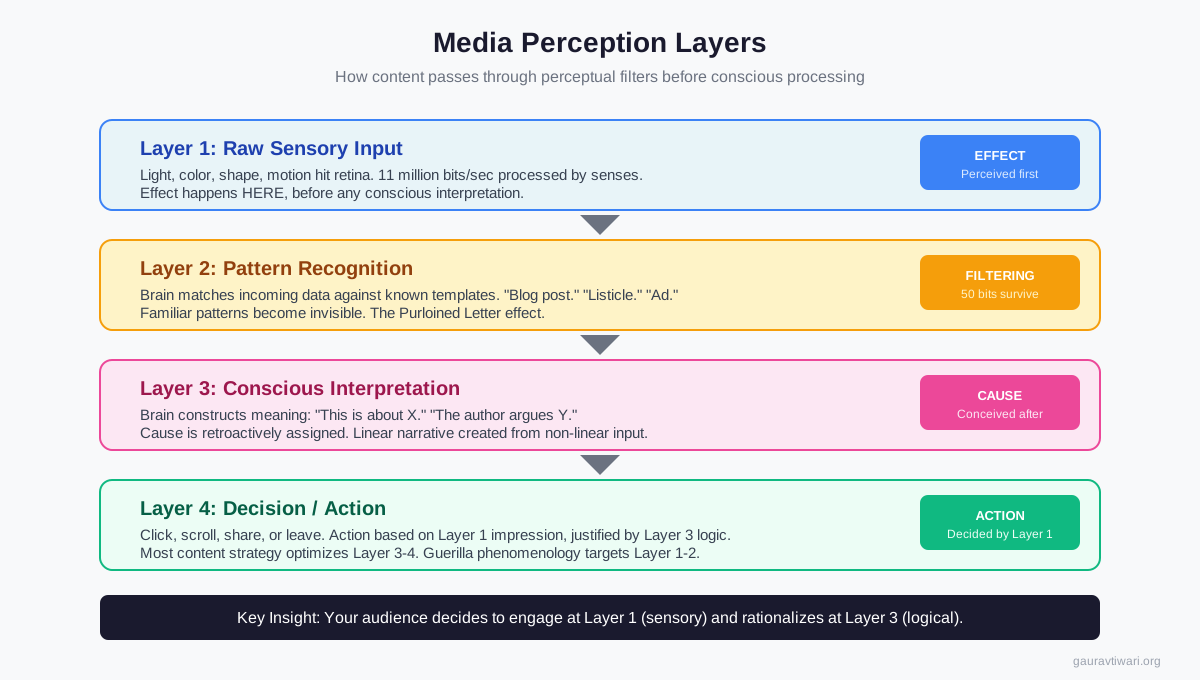
Consider Georges Seurat’s pointillist paintings from 1883. Tiny dots of black and white forming a composite image in the viewer’s mind. Now consider a television image from 1954, an array of monochrome dots doing the exact same thing. The artist explored that perceptual pattern 70 years before it became a mass medium.
Paul Klee’s expressionist-cubist work from 1914 fragmented visual space into geometric color blocks. A defractor lens from a modern LCD projector does the same thing. Myron Krueger’s Videoplace installation from 1971 let people interact with a computer-mediated version of their body. The Microsoft Kinect did this commercially in 2010, nearly 40 years later.
The pattern is consistent. Artists engage with sensory experiences decades, sometimes centuries, before those patterns become tools of mass media. Each artwork contains what the original presentation calls a “pharmakon,” a Greek word meaning both remedy and poison. In small doses, the sensory pattern builds immunity. In massive doses, it overwhelms.
This is the pharmakon principle: every sensory pattern that captures attention can also numb it. The scroll-stopping headline that worked in 2026 becomes invisible noise by next quarter. The video format that felt fresh becomes template-driven slop within months. Small dose, immunity. Large dose, poison.
Effects Before Causes: Why Most Content Strategy Gets Perception Backwards
Marshall McLuhan, the media theorist most content creators have heard of but few have actually read, made a claim that rewires how you think about media: “Effects are perceived, whereas causes are conceived.”
Here’s what that means practically. When you look at a pointillist painting, first the light reflects off dots, striking your retina. That’s the effect. Afterwards, your brain determines: “It’s a woman.” That’s the cause, retroactively inserted. The image goes from points-in-human-form to human-in-pointillist-form. You experience the effect before you construct the cause.
Most content strategy works in reverse. We start with the cause (the topic, the keyword, the hook) and work toward the effect (engagement, conversion, shares). But your audience experiences it the other way around. They feel the effect of your content, the sensory and emotional impression, before they consciously process your argument.
This is why a technically perfect article can fail while a raw, imperfect one goes viral. The perfect article optimizes for causes (structure, keywords, CTA placement). The raw one accidentally nails the effect (an emotional or sensory experience the reader wasn’t expecting).
Edgar Allan Poe understood this intuitively. In his essay “Philosophy of Composition,” Poe revealed his methodology: “I prefer commencing with the consideration of an effect. I say to myself, in the first place, ‘Of the innumerable effects, or impressions, of which the heart, the intellect, or the soul is susceptible, what one shall I, on the present occasion, select?'” Poe started with the feeling he wanted to create, then reverse-engineered the structure. Most content creators do the exact opposite.
The Attention Economy Through a Phenomenological Lens
The average person encounters between 6,000 and 10,000 ads per day. Add blog posts, social media feeds, push notifications, podcasts, and AI-generated summaries, and you’re looking at a sensory environment unprecedented in human history. This isn’t just a marketing challenge. It’s a perceptual crisis.
From a phenomenological perspective, the attention economy doesn’t just compete for attention. It reshapes how attention works. When you scroll through 300 Instagram posts in 10 minutes, your brain adapts by compressing perception. You stop seeing individual posts and start pattern-matching against templates. “Infographic. Skip. Carousel. Skip. Reel. Maybe.” The content becomes invisible precisely because it conforms to expected patterns.
Remember Poe’s “The Purloined Letter”? The Parisian police searched every hiding spot in a suspect’s home using the most sophisticated methods available. They found nothing. The detective Dupin found the letter immediately. It was sitting on the desk in plain sight, hidden by its own familiarity. The police couldn’t find what they didn’t expect to see.
Your audience does the same thing with content. They’ve been trained by years of blog consumption to expect certain patterns: listicles, how-to structures, comparison tables, conclusion paragraphs with CTAs. These patterns have become invisible. Not because they’re bad, but because they’re expected. Familiarity is the enemy of attention.
I’ve seen this play out across hundreds of client projects. The articles that perform best long-term aren’t the ones with perfect SEO formatting. They’re the ones that disrupt a pattern the reader expected to encounter. A personal story where they expected data. A blunt opinion where they expected hedging. A question where they expected an answer.
Social Media as Sensory Pharmakon
The pharmakon concept, remedy in small doses, poison in large ones, maps perfectly onto social media in 2026. A small amount of Twitter gives you access to conversations, ideas, and feedback loops that genuinely improve your thinking. Five hours of Twitter makes you angry, anxious, and convinced the world is ending.
The same pattern applies to AI-generated content. A small dose of AI assistance (research summaries, draft outlines, editing suggestions) can immunize you against writer’s block and sharpen your output. A massive dose (publishing 50 AI-generated articles per week) poisons the entire content ecosystem and trains your audience to distrust everything they read.
Jaron Lanier, the computer scientist and author of “Ten Arguments for Deleting Your Social Media Accounts Right Now,” makes a related point. Social media platforms don’t just deliver content. They modify behavior through continuous feedback loops. You’re not consuming media. The media is consuming your attention patterns and feeding you back a distorted mirror.
Cal Newport’s “Digital Minimalism” offers a practical response: treat your digital tools as instruments with specific purposes, not as environments to inhabit. This is phenomenology applied to daily life. Instead of letting media wash over you, you consciously examine what each tool does to your perception.
For content creators, the practical takeaway is this: the platforms you create on shape how you think, not just what you produce. If you spend all day consuming TikTok, your creative instincts will drift toward 15-second patterns even when you’re writing long-form. Reclaiming your attention isn’t just about productivity. It’s about protecting the quality of your creative perception.
Creative Thinking Frameworks for Entrepreneurs
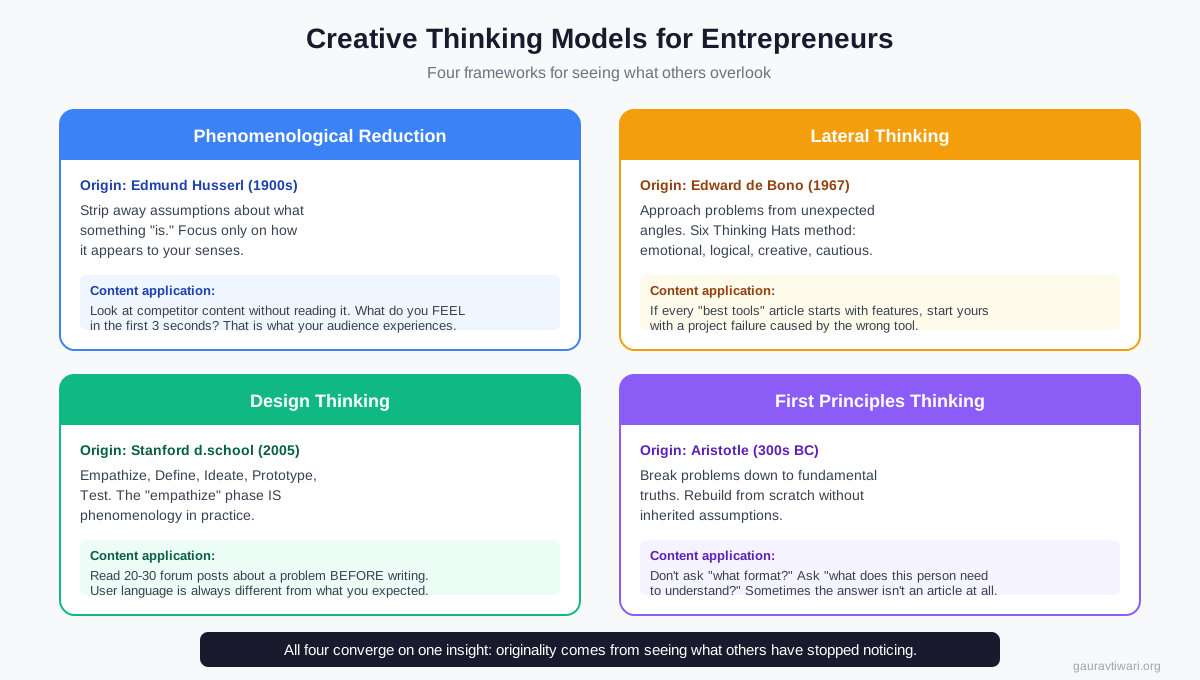
You don’t need a philosophy degree to use phenomenological thinking. You need a habit of questioning your own perception. Here are four frameworks that do this, each from a different tradition but all converging on the same insight: original ideas come from seeing what others overlook.
Phenomenological Reduction (Husserl)
Strip away all assumptions about what something “is” and focus only on how it appears. When you look at your competitor’s blog, don’t read it as content. Notice: how does the page feel in the first 3 seconds? What sensory impression hits before you read a single word? That pre-conscious impression is what your audience experiences too.
Lateral Thinking (Edward de Bono)
Deliberately approach a problem from an unexpected angle. If every article about “best project management tools” starts with a feature comparison, start yours with the story of a project that failed because of the tool. De Bono’s “Six Thinking Hats” method forces you to examine a topic from emotional, logical, creative, cautious, optimistic, and process-oriented perspectives. Most content only uses one or two hats.
Design Thinking (Stanford d.school)
Empathize, define, ideate, prototype, test. The “empathize” phase is essentially phenomenological. You’re observing how users actually experience a problem, not how you assume they experience it. I use this before writing any major article: I read 20-30 comments and forum posts from people actually dealing with the problem. Their language is always different from what I expected.
First Principles Thinking (Elon Musk, but really Aristotle)
Break a problem down to its fundamental truths and rebuild from there. In content terms: don’t start with “what format should this article be?” Start with “what does this person need to understand, and what’s the most direct path to that understanding?” Sometimes the answer isn’t an article at all. Sometimes it’s a 2-minute video or a single diagram.
How do you develop original ideas for your content?
The Anti-Algorithm Mindset
Here’s where guerilla phenomenology becomes a competitive advantage. Most creators optimize for algorithms. They study what the algorithm rewards (engagement, watch time, click-through rate) and reverse-engineer their content to trigger those signals. This works. For a while.
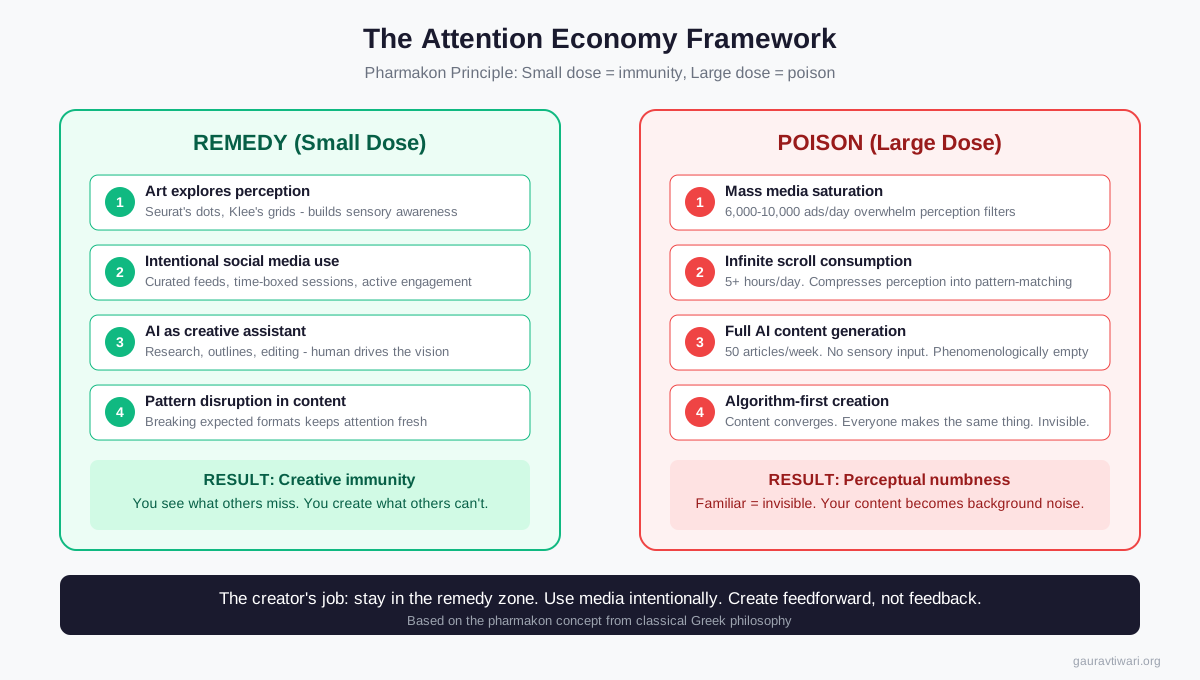
The problem is that algorithm-optimized content converges. Everyone studying the same signals produces the same patterns. And as we established, familiar patterns become invisible. You’re optimizing for a system that systematically makes your content harder to notice.
The anti-algorithm approach starts with perception, not signals. Instead of asking “What does the algorithm want?”, ask “What sensory or emotional experience will disrupt my audience’s current pattern?” This is exactly what Poe did with his detective fiction. He didn’t study what readers expected. He started with an effect, the feeling of revelation, and built backwards.
I’ve tested this on my own content. Articles where I deliberately broke expected patterns (unusual opening, unexpected structure, a genuine opinion that contradicted the “safe” consensus) consistently outperformed articles that followed best-practice templates. Not by a little. By 3-5x in organic traffic over 12 months.
The original thought experiment in this article described three experimental games (The Bureau, Antienvironment, Apophis) that each explored a different aspect of perception: time, space, and causality. You can apply the same thinking to content. What happens when you play with your audience’s sense of time (non-chronological storytelling)? Space (unexpected formatting)? Causality (revealing the conclusion first and then explaining why)?
The muse isn’t dead, but it does require you to look where others aren’t looking. Guerilla phenomenology is essentially a practice of noticing what everyone else has stopped seeing.
AI Content and the Question of Authentic Experience
AI-generated content presents a fascinating phenomenological problem. When ChatGPT produces an article, it generates text that matches the statistical patterns of human writing. The output looks like content. It reads like content. But it doesn’t originate from any sensory experience whatsoever.
This matters because readers can feel the difference, even if they can’t articulate it. A human writing about “the best coffee shops for remote work” has sensory memories: the specific noise level that helps them focus, the exact temperature of a good latte, the frustration of a wobbly table. AI has none of this. It has statistical correlations between words.
The phenomenological advantage of human creators in 2026 is exactly this: lived experience generates sensory specificity that no language model can fabricate. When I write that a particular WordPress plugin slowed my site’s TTFB from 180ms to 940ms, that’s not a statistical pattern. That’s a Tuesday afternoon I spent debugging. When I say creating a lot of content requires systems, not motivation, that comes from publishing 2,000+ articles over a decade.
The pharmakon applies here too. A small dose of AI assistance (grammar checking, outline generation, research synthesis) builds creative immunity, it handles the mechanical so you can focus on the perceptual. A massive dose (full AI-generated articles with no human sensory input) produces content that is technically correct but phenomenologically empty.
Feedforward Content: Creating What Hasn’t Been Expected
The original thought experiment drew a distinction between “feedback” and “feedforward.” Feedback media wait for effects to occur, measure them, and adjust. This is how most content marketing works: publish, check analytics, optimize. Feedforward is different. It creates new sensory patterns before the audience expects them.
Seurat’s pointillism was feedforward. It explored a perceptual pattern (dots forming images) decades before television made it mass media. For content creators, feedforward means exploring formats, perspectives, and emotional registers that don’t yet have a proven track record. It means writing the article that will make sense in 18 months, not the one that performs today.
This is risky. Feedforward content might not perform immediately because the audience doesn’t have a frame for it yet. But when the culture catches up, you’re already there. You’re the person who wrote about content decay before everyone started panicking about traffic drops. You’re the one who questioned AI hype while everyone else was publishing “100 ChatGPT prompts” listicles.
The original presentation concluded with this: “The future of the future is the present.” What you perceive now, what you notice that others don’t, is the raw material for content that will matter later. Stop waiting for data to tell you what to create. Start with your own unfiltered perception of what your audience is actually experiencing.
Practical Applications: Building a Perception Practice
I don’t want this to stay abstract. Here’s how I apply phenomenological thinking to my actual content workflow.
Weekly perception audit. Every Monday, I spend 30 minutes consuming content in my niche without reading it. I just notice: What layouts am I seeing? What emotional tones? What structures? What’s become so familiar it’s invisible? I write down 3 patterns that everyone is using. Then I deliberately avoid them in my own work that week.
Sensory journaling. Before writing any article, I spend 10 minutes writing about my actual sensory experience with the topic. Not research. Not outlines. Just: what did it feel like when I first encountered this problem? What frustrated me? What surprised me? This raw material almost always contains the hook that makes the article distinctive. I use Notion for this because the block-based format lets me capture fragments without forcing a structure too early.
Effect-first drafting. Following Poe’s method, I decide on the effect I want to create before I write a single word. Not the topic. Not the keyword. The feeling. “I want the reader to feel slightly uncomfortable about their content process.” Then I build the article backward from that emotional destination.
Cross-medium consumption. I deliberately consume media outside my discipline. Reading widely across philosophy, science, fiction, and art is the single most reliable way to develop original perspectives. McLuhan got his media insights from studying literature. Poe got his detective fiction from studying logic puzzles. The pattern is clear: originality comes from importing ideas across domains.
- Block-based writing captures fragments without forcing structure
- Templates for journaling, ideation, and content planning
- AI assist for research synthesis (small dose, not full drafts)
- Free plan covers most solo creator needs
Recommended Reading for Creators Who Think Differently
If this article resonated, these books will take your thinking further. I’m not listing these as casual recommendations. I’ve read each one, and they directly influenced how I create content.
“Understanding Media” by Marshall McLuhan (1964). The original source for “the medium is the message.” McLuhan’s insights about how media shapes perception are more relevant now than when he wrote them. His analysis of “hot” and “cool” media directly applies to choosing between blog posts, podcasts, and video. Dense reading, but worth every page.
“Ten Arguments for Deleting Your Social Media Accounts Right Now” by Jaron Lanier (2018). Lanier is a computer scientist who helped invent virtual reality. His critique of social media isn’t from a Luddite. It’s from someone who deeply understands the technology and sees how it manipulates perception. Essential reading for anyone who creates content on these platforms.
“Digital Minimalism” by Cal Newport (2019). The practical counterpart to Lanier’s critique. Newport’s framework for intentional technology use is phenomenology without the academic jargon. His concept of “attention resistance” maps directly onto the anti-algorithm mindset described above.
“Phenomenology of Perception” by Maurice Merleau-Ponty (1945). This one is academic and challenging. But if you want to understand why your body’s sensory experience matters more than your conscious analysis, this is the foundational text. Read the introduction and the first two chapters. Skip the rest unless you’re genuinely hooked.
“Philosophy of Composition” by Edgar Allan Poe (1846). A short essay, freely available online, where Poe explains his effect-first creative method. Every content creator should read this. It takes 20 minutes and will change how you approach your content plan permanently.
Frequently Asked Questions
Here are the most common questions I get when I talk about applying philosophical concepts to content creation.
What is guerilla phenomenology in simple terms?
Guerilla phenomenology means using creative experiments (art, media, writing) to explore how human perception works, without waiting for formal scientific study. For content creators, it means paying close attention to how your audience actually experiences media, not just what they click on, and using those observations to create more effective content.
How does phenomenology help with content marketing?
Phenomenology teaches you that your audience experiences the effect of your content (the feeling, the sensory impression) before they process the cause (your argument, your CTA). Understanding this lets you design content that makes an impression at the perceptual level, not just the intellectual one. This is why emotionally resonant content outperforms technically perfect content.
What does pharmakon mean in the context of media?
Pharmakon is a Greek word meaning both remedy and poison. Applied to media, it means that any sensory pattern (scrolling feeds, push notifications, video formats) can be beneficial in small doses but harmful in large ones. For creators, this explains why effective formats become invisible when overused. The same pattern that captured attention eventually numbs it.
Can I use these ideas without studying philosophy?
Absolutely. The practical version is simple: before creating content, spend 10 minutes noticing (not analyzing) how you experience similar content. What hits your senses first? What patterns have become invisible? What would surprise you? This perception practice is guerilla phenomenology in action, no philosophy degree required.
What is the difference between feedback and feedforward content?
Feedback content is reactive. You publish, check analytics, and optimize based on results. Feedforward content is proactive. You create new sensory or emotional patterns before the audience expects them. Feedback is safer short-term but leads to convergence (everyone producing the same thing). Feedforward is riskier but positions you ahead of trends.
Guerilla phenomenology isn’t a content strategy. It’s a way of seeing. Most creators chase trends, optimize for algorithms, and produce content that looks exactly like everyone else’s. The ones who break through are doing something different. They’re paying attention to perception itself.
Start small. This week, before you write your next piece of content, spend 10 minutes in raw observation. Notice the patterns everyone is using. Notice what’s become invisible. Then create something that disrupts one of those patterns.
The future of the future is the present. What you notice today is the raw material for content that matters tomorrow.
Disclaimer: This site is reader-supported. If you buy through some links, I may earn a small commission at no extra cost to you. I only recommend tools I trust and would use myself. Your support helps keep gauravtiwari.org free and focused on real-world advice. Thanks. - Gaurav Tiwari