
In 1844, Joseph Liouville achieved something remarkable: he proved that specific numbers exist which are not roots of any polynomial equation with integer coefficients. These are the transcendental numbers, and Liouville’s method for finding them was both ingenious and elementary. He showed that algebraic numbers resist rational approximation in a precise, quantifiable way. Any number that fails this resistance test must be transcendental.
This lesson develops Liouville’s approximation theorem in full detail and uses it to construct the first explicitly known transcendental numbers. We also explore the relationship between algebraic degree and approximability, the concept of height for polynomials, and how Cantor’s counting argument guarantees that “almost all” numbers are transcendental, even though finding specific examples is hard.
Algebraic Numbers and Their Properties
Definitions and Examples
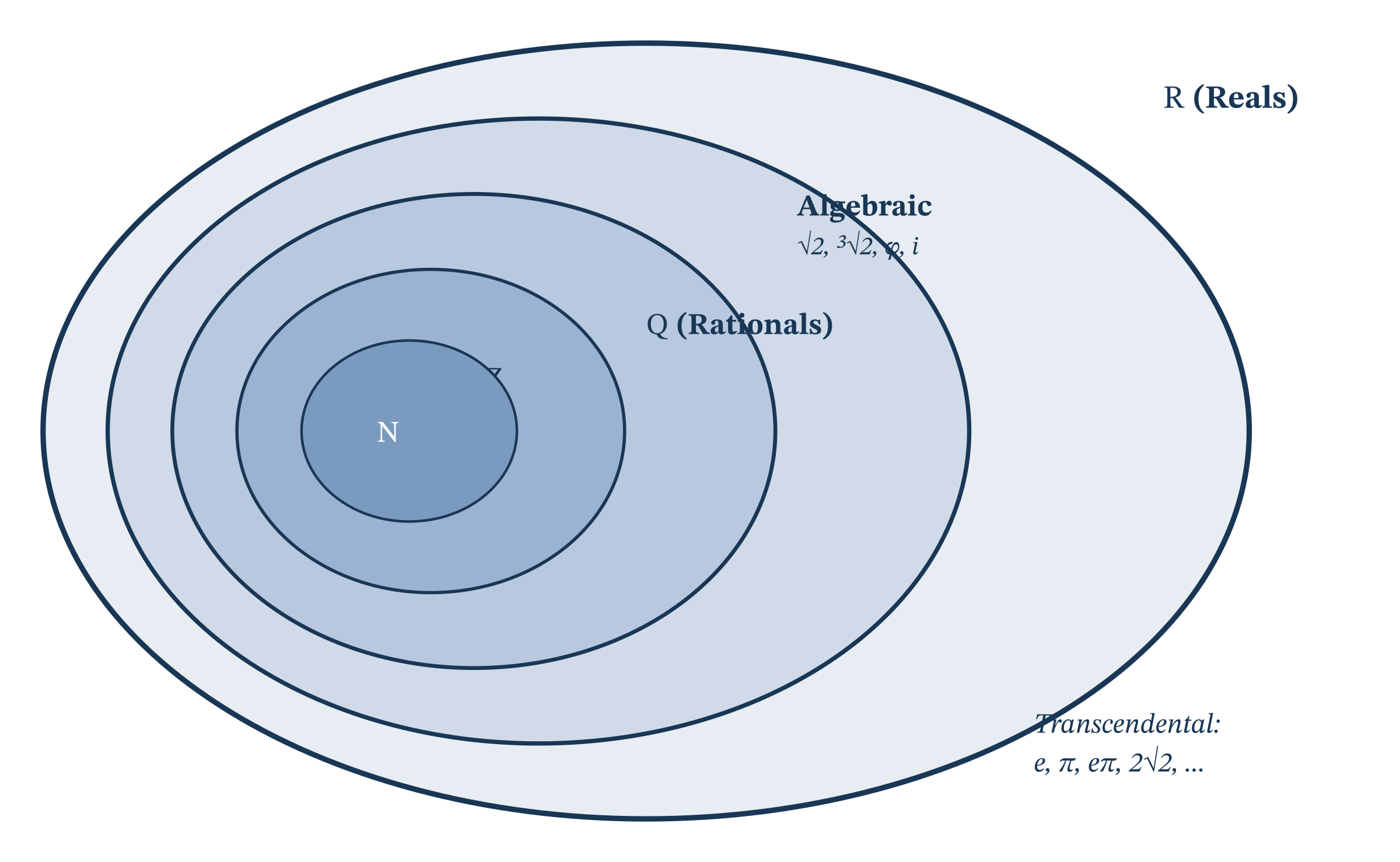
Definition (Algebraic Number). A complex number \( \alpha \) is called algebraic if there exists a nonzero polynomial \( p(x) = a_n x^n + a_{n-1}x^{n-1} + \cdots + a_1 x + a_0 \) with integer coefficients \( a_i \in \mathbb{Z} \) such that \( p(\alpha) = 0 \).
Definition (Degree and Minimal Polynomial). The degree of an algebraic number \( \alpha \) is the smallest positive integer \( n \) such that \( \alpha \) is a root of a polynomial of degree \( n \) with integer coefficients. The unique monic polynomial of least degree with rational coefficients having \( \alpha \) as a root is the minimal polynomial of \( \alpha \).
Examples:
- Every rational number \( r = p/q \) is algebraic of degree 1, being a root of \( qx – p = 0 \).
- \( \sqrt{2} \) is algebraic of degree 2, with minimal polynomial \( x^2 – 2 \).
- The golden ratio \( \varphi = (1+\sqrt{5})/2 \) is algebraic of degree 2, with minimal polynomial \( x^2 – x – 1 \).
- \( \sqrt[3]{2} \) is algebraic of degree 3, with minimal polynomial \( x^3 – 2 \).
- The imaginary unit \( i \) is algebraic of degree 2, with minimal polynomial \( x^2 + 1 \).
The set of all algebraic numbers, often denoted \( \overline{\mathbb{Q}} \), forms a field: sums, products, and quotients of algebraic numbers are again algebraic.
Transcendental Numbers
Definition (Transcendental Number). A complex number is called transcendental if it is not algebraic, that is, it satisfies no nonzero polynomial equation with integer coefficients.
At first glance, it might seem that transcendental numbers are rare curiosities. Cantor’s brilliant argument shows exactly the opposite.
Cantor’s Counting Argument
Theorem (Cantor, 1874). The set of algebraic numbers is countable.
Proof. We assign a height to each polynomial \( p(x) = a_n x^n + \cdots + a_0 \) with integer coefficients by
$$ H(p) = n + |a_n| + |a_{n-1}| + \cdots + |a_0|. $$
For each positive integer \( h \), there are finitely many integer polynomials with \( H(p) = h \), and each polynomial has finitely many roots. Listing all algebraic numbers by increasing height gives a countable enumeration. \( \blacksquare \)
Corollary. Almost all real numbers are transcendental. More precisely, the set of transcendental numbers is uncountable, while the set of algebraic numbers is countable.
Proof. The real numbers are uncountable (Cantor’s diagonal argument). The algebraic reals are countable. The complement, the transcendental reals, must therefore be uncountable. \( \blacksquare \)
Important: The paradox of transcendence. Almost every real number is transcendental, yet proving that any specific number is transcendental requires substantial effort. The first example was not produced until 1844, and to this day, we cannot determine whether many familiar constants are transcendental.
Liouville’s Approximation Theorem
In 1844, Liouville gave the first proof that transcendental numbers exist by establishing a fundamental limit on how well algebraic numbers can be approximated by rationals.
Statement and Proof
Theorem (Liouville’s Approximation Theorem, 1844). Let \( \alpha \) be a real algebraic number of degree \( n \geq 2 \). Then there exists a constant \( c = c(\alpha) > 0 \) such that for all integers \( p \) and \( q \) with \( q > 0 \),
$$ \left|\alpha – \frac{p}{q}\right| > \frac{c}{q^n}. $$
Proof. Let \( f(x) = a_n x^n + a_{n-1}x^{n-1} + \cdots + a_0 \in \mathbb{Z}[x] \) be the minimal polynomial of \( \alpha \), so \( f(\alpha) = 0 \) and \( \deg f = n \).
Step 1: Bounding \( |f(p/q)| \) from below.
For any rational \( p/q \) with \( q > 0 \) and \( p/q \neq \alpha \), multiply \( f(p/q) \) by \( q^n \):
$$ q^n f\!\left(\frac{p}{q}\right) = a_n p^n + a_{n-1}p^{n-1}q + \cdots + a_0 q^n \in \mathbb{Z}. $$
Since \( f \) is the minimal polynomial of \( \alpha \) and \( \alpha \) is irrational (\( n \geq 2 \)), we have \( f(p/q) \neq 0 \). Since \( q^n f(p/q) \) is a nonzero integer:
$$ \left|f\!\left(\frac{p}{q}\right)\right| \geq \frac{1}{q^n}. $$
Step 2: Applying the Mean Value Theorem.
There exists \( \xi \) between \( \alpha \) and \( p/q \) such that
$$ f\!\left(\frac{p}{q}\right) = f\!\left(\frac{p}{q}\right) – f(\alpha) = f'(\xi) \cdot \left(\frac{p}{q} – \alpha\right). $$
Step 3: Bounding \( |f'(\xi)| \) from above.
Restrict to rationals with \( |p/q – \alpha| \leq 1 \). Then \( \xi \in [\alpha – 1, \alpha + 1] \), and set
$$ M = \max_{|x – \alpha| \leq 1} |f'(x)| > 0. $$
Step 4: Combining.
$$ \frac{1}{q^n} \leq \left|f\!\left(\frac{p}{q}\right)\right| \leq M \left|\frac{p}{q} – \alpha\right|, $$
so
$$ \left|\alpha – \frac{p}{q}\right| \geq \frac{1}{Mq^n}. $$
Setting \( c = \min(1, 1/M) \) completes the proof. \( \blacksquare \)
What the Theorem Means
Liouville’s theorem says that algebraic numbers of degree \( n \) are “hard to approximate” by rationals: no rational \( p/q \) can get closer than \( c/q^n \) to an algebraic number of degree \( n \). The key insight is the contrapositive: if a number can be approximated better than \( 1/q^n \) for every \( n \), then it cannot be algebraic of any finite degree, hence it must be transcendental.
Historical Improvements
The exponent \( n \) in Liouville’s theorem was progressively sharpened:
- Year: 1844 | Mathematician: Liouville | Exponent: \( n \)
- Year: 1909 | Mathematician: Thue | Exponent: \( n/2 + 1 \)
- Year: 1921 | Mathematician: Siegel | Exponent: \( 2\sqrt{n} \)
- Year: 1947 | Mathematician: Dyson | Exponent: \( \sqrt{2n} \)
- Year: 1955 | Mathematician: Roth | Exponent: \( 2 + \varepsilon \) (optimal)
Roth received the Fields Medal for proving the optimal result. Each improvement made it harder to use the approximation approach for proving transcendence (since the bar for “too good an approximation” got higher), but also gave deeper insight into the structure of algebraic numbers.
Liouville Numbers
Definition
Definition (Liouville Number). A real number \( \alpha \) is a Liouville number if for every positive integer \( n \), there exist integers \( p \) and \( q \) with \( q > 1 \) such that
$$ 0 < \left|\alpha – \frac{p}{q}\right| < \frac{1}{q^n}. $$
The Transcendence Theorem
Theorem. Every Liouville number is transcendental.
Proof. Suppose \( \alpha \) is a Liouville number and algebraic of degree \( d \geq 1 \).
If \( d = 1 \), then \( \alpha = a/b \) is rational, and for \( p/q \neq a/b \):
$$ \left|\alpha – \frac{p}{q}\right| = \frac{|aq – bp|}{bq} \geq \frac{1}{bq}. $$
The Liouville condition with \( n \geq 2 \) requires \( 1/(bq) < 1/q^n \), i.e., \( q^{n-1} < b \), which fails for large \( q \). Contradiction.
If \( d \geq 2 \), Liouville’s theorem gives \( c > 0 \) with \( |\alpha – p/q| > c/q^d \) for all \( p/q \). But the Liouville condition with \( n = d + 1 \) gives \( p/q \) with \( |\alpha – p/q| < 1/q^{d+1} \). For large \( q \), \( 1/q^{d+1} < c/q^d \), contradiction. \( \blacksquare \)
The Liouville Constant
Statement and Construction
Theorem (Liouville, 1844). The number
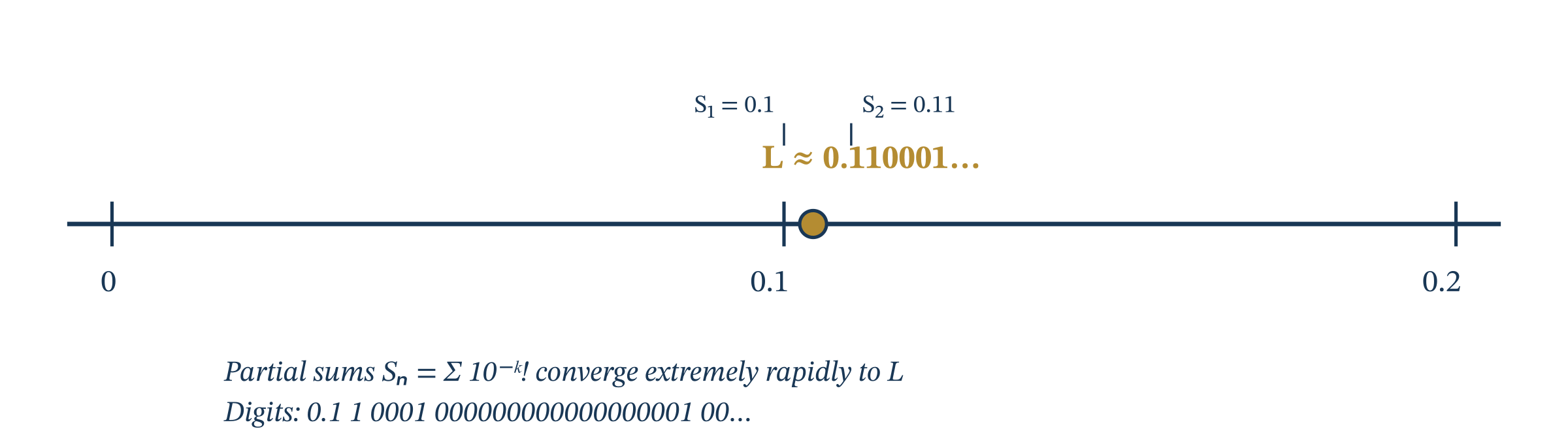
$$ L = \sum_{k=1}^{\infty} 10^{-k!} = 10^{-1} + 10^{-2} + 10^{-6} + 10^{-24} + 10^{-120} + \cdots $$
is transcendental.
In decimal, \( L = 0.110001000000000000000001000\ldots \), where the 1’s appear at positions \( 1!, 2!, 3!, 4!, \ldots = 1, 2, 6, 24, 120, \ldots \) and all other digits are 0.
The Proof
Proof. We show \( L \) is a Liouville number.
Let \( n \) be any positive integer. Define the partial sum
$$ \frac{p_n}{q_n} = \sum_{k=1}^{n} 10^{-k!}, \quad \text{where } q_n = 10^{n!}. $$
Then:
$$ 0 < L – \frac{p_n}{q_n} = \sum_{k=n+1}^{\infty} 10^{-k!}. $$
Bounding the remainder. Since each subsequent factorial is much larger:
$$ \sum_{k=n+1}^{\infty} 10^{-k!} < 10^{-(n+1)!} \cdot \sum_{j=0}^{\infty} 10^{-j} = \frac{10 \cdot 10^{-(n+1)!}}{9} < 2 \cdot 10^{-(n+1)!}. $$
Now \( q_n = 10^{n!} \), so \( q_n^{n+1} = 10^{(n+1) \cdot n!} = 10^{(n+1)!} \). Therefore:
$$ L – \frac{p_n}{q_n} < \frac{2}{q_n^{n+1}} < \frac{1}{q_n^n} $$
for all \( n \geq 1 \) (since \( q_n \geq 10 \)). Since \( n \) was arbitrary, \( L \) is a Liouville number and hence transcendental. \( \blacksquare \)
Important: Liouville’s constant was the first number proven to be transcendental (1844). The proof uses no advanced analysis, only the fact that algebraic numbers resist rational approximation.
Variations and Generalizations
Other Liouville numbers include:
Binary Liouville number:
$$ \sum_{k=1}^{\infty} 2^{-k!} = 0.110001000000000000000001\ldots_2 $$
General construction: Any number of the form \( \sum_{k=1}^{\infty} a_k \cdot b^{-k!} \) where \( b \geq 2 \) and \( a_k \in \{1, 2, \ldots, b-1\} \) for infinitely many \( k \) is a Liouville number, hence transcendental.
Even sparser constructions: Replace factorials with any sequence growing faster than any polynomial:
$$ \sum_{k=1}^{\infty} 10^{-f(k)} $$
where \( f(k)/k \to \infty \) sufficiently fast (e.g., \( f(k) = k^k \) or \( f(k) = 2^{2^k} \)).
The Landscape of Transcendental Numbers
What Liouville’s Method Can and Cannot Do
Liouville’s approximation approach is powerful for constructing transcendental numbers, but it has limitations:
Can prove transcendental:
- Any number with a sufficiently sparse digit pattern (Liouville numbers).
- Numbers explicitly constructed to have very good rational approximations.
Cannot prove transcendental:
- \( e \), because \( \mu(e) = 2 \) (same as algebraic numbers).
- \( \pi \), because its approximation properties are not extreme enough.
- Most “natural” constants, which have irrationality measure 2.
To prove \( e \) and \( \pi \) transcendental required the fundamentally different techniques of Hermite and Lindemann, which we develop in the next lesson.
Measure-Theoretic Perspective
Despite the uncountability result from Cantor’s argument, Liouville numbers themselves are quite rare in a measure-theoretic sense.
The set of Liouville numbers has Lebesgue measure zero. This means that while there are uncountably many transcendental numbers, the subset of them that are Liouville numbers is “negligible” in the sense of measure theory. Most transcendental numbers (including \( e \) and \( \pi \)) are not Liouville numbers; they have irrationality measure exactly 2, just like algebraic irrationals.
In the topological sense, however, Liouville numbers form a residual set (a countable intersection of open dense sets), so they are “generic” from the Baire category perspective. This creates a beautiful paradox: Liouville numbers are measure-zero yet topologically generic.
Exercises
-
Verify that \( L = \sum_{k=1}^{\infty} 10^{-k!} \) satisfies the Liouville condition for \( n = 3 \) by finding explicit values of \( p \) and \( q \) with \( |L – p/q| < 1/q^3 \).
-
Construct a Liouville number in base 5, and prove it is transcendental.
-
Show that \( 2L \) (where \( L \) is the Liouville constant) is also a Liouville number. More generally, prove that if \( \alpha \) is a Liouville number and \( r \) is a nonzero rational, then \( r\alpha \) is also a Liouville number.
-
True or false: If \( \alpha \) and \( \beta \) are both Liouville numbers, then \( \alpha + \beta \) is a Liouville number. Justify your answer.
-
Prove that the number \( \sum_{k=1}^{\infty} 10^{-k^k} \) is transcendental by showing it is a Liouville number. (The key step is comparing \( (k+1)^{k+1} \) with \( (n+1) \cdot k^k \).)
-
Explain why Cantor’s theorem (that algebraic numbers are countable) does not provide an explicit example of a transcendental number, even though it proves their existence.
-
Using the definition of height \( H(p) = n + |a_n| + \cdots + |a_0| \), list all algebraic numbers of height \( \leq 4 \).
-
Let \( f(x) = x^2 – 2 \) (so \( \alpha = \sqrt{2} \) has degree 2). Compute the constant \( M = \max_{|x – \sqrt{2}| \leq 1} |f'(x)| \) explicitly and determine the value of \( c \) in Liouville’s approximation theorem for \( \sqrt{2} \).