
Liouville’s method constructed transcendental numbers, but it could not touch the constants that mathematicians really cared about: \( e \) and \( \pi \). These numbers have irrationality measure 2, meaning they behave like algebraic numbers in terms of rational approximation. Proving their transcendence required a completely different approach.
Charles Hermite broke through in 1873, proving \( e \) transcendental. His method, a tour de force of careful polynomial construction and integration, became the template for all subsequent results. Ferdinand von Lindemann adapted Hermite’s strategy to prove \( \pi \) transcendental in 1882, and Karl Weierstrass generalized both results into a single powerful theorem in 1885.
Hermite’s Proof That e Is Transcendental
Historical Context
Euler introduced \( e \) in the 18th century, and Lambert proved it irrational in 1768. But the question of transcendence remained open for over a century. Hermite’s proof was the first to show that a “naturally occurring” mathematical constant is transcendental.
The Strategy
The key idea, which Hermite invented and which became the template for all proofs in this family, is:
- Assume \( e \) is algebraic: it satisfies some polynomial equation with integer coefficients.
- Construct an auxiliary polynomial \( f(x) \) with carefully controlled properties.
- Integrate \( f \) against the exponential function to produce a quantity \( J \).
- Show \( J \) is a nonzero integer (using divisibility by a large prime \( p \)).
- Show \( |J| < 1 \) for \( p \) large enough (using growth estimates).
- Contradiction: no integer satisfies both \( |J| \geq 1 \) and \( |J| < 1 \).
The Proof
Important: Theorem (Hermite, 1873). The number \( e \) is transcendental.
Proof. Assume for contradiction that \( e \) is algebraic. Then there exist integers \( a_0, a_1, \ldots, a_m \), not all zero, with \( a_0 \neq 0 \), such that
$$ a_0 + a_1 e + a_2 e^2 + \cdots + a_m e^m = 0. $$
Step 1: The auxiliary function.
For a prime \( p \) to be chosen later (sufficiently large), define the polynomial
$$ f(x) = \frac{x^{p-1}(x-1)^p(x-2)^p \cdots (x-m)^p}{(p-1)!}. $$
The degree of \( f \) is \( N = (m+1)p – 1 \).
Step 2: The integral identity.
For each integer \( j \) with \( 0 \leq j \leq m \), define
$$ I_j = \int_0^j e^{j-t} f(t)\, dt. $$
Integration by parts, repeated \( N \) times, yields the fundamental identity:
$$ I_j = e^j \sum_{k=0}^{N} f^{(k)}(0) – \sum_{k=0}^{N} f^{(k)}(j). $$
This can be verified by noting that the derivative of \( e^{j-t}\sum_{k=0}^{K} f^{(k)}(t) \) telescopes.
Step 3: The key quantity.
Define
$$ J = \sum_{j=0}^{m} a_j I_j. $$
Using the integral identity and the algebraic relation \( \sum a_j e^j = 0 \), the terms involving \( e^j \) cancel:
$$ J = -\sum_{j=0}^{m} a_j \sum_{k=0}^{N} f^{(k)}(j). $$
Step 4: Evaluating derivatives at integer points.
We analyze \( f^{(k)}(j) \) for each integer \( j \in \{0, 1, \ldots, m\} \).
At \( j = 0 \): The factor \( x^{p-1} \) contributes a zero of order \( p-1 \). For \( k < p-1 \), \( f^{(k)}(0) = 0 \). For \( k = p-1 \):
$$ f^{(p-1)}(0) = \frac{(p-1)!}{(p-1)!}\cdot(-1)^p(-2)^p\cdots(-m)^p = (-1)^{mp}(m!)^p. $$
This is a nonzero integer. Crucially, it is not divisible by \( p \) if \( p > m \). For \( k \geq p \), \( f^{(k)}(0) \) is an integer divisible by \( p \).
At \( j \in \{1, 2, \ldots, m\} \): The factor \( (x-j)^p \) contributes a zero of order \( p \). For \( k < p \), \( f^{(k)}(j) = 0 \). For \( k \geq p \), \( f^{(k)}(j) \) is an integer divisible by \( p \).
Step 5: \( J \) is a nonzero integer.
From Step 4:
$$ J = -a_0 f^{(p-1)}(0) – \sum_{\substack{j=0,\ldots,m \\ k \geq p}} a_j f^{(k)}(j) = -a_0(-1)^{mp}(m!)^p – p\cdot(\text{integer}). $$
Choose \( p \) to be a prime with \( p > \max(|a_0|, m) \). Then \( a_0(-1)^{mp}(m!)^p \) is not divisible by \( p \) (since \( p > m \) implies \( p \nmid m! \), and \( p > |a_0| \) with \( a_0 \neq 0 \) implies \( p \nmid a_0 \)). Therefore \( J \) is a nonzero integer, so \( |J| \geq 1 \).
Step 6: \( J \) is small.
From the integral definition:
$$ |I_j| \leq m e^m \max_{0 \leq t \leq m} |f(t)|. $$
For \( t \in [0,m] \):
$$ |f(t)| \leq \frac{m^{(m+1)p-1}}{(p-1)!}. $$
Therefore:
$$ |J| \leq (m+1)\max_j|a_j|\cdot m e^m \cdot \frac{m^{(m+1)p-1}}{(p-1)!} = \frac{C^p}{(p-1)!} $$
for some constant \( C \) depending only on \( m \) and the \( a_j \). Since \( (p-1)! \) grows much faster than any exponential, for \( p \) sufficiently large we have \( |J| < 1 \).
Conclusion. We have \( |J| \geq 1 \) and \( |J| < 1 \) simultaneously. Contradiction. Therefore \( e \) is transcendental. \( \blacksquare \)
Important: Hermite’s theorem (1873): the number \( e \) is transcendental. This was the first proof of transcendence for a “naturally occurring” mathematical constant.
Consequences
Corollary. For any nonzero rational number \( r \), the number \( e^r \) is transcendental.
This follows because if \( e^{a/b} \) were algebraic, then \( e = (e^{a/b})^{b/a} \) would be algebraic, contradicting Hermite’s theorem. (The full rigorous proof uses the Lindemann-Weierstrass theorem below.)
The Architecture of Hermite’s Proof
The architecture, which is worth understanding as a template, consists of:
- An auxiliary polynomial with controlled divisibility at integers.
- Integration against an exponential, producing an integer \( J \).
- A divisibility argument showing \( J \neq 0 \) (using a large prime \( p \)).
- A size argument showing \( |J| \to 0 \) as \( p \to \infty \) (factorials beat exponentials).
Lindemann used exactly this strategy to handle \( \pi \).
The Lindemann-Weierstrass Theorem
Lindemann proved the transcendence of \( \pi \) in 1882, and Weierstrass generalized the result in 1885. The key tool is a powerful theorem about exponentials of algebraic numbers.
Statement
Theorem (Lindemann-Weierstrass, 1882/1885). If \( \alpha_1, \alpha_2, \ldots, \alpha_n \) are distinct algebraic numbers and \( \beta_1, \beta_2, \ldots, \beta_n \) are nonzero algebraic numbers, then
$$ \beta_1 e^{\alpha_1} + \beta_2 e^{\alpha_2} + \cdots + \beta_n e^{\alpha_n} \neq 0. $$
An equivalent formulation: if \( \alpha_1, \ldots, \alpha_n \) are algebraic numbers that are linearly independent over \( \mathbb{Q} \), then \( e^{\alpha_1}, \ldots, e^{\alpha_n} \) are algebraically independent over \( \mathbb{Q} \).
Important: The Lindemann-Weierstrass theorem simultaneously implies:
- \( e \) is transcendental (from Hermite’s case).
- \( \pi \) is transcendental (see below).
- \( e^{\alpha} \) is transcendental for every nonzero algebraic \( \alpha \).
Lindemann’s Proof That Pi Is Transcendental
The Proof
Theorem (Lindemann, 1882). The number \( \pi \) is transcendental.
Proof. Assume for contradiction that \( \pi \) is algebraic. Then \( i\pi \) is algebraic (since \( i \) is algebraic and the algebraic numbers form a field).
Step 1: Setting up the algebraic relation.
Let \( \theta_1 = i\pi, \theta_2, \ldots, \theta_d \) be all the roots of the minimal polynomial of \( i\pi \) over \( \mathbb{Q} \). By Euler’s formula, \( e^{i\pi} = -1 \), so \( e^{\theta_1} = -1 \). Therefore
$$ (1 + e^{\theta_1})(1 + e^{\theta_2})\cdots(1 + e^{\theta_d}) = 0, $$
since the first factor is \( 1 + (-1) = 0 \).
Expanding this product:
$$ \sum_{S \subseteq \{1,\ldots,d\}} e^{\sum_{j \in S} \theta_j} = 0. $$
There are \( 2^d \) terms. Let \( \alpha_1, \alpha_2, \ldots, \alpha_n \) be the distinct values among the \( 2^d \) sums \( \sum_{j \in S}\theta_j \), and let \( \beta_1, \ldots, \beta_n \) be the multiplicities. Then
$$ \beta_1 e^{\alpha_1} + \beta_2 e^{\alpha_2} + \cdots + \beta_n e^{\alpha_n} = 0, $$
where each \( \beta_j \) is a positive integer and each \( \alpha_j \) is algebraic.
Step 2: Separating zero and nonzero exponents.
Among the \( \alpha_j \), exactly one equals 0 (corresponding to the empty subset \( S = \emptyset \), contributing \( e^0 = 1 \)). Suppose \( \alpha_1 = 0 \) with multiplicity \( \beta_1 = 1 \). Then:
$$ 1 + \beta_2 e^{\alpha_2} + \cdots + \beta_n e^{\alpha_n} = 0. $$
Step 3: The Hermite-style construction.
We apply Hermite’s method, generalized to handle the algebraic numbers \( \alpha_2, \ldots, \alpha_n \) in place of the integers \( 1, 2, \ldots, m \). For a large prime \( p \), construct a polynomial \( f \) of controlled degree and define
$$ F(x) = \sum_{k=0}^{N} f^{(k)}(x). $$
For each \( j \), the integral
$$ I_j = \int_0^{\alpha_j} e^{\alpha_j – t} f(t)\,dt = e^{\alpha_j}F(0) – F(\alpha_j) $$
connects the exponentials to the sum of derivatives. The sum
$$ J = -\sum_{j=2}^{n} \beta_j F(\alpha_j) $$
is the key quantity.
Step 4: The integer and the contradiction.
The construction of \( f \) ensures:
(a) After symmetrization over Galois conjugates, \( J \) becomes a nonzero rational integer with \( |J| \geq 1 \).
(b) \( |J| \) can be made arbitrarily small by choosing \( p \) large, since \( |I_j| \leq C^p/(p-1)! \).
This gives \( |J| \geq 1 \) and \( |J| < 1 \), a contradiction. Therefore \( \pi \) is transcendental. \( \blacksquare \)
Tip: The proof above omits some technical details around the symmetrization step. Because the \( \alpha_j \) may not be rational integers, one must work with the full set of Galois conjugates and show that the resulting quantity, after taking a product over all conjugates, is a nonzero rational integer.
Squaring the Circle
One of the most famous consequences of Lindemann’s theorem is the impossibility of an ancient construction problem.
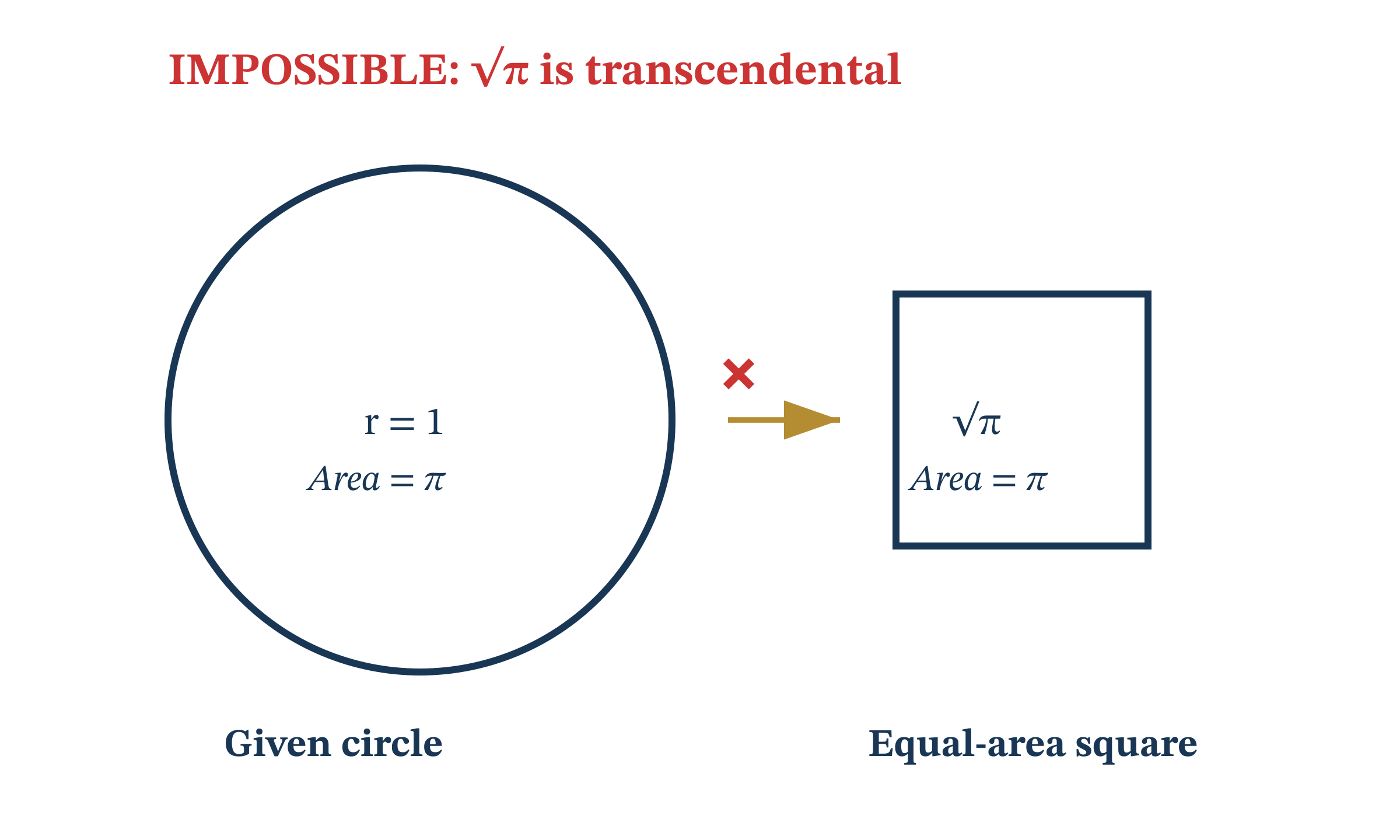
Corollary (Impossibility of Squaring the Circle). It is impossible to construct, using compass and straightedge alone, a square whose area equals that of a given circle.
Proof. A compass-and-straightedge construction can only produce lengths that are algebraic over the given lengths. Starting from a circle of radius 1 (area \( \pi \)), the side of the equal-area square would be \( \sqrt{\pi} \). Since \( \pi \) is transcendental, \( \sqrt{\pi} \) is also transcendental, hence not constructible. \( \blacksquare \)
Important: The transcendence of \( \pi \) resolved the ancient Greek problem of squaring the circle, which had been open for over 2000 years. No compass-and-straightedge construction can square the circle, not because we have not been clever enough, but because it is mathematically impossible.
[Image: The impossibility of squaring the circle: no compass-and-straightedge construction can produce a square with the same area as a given circle]
The Power of the Lindemann-Weierstrass Theorem
The Lindemann-Weierstrass theorem is remarkably versatile. Here are some of its consequences beyond \( e \) and \( \pi \):
Transcendence of Logarithms
If \( \alpha \) is algebraic with \( \alpha \neq 0 \) and \( \alpha \neq 1 \), then \( \ln \alpha \) is transcendental. In particular:
- \( \ln 2 \) is transcendental.
- \( \ln 3 \) is transcendental.
- More generally, \( \ln(p/q) \) is transcendental for any positive rational \( p/q \neq 1 \).
Transcendence of Trigonometric Values
If \( \alpha \) is a nonzero algebraic number, then:
- \( \sin(\alpha) \) is transcendental.
- \( \cos(\alpha) \) is transcendental.
- \( \tan(\alpha) \) is transcendental (when defined).
This follows from the identities \( \sin(\alpha) = (e^{i\alpha} – e^{-i\alpha})/(2i) \) and \( \cos(\alpha) = (e^{i\alpha} + e^{-i\alpha})/2 \), combined with Lindemann-Weierstrass.
Transcendence of Exponentials
If \( \alpha \) is a nonzero algebraic number, then \( e^{\alpha} \) is transcendental. In particular:
- \( e^1 = e \) is transcendental.
- \( e^{\sqrt{2}} \) is transcendental.
- \( e^{i\pi} = -1 \) is algebraic (this is consistent: the theorem says \( e^{\alpha} \) is transcendental for nonzero *algebraic* \( \alpha \), but \( i\pi \) would only be algebraic if \( \pi \) were, which it is not; the actual conclusion is that \( i\pi \) must be transcendental).
Comparing the Three Approaches to Transcendence
- Method: Liouville (1844) | What it proves: Constructed Liouville numbers | Key technique: Rational approximation | Limitations: Cannot handle \( e \) or \( \pi \)
- Method: Hermite (1873) | What it proves: \( e \) is transcendental | Key technique: Auxiliary polynomial + integration | Limitations: Requires series/exponential structure
- Method: Lindemann (1882) | What it proves: \( \pi \) is transcendental | Key technique: Hermite’s method + Galois theory | Limitations: Requires connection to \( e^{i\pi} = -1 \)
- Method: Lindemann-Weierstrass (1885) | What it proves: General exponential transcendence | Key technique: Full generalization | Limitations: Limited to exponential function
Exercises
-
Verify the Lindemann-Weierstrass theorem for the case \( n = 1 \): if \( \alpha \) is a nonzero algebraic number, then \( e^{\alpha} \) is transcendental. (Set up the equation \( \beta_1 e^0 + \beta_2 e^{\alpha} = 0 \) and derive a contradiction.)
-
Use the Lindemann-Weierstrass theorem to prove that \( \sin(1) \) is transcendental.
-
In Hermite’s proof, verify that \( f^{(p-1)}(0) = (-1)^{mp}(m!)^p \) for the specific case \( m = 1 \), i.e., when the assumed relation is \( a_0 + a_1 e = 0 \).
-
Explain why Lindemann’s proof requires Euler’s formula \( e^{i\pi} = -1 \). What goes wrong if you try to apply Hermite’s method directly to \( \pi \)?
-
Prove that \( \sqrt{\pi} \) is transcendental. (Hint: if \( \sqrt{\pi} \) were algebraic, what could you conclude about \( \pi \)?)
-
Prove that \( \pi^2 \) is transcendental. (Hint: if \( \pi^2 \) were algebraic, then \( \pi \) would be algebraic of degree at most what?)
-
The number \( e^{\pi\sqrt{163}} \approx 640320^3 + 744 – 7.5 \times 10^{-13} \) is astonishingly close to an integer but is transcendental. Explain why being close to an integer does not contradict transcendence.
-
State the contrapositive of the Lindemann-Weierstrass theorem and give an example of how it can be used to prove a number is transcendental.