
Definition and the Euler Product
Definition. For \( s \in \mathbb{C} \) with \( \operatorname{Re}(s) > 1 \), the Riemann zeta function is
$$ \zeta(s) = \sum_{n=1}^{\infty} \frac{1}{n^s}. $$
The series converges absolutely for \( \sigma = \operatorname{Re}(s) > 1 \), since \( \sum |n^{-s}| = \sum n^{-\sigma} < \infty \).
Theorem (Euler product). For \( \operatorname{Re}(s) > 1 \),
$$ \zeta(s) = \prod_{p \text{ prime}} \frac{1}{1 – p^{-s}}. $$
Proof. Since \( |p^{-s}| = p^{-\sigma} < 1 \), the geometric series gives \( \frac{1}{1-p^{-s}} = \sum_{k=0}^{\infty} p^{-ks} \). The product over all primes \( p \leq N \) is
$$ \prod_{p \leq N}\frac{1}{1-p^{-s}} = \prod_{p\leq N}\sum_{k=0}^{\infty}p^{-ks}. $$
Expanding and using the Fundamental Theorem of Arithmetic, each positive integer \( n \) whose prime factors are all at most \( N \) appears exactly once, contributing \( n^{-s} \). Therefore
$$ \prod_{p \leq N}\frac{1}{1-p^{-s}} = \sum_{\substack{n \geq 1 \\ p \mid n \Rightarrow p \leq N}} n^{-s}. $$
The difference from \( \zeta(s) \) is \( \sum_{\substack{n \geq 1 \\ \exists p \mid n,\, p > N}} n^{-s} \leq \sum_{n > N} n^{-\sigma} \to 0 \) as \( N \to \infty \) (tail of a convergent series). Letting \( N \to \infty \) gives the result.
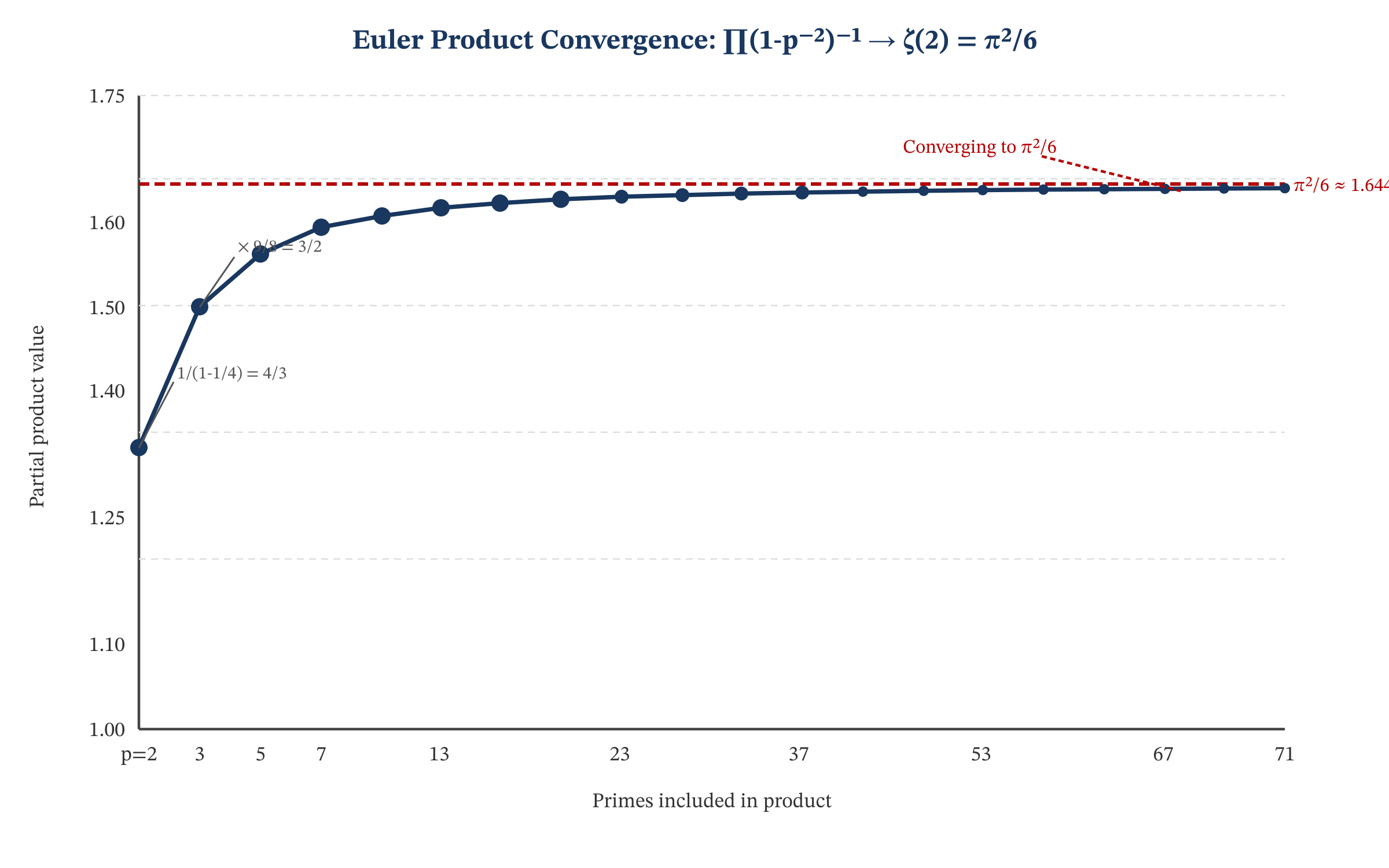
[Image: How the Euler product approximates zeta(2) = pi^2/6 as more prime factors are included]
A key consequence: since the product is over prime factors and never vanishes (each factor \( 1/(1-p^{-s}) \neq 0 \)), we immediately obtain:
Corollary. \( \zeta(s) \neq 0 \) for \( \operatorname{Re}(s) > 1 \).
The Basel Problem
Theorem (Euler, 1734).
$$ \zeta(2) = \sum_{n=1}^{\infty}\frac{1}{n^2} = \frac{\pi^2}{6}. $$
Proof via the sinc function. The function \( \sin(\pi x) \) has simple zeros at \( x = 0, \pm 1, \pm 2, \ldots \). The Weierstrass product for \( \sin(\pi x) \) gives
$$ \frac{\sin(\pi x)}{\pi x} = \prod_{n=1}^{\infty}\!\left(1 – \frac{x^2}{n^2}\right). $$
Expanding the product, the coefficient of \( x^2 \) is \( -\sum_{n=1}^{\infty} 1/n^2 \).
On the other hand, the Taylor series of \( \sin(\pi x)/(\pi x) \) around \( x = 0 \) is
$$ \frac{\sin(\pi x)}{\pi x} = 1 – \frac{(\pi x)^2}{3!} + \frac{(\pi x)^4}{5!} – \cdots = 1 – \frac{\pi^2}{6}x^2 + \frac{\pi^4}{120}x^4 – \cdots $$
Comparing the coefficient of \( x^2 \) from both expressions gives \( \sum_{n=1}^{\infty} 1/n^2 = \pi^2/6 \).
Tip: An alternative self-contained argument uses the double integral \( I = \int_0^1\int_0^1 \frac{dx\,dy}{1-xy} \). Expanding geometrically gives \( I = \sum_{n=1}^{\infty} 1/n^2 \). A change of variables transforms the integral to \( \pi^2/6 \).
Values at Even Positive Integers and Bernoulli Numbers
Definition. The Bernoulli numbers \( B_n \) are defined by the generating function
$$ \frac{t}{e^t – 1} = \sum_{n=0}^{\infty} \frac{B_n}{n!} t^n. $$
The first few values: \( B_0 = 1 \), \( B_1 = -1/2 \), \( B_2 = 1/6 \), \( B_4 = -1/30 \), \( B_6 = 1/42 \), and \( B_{2k+1} = 0 \) for \( k \geq 1 \).
Theorem (Euler). For each positive integer \( k \geq 1 \),
$$ \zeta(2k) = \frac{(2\pi)^{2k}(-1)^{k+1}B_{2k}}{2(2k)!}. $$
Explicitly:
$$ \zeta(4) = \frac{\pi^4}{90}, \qquad \zeta(6) = \frac{\pi^6}{945}, \qquad \zeta(8) = \frac{\pi^8}{9450}. $$
Values at odd integers greater than 1 remain mysterious; it is unknown whether \( \zeta(5) \) is irrational, though Apery proved in 1979 that \( \zeta(3) \) is irrational.
Analytic Continuation
The series \( \sum n^{-s} \) converges only for \( \sigma > 1 \), yet the zeta function extends to a meromorphic function on all of \( \mathbb{C} \).
Theorem (Analytic continuation). The function \( \zeta(s) \) extends to a meromorphic function on \( \mathbb{C} \) with a single simple pole at \( s = 1 \) with residue 1. It is analytic everywhere else.
Proof sketch via the eta function. Define the Dirichlet eta function
$$ \eta(s) = \sum_{n=1}^{\infty}\frac{(-1)^{n-1}}{n^s} = 1 – 2^{-s} + 3^{-s} – \cdots $$
This series converges for \( \operatorname{Re}(s) > 0 \) (by the alternating series estimate). One checks that \( \eta(s) = (1 – 2^{1-s})\zeta(s) \) for \( \operatorname{Re}(s) > 1 \). Hence
$$ \zeta(s) = \frac{\eta(s)}{1 – 2^{1-s}} $$
provides an analytic continuation to \( \operatorname{Re}(s) > 0 \) except where \( 2^{1-s} = 1 \), i.e. \( s = 1 \) (the only singularity here). For \( \operatorname{Re}(s) \leq 0 \) one uses the functional equation.
The Functional Equation
Theorem (Riemann, 1859). Define \( \xi(s) = \frac{1}{2}s(s-1)\pi^{-s/2}\Gamma(s/2)\zeta(s) \). Then \( \xi \) extends to an entire function satisfying
$$ \xi(s) = \xi(1-s). $$
Equivalently, setting \( \Lambda(s) = \pi^{-s/2}\Gamma(s/2)\zeta(s) \),
$$ \Lambda(s) = \Lambda(1-s). $$
The proof uses the Poisson summation formula applied to the theta function \( \vartheta(t) = \sum_{n=-\infty}^{\infty} e^{-\pi n^2 t} \), which satisfies the functional equation \( \vartheta(1/t) = t^{1/2}\vartheta(t) \). The completed zeta function \( \Lambda \) is obtained as a Mellin transform of \( \vartheta \), and the theta functional equation becomes the symmetry \( s \leftrightarrow 1-s \).
Significance. The functional equation accomplishes two things:
- It gives \( \zeta(s) \) for \( \operatorname{Re}(s) < 0 \) in terms of its values for \( \operatorname{Re}(s) > 1 \): \( \zeta(0) = -1/2 \), \( \zeta(-1) = -1/12 \), \( \zeta(-2) = 0 \), etc. The zeros at \( s = -2, -4, -6, \ldots \) are the trivial zeros.
- It shows the non-trivial zeros (those with \( 0 \leq \operatorname{Re}(s) \leq 1 \)) come in pairs: if \( \rho \) is a zero then so is \( 1 – \rho \).
The Critical Strip and Non-Trivial Zeros
The completed functional equation forces all non-trivial zeros into the critical strip \( 0 \leq \operatorname{Re}(s) \leq 1 \). We know:
- \( \zeta(s) \neq 0 \) for \( \operatorname{Re}(s) > 1 \) (Euler product).
- \( \zeta(s) \neq 0 \) for \( \operatorname{Re}(s) < 0 \) except at \( s = -2, -4, \ldots \) (trivial zeros, from \( \Gamma(s/2) \) poles).
- \( \zeta(s) \neq 0 \) for \( \operatorname{Re}(s) = 1 \) (key step in the PNT proof).
- By functional equation, \( \zeta(s) \neq 0 \) for \( \operatorname{Re}(s) = 0 \).
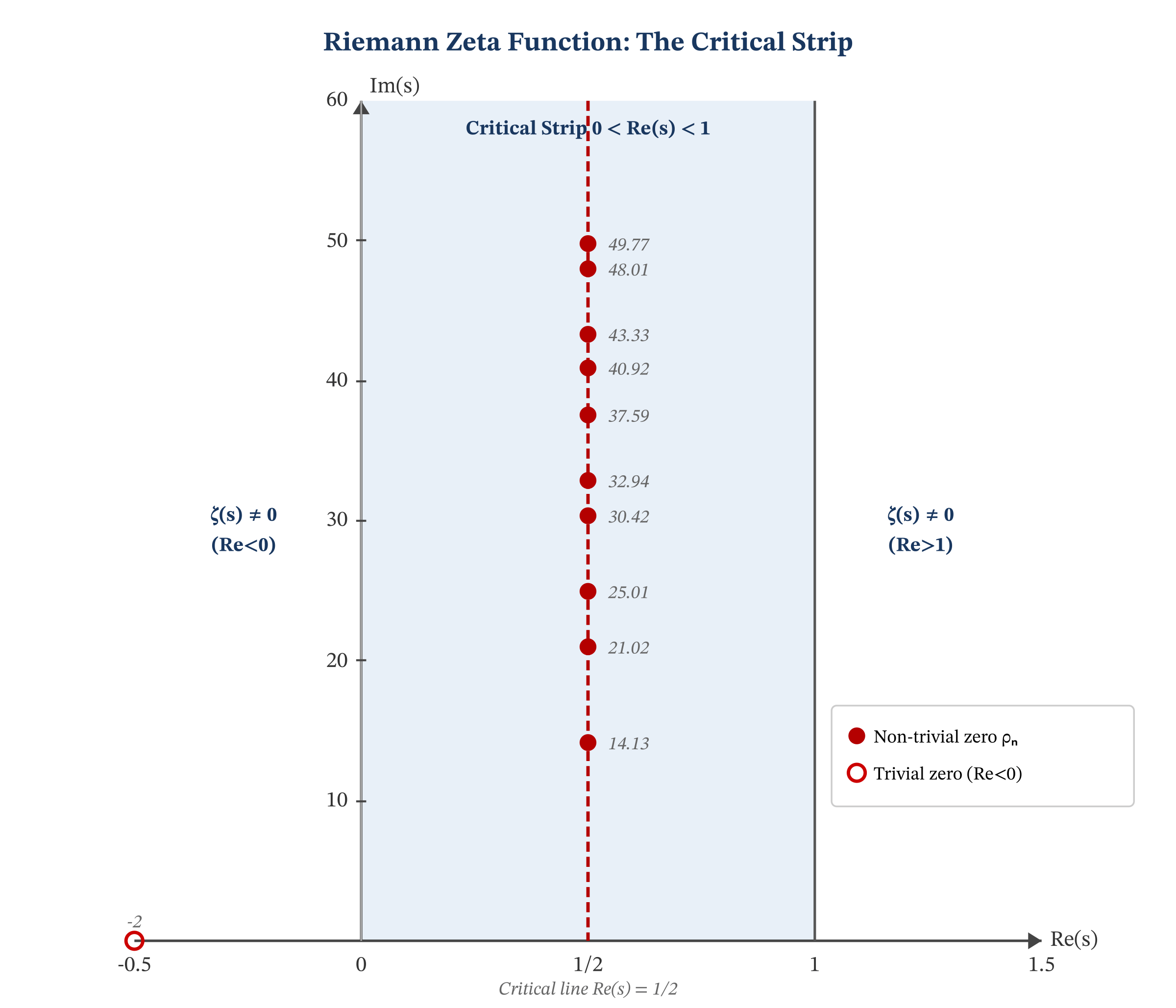
So all non-trivial zeros satisfy \( 0 < \operatorname{Re}(\rho) < 1 \). The functional equation \( \xi(s) = \xi(1-s) \) implies they are symmetric about the critical line \( \operatorname{Re}(s) = 1/2 \); complex conjugation further gives symmetry about the real axis.
[Image: The critical strip with crosses marking the first several non-trivial zeros on the critical line Re(s) = 1/2]
Statement of the Riemann Hypothesis
Important: The Riemann Hypothesis (RH).
$$ \rho = \tfrac{1}{2} + it, \quad t \in \mathbb{R}, \; t \neq 0. $$
All non-trivial zeros of the Riemann zeta function have real part \( 1/2 \). That is, every non-trivial zero has the form
Riemann stated this as a conjecture in his 1859 memoir “Uber die Anzahl der Primzahlen unter einer gegebenen Grosse” (On the Number of Primes Less Than a Given Magnitude). It remains unresolved after 167 years and is one of the seven Millennium Prize Problems, carrying a $1,000,000 prize from the Clay Mathematics Institute.
Numerical Evidence
Riemann computed the first few zeros by hand. The first ten non-trivial zeros (with positive imaginary part) are:
- \( n \): 1 | \( \rho_n = 1/2 + i\,t_n \): \( 1/2 + 14.134725\,i \)
- \( n \): 2 | \( \rho_n = 1/2 + i\,t_n \): \( 1/2 + 21.022040\,i \)
- \( n \): 3 | \( \rho_n = 1/2 + i\,t_n \): \( 1/2 + 25.010856\,i \)
- \( n \): 4 | \( \rho_n = 1/2 + i\,t_n \): \( 1/2 + 30.424876\,i \)
- \( n \): 5 | \( \rho_n = 1/2 + i\,t_n \): \( 1/2 + 32.935062\,i \)
- \( n \): 6 | \( \rho_n = 1/2 + i\,t_n \): \( 1/2 + 37.586178\,i \)
- \( n \): 7 | \( \rho_n = 1/2 + i\,t_n \): \( 1/2 + 40.918719\,i \)
- \( n \): 8 | \( \rho_n = 1/2 + i\,t_n \): \( 1/2 + 43.327073\,i \)
- \( n \): 9 | \( \rho_n = 1/2 + i\,t_n \): \( 1/2 + 48.005151\,i \)
- \( n \): 10 | \( \rho_n = 1/2 + i\,t_n \): \( 1/2 + 49.773832\,i \)
As of 2024, the first \( 10^{13} \) non-trivial zeros have been verified to lie on the critical line.
The Explicit Formula
Riemann’s memoir contained a revolutionary formula connecting primes and zeros.
Theorem (Riemann’s explicit formula).
$$ \psi_0(x) = x – \sum_{\rho} \frac{x^\rho}{\rho} – \ln(2\pi) – \frac{1}{2}\ln(1 – x^{-2}) $$
where \( \psi_0(x) = \psi(x) – \frac{1}{2}\Lambda(x) \) (average at jumps) and the sum runs over all non-trivial zeros \( \rho \), ordered by \( |\operatorname{Im}(\rho)| \).
This formula is the heart of the connection between primes and zeros:
- The dominant term \( x \) gives the leading approximation \( \psi(x) \approx x \).
- Each zero \( \rho = 1/2 + it \) contributes a term \( x^{1/2+it}/\rho \) of modulus \( \sqrt{x}/|\rho| \). These oscillatory terms cause \( \psi(x) \) to deviate from \( x \).
- If RH holds, each zero contributes \( O(\sqrt{x}) \), giving the sharp error term \( \psi(x) = x + O(\sqrt{x}\ln^2 x) \).
- If RH fails, some zero \( \rho = \beta + it \) with \( \beta > 1/2 \) contributes \( x^\beta/|\rho| \), which is larger than \( \sqrt{x} \) and would force a larger error term in the PNT.
Why the Riemann Hypothesis Matters
Theorem (Conditional PNT error bound). Assuming RH,
$$ \pi(x) = \mathrm{Li}(x) + O\!\bigl(\sqrt{x}\,\ln x\bigr). $$
Without RH, the best unconditional bound is \( \pi(x) = \mathrm{Li}(x) + O\bigl(x\exp(-c\sqrt{\ln x})\bigr) \) for some \( c > 0 \).
Beyond prime distribution, RH (or GRH) implies: the fastest algorithm for primality testing is deterministic, bounds on gaps between primes, results on the distribution of values of Dirichlet characters, and even consequences in quantum chaos via random matrix theory.
Dirichlet Series and Convergence
A Dirichlet series \( \sum a_n n^{-s} \) has an abscissa of convergence \( \sigma_c \) such that it converges for \( \operatorname{Re}(s) > \sigma_c \) and diverges for \( \operatorname{Re}(s) < \sigma_c \). For \( \zeta(s) \), \( \sigma_c = 1 \). Absolute convergence holds for \( \operatorname{Re}(s) > \sigma_a \); for \( \zeta(s) \), \( \sigma_a = 1 \) as well.
The Dirichlet series representation is not just a formal tool. It provides the bridge between arithmetic (the coefficients \( a_n \)) and analysis (the function \( \sum a_n n^{-s} \)). When \( a_n = 1 \) for all \( n \), we get the zeta function. When \( a_n = \Lambda(n) \) (the von Mangoldt function), we get \( -\zeta'(s)/\zeta(s) \), the logarithmic derivative. When \( a_n = \mu(n) \), we get \( 1/\zeta(s) \). Each choice encodes a different aspect of prime arithmetic.
Partial Summation (Abel Summation)
If \( A(x) = \sum_{n\leq x} a_n \) and \( f \) is differentiable on \( [1, x] \), then
$$ \sum_{n \leq x} a_n f(n) = A(x)f(x) – \int_1^x A(t)f'(t)\,dt. $$
This technique converts sums into integrals, making them amenable to analytic methods. It is the discrete analog of integration by parts and is used throughout analytic number theory to pass between \( \pi(x) \), \( \theta(x) \), and \( \psi(x) \).
Key Background: The Mobius Function
$$ \mu(n) = \begin{cases} 1 & n = 1, \\ (-1)^k & n = p_1 p_2 \cdots p_k \text{ (distinct primes)}, \\ 0 & p^2 \mid n \text{ for some prime } p. \end{cases} $$
The Mobius inversion formula: if \( f(n) = \sum_{d\mid n} g(d) \) then \( g(n) = \sum_{d \mid n} \mu(n/d) f(d) \).
Key Background: The Gamma Function
\( \Gamma(s) = \int_0^{\infty} t^{s-1}e^{-t}\,dt \) for \( \operatorname{Re}(s) > 0 \); extended meromorphically to \( \mathbb{C} \) with poles at \( 0, -1, -2, \ldots \). The functional equation \( \Gamma(s+1) = s\Gamma(s) \) gives \( \Gamma(n) = (n-1)! \) for \( n \in \mathbb{N} \). The reflection formula \( \Gamma(s)\Gamma(1-s) = \pi/\sin(\pi s) \) links the Gamma function to \( \sin \), and appears in the functional equation for \( \zeta \).
Exercises:
- Verify the Euler product for \( \zeta(2) \) by computing \( \prod_{p \leq 7} \frac{1}{1 – p^{-2}} \) and comparing with \( \pi^2/6 \approx 1.6449 \).
- Use the Basel problem result to show that \( \sum_{n=1}^{\infty} 1/(2n-1)^2 = \pi^2/8 \). (Hint: subtract the even terms from \( \zeta(2) \).)
- Verify that \( \eta(1) = \ln 2 \) by recognizing the alternating harmonic series. Use the relation \( \eta(s) = (1 – 2^{1-s})\zeta(s) \) to confirm the pole of \( \zeta(s) \) at \( s = 1 \).
- The functional equation gives \( \zeta(0) = -1/2 \) and \( \zeta(-1) = -1/12 \). Explain why the “sum” \( 1 + 2 + 3 + \cdots = -1/12 \) is not a convergent sum but a regularized value.
- If all non-trivial zeros lie on the line \( \operatorname{Re}(s) = 1/2 \), explain why the oscillatory contributions to \( \psi(x) \) are bounded by \( O(\sqrt{x}) \). What would happen if a zero existed at \( \operatorname{Re}(s) = 3/4 \)?
- Compute \( \zeta(4) = \sum_{n=1}^{100} 1/n^4 \) numerically and compare with \( \pi^4/90 \).