
The most profound insight in this subject is a duality: nested radicals and continued fractions are two faces of the same coin. Both represent real numbers through infinite recursive structures, and both converge to the same algebraic quantities via different paths. In this final lesson on nested radicals, we explore this duality, Ramanujan’s deepest identities, and the open problems that still challenge mathematicians today.
The Nested Radical-Continued Fraction Duality
A Remarkable Equivalence
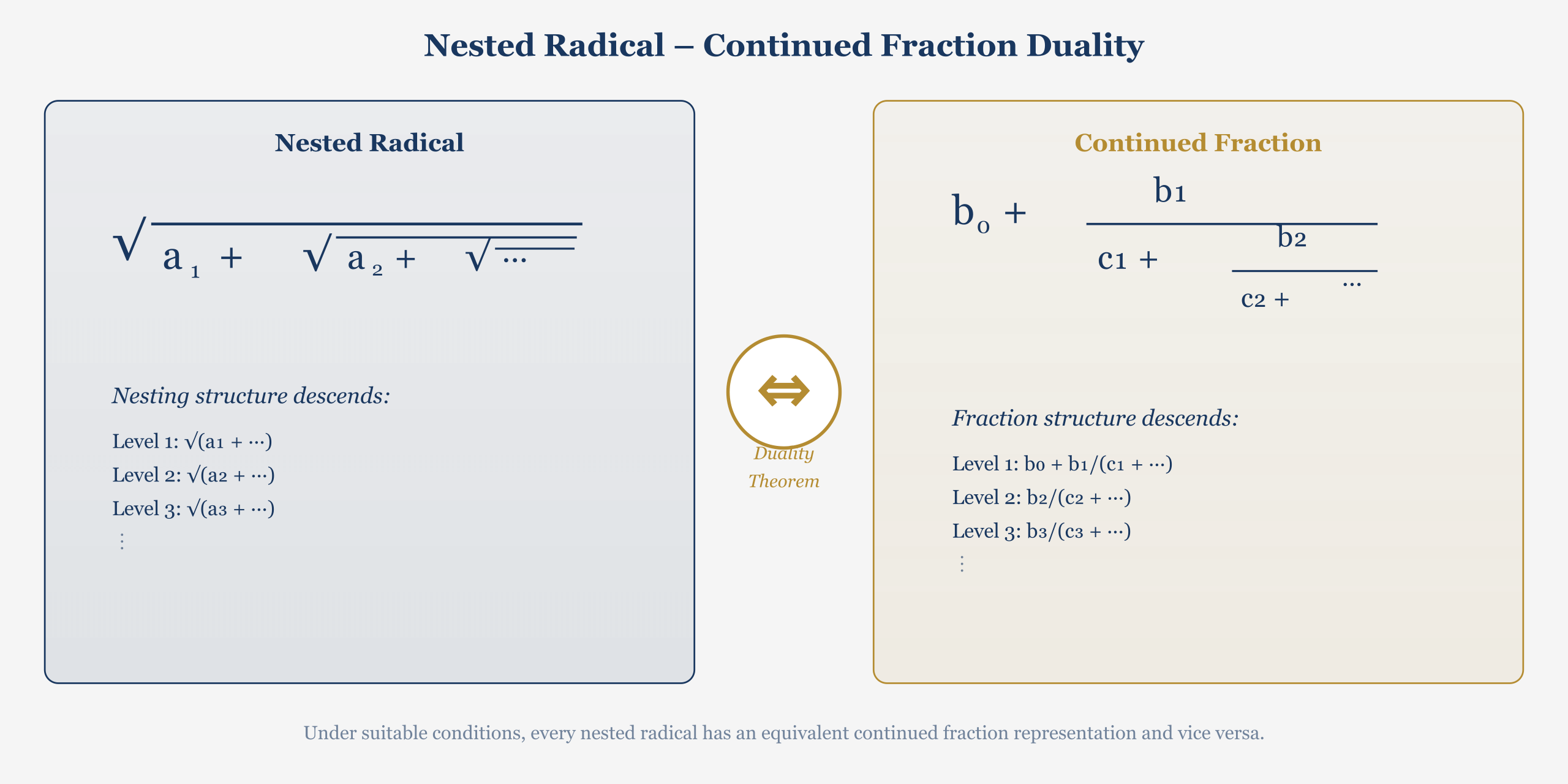
[Image: The duality between nested radicals and continued fractions, showing how both representations converge to the same algebraic quantity via different recursive structures]
Theorem (Nested Radical-Continued Fraction Duality). For \( a, b \geq 0 \):
$$ \sqrt{a + b\sqrt{a + b\sqrt{a + b\sqrt{\cdots}}}} = a + \cfrac{b}{a + \cfrac{b}{a + \cfrac{b}{a + \cdots}}} $$
Both expressions equal:
$$ \frac{a + \sqrt{a^2 + 4b}}{2} $$
Proof. Let \( L \) denote the nested radical. Then \( L = \sqrt{a + bL} \), giving \( L^2 = a + bL \), hence:
$$ L = \frac{b + \sqrt{b^2 + 4a}}{2} $$
Let \( C \) denote the continued fraction. Then \( C = a + b/C \), giving \( C^2 = aC + b \), hence:
$$ C = \frac{a + \sqrt{a^2 + 4b}}{2} $$
The key observation is that the nested radical equation \( L^2 – bL – a = 0 \) and the continued fraction equation \( C^2 – aC – b = 0 \) are related by interchanging the roles of \( a \) and \( b \). When the parameters are appropriately matched, both equal \( (a + \sqrt{a^2 + 4b})/2 \). \( \square \)
The Golden Ratio Connection
Setting \( a = b = 1 \):
$$ \sqrt{1 + \sqrt{1 + \sqrt{1 + \cdots}}} = 1 + \cfrac{1}{1 + \cfrac{1}{1 + \cfrac{1}{\ddots}}} = \frac{1 + \sqrt{5}}{2} = \varphi $$
This demonstrates that the golden ratio can be represented both as an infinite nested radical and as the simplest infinite continued fraction \( [1; 1, 1, 1, \ldots] \). The golden ratio sits at the intersection of these two worlds, embodying the duality perfectly.
Further Examples of the Duality
Setting \( a = 2, b = 1 \):
$$ \sqrt{2 + \sqrt{2 + \sqrt{2 + \cdots}}} = 2 + \cfrac{1}{2 + \cfrac{1}{2 + \cdots}} = \frac{2 + \sqrt{8}}{2} = 1 + \sqrt{2} $$
Wait, let’s check: \( (2 + \sqrt{4 + 4})/2 = (2 + 2\sqrt{2})/2 = 1 + \sqrt{2} \). But \( \sqrt{2 + \sqrt{2 + \cdots}} = 2 \) (from our earlier calculation). The discrepancy is because the nested radical \( \sqrt{a + b\sqrt{\cdots}} \) with \( b = 1 \) is \( \sqrt{2 + 1 \cdot \sqrt{2 + \cdots}} \) which equals \( \sqrt{2 + L} \) where \( L \) satisfies \( L^2 = 2 + L \), giving \( L = 2 \) and the radical equals \( \sqrt{2+2} = 2 \).
The correct application of the duality theorem requires matching the form \( \sqrt{a + b\sqrt{a + b\sqrt{\cdots}}} \) precisely. Let’s be explicit.
Setting \( a = 1, b = 2 \):
$$ \sqrt{1 + 2\sqrt{1 + 2\sqrt{1 + 2\sqrt{\cdots}}}} = \frac{2 + \sqrt{4 + 4}}{2} = \frac{2 + 2\sqrt{2}}{2} = 1 + \sqrt{2} $$
And the corresponding continued fraction:
$$ 1 + \cfrac{2}{1 + \cfrac{2}{1 + \cfrac{2}{\ddots}}} = \frac{1 + \sqrt{1 + 8}}{2} = \frac{1 + 3}{2} = 2 $$
These are different because the duality swaps the roles of \( a \) and \( b \). The nested radical with parameters \( (a, b) \) corresponds to the continued fraction with parameters \( (b, a) \), not \( (a, b) \).
Ramanujan’s Wild Theorem
In his famous letter to G.H. Hardy on January 16, 1913, Ramanujan included one of the most surprising identities in all of mathematics:
Important:
$$ > \cfrac{1}{1 + \cfrac{e^{-2\pi}}{1 + \cfrac{e^{-4\pi}}{1 + \cfrac{e^{-6\pi}}{1 + \ddots}}}} = \left(\sqrt{\frac{5 + \sqrt{5}}{2}} – \frac{\sqrt{5} + 1}{2}\right)\sqrt[5]{e^{2\pi}} > $$
This identity connects an infinite continued fraction with exponential terms to a finite expression involving the golden ratio and fifth roots. The right-hand side simplifies to:
$$ \sqrt{\frac{5 + \sqrt{5}}{2}} – \varphi $$
multiplied by \( e^{2\pi/5} \).
Hardy was initially skeptical but eventually verified it. This theorem belongs to the theory of the Rogers-Ramanujan continued fraction, one of the deepest objects in \( q \)-series theory.
The Rogers-Ramanujan Continued Fraction
For \( |q| < 1 \), the Rogers-Ramanujan continued fraction is:
$$ R(q) = \dfrac{q^{1/5}}{\displaystyle 1 + \dfrac{q}{\displaystyle 1 + \dfrac{q^2}{\displaystyle 1 + \dfrac{q^3}{\displaystyle 1 + \ddots}}}} $$
It admits the remarkable product representation:
$$ R(q) = q^{1/5} \prod_{n=1}^{\infty} \frac{(1 – q^{5n-1})(1 – q^{5n-4})}{(1 – q^{5n-2})(1 – q^{5n-3})} $$
The connection to modular functions led to remarkable exact evaluations at specific values of \( q \), such as \( q = e^{-2\pi} \). These evaluations typically involve the golden ratio, reflecting the deep connection between the Rogers-Ramanujan identities and the number 5.
Ramanujan’s Ultimate Nested Radical Formula
Ramanujan discovered another elegant formula expressing sums as nested radicals.
Theorem (Ramanujan’s Sum Formula). For any \( x, a \in \mathbb{R} \):
$$ x + a = \sqrt{a^2 + x\sqrt{a^2 + (x+a)\sqrt{a^2 + (x+2a)\sqrt{a^2 + (x+3a)\sqrt{\cdots}}}}} $$
Proof. Starting from \( (x + a)^2 = a^2 + x(x + 2a) \), take square roots:
$$ x + a = \sqrt{a^2 + x(x + 2a)} $$
Replace \( x \) by \( x + a \): \( x + 2a = \sqrt{a^2 + (x+a)(x + 3a)} \).
Substitute back and continue inductively to generate the infinite nested radical. \( \square \)
For finite truncation at \( n \) terms:
$$ x + a = \sqrt{a^2 + x\sqrt{a^2 + (x+a)\sqrt{a^2 + (x+2a)\sqrt{\cdots\sqrt{a^2 + (x+na)(x+(n+1)a)}}}}} $$
The innermost term \( a^2 + (x+na)(x+(n+1)a) = (x + (n+1)a)^2 \) is always a perfect square, making verification straightforward.
Generalizations and Open Problems
Algebraic Independence
Two of the most tantalizing open questions in the theory of nested radicals:
-
Is \( \sqrt{1 + \sqrt{2 + \sqrt{3 + \sqrt{4 + \cdots}}}} \) algebraic or transcendental? Numerical computation gives approximately \( 1.7579327566\ldots \), but no closed form is known.
-
What is the exact value of this constant? Despite extensive computation, no one has identified this number with any known constant.
Generalized Nested Radicals
Several directions for generalization remain largely unexplored:
-
Higher-degree roots: Study of \( \sqrt[n]{a_1 + \sqrt[n]{a_2 + \sqrt[n]{a_3 + \cdots}}} \) for \( n > 2 \). The convergence theory extends (with \( 2^{-n} \) replaced by \( n^{-n} \) in Herschfeld’s condition), but explicit evaluations are rare.
-
Mixed-degree nested radicals: Expressions like \( \sqrt{a + \sqrt[3]{b + \sqrt{c + \cdots}}} \) where the degree of the root varies at each level.
-
Complex-valued nested radicals: When the terms \( a_n \) are allowed to be complex, the convergence theory becomes considerably more subtle.
Connections to Modular Forms
Ramanujan’s wild theorem suggests deep connections between nested radicals and modular forms. The Rogers-Ramanujan continued fraction is a modular function for the group \( \Gamma(5) \), and its special values involve nested radicals through expressions with the golden ratio. Understanding why these connections exist remains an active area of research.
Summary: The Three Worlds
The theory we have developed across these three lessons reveals a beautiful tripartite structure:
Continued Fractions represent numbers as:
$$ a_0 + \cfrac{1}{a_1 + \cfrac{1}{a_2 + \cfrac{1}{a_3 + \ddots}}} $$
Nested Radicals represent numbers as:
$$ \sqrt{a_1 + \sqrt{a_2 + \sqrt{a_3 + \sqrt{a_4 + \cdots}}}} $$
The Duality shows these are intimately connected:
- The golden ratio \( \varphi \) is simultaneously the simplest continued fraction and the simplest nested radical.
- Both representations solve the same types of quadratic equations.
- The derivatives of nested radical functions have continued-fraction structure.
- Ramanujan’s identities often express the same quantity in both forms.
The key results across all three lessons:
- Ramanujan’s General Formula: \( x + n + a \) can be expressed as an infinite nested radical.
- Herschfeld’s Convergence Theorem: Convergence if and only if \( \limsup a_n^{2^{-n}} < \infty \).
- The Duality Theorem: Nested radicals and continued fractions yield the same algebraic expressions.
- The Golden Ratio: \( \varphi = (1+\sqrt{5})/2 \) appears as the simplest non-trivial example in both worlds.
- Calculus of Radicals: Functions defined by nested radicals are differentiable and integrable, with derivatives exhibiting their own nested structure.
The theory of nested radicals continues to yield surprises, connecting elementary algebra to deep areas of number theory, modular forms, and analysis.
Exercises
-
Duality verification. For \( a = 3, b = 2 \), compute both sides of the duality theorem:
- The nested radical \( \sqrt{3 + 2\sqrt{3 + 2\sqrt{3 + \cdots}}} \)
- The continued fraction \( 3 + 2/(3 + 2/(3 + \cdots)) \)
- The closed form \( (a + \sqrt{a^2 + 4b})/2 \)
Verify all three agree.
-
Golden ratio identity. Starting from \( \varphi = [1; \overline{1}] \) and \( \varphi = \sqrt{1 + \sqrt{1 + \cdots}} \), prove that \( \varphi^n = F_n \varphi + F_{n-1} \) where \( F_n \) is the \( n \)th Fibonacci number.
-
Ramanujan’s sum formula. Use the sum formula with \( x = 1, a = 1 \) to express 2 as a nested radical. Verify the first 3 finite truncations approach 2.
-
Convergence boundary. Find a sequence \( (a_n) \) with \( a_n^{2^{-n}} \to \infty \) for which the nested radical \( \sqrt{a_1 + \sqrt{a_2 + \sqrt{a_3 + \cdots}}} \) diverges. (Hint: try \( a_n = 2^{2^n \cdot c} \) for large \( c \).)
-
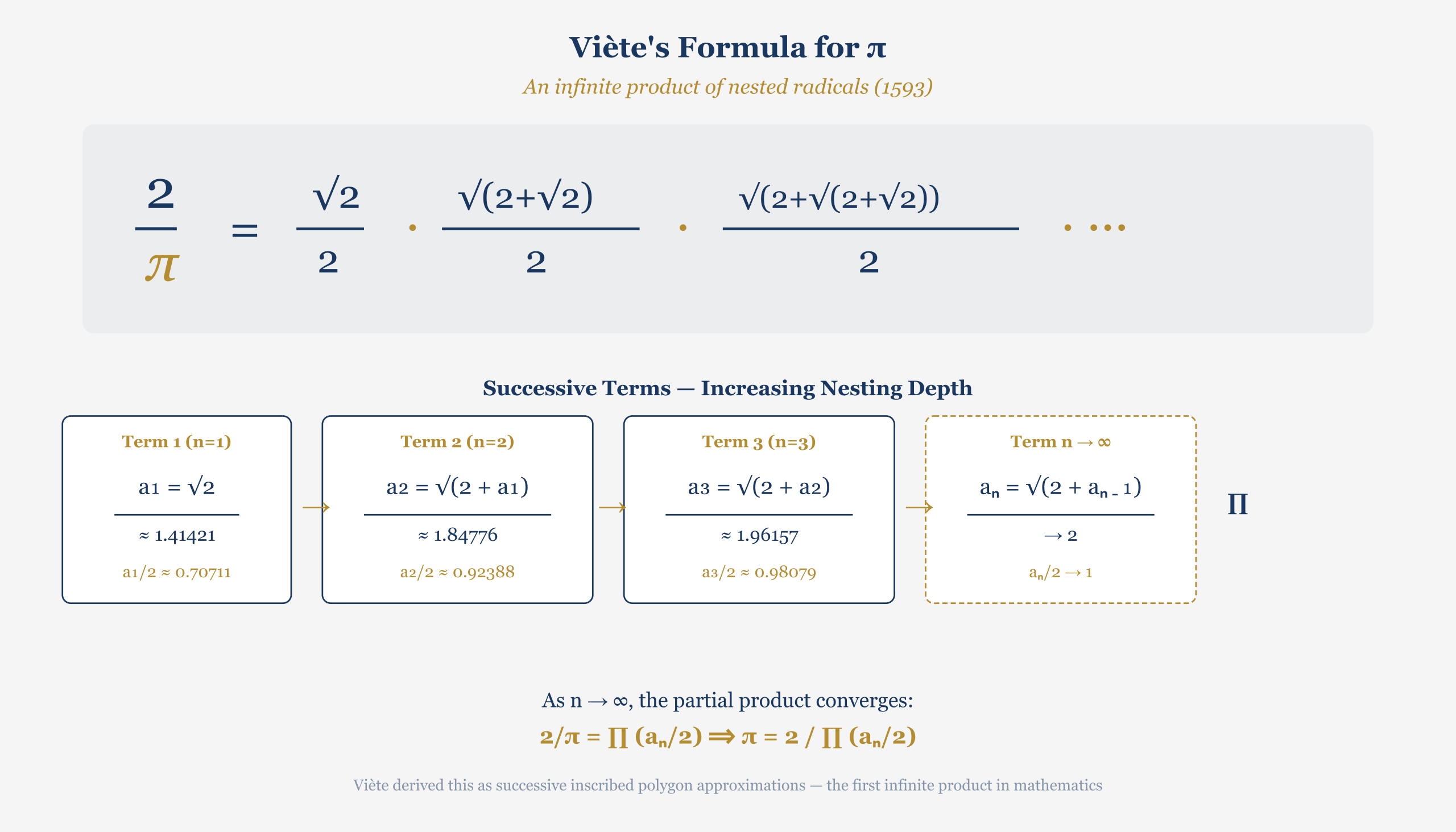
Viete meets the duality. Viete’s formula gives \( 2/\pi \) as an infinite product of nested radicals of the form \( \sqrt{2 + \sqrt{2 + \cdots}} \). Use the fact that \( \sqrt{2 + \sqrt{2 + \cdots + \sqrt{2}}} \) (with \( n \) radicals) equals \( 2\cos(\pi/2^{n+1}) \) to prove Viete’s formula from the telescoping identity for cosine products.
-
Open problem exploration. Compute \( \sqrt{1 + \sqrt{2 + \sqrt{3 + \sqrt{4 + \cdots + \sqrt{n}}}}} \) for \( n = 5, 10, 20, 50 \). How quickly does the sequence converge? How many digits of the limit \( \approx 1.7579327566 \) can you confirm with \( n = 50 \)?
-
The wild theorem numerically. Compute the first few convergents of the continued fraction
$$ \cfrac{1}{1 + \cfrac{e^{-2\pi}}{1 + \cfrac{e^{-4\pi}}{1 + \cfrac{e^{-6\pi}}{1 + \cdots}}}} $$and verify that the result approaches \( \left(\sqrt{(5 + \sqrt{5})/2} – \varphi\right) \cdot e^{2\pi/5} \).