
Square roots inside square roots, going deeper and deeper, potentially forever. Nested radicals are among the most elegant objects in elementary mathematics, and no one explored them with more brilliance than Srinivasa Ramanujan. In this lesson we lay the groundwork: definitions, basic examples, the golden ratio connection, and the art of denesting.
Historical Context
Nested radicals appear throughout the history of mathematics. The ancient Babylonians used iterative methods equivalent to nested radicals for computing square roots. Viete (1593) discovered the remarkable identity:
$$ \frac{2}{\pi} = \frac{\sqrt{2}}{2} \cdot \frac{\sqrt{2+\sqrt{2}}}{2} \cdot \frac{\sqrt{2+\sqrt{2+\sqrt{2}}}}{2} \cdots $$
which expresses \( \pi \) as an infinite product of nested radicals, predating Ramanujan by over 300 years.
Ramanujan’s work elevated nested radicals from curiosities to a systematic theory, revealing deep connections to continued fractions, special functions, and algebraic number theory. In 1911, at the age of 23, he posed a problem in the Journal of the Indian Mathematical Society:
$$ \sqrt{1 + 2\sqrt{1 + 3\sqrt{1 + 4\sqrt{1 + 5\sqrt{\cdots}}}}} = \; ? $$
The answer, as we shall derive, is simply 3.
Fundamentals of Nested Radicals
Definitions and Notation
Definition (Nested Radical). A nested radical is an expression of the form
$$ \sqrt{x_1 + x_2\sqrt{x_3 + x_4\sqrt{x_5 + x_6\sqrt{x_7 + x_8\sqrt{\cdots}}}}} $$
where \( x_i \in \mathbb{R} \) for all \( i \in \mathbb{N} \).
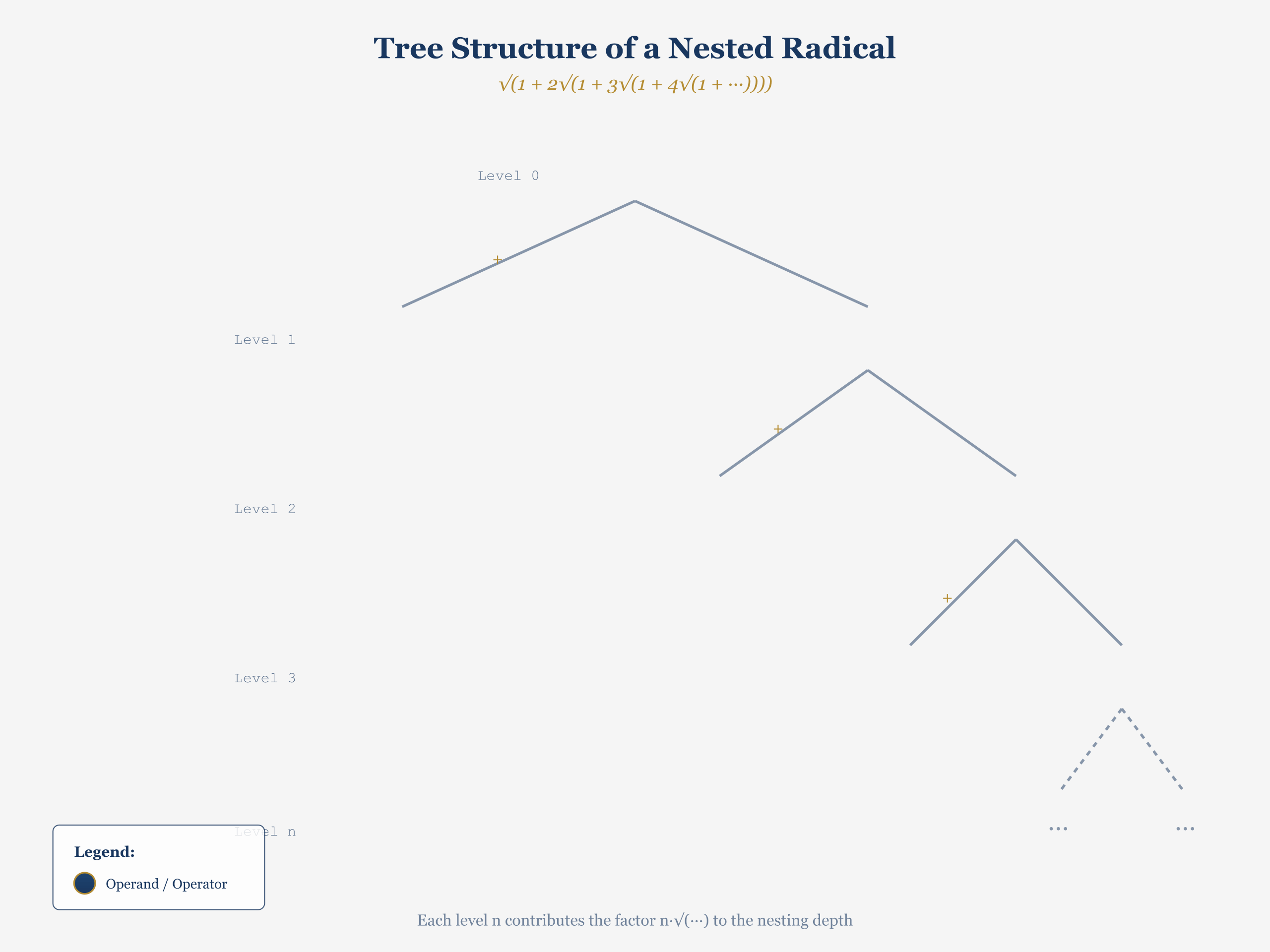
[Image: Tree structure of a nested radical expression, illustrating how each level of nesting branches into its constituent terms]
The nesting can be finite or infinite:
- A finite nested radical has a definite number of radical signs, such as \( \sqrt{1 + \sqrt{2 + \sqrt{3 + \sqrt{4}}}} \).
- An infinite nested radical extends indefinitely, such as \( \sqrt{1 + \sqrt{2 + \sqrt{3 + \sqrt{4 + \cdots}}}} \).
Definition (Depth of Nesting). The depth of a finite nested radical is the number of radical signs it contains. The depth of an infinite nested radical is \( \infty \).
Tip: While we focus primarily on square roots, nested radicals can involve roots of any degree. For example, \( \sqrt[4]{5 + \sqrt[3]{11 + \sqrt{23}}} \) is a nested radical with mixed degrees. Such expressions arise naturally in the theory of solvability of polynomial equations by radicals.
Denesting: Simplifying Nested Radicals
Definition (Denesting). The process of reducing the depth of a nested radical is called denesting. A nested radical is denestable if it can be expressed using radicals of smaller depth.
Example. The expression \( \sqrt{3 + 2\sqrt{2}} \) can be denested:
$$ \sqrt{3 + 2\sqrt{2}} = 1 + \sqrt{2} $$
This can be verified by squaring: \( (1 + \sqrt{2})^2 = 1 + 2\sqrt{2} + 2 = 3 + 2\sqrt{2} \).
Denesting Two-Level Radicals
Consider a nested radical of the form \( \sqrt{a + \sqrt{b}} \) where \( a, b \in \mathbb{Q} \). We seek to express it as \( \sqrt{d} + \sqrt{e} \) where \( d, e \in \mathbb{Q} \).
Theorem (Two-Level Denesting). Let \( a, b \in \mathbb{Q} \) with \( b > 0 \). If there exist \( d, e \in \mathbb{Q} \) such that \( \sqrt{a + \sqrt{b}} = \sqrt{d} + \sqrt{e} \), then \( d \) and \( e \) satisfy:
$$ d + e = a, \qquad 4de = b. $$
Proof. Squaring both sides: \( a + \sqrt{b} = d + e + 2\sqrt{de} \). Equating rational and irrational parts yields the two equations. \( \square \)
From these equations, \( d \) and \( e \) are the roots of \( 4t^2 – 4at + b = 0 \), giving:
$$ e = \frac{a \pm \sqrt{a^2 – b}}{2} $$
Important: The radical \( \sqrt{a + \sqrt{b}} \) is denestable over \( \mathbb{Q} \) if and only if \( a^2 – b \) is a perfect square in \( \mathbb{Q} \).
Example. To denest \( \sqrt{5 + 2\sqrt{6}} \):
- Here \( a = 5 \) and \( b = 24 \) (since \( 2\sqrt{6} = \sqrt{24} \)).
- Check: \( a^2 – b = 25 – 24 = 1 \), which is a perfect square.
- Solving: \( e = (5 \pm 1)/2 \), giving \( e = 3 \) or \( e = 2 \).
- Therefore: \( \sqrt{5 + 2\sqrt{6}} = \sqrt{2} + \sqrt{3} \).
Denesting Three-Level Radicals
For \( \sqrt{a + \sqrt{b + \sqrt{c}}} \), the algebraic complexity grows rapidly with depth. Susan Landau developed algorithms for denesting such expressions, which fall under the domain of computational algebra.
The Constant-Coefficient Case
Nested Radicals of Type \( \sqrt{a + \sqrt{a + \sqrt{a + \cdots}}} \)
Consider the simplest infinite nested radical where all coefficients equal \( a \):
$$ L = \sqrt{a + \sqrt{a + \sqrt{a + \sqrt{\cdots}}}} $$
Theorem. For \( a \geq 0 \), the infinite nested radical \( \sqrt{a + \sqrt{a + \sqrt{a + \cdots}}} \) converges to:
$$ L = \frac{1 + \sqrt{1 + 4a}}{2} $$
Proof. Assuming convergence to \( L \), we have \( L = \sqrt{a + L} \). Squaring: \( L^2 = a + L \), which gives \( L^2 – L – a = 0 \). By the quadratic formula:
$$ L = \frac{1 \pm \sqrt{1 + 4a}}{2} $$
Since \( L \) must be positive, we take the positive root. \( \square \)
The Golden Ratio
The most celebrated special case occurs when \( a = 1 \):
Important:
$$ > \sqrt{1 + \sqrt{1 + \sqrt{1 + \sqrt{1 + \cdots}}}} = \varphi = \frac{1 + \sqrt{5}}{2} \approx 1.6180339887\ldots > $$where \( \varphi \) is the golden ratio.
[Image: The golden spiral arising from the constant nested radical, illustrating the geometric connection between nested radicals and the golden ratio]
The golden ratio satisfies \( \varphi^2 = \varphi + 1 \), which is precisely the equation we derived. This is the same golden ratio that appears as the simplest continued fraction \( [1; 1, 1, 1, \ldots] \), linking our current topic to the previous lessons.
The Identity for 2
For \( a = 2 \):
$$ L = \sqrt{2 + \sqrt{2 + \sqrt{2 + \cdots}}} \implies L^2 = 2 + L \implies L = 2 $$
Important:
$$ > \sqrt{2 + \sqrt{2 + \sqrt{2 + \sqrt{2 + \cdots}}}} = 2 > $$
This connects to a beautiful trigonometric identity:
$$ 2\cos\left(\frac{\pi}{2^n}\right) = \underbrace{\sqrt{2 + \sqrt{2 + \sqrt{2 + \cdots + \sqrt{2}}}}}_{n-1 \text{ nested radicals}} $$
As \( n \to \infty \), \( \cos(\pi/2^n) \to 1 \), confirming our limit of 2.
The Plastic Constant
For cubic nested radicals:
$$ P = \sqrt[3]{1 + \sqrt[3]{1 + \sqrt[3]{1 + \cdots}}} $$
The limit satisfies \( P^3 = 1 + P \), giving
$$ P \approx 1.3247179572\ldots $$
This is the plastic constant, which appears in architecture and number theory.
More generally, for \( n \)th degree constant nested radicals \( L = \sqrt[n]{a + \sqrt[n]{a + \sqrt[n]{a + \cdots}}} \), the limit is the unique positive root of \( L^n – L – a = 0 \).
The Trivial Case
When all coefficients are the same value \( x \) in a multiplicative nested radical:
$$ \sqrt{x \cdot \sqrt{x \cdot \sqrt{x \cdots}}} = x^{1/2} \cdot x^{1/4} \cdot x^{1/8} \cdots = x^{1/2 + 1/4 + 1/8 + \cdots} = x^1 = x $$
More generally, with \( k \) radicals:
$$ \underbrace{\sqrt{x\sqrt{x\sqrt{x\cdots\sqrt{x}}}}}_{k \text{ radicals}} = x^{1 – 2^{-k}} $$
which approaches \( x \) as \( k \to \infty \).
Ramanujan’s General Formula
Derivation from the Binomial Theorem
Theorem (Ramanujan’s Nested Radical Identity). For all \( x, n, a \in \mathbb{R} \) with appropriate sign conditions:
$$ x + n + a = \sqrt{ax + (n+a)^2 + x\sqrt{a(x+n) + (n+a)^2 + (x+n)\sqrt{a(x+2n) + (n+a)^2 + \cdots}}} $$
Proof. We proceed by constructing a telescoping pattern.
Step 1: Begin with the algebraic identity \( (x + n + a)^2 = x^2 + 2x(n+a) + (n+a)^2 \). Rearranging:
$$ (x + n + a)^2 = ax + (n+a)^2 + x(x + 2n + a) $$
Step 2: Taking the positive square root:
$$ x + n + a = \sqrt{ax + (n+a)^2 + x(x + 2n + a)} $$
Step 3: Replace \( x \) with \( x + n \):
$$ x + 2n + a = \sqrt{a(x+n) + (n+a)^2 + (x+n)(x + 3n + a)} $$
Step 4: Substitute Step 3 into Step 2 and continue inductively, yielding the infinite nested radical. \( \square \)
The Identity for 3
Setting \( x = n = a = 1 \) in Ramanujan’s formula:
$$ 3 = \sqrt{1 + 2\sqrt{1 + 3\sqrt{1 + 4\sqrt{1 + 5\sqrt{\cdots}}}}} $$
Proof. With \( x = n = a = 1 \):
- Left side: \( x + n + a = 1 + 1 + 1 = 3 \)
- First term: \( ax + (n+a)^2 = 1 + 4 = 5 \), with coefficient \( x = 1 \)
- Under second radical: \( a(x+n) + (n+a)^2 = 2 + 4 = 6 \), with coefficient \( x + n = 2 \)
- Pattern continues: coefficients are \( 1, 2, 3, 4, \ldots \) and inner terms are \( 5, 6, 7, 8, \ldots \)
Rewriting as \( 5 = 1 + 2 \cdot 2 \), \( 6 = 1 + 2 \cdot 2 + 1 \), etc., and simplifying gives the stated form. \( \square \)
An equivalent form:
$$ x + 1 = \sqrt{1 + x\sqrt{1 + (x+1)\sqrt{1 + (x+2)\sqrt{1 + (x+3)\sqrt{\cdots}}}}} $$
Setting \( x = 2 \) recovers the formula for 3.
Ramanujan’s Sum Formula
Theorem. For any \( x, a \in \mathbb{R} \):
$$ x + a = \sqrt{a^2 + x\sqrt{a^2 + (x+a)\sqrt{a^2 + (x+2a)\sqrt{a^2 + (x+3a)\sqrt{\cdots}}}}} $$
Proof. Starting from \( (x + a)^2 = a^2 + x(x + 2a) \), take square roots and substitute recursively. \( \square \)
Nested Radicals for Multiples
Setting \( x = a = n \) in the general formula yields expressions for \( 3n \) as nested radicals:
$$ 3n = \sqrt{5n^2 + n\sqrt{8n^2 + 2n\sqrt{13n^2 + 3n\sqrt{\cdots}}}} $$
Exercises
-
Verify by squaring that \( \sqrt{7 + 4\sqrt{3}} = 2 + \sqrt{3} \).
-
Denest \( \sqrt{11 + 2\sqrt{30}} \) by finding appropriate \( d \) and \( e \).
-
Find the value of \( \sqrt{6 + \sqrt{6 + \sqrt{6 + \sqrt{6 + \cdots}}}} \) by solving the appropriate quadratic equation.
-
Verify Ramanujan’s identity \( 3 = \sqrt{1 + 2\sqrt{1 + 3\sqrt{1 + 4\sqrt{\cdots}}}} \) numerically by computing the finite nested radical \( \sqrt{1 + 2\sqrt{1 + 3\sqrt{1 + 4\sqrt{1 + 5 \cdot 6}}}} \) (truncated at depth 4) and checking it is close to 3.
-
Show that \( \sqrt{a + \sqrt{a + \sqrt{a + \cdots}}} = n \) if and only if \( a = n^2 – n = n(n-1) \). For which positive integers \( n \) does the nested radical equal \( n \)?
-
Compute the first 5 finite approximations to the golden ratio via the nested radical \( \sqrt{1 + \sqrt{1 + \sqrt{1 + \cdots}}} \) and observe the rate of convergence.
-
Use Ramanujan’s sum formula with \( x = 3, a = 2 \) to express 5 as a nested radical. Write out the first three levels explicitly.