
With the basic theory in place, we now dive deeper into the analytic heart of nested radicals: convergence criteria, Viete’s formula for \( \pi \), and the calculus of functions defined by nested radicals. These results show that nested radicals are far more than algebraic curiosities; they connect to some of the most fundamental ideas in analysis.
Convergence Theory
Not every infinite nested radical converges. The central question is: given a sequence of non-negative numbers \( a_1, a_2, a_3, \ldots \), when does
$$ \sqrt{a_1 + \sqrt{a_2 + \sqrt{a_3 + \sqrt{a_4 + \cdots}}}} $$
converge to a finite value?
Herschfeld’s Theorem
The answer was given by Aaron Herschfeld in 1935.
Important: The infinite nested radical \( \sqrt{a_1 + \sqrt{a_2 + \sqrt{a_3 + \sqrt{a_4 + \cdots}}}} \) with \( a_n \geq 0 \) for all \( n \) converges if and only if
$$ > \limsup_{n \to \infty} a_n^{2^{-n}} < \infty > $$
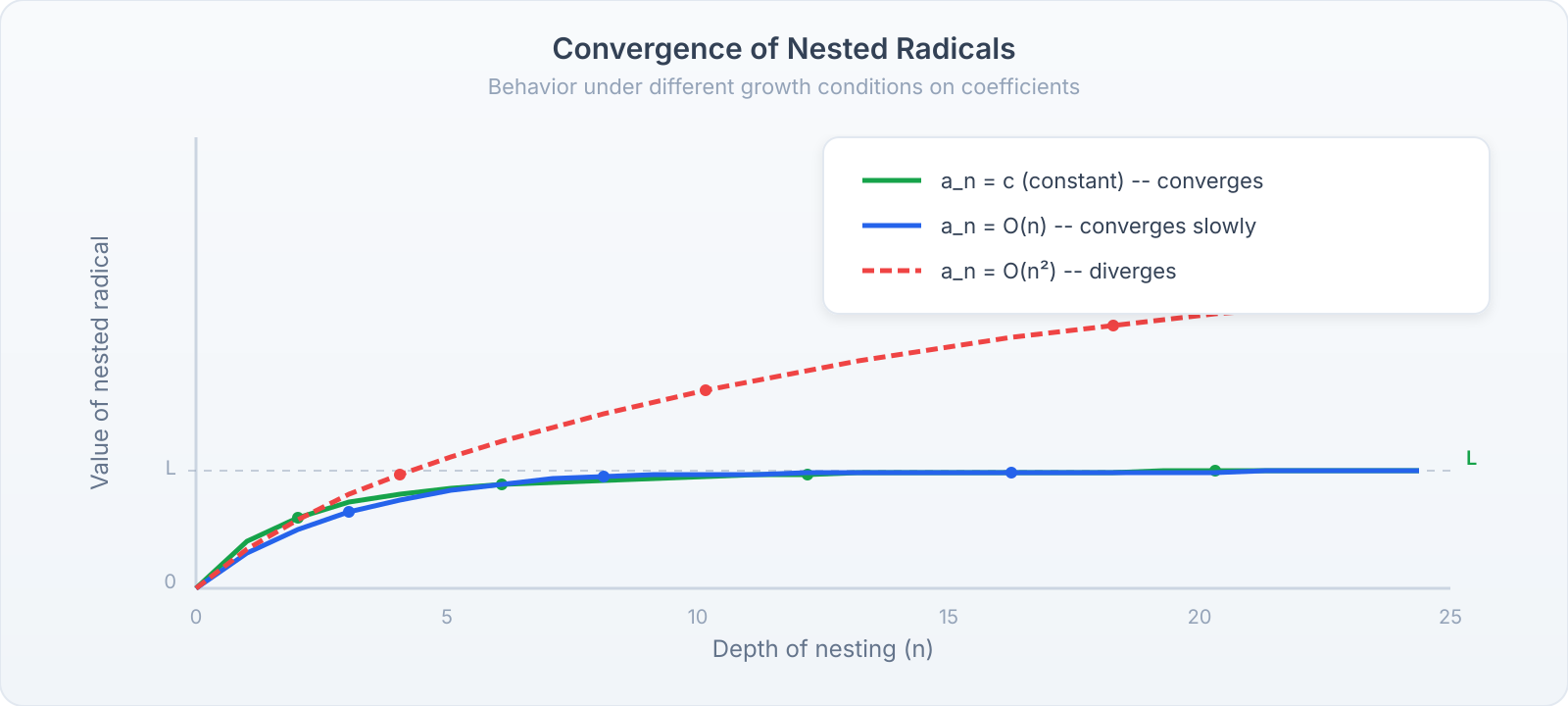
Corollary. If \( a_n = O(n^k) \) for some constant \( k \), then the nested radical converges.
Proof. For polynomial growth, \( a_n \leq Cn^k \) for some \( C > 0 \). Then:
$$ a_n^{2^{-n}} \leq (Cn^k)^{2^{-n}} = C^{2^{-n}} \cdot n^{k \cdot 2^{-n}} $$
As \( n \to \infty \): \( C^{2^{-n}} \to 1 \) and \( n^{k \cdot 2^{-n}} \to 1 \). Thus \( \limsup a_n^{2^{-n}} \leq 1 < \infty \). \( \square \)
Example. The nested radical \( \sqrt{1 + \sqrt{2 + \sqrt{3 + \sqrt{4 + \cdots}}}} \) converges because \( a_n = n \) satisfies Herschfeld’s condition. Its value is approximately \( 1.7579327566\ldots \), but no closed form is known.
The condition \( \limsup a_n^{2^{-n}} < \infty \) is equivalent to saying that the \( a_n \) grow at most doubly exponentially. Sequences like \( a_n = 2^{2^n} \) would be right at the boundary, while \( a_n = 2^{2^{2n}} \) would grow too fast for convergence.
Convergence of \( n \)th Degree Nested Radicals
For nested radicals involving \( n \)th roots:
$$ L = \sqrt[n]{a + \sqrt[n]{a + \sqrt[n]{a + \cdots}}} $$
Theorem. The \( n \)th degree constant nested radical converges to the unique positive root of:
$$ L^n – L – a = 0 $$
When \( n = 2 \), this reduces to \( L^2 – L – a = 0 \), confirming the formula \( L = (1 + \sqrt{1+4a})/2 \).
Viete’s Formula for \( \pi \)
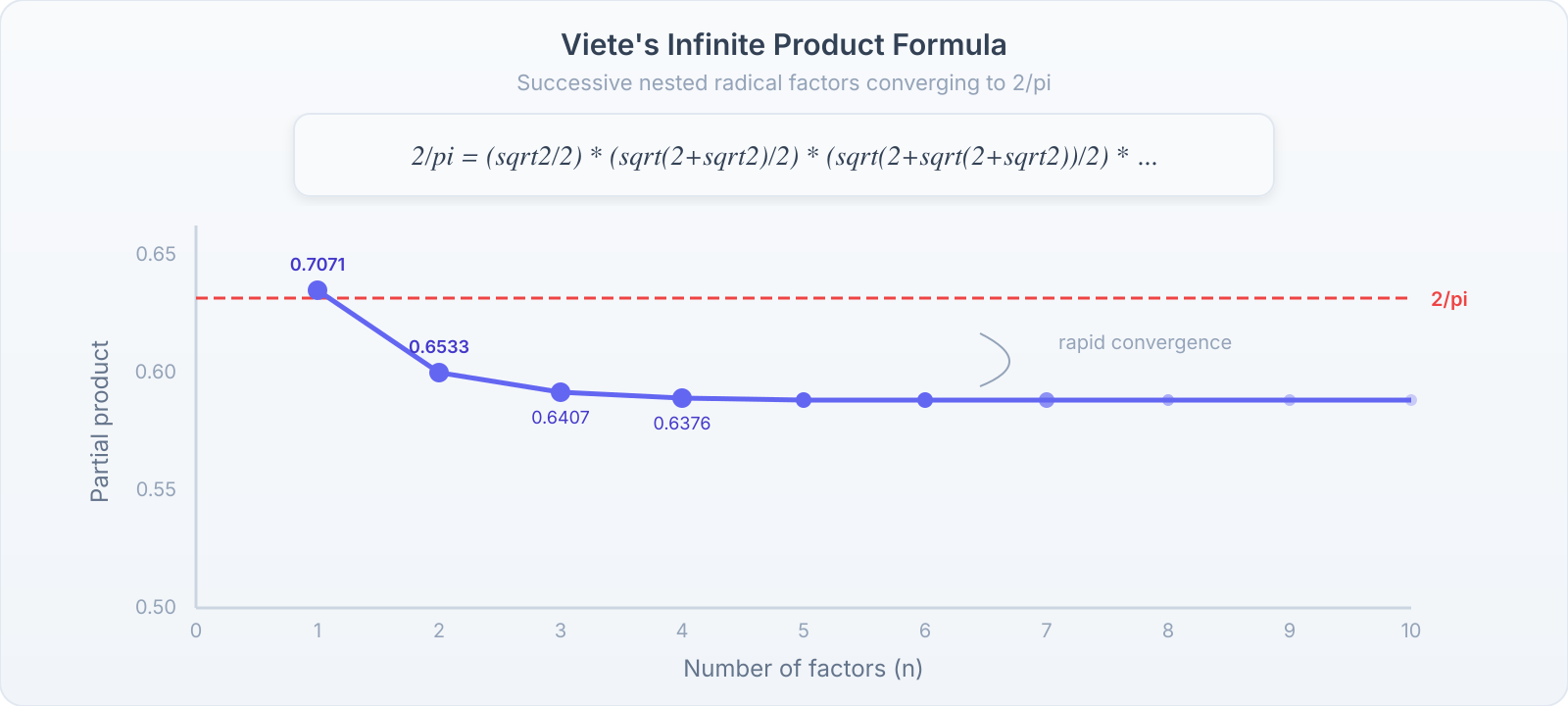
One of the most beautiful connections between nested radicals and fundamental constants is Viete’s formula, discovered in 1593:
$$ \frac{2}{\pi} = \frac{\sqrt{2}}{2} \cdot \frac{\sqrt{2 + \sqrt{2}}}{2} \cdot \frac{\sqrt{2 + \sqrt{2 + \sqrt{2}}}}{2} \cdots $$
This can be written as:
$$ \frac{2}{\pi} = \prod_{n=1}^{\infty} \frac{a_n}{2} $$
where \( a_1 = \sqrt{2} \) and \( a_{n+1} = \sqrt{2 + a_n} \).
Since \( a_n = 2\cos(\pi/2^{n+1}) \), we have:
$$ \frac{2}{\pi} = \prod_{n=1}^{\infty} \cos\left(\frac{\pi}{2^{n+1}}\right) $$
This identity connects nested radicals to \( \pi \) through trigonometry. The key observation is that the half-angle formula \( \cos(\theta/2) = \sqrt{(1 + \cos\theta)/2} \) produces nested radicals when iterated.
Algebraic Identities from Nested Radicals
From the convergence formula for the constant-coefficient case:
$$ \sqrt{a + b\sqrt{a + b\sqrt{a + \cdots}}} = \frac{b + \sqrt{b^2 + 4a}}{2} $$
we can derive many identities.
The Duality Formula
Setting \( a = b^2 \):
$$ \frac{b^2 + \sqrt{b^4 + 4b^2}}{2} = \frac{b^2 + b\sqrt{b^2 + 4}}{2} $$
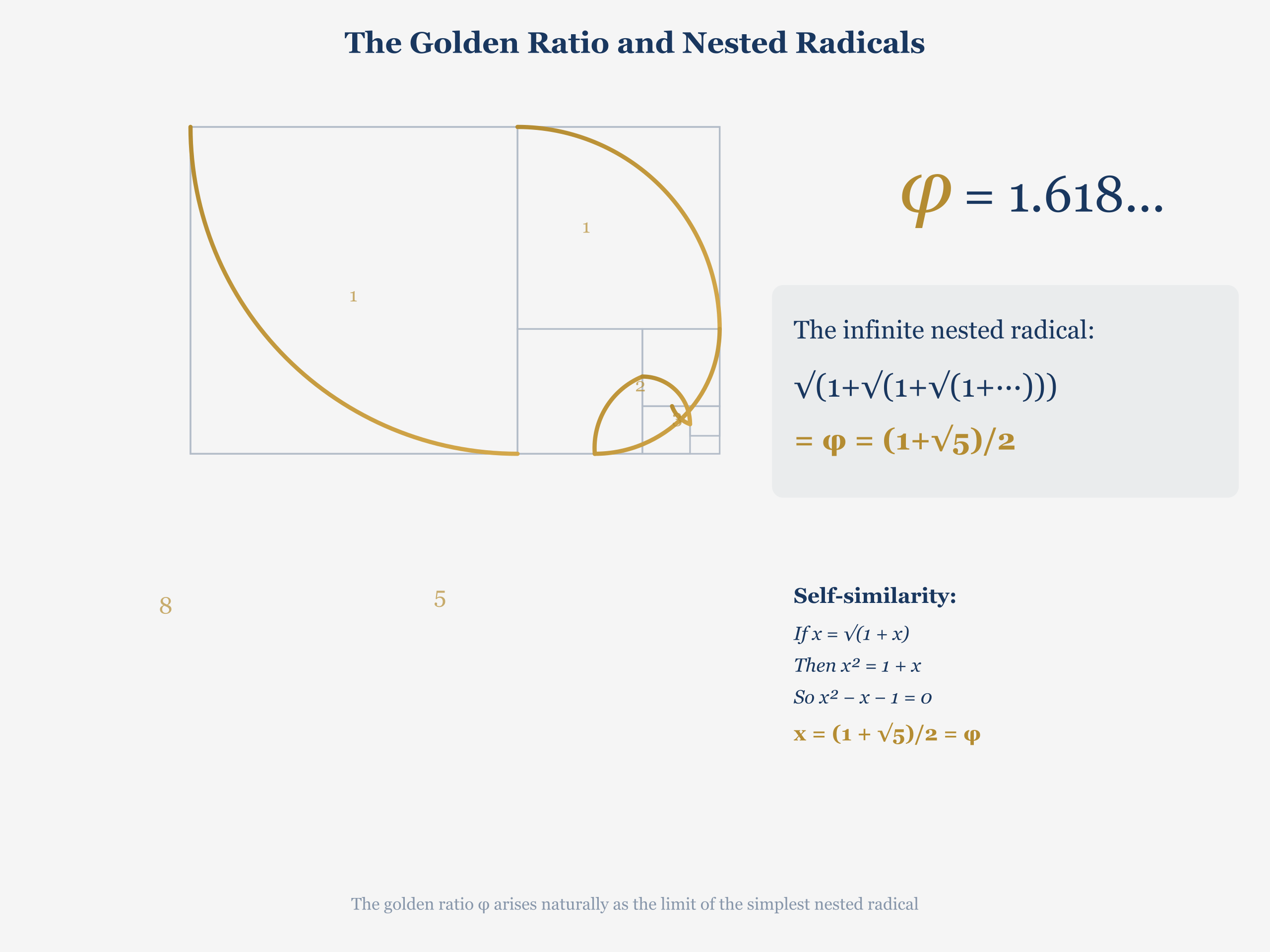
For \( b = 1 \): the nested radical \( \sqrt{1 + \sqrt{1 + \sqrt{1 + \cdots}}} = (1 + \sqrt{5})/2 = \varphi \).
For \( b = 2, a = 0 \): the nested radical \( \sqrt{0 + 2\sqrt{0 + 2\sqrt{\cdots}}} = \sqrt{2\sqrt{2\sqrt{2\cdots}}} \). By the geometric series argument:
$$ \sqrt{2\sqrt{2\sqrt{2\cdots}}} = 2^{1/2 + 1/4 + 1/8 + \cdots} = 2^1 = 2 $$
The Identity \( \sqrt{2} \) from Alternating Signs
An interesting variant:
$$ \sqrt{2} = \sqrt{2 – \sqrt{2 + \sqrt{2 + \sqrt{2 + \cdots}}}} $$
This follows because the inner part \( \sqrt{2 + \sqrt{2 + \cdots}} = 2 \), so the outer radical becomes \( \sqrt{2 – 2 + 2} = \sqrt{2} \). More precisely, one must be careful about the limiting argument.
Calculus of Nested Radicals
Functions Defined by Nested Radicals
Define the sequence of functions:
$$ \begin{aligned} f_0(x) &= k \quad \text{(constant)} \\ f_{n+1}(x) &= \sqrt{x + f_n(x)} \end{aligned} $$
Explicitly:
$$ \begin{aligned} f_1(x) &= \sqrt{x + k} \\ f_2(x) &= \sqrt{x + \sqrt{x + k}} \\ f_3(x) &= \sqrt{x + \sqrt{x + \sqrt{x + k}}} \\ &\;\;\vdots \\ f_n(x) &= \underbrace{\sqrt{x + \sqrt{x + \cdots + \sqrt{x + k}}}}_{n \text{ radicals}} \end{aligned} $$
Differentiability
Theorem. For \( x > 0 \) and \( k \geq 0 \), each \( f_n(x) \) is differentiable, and:
$$ f_n'(x) = \frac{1}{2f_n(x)}\left(1 + f_{n-1}'(x)\right) $$
with \( f_0′(x) = 0 \).
Proof. By the chain rule:
$$ f_{n+1}'(x) = \frac{d}{dx}\sqrt{x + f_n(x)} = \frac{1 + f_n'(x)}{2\sqrt{x + f_n(x)}} = \frac{1 + f_n'(x)}{2f_{n+1}(x)} \quad \square $$
Computing the first few derivatives:
$$ \begin{aligned} f_1'(x) &= \frac{1}{2\sqrt{x + k}} = \frac{1}{2f_1(x)} \\[8pt] f_2'(x) &= \frac{1}{2f_2(x)}\left(1 + \frac{1}{2f_1(x)}\right) \\[8pt] f_3'(x) &= \frac{1}{2f_3(x)}\left(1 + \frac{1}{2f_2(x)}\left(1 + \frac{1}{2f_1(x)}\right)\right) \end{aligned} $$
This generates a beautiful nested structure in the derivatives themselves!
Important: The general formula is:
$$ > f_n'(x) = \frac{1}{2f_n}\left(1 + \frac{1}{2f_{n-1}}\left(1 + \frac{1}{2f_{n-2}}\left(1 + \cdots + \frac{1}{2f_1}\right)\right)\right) > $$
The derivatives of nested radical functions are themselves “nested fractions”, a continued-fraction-like structure. This is a striking manifestation of the deep connection between nested radicals and continued fractions.
Integration
The antiderivatives become increasingly complex with depth.
Theorem. \( \displaystyle\int f_1(x)\,dx = \frac{2}{3}(x+k)^{3/2} + C \)
Proof. Direct integration: \( \int \sqrt{x + k}\,dx = \frac{2}{3}(x + k)^{3/2} + C \). \( \square \)
For \( f_2(x) = \sqrt{x + \sqrt{x + k}} \), the integral is considerably more complex. Setting \( k = 1 \), one obtains an expression involving the function values and logarithmic terms.
For \( n \geq 3 \), closed-form antiderivatives in terms of elementary functions are generally not available, though the functions remain integrable over any bounded interval.
The General \( k \)-Term Formula
For finite \( k \), the nested radical from Ramanujan’s identity takes the explicit form:
Important:
$$ > x + n + a = \sqrt{ax + (n+a)^2 + x\sqrt{a(x+n) + (n+a)^2 + (x+n)\sqrt{\cdots + (x+(k-2)n)\sqrt{R_k}}}} > $$where the innermost term is:
$$ > R_k = a(x + (k-1)n) + (n+a)^2 + (x + (k-1)n)(x + (k+1)n + a) > $$
This provides a finite verification tool: to check that the infinite nested radical converges to \( x + n + a \), one can compute \( R_k \) for each \( k \) and verify the truncated nested radical approaches the correct limit.
Numerical Values
The following table collects the values of several important nested radicals:
- Expression: \( \sqrt{1 + \sqrt{1 + \sqrt{1 + \cdots}}} \) | Approximate Value: \( 1.6180339887\ldots \) (golden ratio)
- Expression: \( \sqrt{2 + \sqrt{2 + \sqrt{2 + \cdots}}} \) | Approximate Value: \( 2.0000000000\ldots \)
- Expression: \( \sqrt{1 + \sqrt{2 + \sqrt{3 + \sqrt{4 + \cdots}}}} \) | Approximate Value: \( 1.7579327566\ldots \)
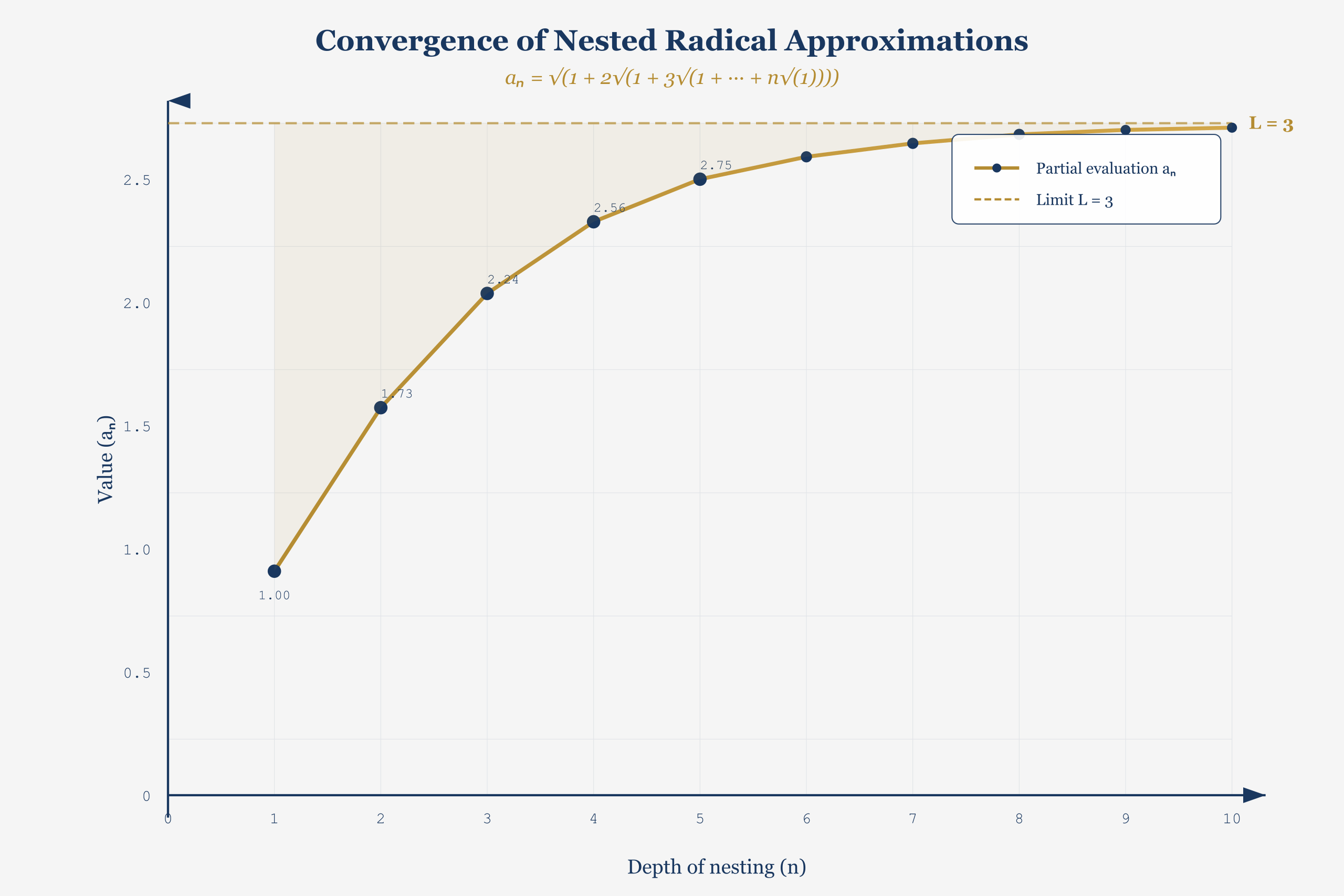
- Expression: \( \sqrt{1 + 2\sqrt{1 + 3\sqrt{1 + 4\sqrt{\cdots}}}} \) | Approximate Value: \( 3.0000000000\ldots \)
- Expression: \( \sqrt[3]{1 + \sqrt[3]{1 + \sqrt[3]{1 + \cdots}}} \) | Approximate Value: \( 1.3247179572\ldots \) (plastic constant)
Exercises
-
Using Herschfeld’s theorem, determine whether \( \sqrt{2^1 + \sqrt{2^2 + \sqrt{2^3 + \sqrt{2^4 + \cdots}}}} \) converges.
-
Using Herschfeld’s theorem, determine whether \( \sqrt{2^{2^1} + \sqrt{2^{2^2} + \sqrt{2^{2^3} + \cdots}}} \) converges.
-
Compute \( f_3′(1) \) where \( f_n(x) \) is the \( n \)-level nested radical with \( k = 1 \), i.e., \( f_3(x) = \sqrt{x + \sqrt{x + \sqrt{x + 1}}} \).
-
Verify that the first 5 partial products of Viete’s formula \( \frac{2}{\pi} = \prod \frac{a_n}{2} \) give an increasingly accurate approximation to \( 2/\pi \).
-
Find a closed form for \( \sqrt{12 + \sqrt{12 + \sqrt{12 + \cdots}}} \) and verify it satisfies the expected quadratic equation.
-
Use the recurrence \( f_{n+1}'(x) = (1 + f_n'(x))/(2f_{n+1}(x)) \) to show that \( f_n'(x) \) is a decreasing function of \( n \) for fixed \( x > 0 \) (assuming \( k = 0 \) for simplicity), and find its limit as \( n \to \infty \).
-
Compute the integral \( \int_0^1 \sqrt{x + \sqrt{x}}\,dx \) numerically (e.g., to 4 decimal places) and compare with the exact antiderivative.