
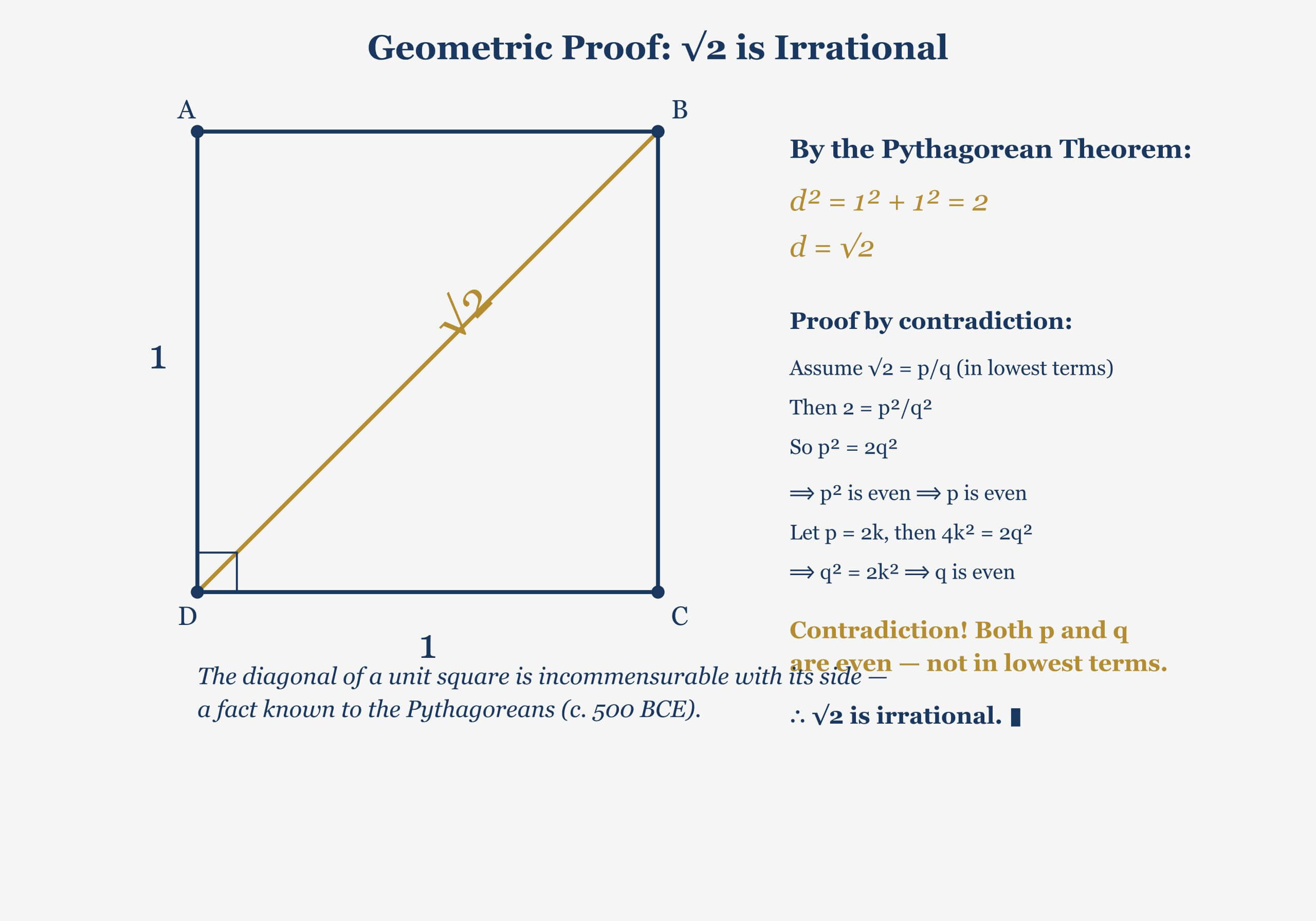
The discovery of irrational numbers is one of the great turning points in mathematical history. The Pythagoreans of ancient Greece (c. 500 BC) believed that all quantities could be expressed as ratios of whole numbers, that the universe was, at its core, a harmony of rational proportions. The discovery that the diagonal of a unit square has length \( \sqrt{2} \), which cannot be so expressed, shattered this worldview.
Legend holds that Hippasus of Metapontum was the Pythagorean who first proved the irrationality of \( \sqrt{2} \), and that his fellow Pythagoreans, horrified by the result, drowned him at sea. While this story is almost certainly apocryphal, it captures the genuine intellectual shock that irrational numbers produced.
The resolution of this crisis required centuries of mathematical development. Eudoxus of Cnidus (c. 400 BC) developed a theory of proportions that could handle incommensurable magnitudes. Euclid’s Elements (c. 300 BC) contains a proof of the irrationality of \( \sqrt{2} \) in Book X. Much later, Euler proved the irrationality of \( e \) in 1737, Lambert proved \( \pi \) irrational in 1761, and the 19th century brought the concepts of algebraic and transcendental numbers.
Foundations: Rational and Irrational Numbers
Before diving into proofs, we need precise definitions.
Definition (Rational Number). A real number \( x \) is rational if there exist integers \( a \) and \( b \) with \( b \neq 0 \) such that \( x = \dfrac{a}{b} \). The set of all rational numbers is denoted \( \mathbb{Q} \).
Definition (Lowest Terms). A fraction \( \dfrac{a}{b} \) is in lowest terms (or reduced form) if \( \gcd(a,b) = 1 \), meaning \( a \) and \( b \) are relatively prime. Every non-zero rational number has a unique representation in lowest terms with \( b > 0 \).
In formal notation:
$$ \frac{a}{b} \in \mathbb{Q} \iff a \in \mathbb{Z}, \quad b \in \mathbb{Z} \setminus \{0\}, \quad \gcd(a,b) = 1. $$
Definition (Irrational Number). A real number \( x \) is irrational if \( x \notin \mathbb{Q} \), that is, it cannot be expressed as a fraction of two integers, regardless of the choice of numerator and denominator.
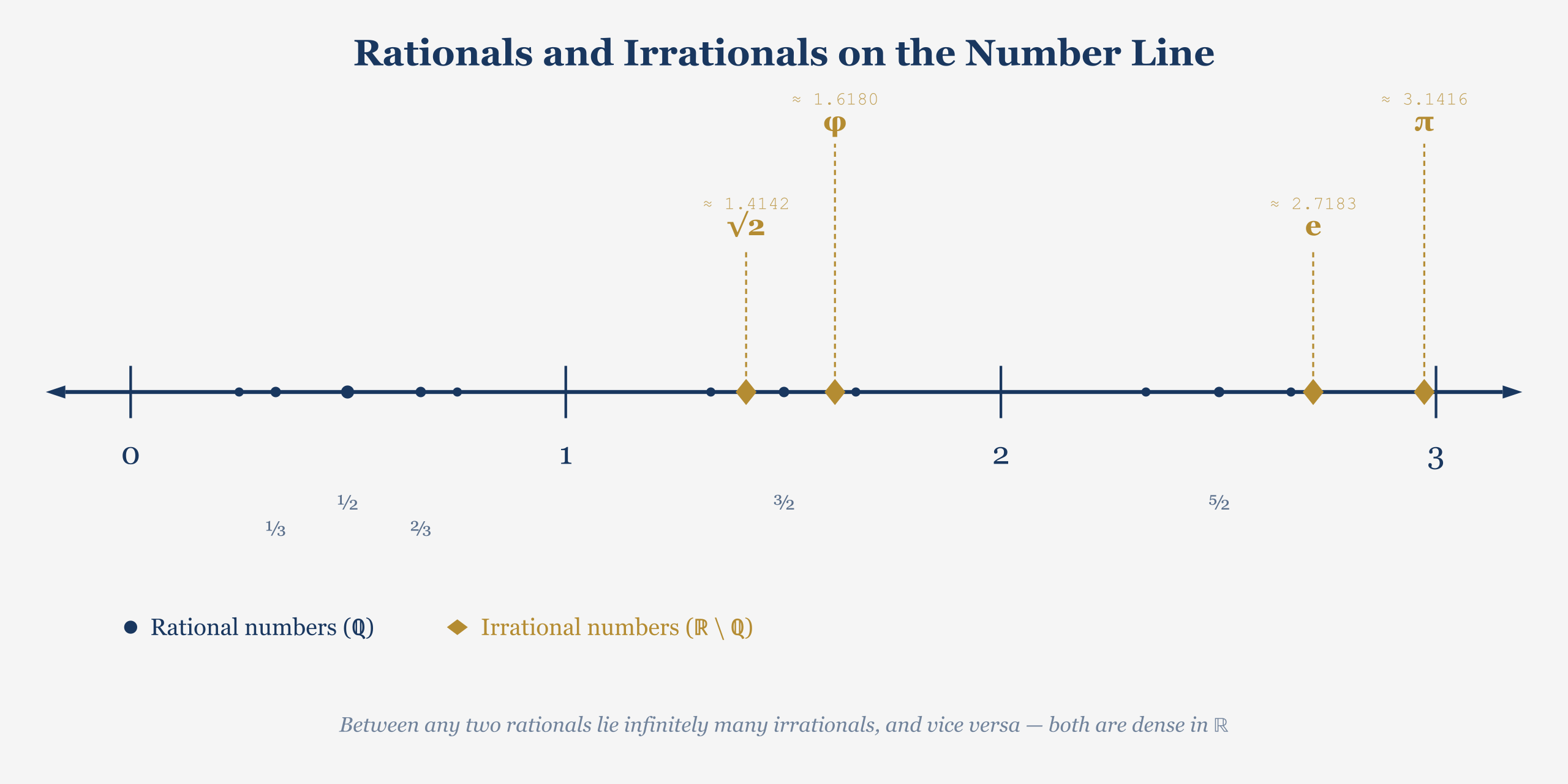
The decimal expansion of a rational number either terminates (e.g., \( 0.25 \)) or eventually becomes periodic (e.g., \( 0.333\ldots = 1/3 \)). The decimal expansion of an irrational number is infinite and non-repeating. However, one cannot prove irrationality by computing finitely many decimal places, since no matter how many digits one checks, one cannot rule out an eventual repetition.
The Density of Irrationals
Although the rationals are dense in \( \mathbb{R} \) (between any two real numbers lies a rational), the irrationals are far more numerous. In the sense of measure theory, the set \( \mathbb{Q} \) has Lebesgue measure zero, while the irrationals have full measure on any interval. In the sense of cardinality, \( \mathbb{Q} \) is countable whereas \( \mathbb{R} \setminus \mathbb{Q} \) is uncountable. Informally: if you pick a real number at random, it is irrational with probability 1.
The Core Strategy: Proof by Contradiction
Almost every irrationality proof uses the same overarching strategy:
Important: Proof by Contradiction (for Irrationality):
- Assume the number is rational: write \( x = \dfrac{a}{b} \) with \( a, b \in \mathbb{Z} \), \( b > 0 \), and \( \gcd(a,b) = 1 \).
- Manipulate this equation algebraically using properties specific to \( x \).
- Derive a contradiction, typically that \( a \) and \( b \) share a common factor, or that some quantity is simultaneously a positive integer and less than 1.
- Conclude the assumption was false: \( x \) is irrational.
The art lies in step 2. Different numbers require different tools for the algebraic manipulation. We explore four major families of techniques across these lessons.
Method 1: The Classical Pythagorean Proof
This is the oldest and most elementary family of irrationality proofs. It exploits the arithmetic of divisibility and the unique factorization of integers.
The Irrationality of \( \sqrt{2} \)
Theorem. \( \sqrt{2} \) is irrational.
Proof. Assume, for contradiction, that \( \sqrt{2} \) is rational. Then we can write
$$ \sqrt{2} = \frac{a}{b} $$
where \( a, b \) are positive integers with \( \gcd(a,b) = 1 \).
Squaring both sides:
$$ 2 = \frac{a^2}{b^2} \implies a^2 = 2b^2. $$
Since \( a^2 = 2b^2 \), the integer \( a^2 \) is even. But the square of an odd number is odd (if \( a = 2m+1 \), then \( a^2 = 4m^2 + 4m + 1 \), which is odd). Therefore \( a \) must be even: write \( a = 2k \) for some integer \( k \).
Substituting:
$$ (2k)^2 = 2b^2 \implies 4k^2 = 2b^2 \implies b^2 = 2k^2. $$
By the same reasoning, \( b^2 \) is even, so \( b \) is even.
But now both \( a \) and \( b \) are even, meaning \( \gcd(a,b) \geq 2 \). This contradicts our assumption that \( \gcd(a,b) = 1 \).
Therefore \( \sqrt{2} \) is irrational. \( \blacksquare \)
[Image: Geometric proof of the irrationality of sqrt(2): the diagonal of a unit square is incommensurable with its side]
An Alternative Proof via the Fundamental Theorem of Arithmetic
Theorem. \( \sqrt{2} \) is irrational.
Proof. Assume \( \sqrt{2} = a/b \) with \( \gcd(a,b) = 1 \) and \( a, b > 0 \). Then \( a^2 = 2b^2 \).
Since \( b > 1 \) (as \( b = 1 \) would force \( a = \sqrt{2} \), which is not an integer), \( b \) has at least one prime factor \( p \). Since \( p \mid b \) and \( b \mid a^2 \), we have \( p \mid a^2 \).
Lemma (Euclid’s Lemma). If \( p \) is prime and \( p \mid a^2 \), then \( p \mid a \).
By Euclid’s Lemma, \( p \mid a \). So \( p \) divides both \( a \) and \( b \), whence \( \gcd(a,b) \geq p > 1 \), a contradiction. \( \blacksquare \)
Proof of Euclid’s Lemma. If \( p \mid a^2 \) and \( p \nmid a \), then \( \gcd(p,a) = 1 \) (since \( p \) is prime). By the Fundamental Theorem of Arithmetic, \( a^2 = a \cdot a \) has a prime factorization in which \( p \) does not appear, contradicting \( p \mid a^2 \). \( \blacksquare \)
Generalization: \( \sqrt{n} \) for Non-Perfect Squares
Theorem. Let \( n \) be a positive integer that is not a perfect square. Then \( \sqrt{n} \) is irrational.
Proof. Assume \( \sqrt{n} = a/b \) with \( \gcd(a,b) = 1 \) and \( a, b > 0 \). Then \( a^2 = nb^2 \).
One can argue directly by comparing the exponent of a prime \( p \) in the prime factorizations of both sides of \( a^2 = nb^2 \). The left side has an even exponent of \( p \); the right side has the exponent of \( p \) in \( n \) (which is odd for some prime \( p \), since \( n \) is not a perfect square) plus an even number. An even number cannot equal an odd number, giving a contradiction. \( \blacksquare \)
Important: If \( n \) is not a perfect square, then in its prime factorization \( n = p_1^{e_1} p_2^{e_2} \cdots p_k^{e_k} \), at least one exponent \( e_i \) is odd. Comparing exponents in \( a^2 = nb^2 \) yields a parity contradiction.
Corollary. \( \sqrt{3} \), \( \sqrt{5} \), \( \sqrt{6} \), \( \sqrt{7} \), \( \sqrt{8} \), \( \sqrt{10} \), \( \sqrt{11} \), \( \sqrt{12} \), … are all irrational.
Irrationality of \( \sqrt{2} + \sqrt{3} \)
Theorem. \( \sqrt{2} + \sqrt{3} \) is irrational.
Proof. Suppose \( \sqrt{2} + \sqrt{3} = r \in \mathbb{Q} \). Then \( \sqrt{3} = r – \sqrt{2} \). Squaring:
$$ 3 = r^2 – 2r\sqrt{2} + 2 \implies \sqrt{2} = \frac{r^2 – 1}{2r}. $$
The right side is rational (since \( r \in \mathbb{Q} \)), but \( \sqrt{2} \) is irrational. Contradiction. \( \blacksquare \)
Irrationality of \( \log_2 3 \)
Theorem. \( \log_2 3 \) is irrational.
Proof. Suppose \( \log_2 3 = a/b \) with \( a, b \in \mathbb{Z} \) and \( b > 0 \). Then \( 2^{a/b} = 3 \), so \( 2^a = 3^b \).
But \( 2^a \) is even for all \( a \geq 1 \), while \( 3^b \) is odd for all \( b \geq 0 \). An even number cannot equal an odd number. Contradiction. \( \blacksquare \)
This argument generalizes: \( \log_p q \) is irrational whenever \( p \) and \( q \) are distinct primes. More generally, \( \log_a b \) is irrational when \( a \) and \( b \) are multiplicatively independent (neither is a rational power of the other).
Method 2: The Euclidean Algorithm and Bezout’s Identity
This method provides an elegant alternative to the Pythagorean approach, using a fundamental result from number theory.
Bezout’s Identity
Theorem (Bezout’s Identity). If \( \gcd(a,b) = 1 \), then there exist integers \( r \) and \( s \) such that
$$ ar + bs = 1. $$
The integers \( r \) and \( s \) can be computed using the extended Euclidean algorithm.
Irrationality of \( \sqrt{2} \) via Bezout
Theorem. \( \sqrt{2} \) is irrational.
Proof. Assume \( \sqrt{2} = a/b \) with \( \gcd(a,b) = 1 \) and \( a, b > 0 \).
By Bezout’s Identity, there exist integers \( r, s \) with \( ar + bs = 1 \).
Multiply both sides by \( \sqrt{2} \):
$$ \sqrt{2} = \sqrt{2}\,ar + \sqrt{2}\,bs. $$
From \( \sqrt{2} = a/b \), we have \( \sqrt{2}\,b = a \). Also, squaring gives \( a^2 = 2b^2 \), so \( \sqrt{2}\,a = a^2/b = 2b^2/b = 2b \).
Substituting:
$$ \sqrt{2} = 2b \cdot r + a \cdot s = 2br + as. $$
The right-hand side is an integer. So \( \sqrt{2} \) would be an integer. But \( 1^2 = 1 < 2 < 4 = 2^2 \), so \( 1 < \sqrt{2} < 2 \). There is no integer between 1 and 2.
Contradiction. Therefore \( \sqrt{2} \) is irrational. \( \blacksquare \)
This proof is particularly elegant because it avoids all even/odd analysis. It reduces the problem to the simple observation that \( \sqrt{2} \) is not an integer.
Generalization via Bezout’s Identity
Theorem. Let \( n \) be a positive integer that is not a perfect square. Then \( \sqrt{n} \) is irrational.
Proof. The same argument works. Assume \( \sqrt{n} = a/b \) with \( \gcd(a,b) = 1 \). By Bezout, \( ar + bs = 1 \) for some integers \( r, s \). Then:
$$ \sqrt{n} = \sqrt{n}\,ar + \sqrt{n}\,bs = \frac{a^2 r}{b} + as = \frac{nb^2 r}{b} + as = nbr + as \in \mathbb{Z}. $$
But if \( n \) is not a perfect square, \( \sqrt{n} \) is not an integer (since \( m^2 < n < (m+1)^2 \) for some non-negative integer \( m \)). Contradiction. \( \blacksquare \)
Method 3: Continued Fractions
Continued fractions provide both a powerful theoretical framework and a practical computational tool for studying irrationality.
Basic Definitions
Definition (Simple Continued Fraction). A simple continued fraction is an expression of the form:
$$ a_0 + \cfrac{1}{a_1 + \cfrac{1}{a_2 + \cfrac{1}{a_3 + \cfrac{1}{\ddots}}}} $$
where \( a_0 \in \mathbb{Z} \) and \( a_1, a_2, a_3, \ldots \) are positive integers. We write this compactly as \( [a_0; a_1, a_2, a_3, \ldots] \).
Definition (Convergents). The \( n \)-th convergent of a continued fraction \( [a_0; a_1, a_2, \ldots] \) is \( \frac{p_n}{q_n} = [a_0; a_1, a_2, \ldots, a_n] \), where \( p_n \) and \( q_n \) satisfy the recurrences:
$$ \begin{aligned} p_n &= a_n p_{n-1} + p_{n-2}, \qquad p_{-1} = 1, \quad p_0 = a_0, \\ q_n &= a_n q_{n-1} + q_{n-2}, \qquad q_{-1} = 0, \quad q_0 = 1. \end{aligned} $$
The Fundamental Theorem
Important: Theorem (Rationality and Continued Fractions). A real number is rational if and only if its simple continued fraction representation is finite. Equivalently: a real number is irrational if and only if its simple continued fraction is infinite.
This gives a clean irrationality test: show the continued fraction never terminates.
Continued Fraction of \( \sqrt{2} \)
Theorem. \( \sqrt{2} = [1; 2, 2, 2, 2, \ldots] = [1; \overline{2}] \).
Proof. Let \( x = \sqrt{2} – 1 \). Then \( 0 < x < 1 \) and:
$$ \frac{1}{x} = \frac{1}{\sqrt{2} – 1} = \frac{\sqrt{2} + 1}{(\sqrt{2})^2 – 1^2} = \sqrt{2} + 1 = 2 + x. $$
So \( 1/x = 2 + x \), meaning \( x = [0; 2, 2, 2, \ldots] \). Hence \( \sqrt{2} = 1 + x = [1; 2, 2, 2, \ldots] \).
Since this continued fraction is infinite, \( \sqrt{2} \) is irrational. \( \blacksquare \)
[Image: The continued fraction representation of sqrt(2) = [1; 2-repeating], showing successive convergents approaching the true value]
Quadratic Irrationals and Periodicity
Theorem (Lagrange, 1770). A real number has an eventually periodic simple continued fraction if and only if it is a quadratic irrational, that is, an irrational root of a quadratic equation with integer coefficients.
Some examples of periodic continued fractions:
$$ \begin{aligned} \sqrt{2} &= [1; \overline{2}] \\ \sqrt{3} &= [1; \overline{1, 2}] \\ \sqrt{5} &= [2; \overline{4}] \\ \varphi = \frac{1+\sqrt{5}}{2} &= [1; \overline{1}] \\ \sqrt{7} &= [2; \overline{1, 1, 1, 4}] \end{aligned} $$
The overline denotes the repeating block.
The golden ratio \( \varphi = [1; 1, 1, 1, \ldots] \) has the simplest possible infinite continued fraction, with all partial quotients equal to 1. This makes it the “most irrational” number in a precise sense: its convergents approach the true value more slowly than for any other irrational number.
The Irrationality of the Golden Ratio
Definition (Golden Ratio). The golden ratio is defined as
$$ \varphi = \frac{1 + \sqrt{5}}{2} \approx 1.6180339887\ldots $$
It is the positive root of \( x^2 – x – 1 = 0 \).
[Image: The golden rectangle: removing a square leaves a smaller rectangle with the same proportions]
Theorem. The golden ratio \( \varphi \) is irrational.
Proof 1 (from \( \sqrt{5} \)). Since \( \varphi = (1 + \sqrt{5})/2 \) and \( \sqrt{5} \) is irrational (as a non-perfect square), \( \varphi \) is irrational. If \( \varphi \) were rational, then \( \sqrt{5} = 2\varphi – 1 \) would be rational, a contradiction. \( \blacksquare \)
Proof 2 (via continued fraction). \( \varphi = [1; 1, 1, 1, \ldots] \) is an infinite continued fraction, hence irrational. \( \blacksquare \)
Proof 3 (direct). Suppose \( \varphi = a/b \) with \( \gcd(a,b) = 1 \) and \( a, b > 0 \). From \( \varphi^2 = \varphi + 1 \):
$$ \frac{a^2}{b^2} = \frac{a + b}{b} \implies a^2 = b(a + b). $$
So \( b \mid a^2 \). Since \( \gcd(a,b) = 1 \), by Euclid’s Lemma, \( b \mid 1 \), so \( b = 1 \).
Then \( a^2 = a + 1 \), giving \( a^2 – a – 1 = 0 \). The discriminant is \( 1 + 4 = 5 \), which is not a perfect square. So there is no integer solution for \( a \). Contradiction. \( \blacksquare \)
Which Method Should You Use?
-
Number: \( \sqrt{n} \) (non-perfect square) | Best Method: Pythagorean | Key Idea: Parity / prime divisibility
-
Number: \( \log_p q \) (\( p,q \) distinct primes) | Best Method: Pythagorean | Key Idea: Unique factorization
-
Number: \( \sqrt{2} + \sqrt{3} \) | Best Method: Algebraic manipulation | Key Idea: Reduce to known irrational
-
Number: Quadratic irrationals | Best Method: Continued fractions | Key Idea: Periodicity
-
Number: General algebraic irrationals | Best Method: Continued fractions | Key Idea: Non-termination
A Timeline of Irrationality Proofs
-
Year: c. 500 BC | Mathematician: Hippasus (attributed) | Result: \( \sqrt{2} \) is irrational
-
Year: c. 300 BC | Mathematician: Euclid | Result: \( \sqrt{2} \) (in Elements, Book X)
-
Year: 1737 | Mathematician: Euler | Result: \( e \) is irrational
-
Year: 1761 | Mathematician: Lambert | Result: \( \pi \) is irrational
-
Year: 1815 | Mathematician: Fourier | Result: \( e \) is irrational (series method)
-
Year: 1840 | Mathematician: Liouville | Result: First transcendental number
-
Year: 1873 | Mathematician: Hermite | Result: \( e \) is transcendental
-
Year: 1882 | Mathematician: Lindemann | Result: \( \pi \) is transcendental
-
Year: 1947 | Mathematician: Niven | Result: \( \pi \) is irrational (elementary proof)
Exercises
-
Prove that \( \sqrt{3} \) is irrational using the classical Pythagorean method. (Hint: if \( a^2 = 3b^2 \), what can you say about divisibility by 3?)
-
Use Bezout’s Identity to prove that \( \sqrt{3} \) is irrational. Verify that the argument reduces to showing \( \sqrt{3} \) is not an integer.
-
Prove that \( \sqrt{2} \cdot \sqrt{3} = \sqrt{6} \) is irrational.
-
Compute the first five convergents of the continued fraction \( \sqrt{2} = [1; 2, 2, 2, \ldots] \). Verify that they alternate between being less than and greater than \( \sqrt{2} \).
-
Prove that \( \log_3 5 \) is irrational using a divisibility argument similar to the proof for \( \log_2 3 \).
-
Is \( \sqrt{2} + \sqrt{5} \) irrational? Prove your answer.
-
Show that the golden ratio satisfies \( \varphi = 1 + 1/\varphi \), and use this to derive its continued fraction representation \( [1; 1, 1, 1, \ldots] \).
-
Prove that \( \sqrt[3]{2} \) is irrational. (Hint: adapt the Pythagorean method, using divisibility by the prime 2 and comparing exponents in \( a^3 = 2b^3 \).)