
Not all irrational numbers are created equal. Some, like \( \sqrt{2} \), resist rational approximation with a kind of algebraic stubbornness. Others can be approximated astonishingly well by simple fractions. The concept of irrationality measure makes this intuition precise, and Liouville numbers represent the extreme: numbers so well-approximated by rationals that they cannot be algebraic at all.
This lesson bridges the gap between irrationality and transcendence. Liouville’s insight that “too much approximability implies transcendence” gave us the first explicit transcendental number in 1844, decades before Hermite and Lindemann tackled \( e \) and \( \pi \).
Algebraic vs. Transcendental Numbers
Before discussing irrationality measure, we need the key distinction between two types of irrational numbers.
Algebraic Numbers
Definition (Algebraic Number). A real number \( \alpha \) is algebraic if it is a root of some nonzero polynomial with integer (equivalently, rational) coefficients:
$$ c_n \alpha^n + c_{n-1}\alpha^{n-1} + \cdots + c_1 \alpha + c_0 = 0, \qquad c_i \in \mathbb{Z}, \quad c_n \neq 0. $$
The minimum degree of such a polynomial is called the degree of \( \alpha \).
Examples:
- Every rational number \( r = p/q \) is algebraic of degree 1, being a root of \( qx – p = 0 \).
- \( \sqrt{2} \) is algebraic of degree 2: it satisfies \( x^2 – 2 = 0 \).
- \( \sqrt[3]{2} \) is algebraic of degree 3: it satisfies \( x^3 – 2 = 0 \).
- The golden ratio \( \varphi = (1+\sqrt{5})/2 \) is algebraic of degree 2: it satisfies \( x^2 – x – 1 = 0 \).
Transcendental Numbers
Definition (Transcendental Number). A real number is transcendental if it is not algebraic, that is, it is not the root of any polynomial with integer coefficients.
Important: Hierarchy:
$$ > \text{Transcendental} \;\subset\; \text{Irrational} \;\subset\; \mathbb{R}. > $$Every transcendental number is irrational, but not every irrational number is transcendental.
Examples:
- \( \sqrt{2} \) is algebraic (degree 2), hence irrational but **not** transcendental.
- \( e \) is transcendental (Hermite, 1873).
- \( \pi \) is transcendental (Lindemann, 1882).
Lindemann’s proof that \( \pi \) is transcendental also settled the ancient Greek problem of “squaring the circle”: constructing a square with the same area as a given circle using compass and straightedge. Since only algebraic numbers (of degree a power of 2) are constructible, and \( \pi \) is transcendental, squaring the circle is impossible.
Irrationality Measure
The Definition
Definition (Irrationality Measure). The irrationality measure (or irrationality exponent) of a real number \( \alpha \) is
$$ \mu(\alpha) = \inf\left\{\mu \geq 1 : \left|\alpha – \frac{p}{q}\right| > \frac{1}{q^{\mu}} \text{ for all but finitely many } \frac{p}{q}\right\}. $$
In words: \( \mu(\alpha) \) is the threshold exponent below which \( \alpha \) cannot be “too well” approximated by rationals. The larger \( \mu(\alpha) \), the better \( \alpha \) can be approximated.
Key Results
Theorem. The irrationality measure satisfies:
- If \( \alpha \) is rational, then \( \mu(\alpha) = 1 \).
- If \( \alpha \) is algebraic and irrational, then \( \mu(\alpha) = 2 \) (Roth’s theorem, 1955).
- \( \mu(e) = 2 \).
- \( \mu(\pi) \leq 7.6063\ldots \) (Zeilberger and Zudilin, 2020).
- Liouville numbers have \( \mu = \infty \).
The irrationality measure quantifies “how irrational” a number is. Rational numbers are perfectly approximable (measure 1). Most irrational numbers, both algebraic and transcendental, have measure 2. Numbers with high irrationality measure are exceptionally well-approximable by rationals.
Roth’s Theorem
Theorem (Roth, 1955). Let \( \alpha \) be an algebraic irrational number. For any \( \varepsilon > 0 \), there exist only finitely many rationals \( p/q \) satisfying
$$ \left|\alpha – \frac{p}{q}\right| < \frac{1}{q^{2+\varepsilon}}. $$
This is best possible: by Dirichlet’s approximation theorem, every irrational number has infinitely many rational approximations with \( |\alpha – p/q| < 1/q^2 \).
Roth received the Fields Medal in 1958 for this achievement. His theorem says that all algebraic irrationals have irrationality measure exactly 2, the smallest possible value for any irrational number. Transcendental numbers, by contrast, can have any irrationality measure \( \geq 2 \).
The Remarkable Case of e
The fact that \( \mu(e) = 2 \) is noteworthy. Despite being transcendental, \( e \) behaves like an algebraic number in terms of how well it can be approximated by rationals. The beautiful pattern in its continued fraction \( [2; 1, 2, 1, 1, 4, 1, 1, 6, \ldots] \) is directly responsible: the partial quotients grow only linearly, which is slow enough to keep the irrationality measure at 2.
The Mysterious Case of Pi
In contrast, the best known bound for \( \pi \) is \( \mu(\pi) \leq 7.6063 \). Most mathematicians believe the true value is \( \mu(\pi) = 2 \), but proving this remains an open problem. The continued fraction \( [3; 7, 15, 1, 292, \ldots] \) of \( \pi \) shows no discernible pattern, making it very hard to establish tight approximation bounds.
Liouville’s Approximation Theorem
The bridge between rational approximation and transcendence was built by Joseph Liouville in 1844.
The Theorem
Theorem (Liouville’s Approximation Theorem, 1844). Let \( \alpha \) be a real algebraic number of degree \( n \geq 2 \). Then there exists a constant \( c = c(\alpha) > 0 \) such that for all integers \( p \) and \( q \) with \( q > 0 \),
$$ \left|\alpha – \frac{p}{q}\right| > \frac{c}{q^n}. $$
In words: algebraic numbers of degree \( n \) cannot be approximated by rationals better than \( 1/q^n \) (up to a constant). The higher the degree, the more “room” there is for approximation, but there is always a definite barrier.
The Proof
Proof. Let \( f(x) = a_n x^n + a_{n-1}x^{n-1} + \cdots + a_0 \in \mathbb{Z}[x] \) be the minimal polynomial of \( \alpha \), so \( f(\alpha) = 0 \) and \( \deg f = n \).
Step 1: Bounding \( |f(p/q)| \) from below.
For any rational \( p/q \) with \( q > 0 \) and \( p/q \neq \alpha \), we compute
$$ f\!\left(\frac{p}{q}\right) = a_n \frac{p^n}{q^n} + a_{n-1}\frac{p^{n-1}}{q^{n-1}} + \cdots + a_0. $$
Multiplying by \( q^n \):
$$ q^n f\!\left(\frac{p}{q}\right) = a_n p^n + a_{n-1}p^{n-1}q + \cdots + a_0 q^n \in \mathbb{Z}. $$
Since \( f \) is the minimal polynomial of \( \alpha \) and \( \alpha \) is irrational (\( n \geq 2 \)), we have \( f(p/q) \neq 0 \). Since \( q^n f(p/q) \) is a nonzero integer:
$$ \left|f\!\left(\frac{p}{q}\right)\right| \geq \frac{1}{q^n}. $$
Step 2: Applying the Mean Value Theorem.
By the Mean Value Theorem, there exists \( \xi \) between \( \alpha \) and \( p/q \) such that
$$ f\!\left(\frac{p}{q}\right) – f(\alpha) = f'(\xi) \cdot \left(\frac{p}{q} – \alpha\right). $$
Since \( f(\alpha) = 0 \):
$$ f\!\left(\frac{p}{q}\right) = f'(\xi)\cdot\left(\frac{p}{q} – \alpha\right). $$
Step 3: Bounding \( |f'(\xi)| \) from above.
We restrict attention to rationals \( p/q \) satisfying \( |p/q – \alpha| \leq 1 \) (for those farther away, the theorem is trivial). Then \( \xi \) lies in \( [\alpha – 1, \alpha + 1] \), and we set
$$ M = \max_{|x – \alpha| \leq 1} |f'(x)|. $$
This maximum exists and is finite since \( f’ \) is continuous on a compact interval, and \( M > 0 \) since \( \alpha \) is a simple root of \( f \).
Step 4: Combining the bounds.
From Steps 1 and 2:
$$ \frac{1}{q^n} \leq \left|f\!\left(\frac{p}{q}\right)\right| = |f'(\xi)|\cdot\left|\frac{p}{q} – \alpha\right| \leq M \left|\frac{p}{q} – \alpha\right|. $$
Therefore:
$$ \left|\alpha – \frac{p}{q}\right| \geq \frac{1}{M q^n}. $$
Setting \( c = \min(1, 1/M) \) completes the proof. \( \blacksquare \)
Improvements After Liouville
The exponent \( n \) in Liouville’s theorem is not optimal. A series of improvements culminated in Roth’s best-possible result:
- Year: 1844 | Mathematician: Liouville | Exponent bound: \( n \)
- Year: 1909 | Mathematician: Thue | Exponent bound: \( n/2 + 1 \)
- Year: 1921 | Mathematician: Siegel | Exponent bound: \( 2\sqrt{n} \)
- Year: 1947 | Mathematician: Dyson | Exponent bound: \( \sqrt{2n} \)
- Year: 1955 | Mathematician: Roth | Exponent bound: \( 2 + \varepsilon \) (best possible)
Roth’s theorem is best possible because Dirichlet’s theorem guarantees infinitely many approximations at the exponent 2.
Liouville Numbers
The contrapositive of Liouville’s Approximation Theorem gives us a tool to prove transcendence: if a number can be approximated “too well” by rationals, it cannot be algebraic.
The Definition
Definition (Liouville Number). A real number \( \alpha \) is a Liouville number if for every positive integer \( n \), there exist integers \( p \) and \( q \) with \( q > 1 \) such that
$$ 0 < \left|\alpha – \frac{p}{q}\right| < \frac{1}{q^n}. $$
Liouville Numbers Are Transcendental
Theorem (Liouville, 1844). Every Liouville number is transcendental.
Proof. Suppose, for contradiction, that \( \alpha \) is a Liouville number that is algebraic of degree \( d \geq 1 \).
Case \( d = 1 \): Then \( \alpha \) is rational, say \( \alpha = a/b \). For \( p/q \neq a/b \):
$$ \left|\alpha – \frac{p}{q}\right| = \left|\frac{a}{b} – \frac{p}{q}\right| = \frac{|aq – bp|}{bq} \geq \frac{1}{bq}. $$
But the Liouville condition requires \( |\alpha – p/q| < 1/q^n \) for every \( n \). Taking \( n \geq 2 \) and \( q \) large, we need \( 1/(bq) < 1/q^n \), i.e., \( q^{n-1} < b \), which fails for large \( q \). Contradiction.
Case \( d \geq 2 \): Liouville’s Approximation Theorem gives a constant \( c > 0 \) such that
$$ \left|\alpha – \frac{p}{q}\right| > \frac{c}{q^d} $$
for all rationals \( p/q \). But since \( \alpha \) is a Liouville number, for \( n > d \) we can find \( p/q \) with
$$ \left|\alpha – \frac{p}{q}\right| < \frac{1}{q^n} \leq \frac{1}{q^{d+1}}. $$
For \( q \) sufficiently large, \( 1/q^{d+1} < c/q^d \) (since this simplifies to \( 1/q < c \)), giving a contradiction. \( \blacksquare \)
The Liouville Constant: The First Transcendental Number
Construction
Theorem (Liouville, 1844). The number
$$ L = \sum_{k=1}^{\infty} 10^{-k!} = 10^{-1} + 10^{-2} + 10^{-6} + 10^{-24} + 10^{-120} + \cdots $$
is transcendental.
In decimal:
$$ L = 0.110001000000000000000001000\ldots $$
where the 1’s appear at positions \( 1!, 2!, 3!, 4!, \ldots = 1, 2, 6, 24, 120, \ldots \) and all other digits are 0.
The Proof
Proof. We show that \( L \) is a Liouville number, hence transcendental.
Let \( n \) be any positive integer. Define
$$ \frac{p_n}{q_n} = \sum_{k=1}^{n} 10^{-k!}, \quad \text{where } q_n = 10^{n!}. $$
Then \( p_n/q_n \) is a rational approximation to \( L \), and
$$ 0 < L – \frac{p_n}{q_n} = \sum_{k=n+1}^{\infty} 10^{-k!}. $$
We bound this remainder. Since \( (n+1)! = (n+1) \cdot n! \) and subsequent factorials grow even faster:
$$ \sum_{k=n+1}^{\infty} 10^{-k!} < 10^{-(n+1)!} \cdot \sum_{j=0}^{\infty} 10^{-j} = \frac{10^{-(n+1)!} \cdot 10}{9} < 2 \cdot 10^{-(n+1)!}. $$
Now \( q_n = 10^{n!} \), so \( q_n^{n+1} = 10^{(n+1) \cdot n!} = 10^{(n+1)!} \). Therefore:
$$ L – \frac{p_n}{q_n} < \frac{2}{q_n^{n+1}} < \frac{1}{q_n^n} $$
for \( q_n \) sufficiently large (which holds for all \( n \geq 1 \) since \( q_n \geq 10 \)). Since \( n \) was arbitrary, \( L \) is a Liouville number and hence transcendental. \( \blacksquare \)
Important: Liouville’s constant \( L = \sum_{k=1}^{\infty} 10^{-k!} \) was the first number proven to be transcendental (1844). The proof uses no advanced analysis, only the fact that algebraic numbers resist rational approximation.
Other Liouville Numbers
Other examples of Liouville numbers include:
- \( \sum_{k=1}^{\infty} 2^{-k!} \), replacing base 10 with base 2.
- \( \sum_{k=1}^{\infty} 10^{-2^k} \), which also admits extremely good rational approximations.
- Any number of the form \( \sum_{k=1}^{\infty} a_k \cdot b^{-k!} \) where \( b \geq 2 \) is an integer and \( a_k \in \{1, 2, \ldots, b-1\} \) for infinitely many \( k \).
Constructing Your Own Transcendental Numbers
Liouville’s theorem gives a recipe for manufacturing transcendental numbers. The key insight is: make the digits sparse enough that the partial sums provide extraordinarily good rational approximations.
For instance, define a number by placing the digit 1 at positions \( 1, 2, 6, 24, 120, 720, \ldots \) (the factorials) and 0 everywhere else. The gaps between consecutive 1’s grow so fast that truncating after any factorial position gives a rational approximation that is “too good” for any algebraic number.
You can vary this construction freely:
- Use any base \( b \geq 2 \).
- Use any nonzero digits (not just 1).
- Use any sequence of positions that grows faster than any polynomial (factorials, tower functions, etc.).
The essential requirement is that the gaps between nonzero digits grow faster than any fixed power, ensuring the Liouville condition holds for every \( n \).
Summary of Key Irrationality Results
- Number: \( \sqrt{2} \) | Status: Irrational, algebraic | Method: Pythagorean | First Proved By: Pythagoreans (c. 500 BC)
- Number: \( \sqrt{n} \) (non-p.s.) | Status: Irrational, algebraic | Method: Pythagorean | First Proved By: Euclid (c. 300 BC)
- Number: \( \varphi \) | Status: Irrational, algebraic | Method: Multiple | First Proved By: Ancient
- Number: \( e \) | Status: Irrational, transcendental | Method: Series / CF | First Proved By: Euler (1737)
- Number: \( \pi \) | Status: Irrational, transcendental | Method: CF / Integral | First Proved By: Lambert (1761)
- Number: \( \log_2 3 \) | Status: Irrational, transcendental | Method: Pythagorean | First Proved By: Folklore
- Number: \( e^2 \) | Status: Irrational, transcendental | Method: Series | First Proved By: Euler (1737)
- Number: \( \sqrt{2} + \sqrt{3} \) | Status: Irrational, algebraic | Method: Algebraic | First Proved By: Elementary
- Number: \( L \) (Liouville) | Status: Transcendental | Method: Approximation | First Proved By: Liouville (1844)
- Number: \( \gamma \) | Status: Unknown! | Method: — | First Proved By: —
- Number: \( \pi + e \) | Status: Unknown! | Method: — | First Proved By: —
Exercises
-
Prove that the number \( \alpha = \sum_{k=1}^{\infty} 2^{-k!} \) is a Liouville number. (Adapt the proof for Liouville’s constant, replacing base 10 with base 2.)
-
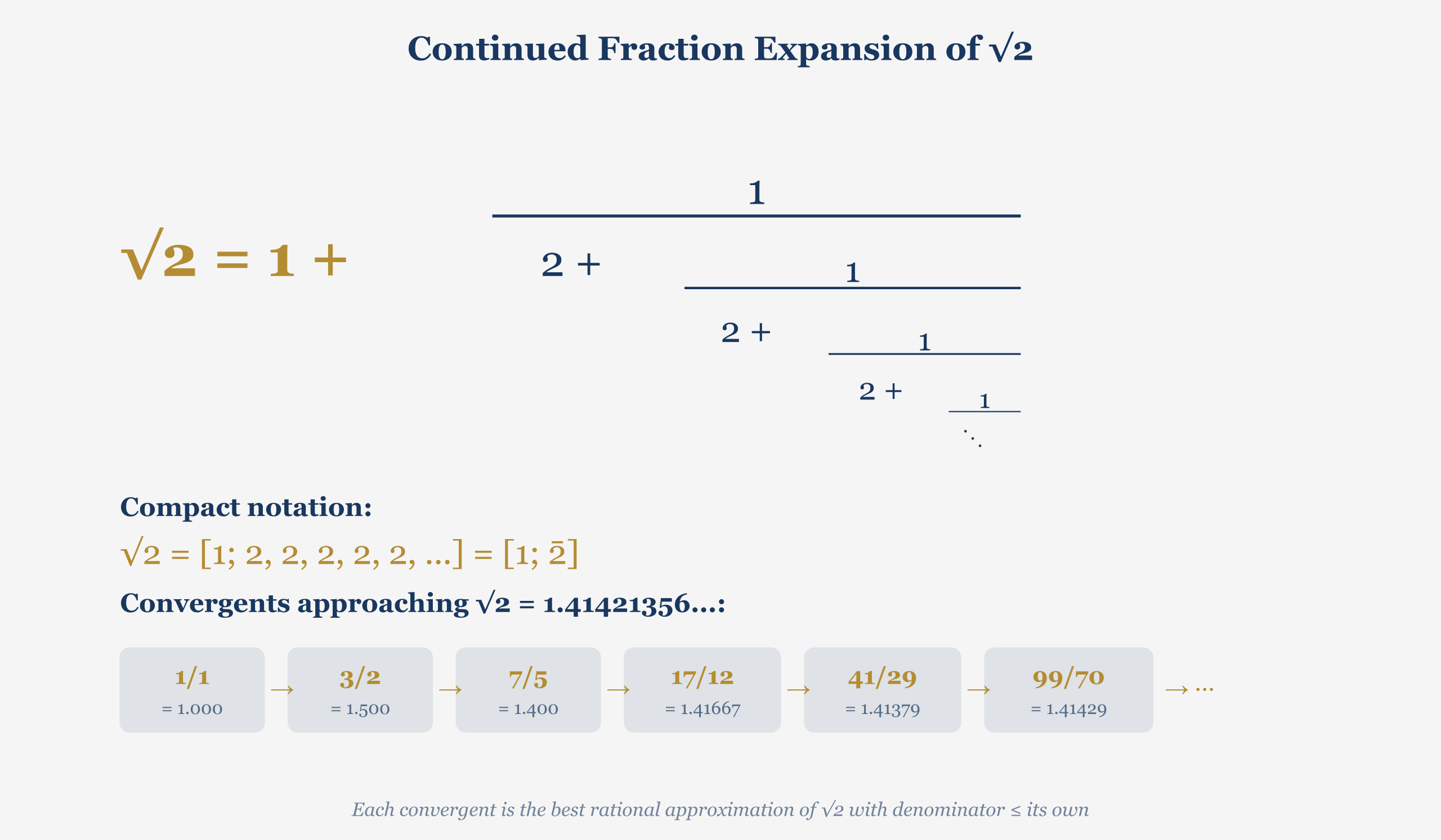
Let \( \alpha = \sqrt{2} \). The best rational approximations to \( \sqrt{2} \) satisfy \( |\sqrt{2} – p/q| \approx 1/(2q^2) \) (from continued fractions). Use this to argue that \( \mu(\sqrt{2}) = 2 \), consistent with Roth’s theorem.
-
Explain why Liouville’s theorem cannot prove that \( e \) is transcendental. (Hint: what is the irrationality measure of \( e \)?)
-
Construct a Liouville number in base 3 and prove it is transcendental.
-
The Liouville constant has digits that are either 0 or 1. Construct a transcendental number whose decimal digits are either 0 or 7, and prove it is transcendental using the Liouville criterion.
-
Prove that the set of Liouville numbers has Lebesgue measure zero. (Hint: for each \( n \), the Liouville condition with exponent \( n \) constrains \( \alpha \) to lie in a union of small intervals around rationals \( p/q \). Show the total length of these intervals goes to zero.)
-
Using Liouville’s Approximation Theorem with \( n = 2 \), show that \( \sqrt{2} \) cannot be approximated by rationals better than \( c/q^2 \) for some constant \( c > 0 \). Find an explicit value of \( c \).
-
Why is \( \mu(\alpha) \geq 2 \) for every irrational number \( \alpha \)? (Hint: use Dirichlet’s approximation theorem, which states that for any irrational \( \alpha \) and any \( Q > 0 \), there exists \( p/q \) with \( 1 \leq q \leq Q \) and \( |\alpha – p/q| < 1/(qQ) \).)