
The Lilavati of Bhaskaracharya (Bhaskara II, 1114-1185 CE) is one of the most celebrated mathematical texts of the ancient world. Written in 1150 CE as the first volume of the Siddhanta Shiromani, it wraps arithmetic, algebra, and geometry inside riddles about bees, snakes, peacocks, and beautiful maidens. In this lesson, we meet Bhaskaracharya, explore his verse-based problems, and work through the arithmetic methods that made the Lilavati a standard textbook for over 800 years.
Bhaskaracharya: The Mathematician
- Attribute: Full Name | Detail: Bhaskaracharya (Bhaskara II)
- Attribute: Born | Detail: 1114 CE; Vijjalavida, Karnataka, India
- Attribute: Died | Detail: c. 1185 CE; Ujjain, Madhya Pradesh, India
- Attribute: Father | Detail: Mahesvara (mathematician and astronomer)
- Attribute: Position | Detail: Head of Astronomical Observatory, Ujjain
- Attribute: Known for | Detail: Siddhanta Shiromani, Lilavati, Bijaganita, Chakravala method, early calculus
Bhaskaracharya was born in 1114 CE in Vijjalavida (in the modern-day Bijapur district of Karnataka, India). His father, Mahesvara, was also a mathematician and astronomer, and Bhaskara grew up surrounded by mathematical manuscripts and astronomical instruments.
By the age of 36, Bhaskara II had completed his magnum opus: the Siddhanta Shiromani (“Crown of Treatises”). This was not a single book but four interconnected volumes:
- Lilavati — Arithmetic, geometry, and combinatorics
- Bijaganita — Algebra, including indeterminate equations
- Grahaganita — Planetary mathematics and astronomy
- Goladhyaya — Spherical astronomy and the celestial sphere
Bhaskara served as the head of the astronomical observatory at Ujjain, the same prestigious position once held by the legendary mathematician Brahmagupta.
Tip: Bhaskara II should not be confused with Bhaskara I (c. 600-680 CE), an earlier Indian mathematician who also made significant contributions to mathematics and astronomy.
The Legend of Lilavati
The name “Lilavati” means “beautiful” or “playful” in Sanskrit. According to a celebrated legend, it was the name of Bhaskara’s daughter:
Bhaskara, being an accomplished astronomer, cast his daughter Lilavati’s horoscope and discovered she had a narrow window for an auspicious marriage. He designed a water clock to track the precise moment. As Lilavati watched the device, a pearl from her dress fell into the water and blocked the hole, stopping the clock. The auspicious moment passed unnoticed. Lilavati’s marriage never happened.
To console his daughter, Bhaskara wrote a mathematics treatise in her name, addressing many problems directly to her with affectionate phrases such as “Oh Lilavati, intelligent girl…” and “Tell me, beautiful one…”
Whether this story is historically accurate remains debated, but the affectionate tone throughout the text is undeniable. Bhaskara wanted his mathematics to be engaging, personal, and memorable.
Zero and Negative Numbers
Indian mathematicians, including Bhaskara, treated zero as a number with defined properties centuries before this became standard in European mathematics.
Bhaskara’s Rules for Zero:
$$ \begin{aligned} a + 0 &= a \\ a \times 0 &= 0 \\ \frac{0}{a} &= 0 \quad (a \neq 0) \\ \frac{a}{0} &= \infty \quad (\textit{khahara}) \end{aligned} $$
Bhaskara wrote: “A quantity divided by zero becomes a fraction the denominator of which is zero. This fraction is termed an infinite quantity.” While not fully rigorous by modern standards, this showed remarkable insight into the concept of limits.
Bhaskara also noted that \( \frac{a}{0} \times 0 = a \), which is consistent with the modern idea that \( \lim_{x \to 0} \frac{a}{x} \cdot x = a \).
Bhaskara’s Rules for Negative Numbers:
$$ \begin{aligned} (+a) \times (-b) &= -ab \\ (-a) \times (-b) &= +ab \\ (+a) + (-b) &= a – b \end{aligned} $$
Bhaskara recognized that “the square of a positive number and the square of a negative number are both positive; and the square root of a positive number is double: positive and negative. There is no square root of a negative number, for it is not a square.”
While European mathematicians struggled to accept negative numbers well into the 18th century, with prominent figures like d’Alembert calling them “absurd,” Bhaskara handled them routinely with consistent operational rules.
Problem 1: The Beautiful Maiden’s Riddle
This is perhaps the Lilavati‘s most famous problem.
“A beautiful maiden, with beaming eyes, asks: which is the number that, multiplied by 3, then increased by three-fourths of the product, divided by 7, diminished by one-third of the quotient, multiplied by itself, diminished by 52, the square root found, the addition of 8, and division by 10 gives the number 2?”
Solution. We work backwards through each operation, undoing them one at a time.
Step 1: Start with the final result: 2.
Step 2: Undo “division by 10”: \( 2 \times 10 = 20 \).
Step 3: Undo “addition of 8”: \( 20 – 8 = 12 \).
Step 4: Undo “square root found”: \( 12^2 = 144 \).
Step 5: Undo “diminished by 52”: \( 144 + 52 = 196 \).
Step 6: Undo “multiplied by itself”: \( \sqrt{196} = 14 \).
Now we must undo the chain of operations applied to the unknown number \( n \):
Step 7: The operations on \( n \) are:
$$ \begin{aligned} \text{Multiply by 3:} &\quad 3n \\ \text{Increase by } \tfrac{3}{4} \text{ of the product:} &\quad 3n + \tfrac{3}{4}(3n) = 3n + \tfrac{9n}{4} = \tfrac{21n}{4} \\ \text{Divide by 7:} &\quad \frac{21n}{4 \times 7} = \frac{3n}{4} \\ \text{Diminish by } \tfrac{1}{3} \text{ of the quotient:} &\quad \frac{3n}{4} – \frac{1}{3} \cdot \frac{3n}{4} = \frac{3n}{4} – \frac{n}{4} = \frac{n}{2} \end{aligned} $$
Step 8: Setting \( \frac{n}{2} = 14 \):
$$ \boxed{n = 28} $$
Important: Verification. Starting with \( n = 28 \): \( 28 \times 3 = 84 \). Then \( 84 + \frac{3}{4}(84) = 84 + 63 = 147 \). Then \( 147 \div 7 = 21 \). Then \( 21 – \frac{1}{3}(21) = 21 – 7 = 14 \). Then \( 14 \times 14 = 196 \). Then \( 196 – 52 = 144 \). Then \( \sqrt{144} = 12 \). Then \( 12 + 8 = 20 \). Then \( 20 \div 10 = 2 \). Correct.
In modern notation, the problem can be expressed as the equation:
$$ \frac{\sqrt{\left(\frac{n}{2}\right)^2 – 52} + 8}{10} = 2 $$
The “working backwards” method used by Bhaskara is equivalent to solving this equation by algebraic manipulation. This technique is now standard in puzzle-type problems and is taught in middle school under the name “inverse operations.”
Problem 2: The Peacock and the Snake
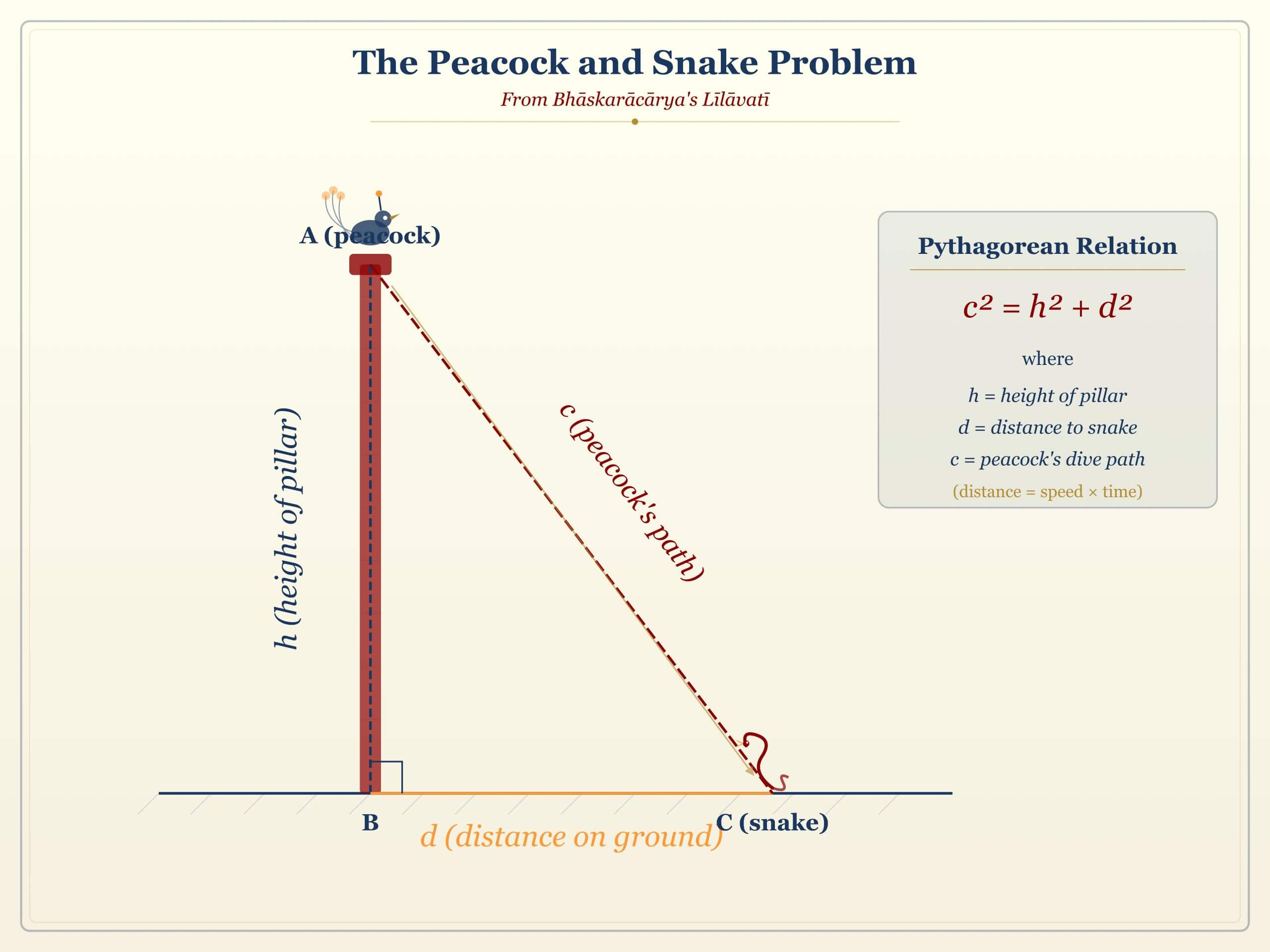
“A peacock sits on a pillar 9 feet high. Seeing a snake coming towards its hole at the base of the pillar from a distance of 27 feet, the peacock flies down to catch it. If both move at the same speed, at what distance from the pillar do they meet?”
Solution. Let \( x \) be the distance from the base of the pillar where they meet.
- The snake travels from 27 feet away toward the base, covering a distance of \( 27 – x \) feet.
- The peacock flies diagonally from the top of the 9-foot pillar to the meeting point on the ground. By the Pythagorean theorem, the peacock covers \( \sqrt{81 + x^2} \) feet.
[Image: The peacock and the snake problem, showing a right triangle with height 9, horizontal distance x, and hypotenuse equal to 27 minus x]
Since both travel at the same speed and meet simultaneously:
$$ 27 – x = \sqrt{81 + x^2} $$
Squaring both sides:
$$ (27 – x)^2 = 81 + x^2 $$ $$ 729 – 54x + x^2 = 81 + x^2 $$
The \( x^2 \) terms cancel:
$$ 729 – 54x = 81 \implies 648 = 54x \implies \boxed{x = 12} $$
Verification: Snake’s distance: \( 27 – 12 = 15 \) feet. Peacock’s distance: \( \sqrt{81 + 144} = \sqrt{225} = 15 \) feet. Correct.
Generalization
If the pillar has height \( h \) and the snake starts at distance \( d \), the meeting point is at distance \( x \) from the pillar where:
$$ x = \frac{d^2 – h^2}{2d} $$
This formula requires \( d > h \) for a physically meaningful solution. For \( h = 9 \) and \( d = 27 \): \( x = \frac{729 – 81}{54} = \frac{648}{54} = 12 \).
Problem 3: The Bees and the Lotus
“One-fifth of a swarm of bees flew to the Kadamba flower, one-third flew to the Silandhara, three times the difference of these two numbers flew to an arbor. One bee remained, hovering and attracted on each side by the fragrant Ketaki and the Malati. What is the number of bees?”
Solution. Let \( n \) be the total number of bees.
$$ \begin{aligned} \text{Bees to Kadamba:} &\quad \frac{n}{5} \\ \text{Bees to Silandhara:} &\quad \frac{n}{3} \\ \text{Difference:} &\quad \frac{n}{3} – \frac{n}{5} = \frac{2n}{15} \\ \text{Three times the difference (to arbor):} &\quad 3 \times \frac{2n}{15} = \frac{2n}{5} \\ \text{Remaining bee:} &\quad 1 \end{aligned} $$
The sum of all parts equals the total:
$$ \frac{n}{5} + \frac{n}{3} + \frac{2n}{5} + 1 = n $$
Finding a common denominator of 15:
$$ \frac{3n}{15} + \frac{5n}{15} + \frac{6n}{15} + 1 = n \implies \frac{14n}{15} + 1 = n \implies 1 = \frac{n}{15} \implies \boxed{n = 15} $$
Verification: Kadamba: 3; Silandhara: 5; Arbor: 6; Remaining: 1. Total: \( 3 + 5 + 6 + 1 = 15 \). Correct.
This type of problem, where an unknown quantity is divided into fractional parts that must sum to the whole, appears across many ancient mathematical traditions. The Rhind Papyrus of ancient Egypt (c. 1650 BCE) contains similar problems.
Problem 4: The Broken Bamboo
“A bamboo 32 cubits high was broken by the wind. Its tip touched the ground at a distance of 16 cubits from its root. At what height was it broken?”
Solution. Let \( x \) be the height at which the bamboo was broken. Then:
- The standing portion has height \( x \).
- The fallen portion has length \( 32 – x \) (the top part that bent over).
- The fallen portion, the ground, and the standing portion form a right triangle.
[Image: The broken bamboo forming a right triangle with the standing portion as one leg, the ground distance as the other leg, and the fallen portion as the hypotenuse]
By the Pythagorean theorem:
$$ x^2 + 16^2 = (32 – x)^2 $$ $$ x^2 + 256 = 1024 – 64x + x^2 $$
The \( x^2 \) terms cancel:
$$ 256 = 1024 – 64x \implies 64x = 768 \implies \boxed{x = 12} $$
Verification: Standing portion: 12. Fallen portion: 20. Check: \( 12^2 + 16^2 = 144 + 256 = 400 = 20^2 \). Correct.
Tip: Problems of this type appear in Chinese mathematics (Jiuzhang Suanshu, c. 200 BCE) as well, suggesting a possible transmission of mathematical ideas along ancient trade routes.
Problem 5: The Lotus in the Pool
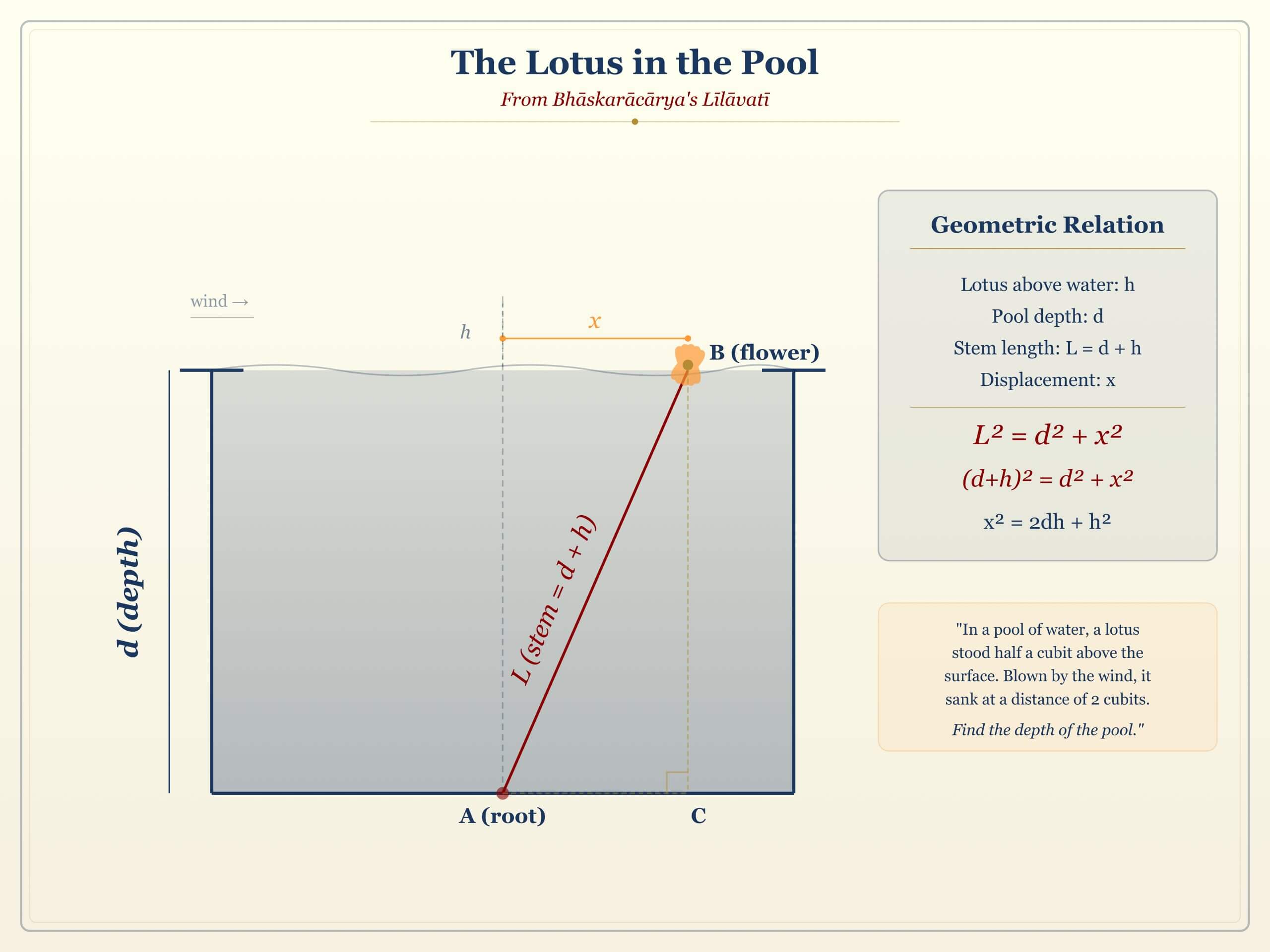
“In a pool of water, a lotus flower stands half a cubit above the surface. Blown by the wind, it sinks and touches the water at a point 2 cubits from where it stood. What is the depth of the pool?”
Solution. Let \( d \) be the depth of the pool. The lotus stem has total length \( d + \frac{1}{2} \) (depth plus the half-cubit above water).
[Image: The lotus in the pool, with the stem forming the hypotenuse of a right triangle when blown sideways]
When the lotus is blown to the side, the stem acts as the hypotenuse of a right triangle with vertical leg \( d \) and horizontal leg 2. By the Pythagorean theorem:
$$ d^2 + 4 = \left(d + \frac{1}{2}\right)^2 = d^2 + d + \frac{1}{4} $$ $$ 4 = d + \frac{1}{4} \implies d = \frac{15}{4} $$ $$ \boxed{d = 3\tfrac{3}{4} \text{ cubits}} $$
Verification: Stem length: \( \frac{15}{4} + \frac{1}{2} = \frac{17}{4} \). Check: \( \left(\frac{15}{4}\right)^2 + 4 = \frac{225}{16} + \frac{64}{16} = \frac{289}{16} = \left(\frac{17}{4}\right)^2 \). Correct.
The Rule of Three (Trairashika)
The Rule of Three states: if quantity \( a \) corresponds to quantity \( b \), then quantity \( c \) corresponds to:
$$ x = \frac{b \cdot c}{a} $$
Bhaskara extends this to the Rule of Five, Rule of Seven, and so on, for problems involving multiple proportional relationships. These are essentially systems of proportions.
Example: Rule of Five
If 5 men can build 3 walls in 7 days, how many days will 8 men take to build 5 walls?
Here we have two proportional relationships:
$$ \text{days}_2 = 7 \times \frac{5}{8} \times \frac{5}{3} = \frac{175}{24} \approx 7.29 \text{ days} $$
Problem 6: The Monkey and the Tree
“A monkey ascends a tree of 100 cubits. In each leap upward, it covers 5 cubits, but slips back 2 cubits. In how many leaps does the monkey reach the top?”
Solution. In each leap, the net progress is \( 5 – 2 = 3 \) cubits. However, the final leap requires special attention: once the monkey reaches or exceeds 100 cubits in its upward phase, it does not slip back.
After \( k \) complete “leap-and-slip” cycles, the monkey is at height \( 3k \) cubits. After 31 complete cycles, the monkey is at \( 3 \times 31 = 93 \) cubits. On the 32nd leap upward, the monkey reaches \( 93 + 5 = 98 \) cubits, then slips to 96. On the 33rd leap upward, the monkey reaches \( 96 + 5 = 101 > 100 \) cubits and has reached the top.
$$ \boxed{\text{The monkey reaches the top in 33 leaps.}} $$
Tip: This is an early instance of a “boundary effect” problem that requires careful analysis at the endpoint. The naive answer of \( \lceil 100/3 \rceil = 34 \) overcounts because it doesn’t account for the fact that no slipping occurs on the final successful leap. Such problems remain popular in modern mathematical competitions and interviews.
Bhaskara’s Square Root Algorithm
Bhaskara presents efficient algorithms for calculating square roots. To find \( \sqrt{N} \), choose an initial approximation \( a \) such that \( a^2 \approx N \). Then refine using:
$$ \sqrt{N} \approx a + \frac{N – a^2}{2a} $$
This is equivalent to one step of Newton’s method applied to \( f(x) = x^2 – N \). The iterative version:
$$ a_{n+1} = \frac{1}{2}\left(a_n + \frac{N}{a_n}\right) $$
converges to \( \sqrt{N} \). This is the Babylonian method, known in India from ancient times and presented by Bhaskara with improved convergence analysis.
The Cistern Problem
“One pipe can fill a cistern in 3 hours, another in 5 hours. A drain can empty it in 15 hours. If all three operate simultaneously, in how many hours will the cistern be filled?”
Solution. The rates of filling and draining per hour are:
$$ \begin{aligned} \text{Pipe 1:} &\quad \frac{1}{3} \text{ of the cistern per hour} \\ \text{Pipe 2:} &\quad \frac{1}{5} \text{ of the cistern per hour} \\ \text{Drain:} &\quad -\frac{1}{15} \text{ of the cistern per hour} \end{aligned} $$
Combined rate: \( \frac{1}{3} + \frac{1}{5} – \frac{1}{15} = \frac{5 + 3 – 1}{15} = \frac{7}{15} \).
Time to fill: \( t = \frac{15}{7} = 2\frac{1}{7} \) hours, approximately 2 hours and 8.6 minutes.
Exercises
-
A merchant bought goods for 200 coins and sold them at a profit of 25%. He invested the proceeds in new goods and again sold at 25% profit. What was his total wealth after the second sale? (This leads to the compound interest formula.)
-
The perimeter of a square is 40 cubits. Find the length of its diagonal. (Bhaskara would use \( \sqrt{2} \approx \frac{577}{408} \).)
-
Solve the following “maiden’s riddle” variant: A number is doubled, then 10 is added, then the result is divided by 4, then 3 is subtracted. The final answer is 5. What was the original number?
-
A bird sits atop a tree 16 feet high. A cat at the base sees a mouse 20 feet away on the ground. Both the bird and the cat race toward the mouse at the same speed (the bird flies in a straight line). At what distance from the tree does the bird catch the mouse? Use the generalized formula from the peacock-and-snake problem.
-
Two-thirds of a herd of elephants are in the forest, one-seventh are on the mountain, and the remaining 12 elephants are near a lake. How many elephants are in the herd?
-
A bamboo 18 cubits high is broken by the wind so that its tip touches the ground 6 cubits from the root. At what height did it break?
-
In a pool, a lotus stands 1 cubit above the water. Blown by the wind, it touches the water at a point 4 cubits away. Find the depth of the pool.