
Beyond its famous word problems, the Lilavati presents systematic mathematical methods that deserve analysis on their own merits. In this lesson, we explore Bhaskara’s treatment of equations, his work with arithmetic and geometric progressions, his combinatorial counting methods, and his remarkable handling of surds (irrational numbers). These techniques, developed in 12th-century India, anticipated methods not seen in Europe for centuries.
Arithmetic Progressions
Bhaskara provides the formula for the sum of an arithmetic series with complete generality.
Important: Sum of an Arithmetic Progression: \( S_n = \frac{n}{2}(2a + (n-1)d) \), where \( n \) is the number of terms, \( a \) is the first term, and \( d \) is the common difference.
The Division of Gems
“Among friends, gems were divided so that each friend received 3 more than the next. The last friend received 3 gems. If the gems form an arithmetic progression with first term 3 and common difference 3, how many gems are distributed among \( n \) friends?”
The terms in ascending order are: \( 3, 6, 9, \ldots, 3n \). The sum is:
$$ S_n = \frac{n}{2}(3 + 3n) = \frac{3n(n+1)}{2} $$
For example, with \( n = 13 \) friends, the total is \( \frac{3 \cdot 13 \cdot 14}{2} = 273 \) gems, with the largest share being 39.
This leads to the quadratic equation \( n^2 + n = \frac{2S}{3} \), which Bhaskara solves using the quadratic formula:
$$ n = \frac{-1 + \sqrt{1 + \frac{8S}{3}}}{2} $$
A solution exists with integer \( n \) only when \( 1 + \frac{8S}{3} \) is a perfect square. The mathematical method, applying the arithmetic series formula and solving the resulting quadratic, is the essential lesson.
Geometric Progressions
Bhaskara extends to sequences where each term is multiplied by a constant ratio:
$$ S_n = a \cdot \frac{r^n – 1}{r – 1} $$
where \( a \) is the first term and \( r \) is the common ratio. This formula, known in India well before Bhaskara’s time, was presented by him with particularly clear examples.
The Merchant’s Profit (Compound Growth)
A merchant bought goods for 200 coins and sold them at a profit of 25%. He invested the proceeds in new goods and again sold at 25% profit.
$$ \begin{aligned} \text{After first sale:} &\quad 200 \times 1.25 = 250 \\ \text{After second sale:} &\quad 250 \times 1.25 = 312.5 \end{aligned} $$
In general, after \( n \) rounds of \( p\% \) profit on initial capital \( C \):
$$ \text{Total} = C \left(1 + \frac{p}{100}\right)^n $$
This is the compound interest formula, a concept well understood by Indian mathematicians. The connection to geometric progressions is immediate: the successive values \( C, C(1+r), C(1+r)^2, \ldots \) form a geometric sequence with common ratio \( 1 + r \).
Combinations and Permutations
Bhaskara presents methods for counting arrangements and selections with the same formula we use today.
Theorem (Combinations). The number of ways to choose \( r \) objects from \( n \) distinct objects is:
$$ \binom{n}{r} = \frac{n!}{r!\,(n-r)!} $$
The Combinations of Tastes
“There are six tastes: sweet, sour, salty, bitter, pungent, and astringent. In how many ways can they be combined, taking one at a time, two at a time, three at a time, and so on?”
Solution. The number of combinations is:
$$ \begin{aligned} \binom{6}{1} &= 6 \\ \binom{6}{2} &= 15 \\ \binom{6}{3} &= 20 \\ \binom{6}{4} &= 15 \\ \binom{6}{5} &= 6 \\ \binom{6}{6} &= 1 \end{aligned} $$
The total number of non-empty combinations is:
$$ \sum_{k=1}^{6}\binom{6}{k} = 2^6 – 1 = 63 $$
Important: Bhaskara’s Rule: The total number of non-empty subsets of \( n \) objects is \( 2^n – 1 \). This is equivalent to the binomial theorem identity: \( \sum_{k=0}^{n}\binom{n}{k} = 2^n \).
Bhaskara expresses his combinatorial rules through examples involving selections of tastes (sweet, sour, bitter, etc.) and provides a systematic method for enumeration. The fact that he states the general formula \( 2^n – 1 \) for the total count of non-empty subsets shows that Indian mathematicians understood the binomial theorem in full generality.
Bhaskara’s Treatment of Surds
Bhaskara systematically handles irrational numbers (surds), providing rules for operations that enable computation without requiring decimal approximations.
Bhaskara’s Rules for Surds:
$$ \begin{aligned} \sqrt{a} \pm \sqrt{b} &= \sqrt{a + b \pm 2\sqrt{ab}} \\ \sqrt{a} \times \sqrt{b} &= \sqrt{ab} \\ \frac{\sqrt{a}}{\sqrt{b}} &= \sqrt{\frac{a}{b}} \end{aligned} $$
Example: Simplifying Surds
Simplify \( \sqrt{3} + \sqrt{12} \).
Using Bhaskara’s method: \( \sqrt{12} = \sqrt{4 \times 3} = 2\sqrt{3} \).
Therefore \( \sqrt{3} + \sqrt{12} = \sqrt{3} + 2\sqrt{3} = 3\sqrt{3} = \sqrt{27} \).
Alternatively, using the addition rule: \( \sqrt{3 + 12 + 2\sqrt{36}} = \sqrt{15 + 12} = \sqrt{27} \).
Rational Approximations
Bhaskara also provides remarkably accurate rational approximations to surds. For instance:
- \( \sqrt{2} \approx \frac{577}{408} \), accurate to six decimal places
- \( \pi \approx \frac{355}{113} \), accurate to six decimal places (used for precise calculations)
- \( \pi \approx \frac{22}{7} \) for rough calculations
The approximation \( \sqrt{2} \approx \frac{577}{408} \) comes from the continued fraction expansion of \( \sqrt{2} \). Indian mathematicians were skilled at deriving rational approximations using methods equivalent to continued fractions.
The Square and the Diagonal
“The perimeter of a square is 40 cubits. Find the length of its diagonal.”
The side length is \( s = 40/4 = 10 \) cubits. By the Pythagorean theorem:
$$ d = s\sqrt{2} = 10\sqrt{2} \approx 14.142 \text{ cubits} $$
Using Bhaskara’s approximation:
$$ d \approx 10 \times \frac{577}{408} = \frac{5770}{408} = \frac{2885}{204} \approx 14.1422 \text{ cubits} $$
The Kuttaka Method for Indeterminate Equations
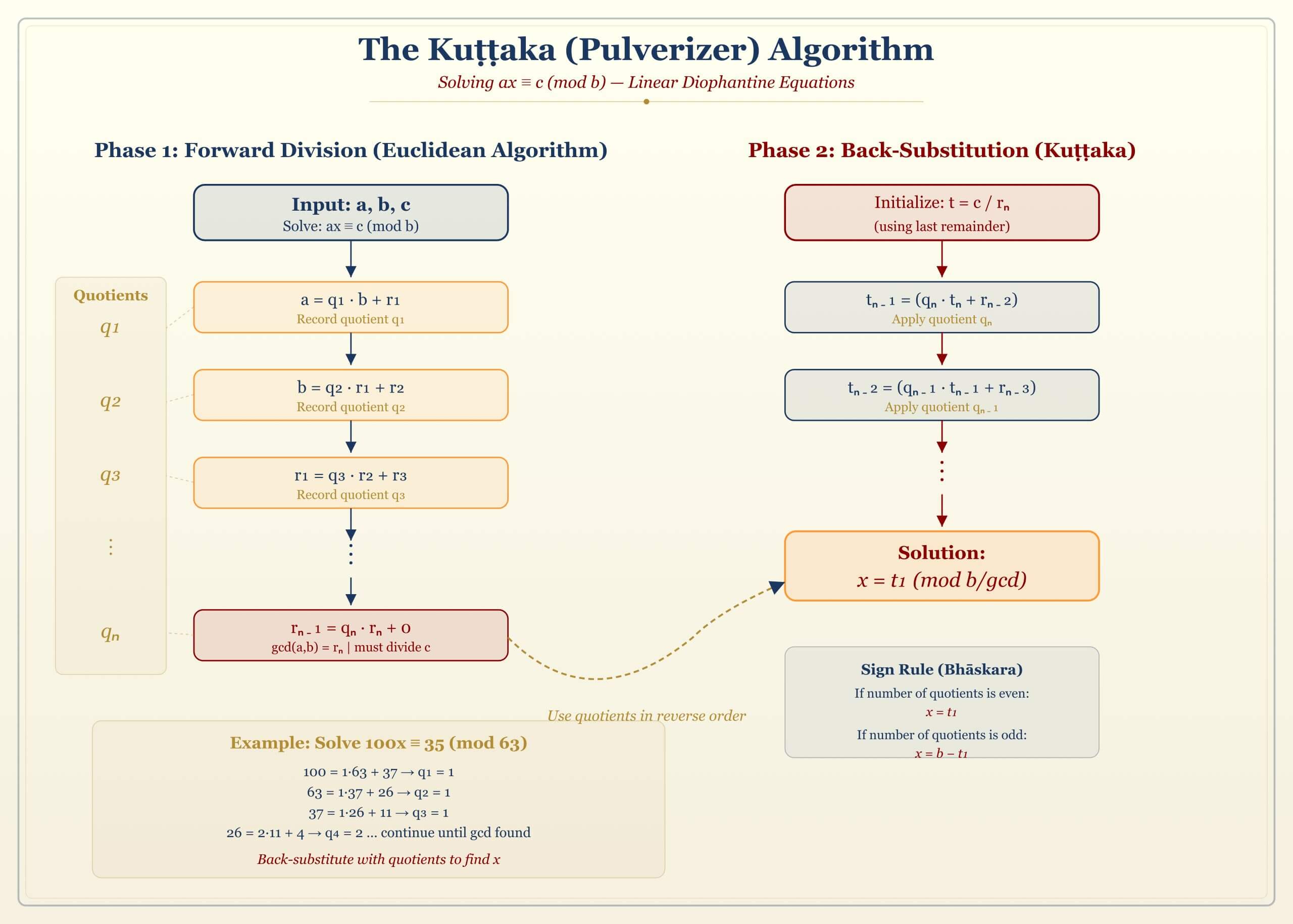
The Kuttaka (“pulverizer”) is one of the most important algorithms in Indian mathematics. It solves equations of the form \( ax \equiv c \pmod{b} \), or equivalently, finds integer solutions to \( ax + by = c \).
[Image: Visualization of the Kuttaka algorithm showing successive divisions reducing the problem to a solvable base case]
The Algorithm
To solve \( ax + c = by \) for integers \( x, y \):
- Apply the Euclidean algorithm to find \( \gcd(a, b) \). If \( \gcd(a, b) \nmid c \), no solution exists.
- Track the quotients \( q_1, q_2, \ldots, q_n \) from the Euclidean algorithm.
- Build the solution backwards using: \( t_n = \frac{c}{\gcd(a,b)} \), then \( t_{k-1} = q_k \cdot t_k + t_{k+1} \).
This technique, refined over centuries by Indian mathematicians from Aryabhata onwards, produces integer solutions when they exist. Bhaskara’s treatment is among the most complete and systematic.
Example
Solve \( 17x + 1 = 5y \) (i.e., find \( x \) such that \( 17x \equiv -1 \pmod{5} \)).
Euclidean algorithm on 17 and 5:
$$ \begin{aligned} 17 &= 3 \times 5 + 2 \\ 5 &= 2 \times 2 + 1 \end{aligned} $$
Back-substitution: \( 1 = 5 – 2 \times 2 = 5 – 2(17 – 3 \times 5) = 7 \times 5 – 2 \times 17 \).
So \( 17 \times (-2) + 5 \times 7 = 1 \), meaning \( 17 \times (-2) \equiv 1 \pmod{5} \).
For \( 17x \equiv -1 \pmod{5} \): \( x \equiv 2 \pmod{5} \). The smallest positive solution is \( x = 2 \), giving \( y = \frac{17 \times 2 + 1}{5} = 7 \).
Verification: \( 17 \times 2 + 1 = 35 = 5 \times 7 \). Correct.
Net of Numbers: Magic Squares
Chapter 12 of the Lilavati covers magic squares and number patterns with specific properties, demonstrating Bhaskara’s interest in recreational mathematics alongside serious computation.
A magic square of order \( n \) is an \( n \times n \) grid of distinct positive integers where every row, column, and main diagonal sums to the same constant, called the magic constant:
$$ M = \frac{n(n^2 + 1)}{2} $$
For a \( 3 \times 3 \) magic square using the numbers 1 through 9, the magic constant is \( M = \frac{3 \times 10}{2} = 15 \).
Indian mathematicians had developed sophisticated methods for constructing magic squares of any order, including methods for odd orders, singly-even orders, and doubly-even orders, anticipating the systematic treatments that appeared in Europe much later.
Comparison with Other Traditions
Indian vs. Greek Mathematics
- Aspect: Emphasis | Indian Tradition: Computation and algorithms | Greek Tradition: Proof and geometry
- Aspect: Number concept | Indian Tradition: Includes zero, negatives | Greek Tradition: Positive magnitudes only
- Aspect: Algebra | Indian Tradition: Symbolic, operational | Greek Tradition: Geometric (areas, lengths)
- Aspect: Proof style | Indian Tradition: Verification by example | Greek Tradition: Deductive chains
- Aspect: Notation | Indian Tradition: Positional decimal system | Greek Tradition: Alphabetic numerals
- Aspect: \( \pi \) approximation | Indian Tradition: \( \frac{355}{113} \) (Bhaskara) | Greek Tradition: \( \frac{22}{7} \) (Archimedes)
Indian vs. Chinese Mathematics
Both traditions independently developed sophisticated mathematics. The Chinese Jiuzhang Suanshu (“Nine Chapters on the Mathematical Art”, c. 200 BCE) shares several problem types with Indian texts, including the broken bamboo problem and linear system solving. The Indian tradition excelled particularly in:
- The development of the decimal place-value system with zero
- Systematic treatment of indeterminate equations (Kuttaka, Chakravala)
- Trigonometric functions and their applications
Timeline of Indian Mathematics
- Date: c. 800 BCE | Mathematician: Shulba Sutras | Key Contribution: Pythagorean theorem, \( \sqrt{2} \) approximation
- Date: c. 300 BCE | Mathematician: Pingala | Key Contribution: Binary numbers, combinatorics
- Date: c. 500 CE | Mathematician: Aryabhata | Key Contribution: \( \pi \approx 3.1416 \), trigonometry, algebra
- Date: c. 600 CE | Mathematician: Bhaskara I | Key Contribution: Commentary on Aryabhata
- Date: 628 CE | Mathematician: Brahmagupta | Key Contribution: Zero, negative numbers, Pell’s equation
- Date: c. 850 CE | Mathematician: Mahavira | Key Contribution: Combinatorics, arithmetic
- Date: 1114-1185 | Mathematician: Bhaskara II | Key Contribution: Lilavati, Chakravala, proto-calculus
- Date: c. 1350 | Mathematician: Narayana Pandit | Key Contribution: Magic squares, combinatorics
- Date: c. 1400 | Mathematician: Madhava | Key Contribution: Infinite series for \( \pi \), \( \sin \), \( \cos \)
- Date: c. 1500 | Mathematician: Nilakantha | Key Contribution: Improved series, heliocentrism
Exercises
-
An arithmetic progression has first term 7, common difference 3, and sum 175. How many terms does it have?
-
A geometric progression has first term 2, common ratio 3, and 5 terms. Find the sum.
-
From a collection of 8 different spices, how many distinct mixtures of exactly 3 spices can be prepared? How many non-empty mixtures (of any size) are possible?
-
Simplify using Bhaskara’s surd rules: \( \sqrt{5} + \sqrt{20} \).
-
Use the Kuttaka method to solve \( 23x + 3 = 7y \) in positive integers. Find the smallest positive solution.
-
A gardener has 120 flowers. He gives one-fourth to a temple, one-sixth to a friend, and one-tenth to a child. How many flowers remain?
-
Construct a \( 3 \times 3 \) magic square using the integers 1 through 9. Verify that all rows, columns, and diagonals sum to 15.
-
If 5 workers can build 3 houses in 10 days, how many days will 8 workers need to build 7 houses? (Use Bhaskara’s Rule of Five.)
-
A sum of money is lent at 5% compound interest per year. In how many years will it double? (Express the answer using logarithms, and compare with Bhaskara’s approach of repeated multiplication.)
-
Verify that the Indian approximation \( \pi \approx \frac{355}{113} \) is accurate to 6 decimal places by computing both sides to 7 digits.