
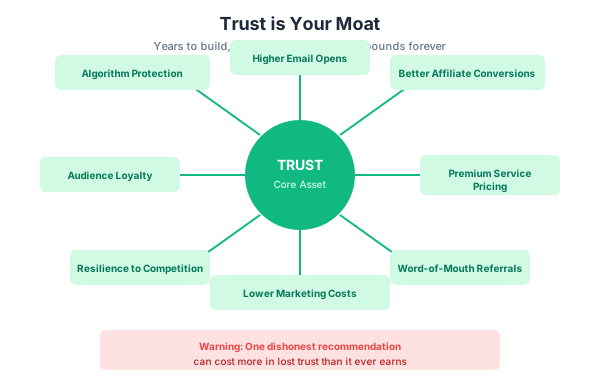
Trust is your moat. In a world of AI-generated content, affiliate spam, and anonymous blogs, the bloggers who build genuine trust will win long-term.
Every decision you make either builds or erodes trust. Small compromises compound into reputation damage. Consistent integrity compounds into a loyal audience that follows you for years.
This chapter is about playing the long game. Building a blog that’s still thriving in 5 years, not just optimized for this quarter’s revenue.
Trust as Competitive Advantage
Anyone can start a blog. Few can build one that readers genuinely trust. That trust becomes an unfair advantage in everything you do.
Why Trust Compounds
Trust takes years to build and seconds to destroy. But once built, it compounds in ways that accelerate every aspect of your business.
Compounding effects of trust:
- Higher email open rates (they expect value from you)
- Higher affiliate conversion rates (they believe your recommendations)
- Premium pricing for services (they see you as an expert)
- Word-of-mouth referrals (they tell others about you)
- Lower marketing costs (less effort to convert)
- Resilience to competition (loyalty protects you)
A blogger with 10,000 trusting subscribers can outperform a blogger with 100,000 skeptical visitors. Trust is the multiplier that makes everything work better.
How Trust Affects All Monetization
Affiliate marketing: Readers click and buy when they trust you’re genuinely recommending products you believe in. Distrust makes every affiliate link feel like a money grab.
Sponsored posts: Readers accept sponsored content when they trust you’ve maintained editorial standards. Distrust makes them skip anything that looks promotional.
Services: Clients pay premium rates when they trust your expertise and integrity. Distrust makes every price seem too high.
Products: Subscribers buy your products when they trust you’ll deliver value. Distrust breeds refund requests and complaints.
Trust isn’t separate from monetization. It’s the foundation that makes monetization work.
The Recovery Cost of Broken Trust
Breaking trust is expensive.
Immediate costs:
- Lost sales from the specific incident
- Unsubscribes from disgusted readers
- Negative comments and social mentions
Long-term costs:
- Readers who never fully trust you again
- Reputation damage that spreads to new potential readers
- The work required to rebuild (if possible)
- Opportunity cost of the reputation you could have built
I’ve seen bloggers destroy years of credibility with a single dishonest product recommendation. The $500 commission wasn’t worth the thousands of dollars in future revenue they lost.
The math always favors protecting trust.
Transparency That Builds Trust
Transparency isn’t just an ethical choice. It’s a strategy that actively builds trust over time.
Affiliate Disclosure Done Right
We covered disclosure requirements in Chapter 7. But disclosure can do more than satisfy legal requirements. It can actually increase trust.
Weak disclosure: “This post contains affiliate links.”
Strong disclosure: “This post contains affiliate links. I only recommend products I personally use, and I earn a commission if you buy through my links. This doesn’t affect my opinions or the price you pay.”
The stronger disclosure:
- Acknowledges the financial relationship openly
- Asserts that it doesn’t compromise your opinion
- Addresses the reader’s potential concern proactively
- Shows confidence in your integrity
Don’t hide disclosure. Feature it. Make it clear you’re not trying to sneak anything past your readers.
Sponsored Content Honesty
When publishing sponsored content, go beyond the minimum required disclosure.
Minimum: “This is a sponsored post.”
Better: “This post is sponsored by [Company]. They compensated me to write about [topic]. All opinions are my own, and I wouldn’t have accepted the sponsorship if I didn’t genuinely believe in [product/message].”
Tell readers:
- Who paid you
- What they paid for
- That your opinions remain yours
- Why you accepted this particular sponsorship
Readers appreciate honesty. They know sponsorships exist. They respect bloggers who are upfront about them.
Admitting What You Don’t Know
One of the strongest trust-builders is admitting the limits of your expertise.
Trust-building phrases:
- “I haven’t tested this with [specific situation], so I can’t give confident advice there.”
- “This is outside my area of expertise. I’d recommend consulting [appropriate expert].”
- “I’m not sure about this. Here’s my best guess, but verify before acting.”
- “I was wrong about [thing]. Here’s what I’ve learned since.”
Readers know you can’t know everything. When you pretend otherwise, they sense it. When you honestly acknowledge gaps, they trust you more on the topics where you do claim expertise.
Conflict of Interest Management
Sometimes your financial interests don’t align perfectly with your readers’ interests. How you handle these conflicts defines your integrity.
When Your Incentives Misalign with Readers
Common conflicts:
- The highest-commission product isn’t the best product
- A sponsor wants you to write something you don’t fully believe
- A service client wants you to say something misleading
- Short-term revenue opportunities compromise long-term value
These situations arise constantly. Having a framework for handling them matters.
The Recommendation Firewall
I operate with a simple rule: I recommend what I would recommend without financial incentive.
The test: “If I were advising a friend for free, what would I tell them?”
If the answer differs from what I’m writing, something is wrong.
Practical applications:
- If the best product doesn’t have an affiliate program, recommend it anyway and skip the commission
- If the highest-commission product isn’t the best, recommend the better product with the lower commission
- If a sponsor wants me to overstate benefits, I push back or walk away
- If my service wouldn’t actually help someone, I tell them
Yes, this costs money sometimes. But it builds the trust that makes everything else work.
Turning Down Money That Compromises Trust
Some opportunities should be rejected.
I’ve turned down:
- Sponsored posts for products I don’t believe in
- Affiliate partnerships with companies that treat customers badly
- Link placements that would mislead my readers
- Service clients who wanted me to do things I disagree with
Every rejection stings a little. The money was real. But every acceptance of something compromising would have cost more in trust than it earned in revenue.
Build a “walk away” list of things you won’t do regardless of the money. Refer to it when tempting offers arrive.
Audience Alignment Over Time
Your audience evolves. You evolve. Staying aligned while growing is an ongoing challenge.
Evolving with Your Readers
Some of your early readers outgrow your content. That’s okay. It means you helped them progress.
But you also need to evolve with the readers who stay. If your content stagnates while they advance, you lose relevance.
Signs of audience evolution:
- Questions get more sophisticated over time
- Beginners move to intermediate, intermediate to advanced
- Reader needs shift as the industry changes
- Your own expertise deepens
How to evolve:
- Add more advanced content without abandoning fundamentals
- Create clear pathways from beginner to advanced content
- Stay current with industry changes
- Deepen expertise rather than just broadening topics
When to Pivot vs. When to Stay
Sometimes the right move is significant change. Sometimes it’s staying the course.
Consider pivoting when:
- Your passion for the topic has died
- The market has fundamentally changed
- Your audience wants something different from what you offer
- New opportunities significantly outweigh current trajectory
Stay the course when:
- You’re in a temporary dip, not a permanent decline
- The core value you provide is still needed
- You’d be chasing trends rather than building sustainable value
- The grass just looks greener elsewhere
Most pivots I’ve seen fail were premature. Bloggers abandoned good positions because growth slowed, then discovered the new direction was even harder.
Give strategies time to work before pivoting. But don’t stubbornly persist with something that’s genuinely failing.
Managing Expectations Through Changes
When you do make significant changes, communicate clearly.
If changing topics: “I’m shifting focus toward [new topic] because [reason]. If you’re here for [old topic], here are other resources I recommend. If you’re interested in [new topic], I think you’ll love what’s coming.”
If changing format: “I’m moving from [old format] to [new format]. Here’s why I think this will serve you better.”
If changing monetization: “I’m introducing [new revenue stream]. Here’s how it works and why it doesn’t compromise what I offer.”
Readers handle change well when they understand it. They react badly to changes that feel sneaky or unexplained.
The Long-Game Mindset
Short-term thinking kills blogs. Long-term thinking builds them.
Decisions That Sacrifice Short-Term for Long-Term
Every day, you face choices between quick wins and sustainable growth.
Short-term temptations:
- Promote anything with a commission
- Write sensational content for clicks
- Cut corners on quality to publish faster
- Take any sponsorship regardless of fit
- Make promises you can’t keep
Long-term investments:
- Only promote products you believe in
- Write content that’s genuinely useful
- Maintain quality even when it takes longer
- Be selective about partnerships
- Under-promise and over-deliver
The short-term path often looks more lucrative in the moment. The long-term path always wins over years.
Building an Asset vs. Extracting Value
Some bloggers build assets. Others extract value.
Asset builders:
- Create evergreen content that compounds
- Build email lists and genuine relationships
- Invest in infrastructure and systems
- Think in years, not months
- Leave opportunities on the table that would compromise the asset
Value extractors:
- Chase short-term revenue at any cost
- Burn through audiences with aggressive tactics
- Neglect infrastructure for immediate gains
- Think in weeks and months
- Squeeze every dollar regardless of long-term impact
Asset building is slower but creates something valuable and sustainable. Value extraction looks great short-term but leaves you with nothing.
I’ve seen blogs sold for 6 figures because they were genuine assets. I’ve seen blogs worth nothing because they were extracted until nothing remained.
Your Blog in 5 Years
Where will your blog be in 5 years?
If you play the long game:
- Established authority in your space
- Loyal audience that trusts your recommendations
- Multiple revenue streams working together
- A valuable asset you could sell or continue growing
- Reputation that opens doors
If you extract short-term value:
- Burned-out audience who doesn’t trust you
- Struggling to maintain traffic
- Constantly chasing the next tactic
- Nothing of lasting value built
- Reputation that closes doors
Every decision you make today shapes which future you’re building. Choose accordingly.
Chapter Checklist
- [ ] Am I transparent about affiliate relationships in a way that builds trust?
- [ ] Do I turn down opportunities that would compromise reader trust?
- [ ] Am I honest about the limits of my expertise?
- [ ] Do I have a framework for handling conflicts of interest?
- [ ] Am I thinking in years, not just months?
- [ ] Am I building an asset, not just extracting value?
Chapter Exercise
Task: List 3 decisions you’ve made (or could make) that prioritize long-term trust over short-term revenue.
Time required: 30 minutes
Deliverable: A document capturing your trust-building commitments and one conflict you’ll handle differently going forward.
Process:
-
Reflect on past decisions (10 minutes)
- Have you ever turned down money to protect trust?
- Have you ever regretted a decision that compromised trust?
- What were the outcomes in each case?
-
Identify current conflicts (10 minutes)
- Are there any current opportunities that tempt you but feel wrong?
- Are there any affiliate products you promote that you’re not proud of?
- Are there any content practices you’d be embarrassed to explain?
-
Make commitments (10 minutes)
- Write down 3 specific trust-protecting decisions:
- Something you’ll stop doing
- Something you’ll start doing
- A policy you’ll implement
- Write down 3 specific trust-protecting decisions:
Example output:
Trust-Building Decisions I’m Committing To:
1. Stop: Promoting hosting companies that I know have poor support, even though they have high commissions. I’ll remove these affiliate links and recommend only hosts I’d use myself.
2. Start: Including a “what I’d change” section in every product review. Even products I recommend have weaknesses. Being honest about them builds more trust than pretending they’re perfect.
3. Policy: I will not publish sponsored content for any company I wouldn’t recommend to a friend. If a sponsor approaches me with a product I don’t believe in, the answer is no regardless of the payment.
Conflict I’ll handle differently:
I’ve been promoting [Product X] because it has a recurring commission, even though I switched away from it last year. Going forward, I’ll update all content mentioning it to reflect my honest current opinion and recommend what I actually use now.
These commitments become your ethical guidelines. Refer to them when tempting opportunities arise.