
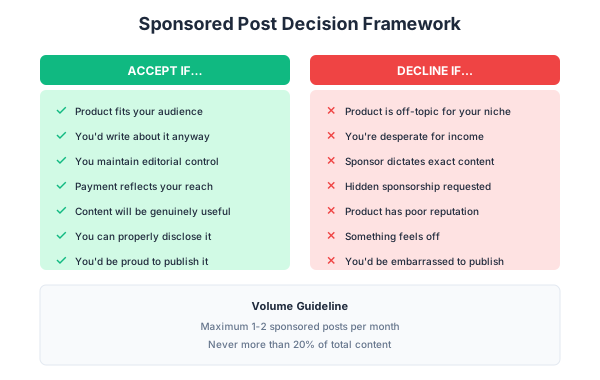
Sponsored content gets a bad reputation because most bloggers do it badly. They take money from anyone, publish barely-disguised advertisements, and erode the trust they spent years building.
Done right, sponsored posts are good money without selling out. The key is selectivity, editorial control, and treating sponsored content with the same standards as everything else you publish.
This chapter covers how to work with sponsors while keeping your integrity intact.
Sponsored Posts as Secondary Income
I put sponsored posts second in the monetization stack, after affiliate marketing. Here’s why.
Why Sponsors Come Second to Affiliate
Affiliate advantages:
- Income grows with traffic automatically
- You control what you recommend
- No negotiation or client management
- Works at any traffic level
- Scales infinitely
Sponsored advantages:
- Higher per-post payouts
- Cash upfront (not dependent on conversions)
- Can create long-term relationships
- Opens doors to industry connections
Sponsored disadvantages:
- Requires active sales/outreach
- Limited by how many sponsors you can accommodate
- Client management overhead
- Can compromise editorial independence if not careful
Affiliate marketing is more passive and scalable. Sponsored posts require ongoing relationship management. Start with affiliate as your foundation, then add sponsored deals selectively.
The Volume vs. Margin Tradeoff
Sponsored posts have higher per-post revenue but limited volume. You can only publish so many sponsored posts before readers tune out.
My guideline: no more than 1-2 sponsored posts per month, and never more than 20% of total content.
If you publish 8 posts monthly, that’s 1-2 sponsored posts maximum. More than that, and readers start wondering if anything you write is genuine.
The math often works out:
- 2 sponsored posts at $500 each = $1,000/month
- 6 regular posts driving affiliate revenue = $800-1,500/month
- Combined: $1,800-2,500/month
Both streams contribute, but affiliate remains the foundation that doesn’t require ongoing sales effort.
When Sponsored Makes Sense
Sponsored posts make sense when:
- You have established traffic and engagement (sponsors want reach)
- The sponsor’s product genuinely fits your audience
- The payment is worth your time and the editorial compromise
- You can create content that’s actually useful, not just promotional
- You maintain full editorial control
Sponsored posts don’t make sense when:
- You’re desperate for any income (leads to bad partnerships)
- The product doesn’t fit your audience
- The sponsor wants to dictate exactly what you write
- The payment doesn’t reflect the value of your reach
- You’d be embarrassed to publish it
Being selective protects your reputation. A bad sponsored post can cost more in lost trust than it earns in payment.
Setting Sponsorship Criteria
Before you accept any sponsored deal, define your criteria. This prevents you from making bad decisions when money is on the table.
Product Fit Requirements
The product must fit your audience and content.
Ask:
- Is this something my readers would actually use?
- Does it solve a problem they have?
- Is it in the same general space as my regular content?
- Would I consider using this product myself?
Red flags:
- Products completely unrelated to your niche
- Low-quality products you’d never recommend otherwise
- Products targeting a different demographic than your readers
- Products you can’t evaluate because you don’t understand them
I’ve turned down sponsored posts paying $1,000+ because the product didn’t fit. A mattress company approached me for a WordPress blog. The money was tempting, but my readers don’t come to me for mattress advice. Publishing that would confuse them and make future recommendations seem random.
Audience Alignment Test
Beyond product category, check deeper alignment:
- Price point: Is this affordable for your audience? A $5,000 enterprise tool doesn’t fit a blog for beginner freelancers.
- Technical level: Is this appropriate for your readers’ skill level?
- Values alignment: Does this company share values your audience cares about?
The best sponsored partnerships feel natural. Readers barely notice it’s sponsored because the product genuinely fits.
The “Would I Write About This Anyway?” Filter
My strongest test: would I write about this product without payment?
If a company approaches me about their WordPress plugin and it’s something I’d have covered organically anyway, that’s a great fit. The sponsorship just compensates me for content I’d have created regardless.
If a company approaches me about something I’d never naturally write about, it’s probably not a fit. The content would feel forced, and readers would sense it.
Red Flags to Avoid
Immediate no:
- Companies with reputations for scams or poor customer treatment
- Products you’ve never heard of with no reviews or reputation
- Requests for hidden sponsorship (no disclosure)
- Requests to attack competitors
- Deals that feel too good to be true
Proceed with caution:
- Companies that want too much editorial control
- Rush deadlines that don’t allow proper evaluation
- Requests to make claims you can’t verify
- Products you have no way to actually test
Trust your instincts. If a deal feels off, it probably is.
Pricing Your Sponsored Content
Pricing sponsored content is part art, part science. Undercharge and you devalue your work. Overcharge and you get no deals.
Factors That Affect Pricing
Traffic: More traffic = higher prices. A blog with 100,000 monthly visitors can charge more than one with 10,000.
Engagement: Traffic quality matters. A highly engaged niche audience is worth more than random visitors.
Niche: Some niches pay more than others. Finance and business pay premium rates. Lifestyle and entertainment pay less.
Content type: Different content requires different pricing:
- Full sponsored post: Highest price
- Sponsored mention in regular post: Medium price
- Social media mention: Lowest price
Exclusivity: If they want you not to mention competitors, charge more.
Usage rights: If they want to repurpose your content for their marketing, charge more.
The Rate Card Approach
Create a simple rate card with your standard pricing:
- Content Type: Dedicated sponsored post | Base Price: $XXX | Notes: 1,000-1,500 words, 1 revision
- Content Type: Sponsored mention | Base Price: $XXX | Notes: Product mention in relevant post
- Content Type: Sponsored newsletter mention | Base Price: $XXX | Notes: In email newsletter
- Content Type: Social media package | Base Price: $XXX | Notes: X posts across platforms
Having set rates: - Makes negotiation easier
- Signals professionalism
- Prevents you from undercharging in the moment
- Gives you a baseline to negotiate from
Starting Point Formula
If you’re not sure what to charge, start here:
Sponsored post: $100 per 10,000 monthly pageviews as a baseline
- 10,000 monthly views = $100
- 50,000 monthly views = $500
- 100,000 monthly views = $1,000
Adjust up for:
- High engagement metrics
- Premium niche (finance, business, tech)
- Exclusive audience (decision-makers, high-income)
- Significant follower count across platforms
Adjust down for:
- New blog still building reputation
- Lower engagement rates
- Highly competitive niche with many alternatives
- If you really want to work with this brand
Negotiation Basics
Most companies expect to negotiate. Build in room.
- If your target is $500, start at $650
- Be prepared to explain your value (traffic, engagement, audience quality)
- Non-monetary compensation counts (free products, extended partnerships)
- Don’t be afraid to walk away
Phrases that work:
- “My standard rate for this type of content is $X”
- “I can work within your budget if we adjust the scope to Y”
- “For that budget, I could offer Z instead”
When to Say No
Say no when:
- The offer is insultingly low
- The product doesn’t fit
- The company wants too much control
- Something feels off
- You’re already at your sponsored post limit for the month
Saying no to bad deals makes room for good ones. And it protects your reputation, which is your most valuable asset.
Maintaining Editorial Control
Editorial control is non-negotiable. The moment you let sponsors dictate your content, you’ve become an advertising platform, not a blog.
What You Will and Won’t Change
Be clear upfront about what’s negotiable:
Negotiable:
- Product focus and angle
- Specific features to highlight
- Publishing timeline
- Where links point
- Number of images/screenshots
Not negotiable:
- Your honest opinion and evaluation
- Disclosing that content is sponsored
- Your writing voice and style
- Including any claims you can’t verify
- Removing genuine criticism or caveats
The Approval Process
Most sponsors want to review content before publication. That’s reasonable. But define the boundaries:
- They can request factual corrections
- They can suggest clarifications
- They can flag concerns about their brand representation
- They cannot rewrite your content
- They cannot remove honest criticisms
Set expectations in writing before you start:
“I’ll share the draft for your review. You can request factual corrections and clarifications, but I maintain final editorial control over the content and voice.”
Disclosure Requirements
Sponsored content must be disclosed. This isn’t optional.
- Mark posts clearly: “This post is sponsored by [Company]” or “This is a sponsored post”
- Disclosure should appear at the beginning, not buried at the bottom
- Use nofollow links for sponsored posts (Google’s guidelines)
- Make it obvious to any reasonable reader that money changed hands
Beyond legal requirements, clear disclosure maintains trust. Readers appreciate transparency.
Protecting Your Voice
The worst sponsored content sounds nothing like the blogger’s normal voice. It reads like marketing copy because the sponsor essentially wrote it.
Protect your voice by:
- Writing the content yourself, always
- Using your normal tone and structure
- Including your genuine perspective, even if it’s not 100% glowing
- Treating it like any other post on your blog
If you can’t write about a product in your authentic voice, you shouldn’t be writing about it at all.
Sponsored Post Structure
Good sponsored content doesn’t feel like an ad. It provides value while featuring the sponsor’s product.
Integration vs. Dedicated Post
Integrated sponsored content: Product is mentioned naturally within a larger topic.
Example: A post about “WordPress Security Checklist” that features a security plugin sponsor within the broader content.
- Feels more natural
- Lower payment (less prominent)
- Reader may not focus on product
Dedicated sponsored post: Entire post focuses on the sponsored product.
Example: A full review or tutorial about the sponsor’s product.
- More prominent placement
- Higher payment
- More obviously promotional
Both work. Match the type to the product and your comfort level.
Making Sponsored Content Genuinely Useful
The best sponsored content is useful independent of the sponsorship. Readers get value whether or not they buy the product.
Approach sponsored content like any other post:
- Solve a real problem your readers have
- Provide genuine information and insight
- Include your actual experience and opinions
- Add value beyond just promoting the product
Example: Instead of “Why [Product] Is Great,” write “How to Solve [Problem]” with the sponsored product as part of the solution. The post is useful even if they don’t buy.
Examples of Good Sponsored Execution
Good: “5 Ways to Speed Up Your E-commerce Site (+ How [Sponsor] Helped My Client Save 2 Seconds)”
- Useful tips regardless of sponsor
- Specific results from using the product
- Honest integration with genuine content
Bad: “Why [Sponsor] Is the Best Tool You Need Right Now!”
- No value without the sales pitch
- No evidence or specifics
- Obviously just an advertisement
Good: “I Tested [Sponsor] for 30 Days on My WordPress Site. Here’s What Happened.”
- Personal experience focus
- Specific, verifiable claims
- Room for honest assessment including negatives
Bad: “[Sponsor]: The Complete Review”
- Generic format easily produced without real use
- Likely reads like marketing material
- No personal stake or experience
Chapter Checklist
- [ ] Have I defined my sponsorship criteria before accepting deals?
- [ ] Do I have a rate card with standard pricing?
- [ ] Am I limiting sponsored posts to 20% or less of content?
- [ ] Do I maintain editorial control over sponsored content?
- [ ] Am I properly disclosing all sponsored relationships?
- [ ] Does my sponsored content provide genuine value?
Chapter Exercise
Task: Create your sponsorship criteria document and rate card.
Time required: 60 minutes
Deliverable: A one-page document you can reference when sponsors approach you.
Process:
-
Define your criteria (20 minutes)
Write answers to:
- What niches/product categories will you accept?
- What won’t you accept under any circumstances?
- Minimum traffic/engagement requirements for sponsors?
- Maximum sponsored posts per month?
- What editorial control requirements are non-negotiable?
-
Research competitive pricing (15 minutes)
- Look at similar blogs’ advertising pages
- Check industry benchmarks for your traffic level
- Consider your niche’s typical rates
-
Create your rate card (15 minutes)
Content Type Base Price Notes Dedicated sponsored post $ Words, revisions included Sponsored mention $ Scope Newsletter mention $ List size Social package $ What’s included -
Write your standard terms (10 minutes)
Draft a paragraph covering:
- Editorial control expectations
- Approval process
- Disclosure requirements
- Timeline expectations
- Payment terms
Example output:
My Sponsorship Criteria
I accept sponsorships for:
- WordPress plugins, themes, and tools
- Hosting services
- Development and productivity tools
- SaaS products relevant to bloggers/developers
I don’t accept sponsorships for:
- Products outside my niche
- Gambling, adult content, multi-level marketing
- Products I haven’t tested or can’t evaluate
- Companies requesting hidden sponsorship
Editorial control:
I write all content in my voice. Sponsors may review and request factual corrections but cannot rewrite content or remove honest opinions.Rates:
- Dedicated post (1,200+ words): $500
- Sponsored mention: $200
- Newsletter feature (5K subscribers): $150
Terms:
50% upfront, 50% on publication. 14-day production time. All sponsored content is clearly disclosed.
Keep this document handy. When sponsors approach, you can respond confidently with your terms instead of making decisions under pressure.