
Services are where your blog authority converts into serious money. A single client can pay more than months of affiliate commissions. The margins are high because you’re selling expertise, not referring products.
But services also require the most from you. They’re time-intensive, require client management, and don’t scale the way passive income does. That’s why I put them last in the monetization stack, not because they’re least valuable, but because they work best after you’ve built authority through content.
This chapter covers how to design, price, and sell services that leverage your blog’s credibility.
Why Services Come Last in the Stack
I’ve offered services throughout my career, from freelance development to consulting to done-for-you optimization. Here’s why I recommend building affiliate and content revenue first.
Time-for-Money Tradeoff
Services trade your time for money. That’s not necessarily bad, but it has limits.
With affiliate income, one post can earn for years. With services, you get paid once for the hours worked. There’s no compounding.
I’ve made $50,000 from services in a year. Sounds great until you calculate that I worked 800+ hours to earn it. That’s $62.50/hour, decent but not exceptional for skilled work.
The same year, I made $40,000 from affiliates. The hours invested in content? Maybe 300 total. That’s $133/hour equivalent, and the posts continue earning.
Services should supplement your passive income, not replace it. Build the passive base first, then add services for premium clients.
The Authority Prerequisite
Services work best when clients come to you. Chasing clients is exhausting and commoditizes your work.
When you have an established blog with traffic and credibility, clients seek you out. They’ve read your content, they trust your expertise, and they’re pre-sold before they even contact you. The sales process is easy because you’re not starting from zero.
Without that authority, you’re just another freelancer competing on price. The blog changes the game by positioning you as the expert.
When Services Make Sense
Add services when:
- Your blog has established traffic and reputation
- You’re getting consistent questions about “can you do this for me?”
- Your expertise is in demand and hard to find
- You want higher-income clients, not just volume
- You’re comfortable with client work and project management
Services might not be for you if:
- You hate client communication
- Your topic doesn’t lend itself to services
- You prefer the freedom of passive income
- You’re not ready to commit time to deliverables
There’s no rule that every blogger must offer services. Many successful bloggers never do. It’s one option, not a requirement.
The Service Ladder
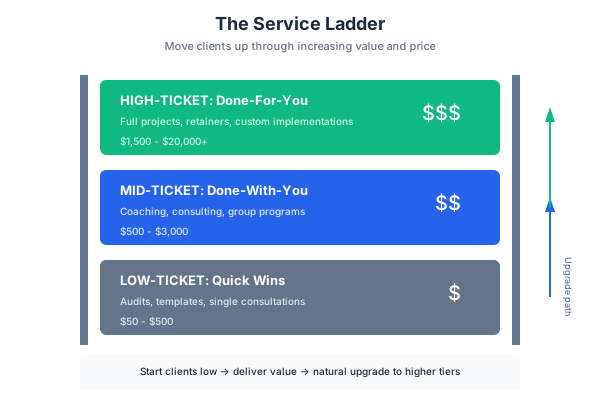
Don’t jump straight to high-ticket services. Build a ladder that lets clients engage at different levels.
Low-Ticket: Audits, Quick Wins, Templates
Entry-level services have lower prices and lower time commitment. They let clients try working with you before committing to larger projects.
Examples:
- Site audit ($100-300): Review their site and provide recommendations
- One-hour consultation ($100-250): Answer their specific questions live
- Template or toolkit ($50-150): Done-for-you resources they can implement
Benefits:
- Easy sale (low commitment)
- Qualifies potential bigger clients
- Can be partially productized
- Provides testimonials and case studies
Mid-Ticket: Done-With-You, Coaching, Consulting
Mid-tier services involve more time but also more value and higher prices.
Examples:
- Implementation coaching ($500-1,500): Guide them through implementing a strategy
- Multi-session consulting ($1,000-3,000): Ongoing advisory relationship
- Course + coaching hybrid ($500-2,000): Training with personal support
Benefits:
- Better hourly rate than low-ticket
- Builds deeper client relationships
- Room for ongoing work
High-Ticket: Done-For-You, Retainers, Projects
High-ticket services are where the real money is, but they also require the most expertise and trust.
Examples:
- Full site optimization ($1,500-5,000): Complete done-for-you service
- Monthly retainer ($1,000-5,000/month): Ongoing management and support
- Custom projects ($3,000-20,000+): Major implementations or builds
Benefits:
- Highest total revenue per client
- Clients are serious and committed
- Builds reputation for premium work
Requirements:
- Significant expertise and track record
- Portfolio and testimonials
- Systems to deliver consistently
- Capacity to handle project scope
Moving Clients Up the Ladder
The ladder works when clients naturally progress from lower to higher tiers.
Someone buys your $200 audit. You deliver great insights. They realize they need help implementing and upgrade to $1,500 coaching. That goes well, and they ask you to manage everything monthly for $2,000/month.
One client who started at $200 is now paying $24,000/year. That’s the power of the ladder.
Design your services so each tier naturally leads to the next. The audit identifies problems your coaching solves. The coaching creates systems your retainer maintains.
Problem-First Service Design
The worst services are designed around what you want to offer. The best services are designed around problems clients desperately want solved.
Starting with Reader Pain Points
Your blog comments, emails, and reader questions are gold for service design.
Look for patterns:
- What do readers ask for help with most often?
- What problems do they mention repeatedly?
- What tasks do they wish someone else would do?
- What are they already paying others to do (badly)?
These pain points are your service opportunities.
For a WordPress performance blog, pain points might include:
- “My site is slow but I don’t know how to fix it”
- “I failed Core Web Vitals and it’s affecting my rankings”
- “I don’t have time to optimize images and caching”
Each pain point suggests a service:
- Speed audit and recommendations
- Core Web Vitals fix service
- Ongoing performance maintenance retainer
Packaging Solutions, Not Hours
Don’t sell hours. Sell outcomes.
Bad positioning: “I charge $100/hour for consulting.”
Good positioning: “I’ll get your site passing Core Web Vitals for $1,500.”
When you sell hours, clients count them and try to minimize them. When you sell outcomes, they focus on the result and pay for value.
This also lets you price based on value, not time. If fixing Core Web Vitals will help them rank better and earn more, $1,500 is cheap compared to the outcome. If you charged $100/hour and it took 8 hours, you’d make $800 for the same result.
The Outcome Promise
Every service should have a clear outcome promise. What will be different when you’re done?
Weak promises:
- “I’ll optimize your site”
- “I’ll consult on your strategy”
- “I’ll manage your marketing”
Strong promises:
- “Your site will load in under 2 seconds, guaranteed”
- “You’ll have a 90-day content plan with 24 topic ideas mapped to keywords”
- “Your email list will grow by 500+ subscribers this quarter or I’ll work free until it does”
Strong promises are scary because they require confidence. But they also command premium prices and attract serious clients.
Only promise what you can deliver. But push yourself to be specific about outcomes.
Service Pages That Convert
Your service page is a sales page. It needs to convince readers that you can solve their problem better than alternatives.
Structure That Works
High-converting service pages follow a pattern:
- Headline: Clear outcome statement
- Problem agitation: Show you understand their pain
- Solution introduction: What you offer, briefly
- Authority proof: Why you’re qualified
- How it works: Clear process steps
- What’s included: Specific deliverables
- Results/testimonials: Proof it works
- Pricing: Clear options
- FAQ: Address objections
- Call to action: Clear next step
You don’t need every element on every page, but this structure covers the essential conversion elements.
Proof and Case Studies
Nothing sells services like proof that they work.
Types of proof:
- Before/after results with numbers
- Client testimonials with names and photos
- Case studies with detailed stories
- Screenshots of outcomes
- Logos of clients (with permission)
Build proof from day one. Ask every client for a testimonial. Document results meticulously. Screenshot everything.
Even if you’re just starting, you can show:
- Results from your own site
- Free work you’ve done for others
- Training or certifications
- Relevant experience
Pricing Display (Or Not)
There are arguments for and against showing pricing:
Show pricing if:
- Your price is competitive
- You want to filter out non-serious inquiries
- Your service is standardized
- You’re trying to minimize sales calls
Hide pricing if:
- You customize pricing based on scope
- Your price is premium and needs context
- You want to have a conversation first
- Your service requires detailed scoping
Both approaches work. I generally prefer showing at least starting prices to filter inquiries, with room for custom quotes on larger projects.
The Application Process
For high-ticket services, an application process helps you:
- Qualify leads before spending time on calls
- Position yourself as selective (not desperate)
- Gather information before conversations
- Increase commitment from prospects
A simple application form:
- What’s your website?
- What’s the main problem you need solved?
- What’s your budget range?
- What’s your timeline?
- Why are you interested in working with me specifically?
Review applications and only take calls with qualified prospects.
Scaling Service Income
Services don’t scale like passive income, but there are ways to increase revenue without proportionally increasing hours.
Productized Services
Productized services are standardized offerings with fixed scope and pricing.
Instead of custom quotes for every project, you offer:
- “WordPress Speed Optimization Package: $1,500, includes X, Y, Z”
- “Content Strategy Sprint: $2,000, 2-week engagement, deliverable is a 90-day plan”
Benefits of productizing:
- Faster sales (no back-and-forth scoping)
- More predictable delivery
- Easier to market and explain
- Can be delivered more efficiently over time
The key is finding a common problem that can be solved with a consistent process.
Group Offerings
Serve multiple clients simultaneously:
- Group coaching: 5-10 clients in a cohort, meeting weekly. Charge 50% of 1:1 rate per person, but serve 5x the clients.
- Workshops: One-day intensive sessions for multiple participants.
- Mastermind groups: Ongoing group for peer support and expert guidance.
Group offerings leverage your time better. Teaching 10 people in a 2-hour call is more efficient than 10 separate 1-hour calls.
The Ceiling and When to Pivot
Every service model has a ceiling. At some point, you’re fully booked and can’t take more clients without burning out.
When you hit the ceiling, options include:
- Raise prices (same hours, more revenue)
- Reduce scope (faster delivery, more clients)
- Build a team (leverage others’ time)
- Pivot to products (courses, templates, software)
Many successful bloggers start with services, hit the ceiling, and use that experience to create scalable products. The service work teaches you what people need and pay for.
Chapter Checklist
- [ ] Have I built enough blog authority to attract service clients?
- [ ] Have I designed a service ladder with multiple entry points?
- [ ] Are my services designed around client problems, not my preferences?
- [ ] Am I selling outcomes, not hours?
- [ ] Do I have proof and testimonials for my services?
- [ ] Have I considered how to scale beyond trading time for money?
Chapter Exercise
Task: Design one productized service based on your most common reader questions.
Time required: 60-90 minutes
Deliverable: A complete service description including problem, solution, deliverables, process, and pricing.
Process:
-
Identify the problem (15 minutes)
- Review your blog comments, emails, and common questions
- What do readers ask for help with most?
- What problem appears repeatedly?
- What would people pay to have solved?
-
Design the service (20 minutes)
- What outcome does this service deliver?
- What’s included in the deliverables?
- What’s your process for delivering it?
- How long does it take?
-
Price it (15 minutes)
- What’s the value of this outcome to the client?
- What are competitors charging for similar services?
- What price would you be excited to deliver this at?
- What would make this a clear “yes” for your target client?
-
Write the sales page outline (20 minutes)
- Headline promising the outcome
- 3-4 pain points you’ll address
- What’s included (bullet list)
- How it works (3-5 steps)
- What results look like
- Price and call to action
Example service design:
Service: WordPress Speed Fix Package
Problem: Site owners failing Core Web Vitals, losing rankings, don’t know how to fix it themselves.
Outcome: Site passes Core Web Vitals with load time under 2 seconds.
Deliverables:
- Complete speed audit with prioritized recommendations
- Caching configuration
- Image optimization
- Database cleanup
- Performance tuning
- Before/after documentation with PageSpeed scores
Process:
- Initial audit and benchmark (Day 1-2)
- Implement optimizations (Day 3-7)
- Testing and refinement (Day 8-10)
- Final report and documentation (Day 11-14)
Price: $1,500
Page headline: “Get Your WordPress Site Passing Core Web Vitals in 14 Days, Guaranteed”
This exercise gives you a concrete service you can start offering. Refine based on client feedback after your first few projects.