
Let’s talk about the monetization method nobody wants to discuss openly. Selling backlinks.
Companies pay bloggers to link to their websites. It happens constantly. Some bloggers make significant income from it. Others have had their sites penalized into oblivion for doing it wrong.
This chapter covers the reality of paid links: when it’s acceptable, when it’s risky, and where the lines are that you shouldn’t cross.
The Reality of Paid Links
I’ll be direct: selling links exists in a gray area between acceptable business practice and Google guidelines violation. Understanding this reality is essential before you decide whether to participate.
Why Companies Pay for Links
Links are a ranking factor. Google uses them as “votes” for a website’s authority and relevance. The more quality sites link to you, the better you tend to rank.
This creates demand. Companies want links from authoritative sites. Bloggers have authoritative sites. Money changes hands.
The link buying market is enormous. Agencies charge $100-1,000+ per link placement. Individual bloggers charge anywhere from $50 to $500 per link depending on their site’s authority.
The SEO Value Proposition
From a buyer’s perspective:
- One high-quality link can improve rankings significantly
- Rankings improvements lead to traffic and revenue
- The ROI can be substantial for competitive keywords
From a seller’s perspective:
- You have an asset (site authority) that has value
- Links require relatively little work to place
- The income can be meaningful
Why This Is a Gray Area
Google’s official position: paid links that pass PageRank violate their guidelines. They should be marked with rel=”nofollow” or rel=”sponsored” attributes, which tells Google not to count them as ranking signals.
The reality: many paid links are not marked this way. Buyers specifically pay for “dofollow” links that do pass authority. This is technically against Google’s rules but is widely practiced.
The gray area exists because:
- Google can’t detect all paid links
- Many sites sell links without consequences
- The line between “paid link” and “earned mention” is blurry
- Different people have different risk tolerances
I’m not going to tell you whether to sell links. I am going to explain the risks and rules so you can make an informed decision.
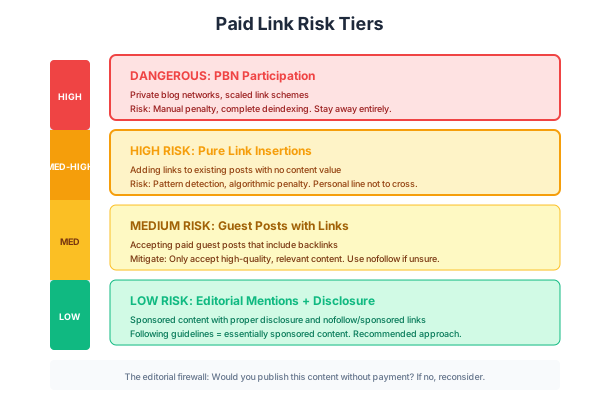
Risk Tiers for Link Selling
Not all paid link situations carry equal risk. Understanding the tiers helps you decide what you’re comfortable with.
Low Risk: Editorial Mentions with Disclosure
What it looks like: A company pays you to write about them, you disclose the sponsorship, and you include a link with proper attributes (rel=”sponsored” or rel=”nofollow”).
Why it’s low risk: You’re following Google’s guidelines. The link is disclosed and doesn’t pass PageRank inappropriately. This is essentially sponsored content with proper handling.
Income potential: Lower, because buyers often specifically want PageRank-passing links. But legitimate sponsored content can still pay well.
My take: This is the safest approach and what I recommend for most bloggers.
Medium Risk: Guest Posts with Links
What it looks like: Someone pays you to accept their guest post on your site, which includes links to their website.
Why it’s medium risk: Guest posts are common and often legitimate. But Google knows they’re frequently used for link building. Low-quality guest posts with obvious link placement can trigger penalties.
Risk factors:
- Off-topic guest posts (finance article on a cooking blog)
- Low-quality content that exists only to place links
- Unnatural anchor text optimization
- Patterns of accepting many guest posts with similar links
Mitigating risk: Only accept high-quality guest posts that fit your site’s topic. Edit them to meet your standards. Use nofollow on links if uncertain.
High Risk: Pure Link Insertions
What it looks like: Someone pays you to add a link to an existing post. No new content, just a link inserted into your content.
Why it’s high risk: This is purely about the link, not about content value. Google’s algorithms have gotten better at detecting these patterns. Sites that do this heavily often get penalized.
Risk factors:
- Unnatural link placement that doesn’t fit the content
- Multiple paid links in the same posts
- Anchor text that’s obviously keyword-optimized
- Links to sites completely unrelated to your content
My take: This is where I draw my personal line. The risk/reward isn’t worth it for my sites.
Dangerous: PBN Participation
What it looks like: Private Blog Networks (PBNs) are networks of sites created primarily to sell links. Participating can mean creating PBN sites or selling links to obvious PBN operators.
Why it’s dangerous: Google actively hunts for and penalizes PBNs. Getting caught can result in manual penalties that destroy your site’s rankings entirely.
Signs of PBN involvement:
- Buyers who want to place links on dozens of sites simultaneously
- Buyers who don’t care about content quality at all
- Networks of sites with similar characteristics, no real audience
- Extremely high link volume requests
My take: Stay away entirely. The risk of catastrophic penalty isn’t worth any amount of money.
The Editorial Firewall
If you do sell links or accept paid content, maintaining an editorial firewall protects your site’s quality and reputation.
Content Quality Requirements
Never publish anything that doesn’t meet your normal standards just because someone paid for it.
The content should:
- Be well-written and free of errors
- Fit your site’s topic and audience
- Provide genuine value to readers
- Not be duplicate or scraped content
- Make sense independent of the links
If someone submits garbage, reject it or require rewrites. Your site’s quality is more important than any single payment.
Relevance Requirements
The link and content should make sense together, and both should make sense on your site.
Bad: A WordPress blog suddenly publishing content about payday loans with links to financial services.
Better: A WordPress blog publishing content about e-commerce with links to WooCommerce-related services.
Best: A WordPress blog publishing content you’d have written anyway that happens to reference a relevant product.
Relevance protects you from penalty and protects readers from confusion.
The “Would I Publish This Without Payment?” Test
Before accepting any paid content or link placement, ask:
“If this person came to me without offering payment, would I still consider publishing this content or adding this link?”
If the answer is no, you’re compromising your editorial standards for money. That’s your call to make, but understand the tradeoff.
If the answer is yes, you’re being compensated for something that has genuine value on your site anyway. That’s a cleaner arrangement.
Pricing and Deal Terms
If you decide to participate in any form of link selling, price and terms matter.
Factors That Affect Link Pricing
Domain authority/rating: Higher authority sites can charge more. A DA 60 site charges significantly more than a DA 30 site.
Traffic: Sites with real traffic and engagement command higher prices than sites that only have authority metrics.
Niche: Some niches (finance, gambling, CBD) pay premium rates because they’re competitive and have limited options.
Link type:
- Homepage link: Highest price
- Inner page link in relevant content: High price
- Link in new content: Medium price
- Link in sponsored/nofollow format: Lower price
Permanence: Permanent links cost more than temporary placements.
Pricing Ranges
Very rough guidelines based on what I’ve seen in the market:
- Site Quality: DA 20-30 | Guest Post: $50-100 | Link Insertion: $30-50 | Sponsored Post: $75-150
- Site Quality: DA 30-40 | Guest Post: $100-200 | Link Insertion: $50-100 | Sponsored Post: $150-300
- Site Quality: DA 40-50 | Guest Post: $200-400 | Link Insertion: $100-200 | Sponsored Post: $300-500
- Site Quality: DA 50-60 | Guest Post: $400-800 | Link Insertion: $200-400 | Sponsored Post: $500-1,000
- Site Quality: DA 60+ | Guest Post: $800+ | Link Insertion: $400+ | Sponsored Post: $1,000+
These vary significantly by niche, traffic, and negotiation. Use them as starting points, not absolutes.
One-Time vs. Ongoing Arrangements
One-time deals: Single payment, single link. Simple but requires constant sales effort to maintain income.
Ongoing arrangements: Monthly retainer for a certain number of placements. More predictable but requires managing ongoing relationships.
For most bloggers, one-time deals are simpler. Ongoing arrangements make sense only if you have significant capacity and want to treat this as a serious revenue stream.
Contract Basics
Protect yourself with clear terms:
- What exactly is being purchased (content type, link attributes, placement location)
- Payment terms and timeline
- Revision policy
- Duration (permanent link? guaranteed for X months?)
- Content standards and rejection rights
- Disclosure requirements
Written agreements prevent misunderstandings and protect both parties.
The Lines You Don’t Cross
Some practices are too risky or unethical to consider regardless of payment.
No Nofollow Manipulation Without Disclosure
If someone pays for a link and you agree to make it dofollow without disclosing the paid relationship, you’re deceiving both Google and your readers. This is the core of what makes paid links problematic.
If you’re going to sell dofollow links, at least be honest with yourself about what you’re doing and the risks involved.
No Irrelevant Placements
A casino link on a parenting blog damages your site’s topical relevance and confuses readers. It’s also a red flag for Google’s algorithms.
Stay in your lane. Only accept links that make sense on your site.
No Scaled Link Schemes
If someone approaches you to place links across 50 sites simultaneously, you’re probably dealing with a link scheme operator. Even if your individual site might not get caught, you’re participating in something that’s clearly designed to manipulate search results.
These operations eventually get detected, and everyone involved can get penalized.
Protecting Your Domain Authority
Your domain authority is an asset that took years to build. Link selling, done irresponsibly, can destroy it.
Protect your DA by:
- Limiting the volume of paid links
- Maintaining content quality standards
- Keeping relevance high
- Using proper disclosure when required
- Avoiding obvious manipulation patterns
If link income is destroying your site’s long-term value, you’re not making money. You’re liquidating an asset.
Chapter Checklist
- [ ] Do I understand the risk tiers for different types of paid link arrangements?
- [ ] Have I decided what I’m personally comfortable with?
- [ ] Do I have content quality requirements for any paid content?
- [ ] Am I maintaining relevance in any link partnerships?
- [ ] Do I have clear pricing and terms for any services I offer?
- [ ] Am I avoiding the practices that cross ethical or high-risk lines?
Chapter Exercise
Task: Write your personal link selling policy.
Time required: 30-45 minutes
Deliverable: A one-page policy document outlining what you will and won’t do, with your pricing if applicable.
Process:
-
Decide your position (15 minutes)
Answer honestly:
- Am I comfortable with any form of paid links?
- What risk level am I comfortable with?
- What content/relevance requirements will I enforce?
- What’s non-negotiable for me?
-
Document your boundaries (15 minutes)
Write out:
- What I will accept (with conditions)
- What I won’t accept under any circumstances
- Quality standards for any paid content
- Disclosure practices I’ll follow
-
Set pricing if applicable (10 minutes)
If you decide to participate:
- Research your site’s authority metrics
- Set baseline prices for different offerings
- Define what’s included and terms
Example policy:
My Link/Content Partnership Policy
What I’ll accept:
- Sponsored posts with proper disclosure and nofollow links
- High-quality guest posts that fit my niche, with nofollow links
- Editorial mentions of relevant products with disclosure
What I won’t accept:
- Dofollow paid links without disclosure
- Link insertions into existing content
- Off-topic content regardless of payment
- Participation in multi-site link networks
- Anything that requires me to mislead readers
Content standards:
- Must be well-written and original
- Must fit my site’s topic and audience
- Must pass my normal editorial review
- Must not be promotional spam
Pricing:
- Sponsored post (nofollow links): $X
- Guest post acceptance (nofollow): $X
- All content must be disclosed as sponsored/paid
Terms:
- 50% upfront, 50% on publication
- I reserve right to edit for quality and fit
- I reserve right to reject content that doesn’t meet standards
This policy helps you make consistent decisions and gives you something to reference when opportunities arise.