
Clickbait works. Once.
You can write a sensational headline, overpromise, and get someone to click. But when the content doesn’t deliver, you’ve burned trust. That reader probably won’t click next time. Worse, they’ll tell others.
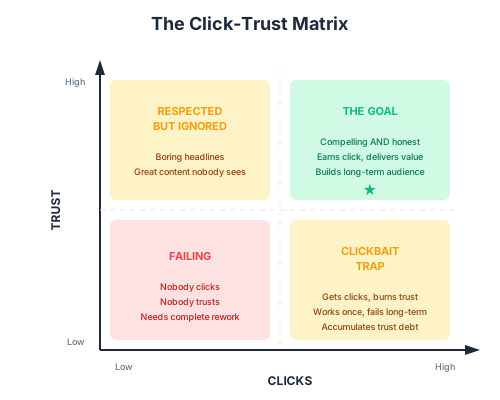
The best content earns the click and delivers on the promise. It’s interesting enough to stand out in a crowded feed but honest enough to build long-term relationships. This chapter is about finding that balance, not choosing between attention and trust, but getting both.
The Click-Trust Paradox
You need people to click on your content. That’s just reality. The best article in the world is worthless if nobody reads it. Headlines and hooks matter.
But every time you prioritize clicks over substance, you take on trust debt. And trust debt compounds just like financial debt, until eventually you’re bankrupt and no one believes anything you write.
Why Clicks Without Trust Kills Long-Term Growth
Short-term, clickbait performs. It gets higher initial click-through rates. It can even generate some traffic.
Long-term, it’s a death spiral:
Readers learn to distrust you. They clicked on “I Made $50,000 in One Month” and found a vague post about mindset with no actual proof. Next time they see your headline, they scroll past.
Bounce rates increase. Google notices when people click and immediately leave. That’s a signal that your content didn’t match the search intent. Your rankings drop.
Sharing decreases. People share content that makes them look good. Sharing clickbait makes them look gullible. Your best distribution channel (word of mouth) dies.
Email engagement drops. Subscribers who’ve been burned stop opening your emails. Your deliverability suffers. You’re training them to ignore you.
The blogger who delivers on their promises every time builds an audience that clicks on everything they publish. That’s the goal.
The Trust Debt Problem
Every time you overpromise in a headline, you borrow against future trust. Sometimes the loan is small, sometimes it’s massive.
Small trust debt: A headline that’s slightly more exciting than the content warrants. Readers might not consciously notice, but trust erodes slowly.
Medium trust debt: A headline that promises specific outcomes but the content only vaguely gestures at them. “How I Tripled My Traffic” but the post is just generic tips without your actual data.
Large trust debt: Complete mismatch between promise and delivery. “The Secret That Made Me a Millionaire” and it’s a 500-word post about gratitude journaling with no evidence it made anyone a millionaire.
The problem with trust debt is you can’t see the damage accumulating. Traffic might look fine for a while. But one day you notice open rates are down, shares are down, comments are gone, and you’ve been borrowing so long that readers have quietly left.
How Readers Remember Disappointment
Readers rarely remember good content consciously. They just keep reading. But they absolutely remember being disappointed.
I still remember a blogger who promised “the exact template” that made them $100K. The template was a vague Google Doc with placeholder text. That was 5 years ago. I haven’t clicked on their content since.
Your readers remember too. And they’re making mental notes about whether you can be trusted.
The asymmetry is brutal: you need to deliver value 10 times to build trust, but you can destroy it with one bad experience. That’s why erring on the side of under-promising and over-delivering is always the right call.
Headlines That Work Without Lying
Good headlines are specific, clear, and honest. They promise something real and make you curious how they’ll deliver.
Specificity Beats Hype
Vague headlines are weak headlines. “How to Be More Productive” is forgettable. “The 20-Minute Morning Routine That Saved My Workday” is specific enough to be interesting.
Compare:
- Weak: “Ways to Make Money Blogging”
- Specific: “How I Made $2,340 Last Month From One Blog Post”
Compare:
- Weak: “WordPress Speed Tips”
- Specific: “The 3 Changes That Dropped My Load Time From 4.2s to 0.9s”
Specificity works because it signals that the content has substance. Anyone can write “ways to make money.” Only someone with actual experience can write about specific results with specific numbers.
Numbers That Mean Something
Numbers in headlines work, but they have to be meaningful.
Good uses of numbers:
- Specific results: “$5,347 in affiliate revenue from this single guide”
- Time frames: “in 30 minutes” or “in 90 days”
- Limitations: “with only 1,000 visitors”
- Counts that matter: “The 3 metrics I actually track”
Bad uses of numbers:
- Arbitrary lists: “17 Ways to…” (why 17? Because you ran out at 17?)
- Vague quantities: “Tons of tips for…”
- Meaningless precision: “47.3% improvement” (suspiciously precise without context)
Numbers should be exact when you have exact data and round when you’re approximating. “About 40% improvement” is more honest than “42.7% improvement” if you didn’t actually measure to that precision.
Promise Only What You Deliver
Before finalizing any headline, ask: “Does the content actually deliver this?”
If your headline says “complete guide,” is it actually complete? If your headline says “step-by-step,” are there actual steps? If your headline says “how I made $X,” do you show the actual numbers and process?
Some bloggers write headlines first, then try to make the content match. That’s backwards. Write the content first, then write the most accurate, interesting headline for what you actually created.
Ten Headline Formulas That Build Trust
These formulas work without requiring exaggeration:
-
How I [Achieved Result] [In Timeframe/With Constraint]
- “How I Doubled My Email List in 60 Days With No Budget”
-
[Number] [Things] That [Specific Outcome]
- “5 WordPress Plugins That Actually Improved My Page Speed”
-
Why [Common Advice] Is Wrong (And What to Do Instead)
- “Why ‘Just Be Consistent’ Is Bad Blogging Advice”
-
[Thing] vs [Thing]: [Specific Decision Criteria]
- “WP Rocket vs FlyingPress: Which Is Better for WooCommerce?”
-
The [Adjective] Guide to [Topic] for [Specific Audience]
- “The No-Nonsense Guide to WordPress SEO for Beginners”
-
What [Timeframe] of [Activity] Taught Me About [Topic]
- “What 3 Years of Affiliate Marketing Taught Me About Trust”
-
[Doing Thing] Without [Common Negative]
- “Monetizing Your Blog Without Annoying Your Readers”
-
I Tested [Number] [Things]. Here’s What Won.
- “I Tested 7 Caching Plugins. Here’s the Only One I Recommend.”
-
Stop [Common Mistake] (Do This Instead)
- “Stop Chasing Keywords (Focus on Topics Instead)”
-
The [Hidden/Overlooked] [Thing] That [Outcome]
- “The Overlooked Setting That’s Slowing Down Your Site”
Notice what these formulas have in common: they make a specific promise that can actually be delivered. No vague “secrets” or impossible claims. Just clear value propositions.
First Impressions: The Opening 100 Words
Your headline earns the click. Your opening keeps them reading or loses them forever. Most readers decide within the first few sentences whether to continue.
Hook Patterns That Work
Start with the problem. Readers should feel like you understand their frustration.
“You’ve published 50 posts and your traffic is stuck at 200 visits a month. You’re doing everything the gurus say. It’s not working. Here’s why.”
Start with a strong claim. Make a statement that creates curiosity.
“Most WordPress speed advice is wrong. Not just incomplete. Actively harmful. I spent two years following it before realizing I was making my sites slower.”
Start with a specific story. Pull readers into a narrative.
“Last month a client called me in a panic. Their site had dropped from position 3 to position 27 overnight. Google’s algorithm update had hit them hard. Here’s what we found when we looked under the hood.”
Start with a counterintuitive point. Challenge what they expect to hear.
“I stopped writing new content for 6 months. My traffic doubled. This is the story of how I learned that more posts isn’t always the answer.”
Each of these hooks does the same thing: creates enough curiosity that the reader has to keep reading to get resolution.
What to Avoid in Openings
Throat-clearing. “Hello everyone! Today I’m going to talk about…” Stop. Nobody cares. Get to the point.
Dictionary definitions. “According to Merriam-Webster, SEO is defined as…” This is lazy padding. Skip it entirely.
Background that can come later. Don’t start with the history of WordPress. Start with something the reader cares about right now.
Vague statements. “Content is important.” “Marketing matters.” These mean nothing. Be specific or be quiet.
Meta-commentary. “Before I get into this, I want to explain why I’m writing this post…” Just write the post. They clicked on it, they’ll figure out why it exists.
The “Prove You Understand My Problem” Approach
The most effective openings demonstrate that you understand the reader’s situation better than they do themselves.
“You’re following every piece of SEO advice you can find. You’re writing long-form content. You’re targeting keywords. You’re building backlinks. But your traffic has flatlined and you don’t know why.”
This opening works because readers think, “Yes, that’s exactly me.” Once they feel understood, they trust that you might have the answer.
To write this way, you need to know your reader intimately (which you defined in Chapter 2). Use their language. Describe their specific frustrations. Show them you’ve been where they are.
Content Structure for Engagement
How you structure content affects whether people read it all or bail halfway through.
Scannable Formatting (But Not Lazy)
Most readers scan before they read. They’re looking for signals that this content is worth their time.
Good scannable formatting includes:
- Clear subheadings that tell you what each section covers
- Short paragraphs (3-5 sentences, occasionally 1-2 for emphasis)
- Bold key phrases so scanners can grab main points
- Bulleted lists for multiple related items
- Images or screenshots to break up text walls
But scannable doesn’t mean shallow. Each section should have substance when someone does read it. The goal is to serve both scanners and readers, not to turn everything into bullet points.
Subheadings That Pull Readers Forward
Your subheadings should create a mini-outline of the post. Someone who reads only the subheadings should understand what the post covers.
Weak subheadings:
- Introduction
- Main Points
- Tips
- Conclusion
Strong subheadings:
- The Problem: Why Most Speed Advice Fails
- What Actually Matters: Server Response Time
- The Three Fixes That Work (In Order of Priority)
- What I’d Do If I Were Starting Over
Strong subheadings are specific and create curiosity. They make readers want to know more.
The Rhythm of Paragraphs
Variety in paragraph length keeps readers engaged. A wall of uniform paragraphs is tiring. Mix it up.
- Long paragraph for detailed explanation
- Short paragraph for emphasis
- Medium paragraph for transition
- One sentence for impact
Like this.
See how that single sentence breaks the rhythm? It creates a pause, emphasis. Use this intentionally.
Also vary sentence length within paragraphs. Mix long sentences that pack in detail with short ones that punch. This keeps energy up and prevents monotony.
Closing Without Cliches
Your closing is the last impression readers take with them. Don’t waste it on “Thanks for reading!” or “Let me know in the comments!”
End with Value, Not Filler
The strongest closings give one final piece of value or perspective that ties everything together.
Strong closings:
- A summary of the one thing they should remember
- A direct recommendation for their next action
- A personal note about what this topic means to you
- A challenge that prompts them to take action
Weak closings:
- “I hope this was helpful!” (passive, generic)
- “Drop a comment with your thoughts!” (begging for engagement)
- “Don’t forget to subscribe!” (salesy)
- “There’s so much more I could say but…” (then say it or don’t)
The Clear Next Action
Every piece of content should lead somewhere. What should the reader do next?
For SEO content, the next action might be:
- Read a related post
- Download a resource
- Try a recommended tool
- Subscribe for more
For affiliate content, the next action is clear: click the link and consider the product.
For audience-building content, the next action might be:
- Subscribe to your email list
- Follow you on social media
- Apply what they learned and report back
Make the next action explicit. Don’t assume readers will figure out what to do. Tell them.
How to Close Different Content Types
Tutorials: End with a summary of what they’ve accomplished and a suggestion for what to learn next.
“You’ve now set up caching on your WordPress site. Expected result: 40-60% improvement in load time. Next step: check out my guide to image optimization to squeeze out even more speed.”
Reviews: End with a clear recommendation and who it’s best for.
“FlyingPress is my current recommendation for most WordPress sites. It’s faster than WP Rocket, simpler than W3 Total Cache, and well-maintained. If you’re on a budget, LiteSpeed Cache is free and excellent. Get FlyingPress if you want the best results with minimal setup.”
Opinion pieces: End with a direct statement of your position and a challenge.
“I think most blogging advice is actively harmful. It optimizes for metrics that don’t matter while ignoring what actually builds sustainable income. You can disagree. But before you do, check your own results. Is the standard advice working for you?”
Comparison posts: End with a decision framework, not just a winner.
“Choose WP Rocket if you want easier setup and better documentation. Choose FlyingPress if you want faster performance and are willing to configure settings. There’s no wrong answer, just which tradeoff fits your situation.”
Chapter Checklist
- [ ] Do my headlines promise only what the content delivers?
- [ ] Are my headlines specific rather than vague?
- [ ] Do my openings hook readers immediately without throat-clearing?
- [ ] Is my content scannable with clear subheadings?
- [ ] Do my closings end with value and clear next actions?
- [ ] Am I building trust with every piece of content, not borrowing against it?
Chapter Exercise
Task: Rewrite the headline and opening of your 3 worst-performing posts.
Time required: 60-90 minutes
Deliverable: Three revised headlines and openings, plus notes on what was wrong with the originals.
Process:
-
Identify your 3 worst-performing posts (15 minutes)
- Use your analytics to find posts with high impressions but low click-through, or high traffic but high bounce rate
- These posts are getting seen but not performing
-
Analyze the current headline (10 minutes each)
- Is it specific or vague?
- Does it promise something the content delivers?
- Is there a reason someone would click on this over other results?
-
Rewrite each headline (15 minutes each)
- Write 5 alternatives for each post
- Pick the one that’s most specific and honest
- Make sure the content actually delivers on the promise
-
Analyze the current opening (10 minutes each)
- Does it hook immediately or throat-clear?
- Does it demonstrate understanding of the reader’s problem?
- Is there a reason to keep reading?
-
Rewrite each opening (15 minutes each)
- Use one of the hook patterns from this chapter
- Get to value within the first 3 sentences
- Create curiosity that makes continuing irresistible
Example before/after:
Original headline: “WordPress Speed Tips”
Problem: Vague, generic, no reason to click on this vs. thousands of others
Revised headline: “The 3-Step Speed Fix That Took My Site From 4s to Under 1s”Original opening: “Website speed is important for SEO and user experience. There are many ways to speed up your WordPress site. In this post, I’ll share some tips.”
Problem: Throat-clearing, no hook, no specificity, no proof of expertise
Revised opening: “My client’s site was loading in 4.2 seconds. Google’s threshold for ‘fast’ is 2.5 seconds. We were failing Core Web Vitals, losing rankings, and hemorrhaging mobile visitors. Here’s exactly what we fixed, in order, to get load time under 1 second.”
Apply this process to your three posts. Then consider doing it for your entire content library over time. Better headlines and openings can double the performance of content you’ve already written.