
Affiliate marketing is the cleanest monetization path for most bloggers. You recommend products you believe in, readers buy through your links, and you earn a commission. No inventory. No support tickets. No massive upfront investment.
I’ve earned over $650,000 from affiliate marketing since I started tracking it properly. Most of that came from the same core products I genuinely use and recommend. It’s not complicated, but it requires doing things right from the start.
This chapter covers the foundation: why affiliate should come first in your monetization stack, how to choose products worth recommending, the ethics you can’t skip, and the content structure that makes it work.
Why Affiliate First Makes Sense
When I advise new bloggers on monetization, affiliate marketing is almost always where I tell them to start. Here’s why.
Low Barrier to Entry
You don’t need:
- A product to create
- Inventory to manage
- Customer support infrastructure
- Significant startup capital
- A huge audience to get started
You need:
- A blog with some traffic
- Useful content about products people buy
- Affiliate relationships (most are free to join)
- Honest recommendations
Most affiliate programs accept you immediately or within a few days of applying. You can have affiliate links live within a week of deciding to start.
Aligned Incentives (Usually)
When done right, affiliate marketing aligns your incentives with your readers’ interests.
You want them to buy good products because:
- Happy customers don’t request refunds (which cost you commission)
- Happy customers trust your future recommendations
- Good products are easier to write about honestly
The incentives only break when you chase commission over quality. A $200 product with a 50% commission is tempting, but if it sucks and your readers complain, you’ve burned trust for a short-term payout.
Keep incentives aligned by recommending what you’d recommend even without commission.
Scalable Without Inventory or Support
If 10 people buy through your affiliate link, you earn 10 commissions. If 1,000 people buy, you earn 1,000 commissions. The work is the same either way.
You don’t:
- Ship anything
- Handle returns
- Answer product questions
- Deal with payment processing
- Manage customer relationships
The company does all of that. You just send them qualified buyers.
This leverage is why affiliate can scale faster than services. I’ve had single blog posts generate $20,000+ in affiliate revenue over their lifetime, earning while I sleep.
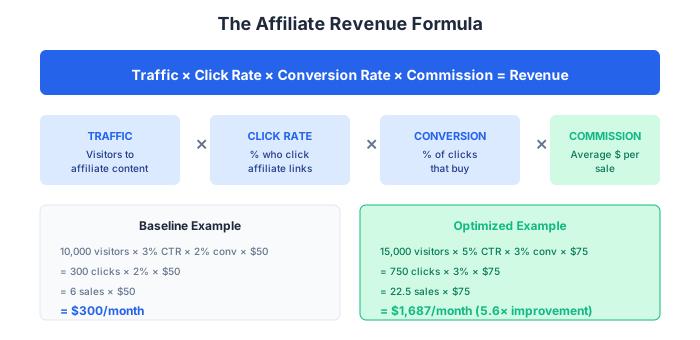
The Math: Traffic × CTR × Conversion Rate × Commission
Here’s the simple formula that determines affiliate income:
Monthly visitors × Click-through rate × Conversion rate × Average commission = Revenue
Let’s plug in realistic numbers:
- 10,000 monthly visitors to affiliate content
- 3% click through to affiliate links (300 clicks)
- 2% of clicks convert to purchases (6 sales)
- $50 average commission
- Result: $300/month
Now let’s improve each variable by a reasonable amount:
- 15,000 monthly visitors (grew traffic)
- 5% click through (better placement and context)
- 3% of clicks convert (better product-audience fit)
- $75 average commission (focused on higher-value products)
- Result: $1,687/month
Same fundamental approach, over 5x the revenue. Small improvements at each stage multiply together.
This is why affiliate income can grow quickly once you understand the levers.
Choosing Products Worth Recommending
Not all affiliate products deserve your recommendation. Being selective here protects your reputation and actually increases long-term earnings.
The “Would I Recommend This to a Friend?” Test
Before promoting any affiliate product, ask yourself: “If a friend asked me about this, would I genuinely recommend it?”
Not “would I mention it as an option” but “would I tell them to buy it?”
If the answer is no or hesitant, don’t promote it. Your readers can sense when you’re not fully behind a recommendation.
Products that pass this test:
- Solve a real problem your audience has
- Work as advertised
- Have reasonable pricing for the value
- Have decent support and documentation
- Are from companies that treat customers well
Products that fail:
- Are overpriced for what they deliver
- Have a history of customer complaints
- Are buggy or poorly maintained
- Come from companies with shady practices
- You’ve never actually used
Commission Rate vs. Product Quality
This is where many bloggers go wrong. They see a product with a 50% commission and immediately sign up, even if the product is mediocre.
High commission rates often signal:
- High refund rates (they have to pay affiliates enough to justify the risk)
- Lower quality products (good products don’t need to bribe affiliates)
- Aggressive upsells that annoy customers
- Short-term thinking by the company
I’d rather promote a $100 product with a 20% commission ($20) that delights customers than a $100 product with 50% commission ($50) that disappoints them.
The $20 commission comes with:
- Higher conversion rates (good reputation)
- Lower refund rates (happy customers)
- Repeat customers who trust your recommendations
- Long-term relationship with a quality company
The $50 commission often comes with:
- Lower conversion rates (bad reputation)
- Higher refund rates (unhappy customers)
- Readers who lose trust in you
- Short-term relationship (company may disappear)
Commission rate matters, but product quality matters more.
Recurring vs. One-Time Commissions
Some affiliate programs pay once when a customer signs up. Others pay recurring commissions for as long as the customer stays subscribed.
One-time commissions:
- Higher initial payout (often 50-100% of first payment)
- Done after the first sale
- Predictable per-sale earnings
Recurring commissions:
- Lower initial payout (often 20-30% monthly)
- Continues for months or years
- Compounds over time as you refer more customers
Recurring commission programs are harder to find but much more valuable long-term.
Example: A hosting company pays $65 one-time vs. $20/month recurring.
- After month 1: One-time = $65, Recurring = $20
- After month 6: One-time = $65, Recurring = $120
- After month 12: One-time = $65, Recurring = $240
- After month 24: One-time = $65, Recurring = $480
If the average customer stays 18+ months, the recurring program pays 3-4x more.
I prioritize recurring commission programs when quality is equal. The compounding effect is significant over time.
Building a Focused Product Stack
Don’t try to promote everything. Build a focused stack of products you recommend consistently.
My WordPress stack, for example:
- Hosting: One primary recommendation, one budget alternative
- Theme: One recommendation for most cases
- Caching: One recommendation
- SEO: One recommendation
- Forms: One recommendation
- Backups: One recommendation
Each category has a clear winner based on my testing and experience. When I write about that category, I recommend the same product consistently.
This approach:
- Builds authority (you become known for specific recommendations)
- Increases trust (readers see consistency, not random product pushing)
- Simplifies content creation (you know what you’re recommending)
- Improves conversion (focused recommendations convert better than options lists)
Add new products to your stack slowly and only when they genuinely improve on what you’re already recommending.
Disclosure and Ethics (Non-Negotiable)
Affiliate disclosure isn’t just legally required, it’s ethically necessary and actually good for business.
FTC Requirements in Plain English
In the US, the FTC requires you to disclose “material connections” with companies you recommend. An affiliate relationship is a material connection.
What this means:
- You must disclose that you earn commissions from affiliate links
- The disclosure must be clear and conspicuous (not buried in fine print)
- The disclosure must appear before the affiliate link
- “Clear and conspicuous” means a reasonable reader would notice it
What qualifies as disclosure:
- A statement at the top of the post: “This post contains affiliate links. I may earn a commission if you make a purchase.”
- Text near the link: “This is an affiliate link”
- A clearly visible disclosure page linked from every post
What doesn’t qualify:
- A disclosure buried in your privacy policy
- A disclosure only at the bottom of the post
- Vague language like “this site is monetized”
- Relying on readers to figure it out
Where and How to Disclose
I use multiple layers:
Site-wide disclosure: A clear statement in my footer and a dedicated disclosure page.
Post-level disclosure: A brief statement at the top of any post with affiliate links: “This article contains affiliate links. I may earn a commission if you purchase through these links, at no extra cost to you.”
In-context disclosure: Near significant affiliate mentions: “FlyingPress (affiliate link)” or “If you purchase through my link, I earn a small commission.”
Overkill? Maybe. But I’d rather over-disclose than have any reader feel deceived.
Why Transparency Builds Trust, Not Kills Conversions
New bloggers worry that disclosing affiliate relationships will hurt conversions. The opposite is true.
Readers know affiliate links exist. They’re not stupid. When they see you’re transparent about it, they trust you more, not less.
Think about it from the reader’s perspective:
Blogger A: No disclosure, pretends to be purely objective, readers suspect (correctly) that money is involved but don’t know how.
Blogger B: Clear disclosure, says “I earn a commission if you buy, but I only recommend products I genuinely use,” readers know exactly where they stand.
Who do you trust more? Most readers trust Blogger B.
Transparency also protects you. If a reader discovers undisclosed affiliate links, they feel deceived. That’s worse for your reputation than any conversion loss from disclosure.
The Affiliate Content Stack
Not all content is equal for affiliate marketing. Some content types convert much better than others.
Money Pages (Direct Purchase Intent)
Money pages target readers who are actively looking to buy. They have the highest conversion rates.
Types of money pages:
- “Best [category] for [use case]” posts
- “[Product A] vs [Product B]” comparisons
- “[Product] review” posts
- “[Product] alternatives” posts
- “[Product] discount/coupon” posts
Money pages should be your highest-quality content. Spend extra time on them because they directly drive revenue.
Characteristics of good money pages:
- Comprehensive coverage of the decision factors
- Clear recommendations with reasoning
- Honest pros and cons
- Specific results and evidence
- Easy-to-find affiliate links
Support Pages (Problem-Solving That Leads to Products)
Support pages solve problems that naturally lead to product recommendations.
Examples:
- “How to speed up WordPress” → leads to caching plugin recommendation
- “How to prevent WordPress hacking” → leads to security plugin recommendation
- “Why your site isn’t ranking” → leads to SEO tool recommendation
Support pages have lower conversion rates than money pages because readers aren’t in buying mode yet. But they:
- Build trust and demonstrate expertise
- Create internal linking opportunities to money pages
- Capture traffic from problem-aware searches
- Warm readers up for future purchases
A good content mix includes both money pages and support pages, with support pages linking to money pages.
Trust Pages (Expertise Builders That Don’t Sell)
Some content shouldn’t sell at all. It should just establish you as an expert worth listening to.
Examples:
- Case studies of your own results
- Opinion pieces on industry topics
- In-depth explanations of complex concepts
- Behind-the-scenes looks at your work
Trust pages don’t have affiliate links or have them minimally. Their job is to convince readers you know what you’re talking about, which makes them more likely to follow your recommendations elsewhere.
The Ratio
My recommended ratio for affiliate-focused blogs:
- 40-50% money pages: Your revenue drivers
- 30-40% support pages: Traffic builders and trust builders that link to money pages
- 10-20% trust pages: Pure authority building
This ratio shifts based on your niche and audience. Some niches have more buying intent and can support more money pages. Some need more trust-building first.
Common Affiliate Mistakes
I’ve made most of these mistakes myself. Learn from them.
Promoting Everything With a Commission
Just because a product has an affiliate program doesn’t mean you should promote it.
The temptation: “This company has a 40% commission! I should write about them!”
The reality: If the product doesn’t fit your audience or isn’t genuinely good, promoting it hurts your reputation and probably won’t convert anyway.
Be selective. Promote only products that:
- Your specific audience needs
- You’ve tested or would use yourself
- Meet your quality standards
- Fit naturally into your content
Saying no to affiliate opportunities protects your most valuable asset: reader trust.
Ignoring Product Fit
A great product for one audience is useless for another.
I could promote enterprise-level tools with huge commissions, but my audience is mostly small bloggers and WordPress site owners. Enterprise tools don’t fit.
Before promoting anything, ask:
- Does my specific audience need this?
- Can they afford it?
- Is it appropriate for their skill level?
- Does it solve a problem they actually have?
Product fit matters more than commission rate.
Over-Linking
More links doesn’t mean more clicks. Often, it means fewer.
When every other sentence has an affiliate link, readers feel overwhelmed and suspicious. They click nothing.
Better approach:
- One primary affiliate link per section
- 2-3 total affiliate mentions in a standard post
- More links only in dedicated comparison/roundup content
- Quality of placement over quantity
Make each link count rather than spamming them everywhere.
Neglecting Existing Content
Bloggers often focus on creating new affiliate content while their existing posts could be earning with minor updates.
Go back through your archives:
- Which posts discuss problems that products solve?
- Which posts already mention products but don’t have affiliate links?
- Which posts rank well but aren’t monetized?
Adding affiliate links to existing content is often faster and more effective than creating new content from scratch.
Chapter Checklist
- [ ] Do I understand why affiliate should come first in my monetization stack?
- [ ] Have I built a focused product stack of things I genuinely recommend?
- [ ] Am I properly disclosing affiliate relationships?
- [ ] Do I understand the difference between money pages, support pages, and trust pages?
- [ ] Am I avoiding the common affiliate mistakes?
Chapter Exercise
Task: Audit your current affiliate products and build your focused product stack.
Time required: 2 hours
Deliverable: A document listing your recommended products by category, with commission rates, quality ratings, and notes on why you recommend each.
Process:
-
List all affiliate programs you’re currently in (20 minutes)
- Product name
- Commission rate and type (one-time vs recurring)
- How often you promote it
- Last time you actually used/tested it
-
Rate each product (30 minutes)
For each product, answer:- Would I recommend this to a friend? (Yes/No/Maybe)
- Have I actually used this product? (Yes/No)
- Quality rating (1-10)
- Audience fit rating (1-10)
- Commission attractiveness (1-10)
-
Cut the bottom 20% (15 minutes)
- Identify products that score low on quality or audience fit
- Remove them from your active promotion list
- These products aren’t worth promoting regardless of commission
-
Organize by category (30 minutes)
- Group remaining products by category (hosting, tools, courses, etc.)
- For each category, identify your #1 recommendation
- Identify one budget alternative if applicable
- Note why your #1 beats the alternatives
-
Document your stack (25 minutes)
Create a reference document with:- Category
- Primary recommendation
- Why you recommend it
- Affiliate link
- Commission rate
- Alternative option (if any)
- Content opportunities (posts you could write featuring this product)
Example output:
- Category: Caching | Primary Pick: FlyingPress | Why: Fastest in my tests, clean interface | Commission: $30/sale | Alternative: LiteSpeed Cache (free)
- Category: Hosting | Primary Pick: Cloudways | Why: Best speed/price, I use it | Commission: $50 + $10/mo recurring | Alternative: Hostinger (budget)
- Category: SEO | Primary Pick: Rank Math Pro | Why: Better than Yoast, I use it | Commission: 30% | Alternative: Rank Math Free
- Category: Email | Primary Pick: MailerLite | Why: Best free tier, simple UI | Commission: 30% recurring | Alternative: SendFox (LTD)
This document becomes your affiliate reference. Consult it whenever you’re writing content to ensure you’re recommending your vetted products consistently.