
Why Ruby on Rails is a Good Choice?
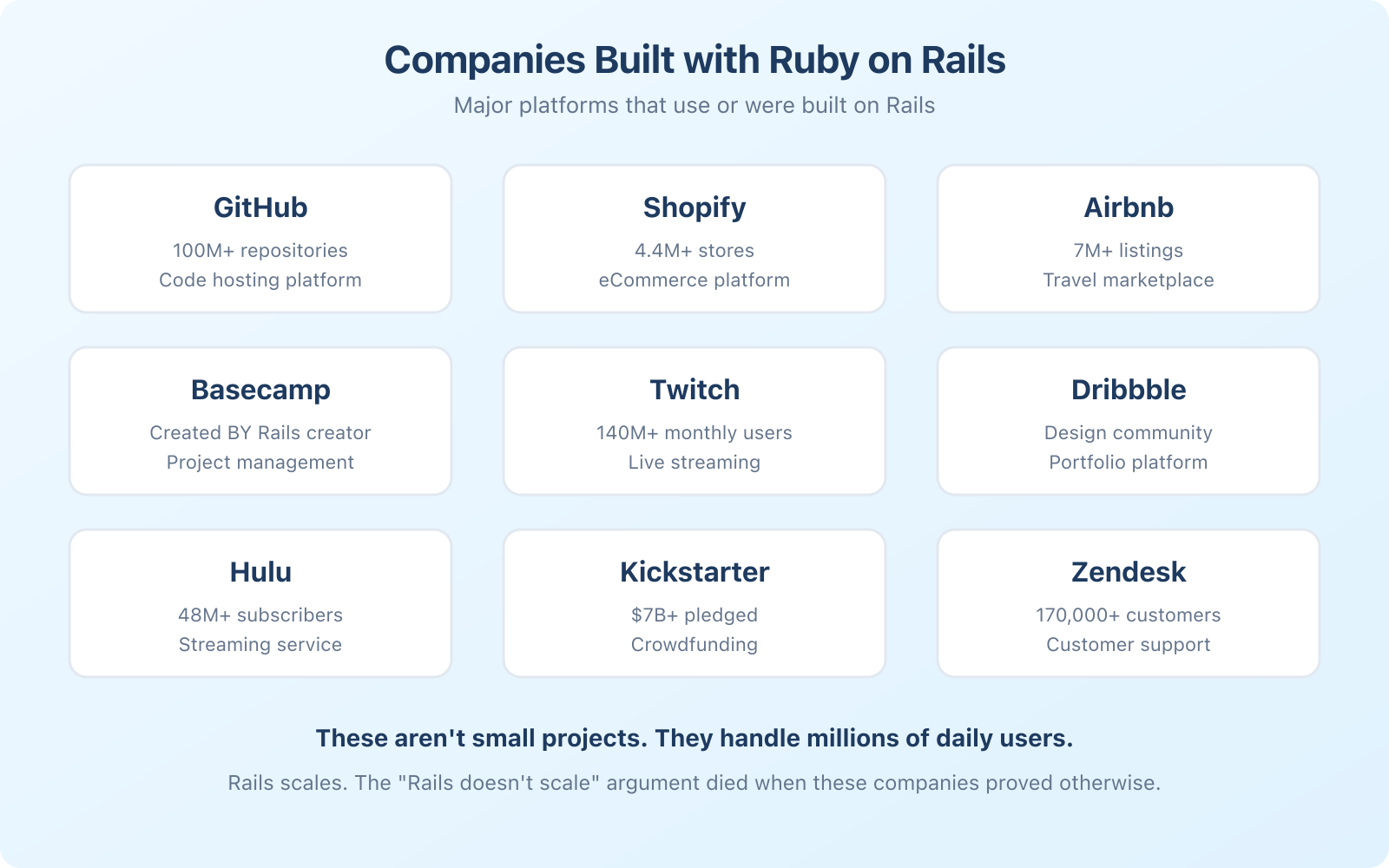
Ruby on Rails gets declared “dead” every year, and every year it continues powering some of the largest platforms on the internet. GitHub, Shopify, Airbnb, Basecamp, Kickstarter, and Twitch all run on Rails. If it’s dead, nobody told these billion-dollar companies. The reality is more nuanced than the hot takes suggest. Rails isn’t the right choice for everything, but for a specific set of use cases, it remains one of the best frameworks available in 2026.
Written in Ruby under the MIT license, Ruby on Rails is a web application framework that’s been around since 2005. It follows the Model-View-Controller (MVC) pattern and has built its reputation on developer happiness, rapid development, and the principle of “Convention over Configuration.” Let me break down where Rails still shines, where it falls short, and how it compares to modern alternatives.
Rapid Development Speed
This is Rails’ defining strength, and it’s the reason startups keep choosing it despite newer alternatives. Rails’ “Convention over Configuration” approach means developers spend less time configuring infrastructure and more time building features. The framework makes opinionated decisions about database structure, file organization, and routing so you don’t have to reinvent the wheel for every project.
The practical impact is real: Rails reduces development time by 30-40% compared to frameworks that require more manual configuration. That’s not a marketing claim. It’s a consistent observation from teams building web applications across multiple frameworks. When you’re a startup burning cash monthly, shipping 30% faster means extending your runway by months.
The DRY (Don’t Repeat Yourself) principle is baked into everything. Scaffolding generates full CRUD operations with a single command. Active Record handles database interactions without writing SQL. Action Mailer handles emails. Active Storage handles file uploads. For standard web application patterns, Rails provides a ready-made solution for almost everything.
The Gems Ecosystem
RubyGems is one of the most mature package ecosystems in web development. With over 170,000 gems available, there’s a well-tested, community-maintained solution for virtually any common web application need:
- Devise for authentication (used by the majority of Rails applications)
- Pundit or CanCanCan for authorization
- Sidekiq for background job processing
- Stripe for payment processing
- Solidus or Spree for full eCommerce functionality
- RSpec and Minitest for comprehensive testing
The key difference between Rails gems and packages in newer ecosystems (like npm) is maturity. Many popular gems have been maintained for 10+ years, are battle-tested at massive scale, and follow consistent patterns. The npm ecosystem is larger but also more fragmented, with multiple competing solutions of varying quality for every need.
Ideal for Startups and MVPs
If you need to go from idea to working product as fast as possible, Rails is hard to beat. The framework excels at exactly what startups need: building standard web applications quickly with a small team.
Rails is particularly well-suited for:
- SaaS products with user accounts, subscriptions, and dashboards
- Marketplaces connecting buyers and sellers
- Content platforms with publishing workflows
- eCommerce sites with product catalogs and payment processing
- Internal tools and admin dashboards
- API backends serving mobile or single-page applications
As an open-source framework, there are no licensing costs. Your investment goes into developer salaries and hosting. And because Rails developers are generally experienced (it’s rarely someone’s first framework), the code quality tends to be high from the start.
If you’re building a proof of concept to show investors, Rails lets you ship a working prototype in 2-4 weeks that looks and functions like a real product. Some frameworks require that much time just for setup and configuration.
Built-In Security
Rails takes security seriously out of the box. The framework includes built-in protection against the most common web application attacks:
- Cross-Site Scripting (XSS): Rails automatically escapes HTML output by default
- SQL Injection: Active Record parameterizes all queries automatically
- CSRF attacks: Authenticity tokens are included in every form by default
- Session hijacking: Secure session handling with encrypted cookies
- Mass assignment: Strong Parameters prevent unauthorized attribute updates
These protections work automatically. You don’t need to remember to add them or install separate security packages. In frameworks where security is opt-in rather than default, developers often forget a critical protection and only discover the gap after an attack. Rails’ approach of secure-by-default prevents this.
The Rails security team also releases regular patches for newly discovered vulnerabilities. The community takes security seriously, and major issues typically get patched within days of discovery.
Strong Community Support
Rails has one of the most experienced developer communities in web development. The community skews toward senior developers who value clean code, testing, and software craftsmanship. This means:
- Stack Overflow has answers for virtually every Rails question you’ll encounter
- Well-maintained gems get regular updates and security patches
- Best practices are well-documented and widely followed
- The Rails Guides are some of the best framework documentation available
- Annual RailsConf events drive innovation and knowledge sharing
The community’s focus on convention means Rails codebases are remarkably consistent. A developer who’s worked on one Rails app can jump into another and immediately understand the structure. Try that with a random Express.js project where every developer invents their own architecture.
Rails vs. Node.js (Express)
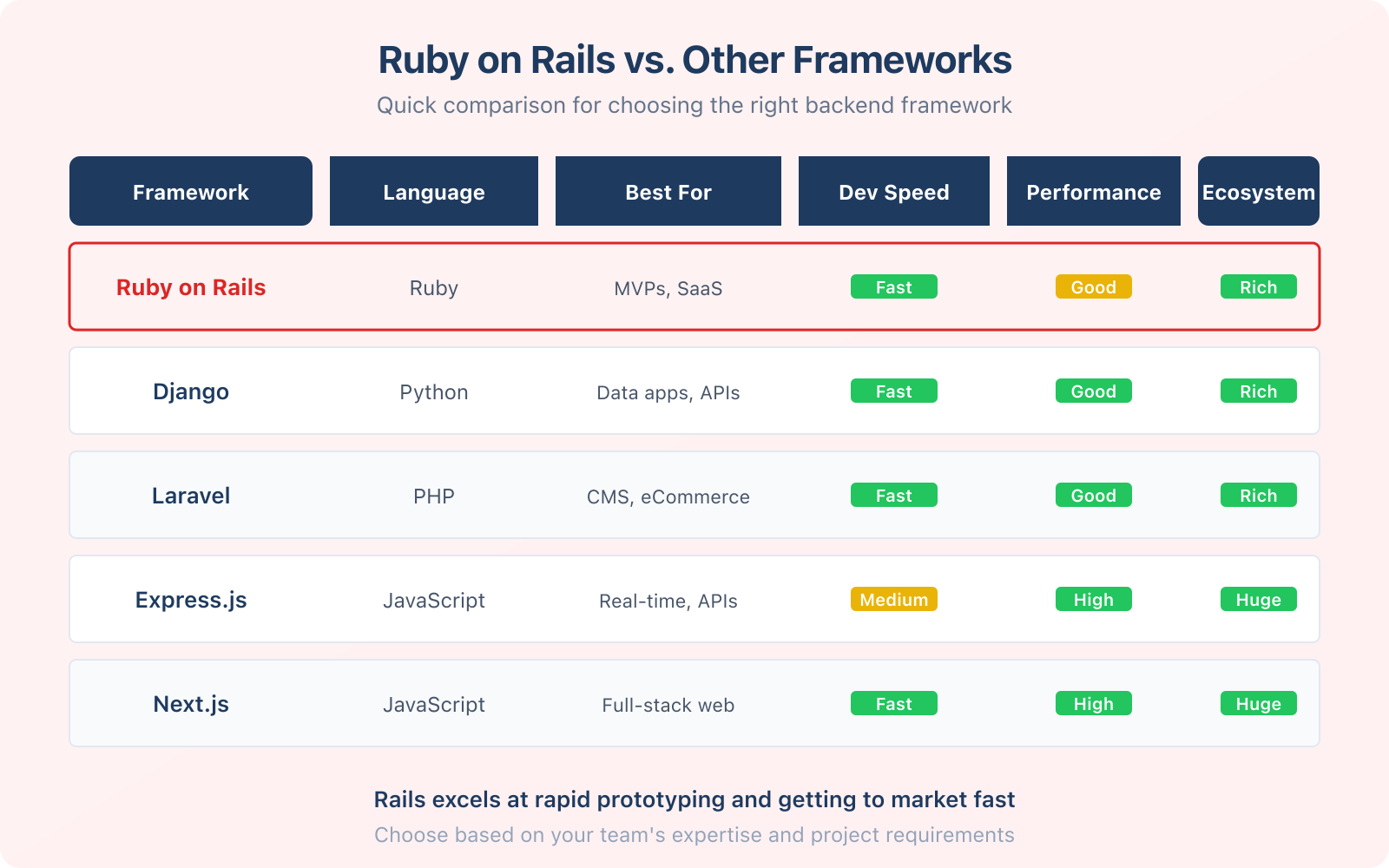
Node.js (usually with Express) is Rails’ most common competitor for backend web development. Here’s how they actually compare:
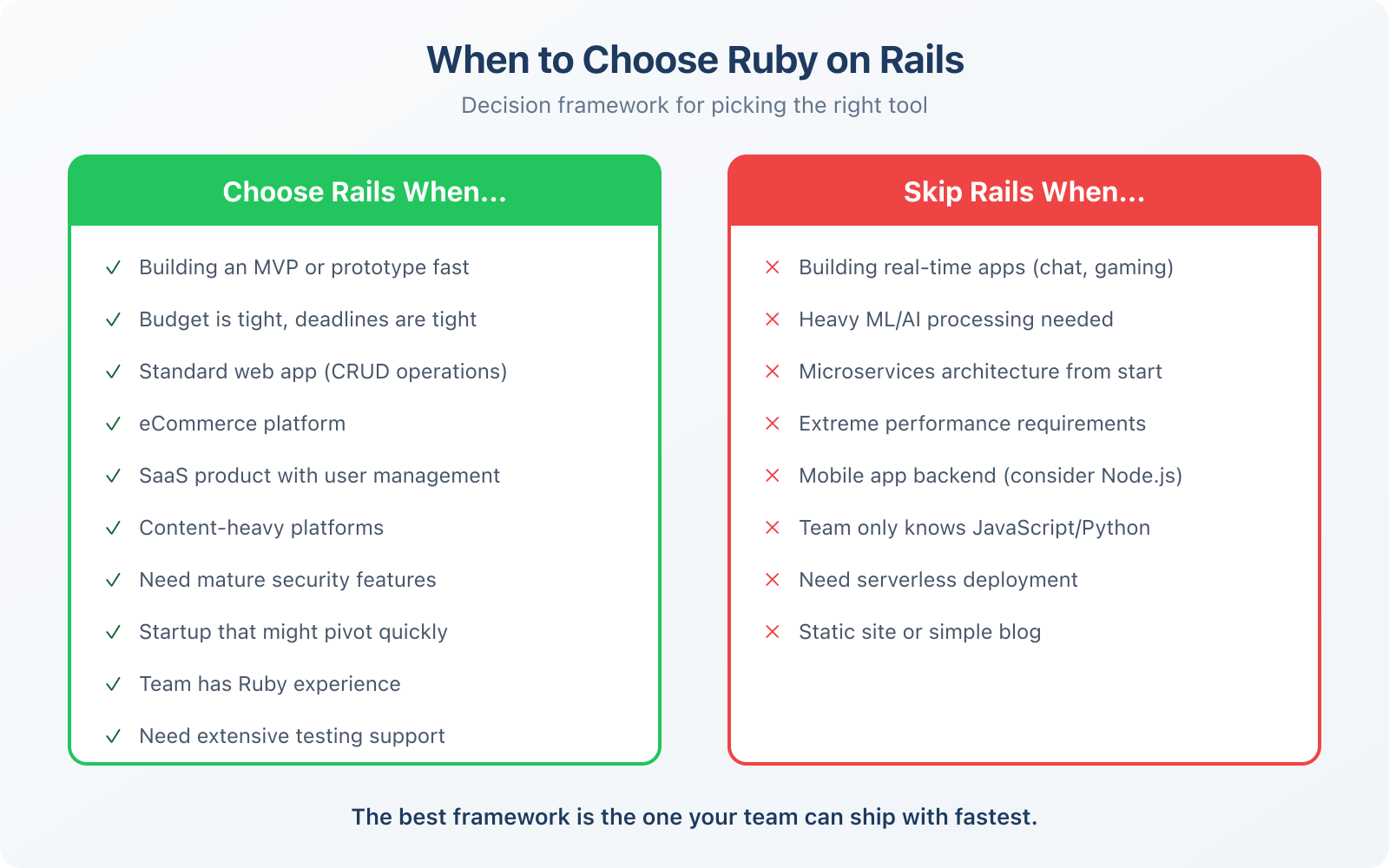
Choose Rails when: You’re building a traditional web application with database-heavy operations, user authentication, admin panels, and content management. Rails’ batteries-included approach means less decision-making and faster development for these use cases.
Choose Node.js when: You need real-time functionality (chat, live updates, streaming), your team already knows JavaScript and wants a single language for frontend and backend, or you need to handle a very high number of concurrent connections with minimal processing per connection.
Node.js has better raw throughput for I/O-heavy operations due to its event-driven, non-blocking architecture. Rails handles CPU-intensive tasks well but can struggle with thousands of simultaneous WebSocket connections without additional infrastructure.
Rails vs. Django
Django is Rails’ closest philosophical cousin. Both are “batteries-included” MVC frameworks with strong opinions about how web applications should be built.
Choose Rails when: Development speed is your top priority and your team has Ruby experience. Rails’ scaffolding and gem ecosystem accelerate standard web application development faster than Django for most use cases.
Choose Django when: Your project involves data science, machine learning, or heavy data processing alongside the web application. Python’s ecosystem for data work (NumPy, Pandas, TensorFlow) is unmatched, and Django integrates naturally with these tools.
Rails vs. Laravel
Laravel is essentially “Rails for PHP.” It borrowed many of Rails’ conventions and philosophy but built them on top of PHP’s massive existing ecosystem.
Choose Rails when: You’re starting fresh without an existing PHP codebase, your team prefers Ruby’s elegant syntax, or you’re building a SaaS product where Rails’ conventions shine.
Choose Laravel when: You have existing PHP infrastructure, your team knows PHP, or you need to integrate with WordPress, Drupal, or other PHP-based systems. Laravel also has a larger available developer pool since PHP developers outnumber Ruby developers significantly.
Where Rails Falls Short
Honest assessment matters. Rails isn’t the best choice for every project, and pretending otherwise would be misleading. Here’s where it genuinely struggles:
Raw performance. Rails is slower than Go, Rust, Node.js, and even modern PHP in benchmarks. For most web applications, this doesn’t matter because database queries and network calls are the actual bottleneck, not framework overhead. But if you’re building something that needs to handle 100,000+ requests per second with minimal latency, Rails isn’t the right tool.
Developer availability. There are fewer Ruby/Rails developers than JavaScript, Python, or PHP developers. This makes hiring harder and often more expensive. Senior Rails developers command premium salaries because demand outstrips supply.
Real-time applications. While Hotwire and Action Cable have improved Rails’ real-time capabilities, frameworks built on Node.js are still better suited for applications where real-time communication is the primary feature (chat apps, multiplayer games, live collaboration tools).
Machine learning integration. If your application needs heavy ML/AI features, Python’s ecosystem is years ahead. You’d end up building separate microservices anyway, which undermines Rails’ monolithic strength.
The “Rails doesn’t scale” myth has been thoroughly debunked. Shopify processes over $7 billion in commerce annually on Rails. GitHub handles millions of git operations per day. The key is proper architecture, caching, and database optimization, which are required regardless of your framework choice.
Rails in 2026: What’s New
Rails continues to evolve. Recent versions have addressed many historical criticisms:
Hotwire (Turbo + Stimulus). Rails’ answer to heavy JavaScript frameworks. Hotwire lets you build modern, reactive interfaces with minimal JavaScript by sending HTML over the wire instead of JSON. It’s a paradigm shift that eliminates the need for React or Vue in many applications.
Ruby performance improvements. Ruby 3.x brought YJIT (Yet Another Ruby JIT compiler), which significantly improved Rails application performance. Real-world benchmarks show 15-30% speed improvements with YJIT enabled, closing the performance gap with other interpreted languages.
Active Record improvements. Better support for async queries, improved connection pooling, and enhanced encryption for sensitive data at the database level.
Kamal for deployment. Rails now includes Kamal (formerly MRSK), a deployment tool that makes deploying Rails applications to bare metal or cloud servers straightforward. No Kubernetes or complex DevOps setup required.
Frequently Asked Questions
Is Ruby on Rails still worth learning in 2026?
Yes, if you want to build web applications efficiently. Rails developers are in demand and command high salaries because there are fewer of them compared to JavaScript or Python developers. The framework teaches excellent software development practices (MVC, testing, convention-based development) that transfer to any other language or framework. It’s not the trendiest choice, but it’s a practical and profitable one.
How long does it take to learn Ruby on Rails?
If you already know another programming language, you can build basic Rails applications within 2-4 weeks. Becoming proficient enough for professional work takes 3-6 months of consistent practice. Mastering Rails (advanced Active Record, performance optimization, testing strategies, custom gems) takes 1-2 years. The learning curve is steeper than some frameworks because Rails has many built-in features to understand, but the payoff is higher productivity once you know the conventions.
Can Rails handle high traffic applications?
Yes. Shopify, GitHub, Basecamp, and Twitch prove this daily. Rails can handle millions of requests with proper caching (Redis, Memcached), database optimization, CDN usage, and horizontal scaling. The vast majority of web applications will never hit the performance ceiling of a properly optimized Rails setup. Performance issues in Rails are almost always caused by unoptimized database queries or missing caching, not the framework itself.
What type of projects should avoid Ruby on Rails?
Avoid Rails for: real-time applications where WebSockets are the primary feature (use Node.js or Elixir instead), projects requiring heavy machine learning integration (use Python/Django), microservices architectures with dozens of tiny services (Rails’ monolithic strength becomes overhead), and extremely high-throughput APIs handling 100,000+ requests per second (use Go or Rust). For everything else, Rails is a strong contender.
How much do Ruby on Rails developers cost?
In the US, junior Rails developers earn $70,000-$90,000/year, mid-level developers earn $100,000-$140,000/year, and senior developers earn $150,000-$200,000+/year. Freelance Rails developers charge $80-$200/hour depending on experience and location. Offshore Rails development teams (Eastern Europe, India) charge $30-$80/hour. The higher individual cost is often offset by the faster development speed Rails enables.
Ruby on Rails isn’t the right framework for everything, and anyone who tells you otherwise is selling something. But for building web applications quickly, securely, and with a small team, it remains one of the best tools available in 2026. The key is matching the tool to the job. If you’re building a standard web application, SaaS product, marketplace, or eCommerce platform and need to ship fast, Rails deserves serious consideration. The companies that bet on it years ago are still running on it today, at massive scale, which tells you everything you need to know about its staying power.