
The Impact of Custom Designs on Customer Experience
Generic design is invisible. You scroll past it, click away from it, forget it existed within seconds. Custom design stops you. It makes you feel something. And in a market where every competitor is one click away, that emotional response is the difference between a customer who buys and one who bounces.
I’ve built websites and digital products for hundreds of businesses, and the correlation between custom design investment and customer satisfaction is striking. Businesses that invest in personalized design consistently see higher conversion rates, lower bounce rates, and stronger customer loyalty than those using off-the-shelf templates. Let me show you exactly how custom design impacts customer experience and why the ROI justifies the investment.
Emotional Impact of Custom Designs

Custom design triggers emotional responses that template-based design simply can’t. When a product or website feels personalized, it creates a sense of belonging. People connect with items and experiences that reflect their identity, values, or aspirations.
Think about the difference between receiving a generic email and one that uses your name, references your previous purchase, and recommends products based on your actual browsing history. The content might be similar, but the emotional response is completely different. The personalized version says “we know you” while the generic one says “you’re just another email address.”
This principle extends to every customer touchpoint. A website with a custom-designed interface that matches your brand personality feels intentional. A product with personalized packaging feels like a gift, not a transaction. These emotional triggers drive loyalty. Research from Deloitte shows that 1 in 5 consumers who expressed interest in personalized products were willing to pay a 20% premium for them.
The emotional bond between customer and brand strengthens with each personalized interaction. Businesses that invest in custom design report 26% higher customer lifetime value on average. That’s not a design statistic. That’s a revenue statistic.
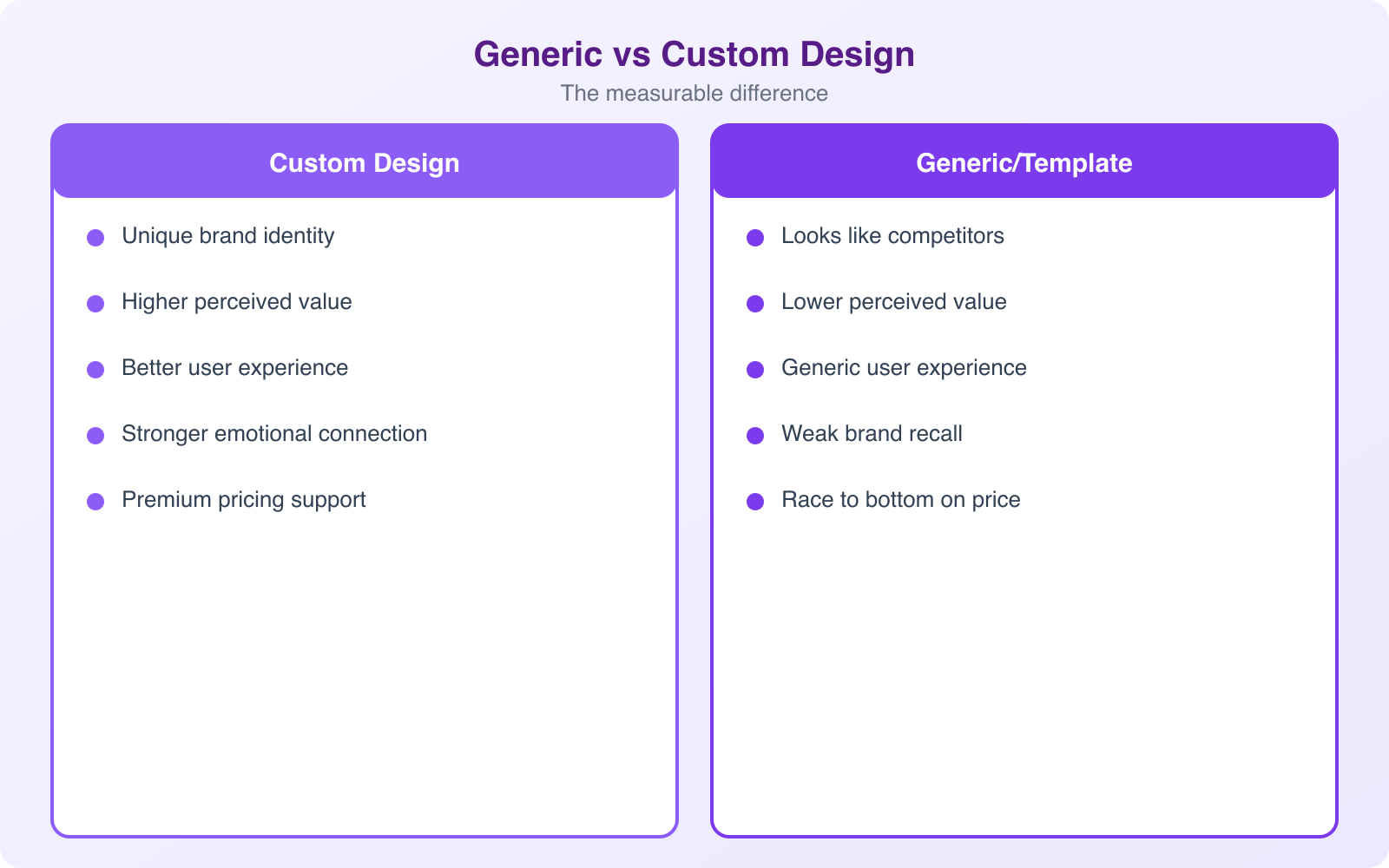
Generic vs Custom Design: The Measurable Difference
Let’s look at hard numbers. The gap between generic and custom design isn’t subjective. It shows up in every metric that matters.
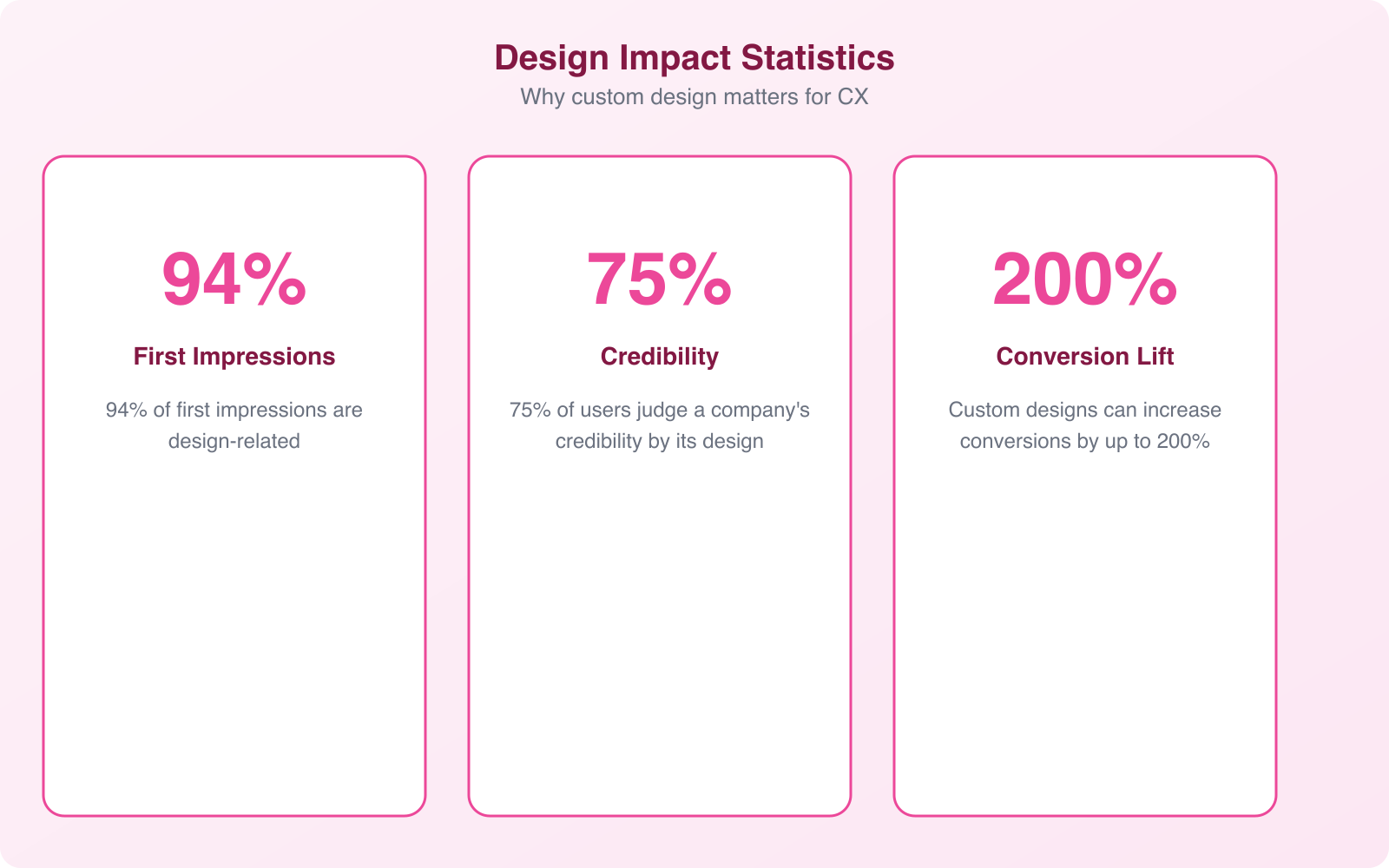
Conversion rates: Custom-designed landing pages convert 30-50% higher than template-based ones. A study by HubSpot found that companies using custom-designed CTAs converted 202% better than basic template CTAs. The design signals credibility, professionalism, and attention to detail, all of which reduce buyer hesitation.
Bounce rates: Users form opinions about a website in 0.05 seconds. Custom design that aligns with your brand and audience expectations reduces bounce rates by 15-35% compared to generic templates. First impressions are visual, and you don’t get a second chance.
Brand recall: Custom visual elements (unique illustrations, branded photography, distinctive color palettes) increase brand recall by up to 80% compared to stock photography and template layouts. When customers remember your brand, they return. When they don’t, you’re paying to reacquire them every single time.
Customer trust: 75% of consumers judge a company’s credibility based on website design. A custom-designed website signals investment and legitimacy. A template site (especially one that looks like hundreds of others in your industry) signals “we didn’t care enough to do this properly.”
Strengthening Customer Connections Through Personalization
Personalization goes beyond putting someone’s name on a product. Real personalization means understanding your customer’s context and adapting the experience to match. Here’s how different types of custom design strengthen customer relationships.
Website personalization. Showing different content, product recommendations, or offers based on visitor behavior increases engagement by 20-30%. Tools like Google Workspace integrated with your CRM can power personalized email sequences that feel individually crafted.
Product customization. Letting customers choose colors, add text, or modify features of your product creates ownership before they even buy it. Nike’s custom shoe builder, for example, increases average order value by 30% compared to standard purchases. You don’t need to be Nike to offer customization. Even simple options like personalized engraving, color choices, or monogramming can drive premium pricing.
Packaging design. Unboxing is a customer experience moment that most businesses waste. Custom packaging that surprises, delights, or reinforces your brand story turns a delivery into an event. Customers who have a positive unboxing experience are 40% more likely to share it on social media, giving you free marketing.
Communication design. Custom-designed emails, proposals, and reports show clients that you value the relationship enough to invest in presentation. A well-designed proposal converts at 2-3x the rate of a plain text or generic template proposal. The design communicates competence before the client reads a single word.
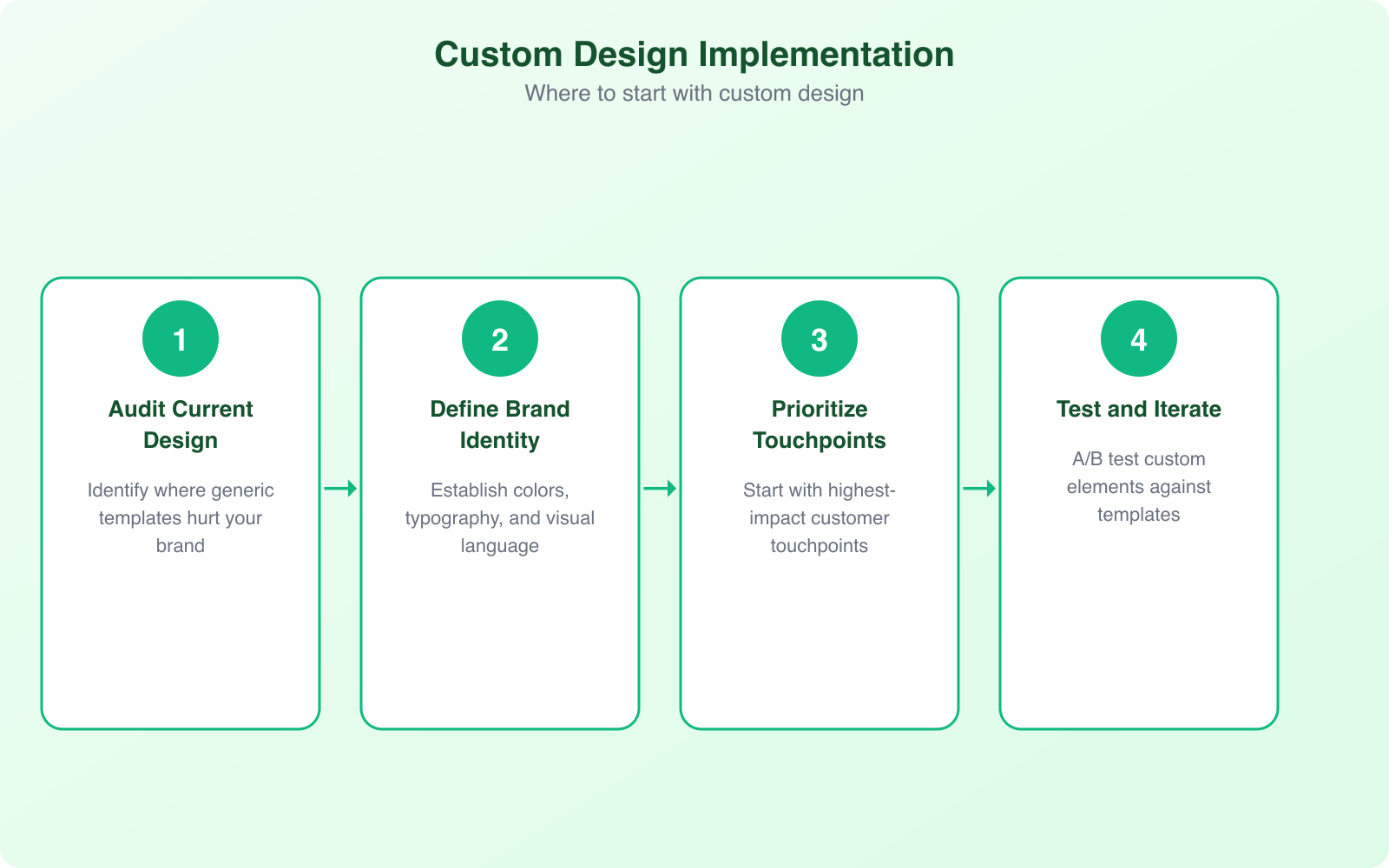
You don’t need a massive budget for custom design. Start with the highest-impact touchpoints: your homepage, product pages, and email templates. A custom homepage alone can improve conversion rates by 20-40% compared to a stock template. Once that’s generating returns, reinvest in customizing additional touchpoints.
Shaping Brand Identity with Custom Design
Your brand identity is what people remember when they’re not looking at your website. Custom design is the primary vehicle for creating and reinforcing that identity.
Consider what makes Apple’s design instantly recognizable. It’s not just the logo. It’s the consistent use of white space, the specific typography, the photography style, the packaging precision. Every touchpoint reinforces the same identity. You don’t need Apple’s budget to achieve this. You need consistency and intentionality.
Custom design elements that build brand identity include: a distinctive color palette (beyond the obvious primary color), custom illustrations or icons (instead of generic stock vectors), a specific photography style (consistent lighting, angles, and composition), branded templates for social media and documents, and custom UI patterns on your website that become associated with your brand.
Eco-friendly companies, for example, can reinforce their values through design choices: sustainable packaging materials, earth-tone color palettes, organic shapes, and recycled paper textures. These design decisions communicate brand values without words and resonate with environmentally-conscious consumers.
Practical Benefits for Customer Satisfaction
Custom design isn’t just about aesthetics. It directly improves usability, which is the foundation of customer satisfaction.
Reduced friction. Custom-designed user interfaces can be optimized for your specific user flows. Template designs force you to adapt your business to their layout. Custom design adapts the layout to your business. This reduces the number of clicks to purchase, simplifies navigation, and eliminates confusion points.
Accessibility. Custom design allows you to build accessibility into the experience from the start rather than retrofitting it onto a template. Proper color contrast, readable font sizes, keyboard navigation, and screen reader compatibility can all be designed natively. This isn’t just ethical. It’s practical, as 15% of the global population has some form of disability.
Mobile optimization. Templates claim to be responsive, but true mobile optimization requires custom design decisions. Touch target sizes, content hierarchy on small screens, loading speed optimization, and mobile-specific user flows all benefit from custom design attention. With 60%+ of web traffic coming from mobile devices, this directly impacts revenue.
Performance. Custom-designed websites typically load faster than template-heavy sites because they include only the code and assets they need. No bloated framework files, no unused CSS, no scripts for features you’re not using. A 1-second improvement in load time can increase conversions by 7%.
Adapting Custom Design to Changing Consumer Needs
Consumer preferences shift constantly. Custom design gives your business the flexibility to adapt without starting from scratch every time trends change.
Template-based designs lock you into someone else’s vision. When you need to add a new product category, change your pricing model, or target a different audience segment, templates become constraints. Custom design is built around your business logic, so adapting is a matter of updating elements rather than rebuilding entirely.
In 2026, consumers are increasingly drawn to sustainability, transparency, and authenticity. Custom design lets you weave these values into every interaction. Custom eco-friendly packaging, transparent supply chain visualizations on your website, and authentic brand photography all require design decisions that templates can’t accommodate.
The brands that stay relevant decade after decade are the ones that evolve their design with their audience. Apple refreshed its design language several times over 40 years. Nike continuously updates its visual identity while maintaining recognizability. You don’t need their budget, but you need their mindset: design is an ongoing investment, not a one-time expense.
How to Invest in Custom Design (Without Overspending)
You don’t need to redesign everything at once. Here’s a practical approach to investing in custom design that maximizes ROI at every step.
Phase 1: Brand foundation ($2,000-5,000). Logo, color palette, typography, and basic brand guidelines. This creates the foundation that all future design builds upon. Don’t skip this step. Everything else looks disjointed without it.
Phase 2: Website design ($5,000-15,000). Custom homepage, product/service pages, and checkout flow. Focus on the pages with the highest traffic and conversion impact first. Your homepage and top 3-5 product pages drive most of your revenue.
Phase 3: Marketing materials ($1,000-3,000). Custom email templates, social media templates, and presentation designs. These create consistency across every channel where customers interact with your brand.
Phase 4: Product and packaging ($2,000-10,000). Custom product design, packaging, and unboxing experience. This phase has the highest impact on customer delight and social sharing, but only makes sense once your digital presence is solid.
Avoid the temptation to design for awards instead of customers. A beautiful website that confuses your users is worse than a simple one that converts. Always prioritize clarity and usability over visual complexity. The best designs look effortless because they were designed around the user’s needs, not the designer’s portfolio.
Frequently Asked Questions
How much does custom website design cost?
Custom website design typically costs $5,000-$25,000 for small business sites, $25,000-$100,000+ for complex e-commerce or enterprise sites. A custom logo and brand identity package runs $2,000-$10,000. Product packaging design costs $1,500-$5,000. These are significantly more than templates, but the ROI comes from higher conversion rates, brand differentiation, and customer trust. For businesses earning $500K+/year, custom design almost always pays for itself through improved customer perception.
Is custom design worth it for small businesses?
Yes, if your business relies on customer trust and competes in a crowded market. Custom design immediately differentiates you from competitors using the same Shopify themes or Squarespace templates. Studies show 75% of consumers judge credibility by design alone. For service businesses, custom design communicates professionalism that justifies premium pricing. The exception: if you’re validating a new business idea, start with a clean template and invest in custom design once you’ve proven demand.
How long does a custom design project take?
A custom website takes 6-12 weeks from kickoff to launch. A complete brand identity (logo, colors, typography, guidelines) takes 3-6 weeks. Custom packaging design runs 4-8 weeks including production samples. The design phase itself is often faster than the feedback and revision cycles. Set clear timelines upfront, limit revision rounds to 2-3, and assign one decision-maker on your team to avoid design-by-committee delays that stretch projects to months.
What’s the ROI of custom design compared to templates?
Custom designs typically deliver 2-3x higher conversion rates compared to templates. A study by Adobe found that companies with strong design practices outperform competitors by 219% on the S&P Index. For e-commerce sites, custom product pages can increase conversion rates by 30-50% compared to default templates. The ROI math is straightforward: if custom design costs $15,000 and increases monthly revenue by $5,000 through better conversions, it pays for itself in three months.
Should I hire a freelancer or agency for custom design?
For brand identity and strategy, hire an agency. They bring diverse expertise, project management, and a broader perspective. For specific execution tasks (a new landing page, social media graphics), freelancers offer better value. The ideal approach for growing businesses: agency for initial brand creation and design system, then a skilled freelancer for ongoing implementation. Budget $3,000-$8,000 for a freelancer, $10,000-$30,000+ for an agency for comparable scope.
Invest in Design, Invest in Experience
Custom design is one of the few investments that improves both how customers feel about your brand and how much revenue you generate. It’s not a luxury reserved for big companies. It’s a strategic tool that levels the playing field for businesses of any size.
Start where the impact is highest: your website, your product packaging, and your customer communications. Measure the results. Then reinvest. The businesses that treat design as an ongoing investment rather than a one-time project are the ones that build lasting customer relationships and sustainable competitive advantages.
Your customers make split-second judgments based on design. Make sure those judgments are working in your favor.
Disclaimer: This site is reader-supported. If you buy through some links, I may earn a small commission at no extra cost to you. I only recommend tools I trust and would use myself. Your support helps keep gauravtiwari.org free and focused on real-world advice. Thanks. - Gaurav Tiwari