
10 Effective Strategies for Getting Inspiration to Write

The cursor blinks. The draft stays blank. Every sentence you type gets deleted before it’s finished. You know what good writing looks like, which makes the block worse, because nothing you produce feels good enough. If you’ve been staring at an empty page for more than 20 minutes, you’re not going to write your way out of it by forcing harder.
Writer’s block isn’t a beginner problem. It hits prolific writers just as hard. Stephen King, who publishes a book nearly every year, has talked openly about creative dry spells. The difference between writers who publish consistently and those who don’t isn’t talent or discipline. It’s systems. Specific, repeatable techniques that generate ideas even when motivation is gone.
This guide covers 10 tested strategies for getting unstuck, from freewriting sprints to AI-assisted brainstorming, with specific tools and methods you can use today. These aren’t vague “just write more” tips. They’re actionable techniques backed by cognitive science and real-world practice.
Table of Contents
1. Read Widely and Intentionally
Reading is the single best way to fill your creative tank. Every article, book, and essay you consume adds patterns, vocabulary, and ideas to your mental library. But passive reading won’t cut it. You need to read with intention.
Stephen King recommends writers read 70-80 books per year. That sounds like a lot, but it works out to roughly 20 minutes of focused reading per day. The key is variety. If you only read within your niche, you’ll recycle the same ideas everyone else has. Read history, science, memoir, fiction, poetry. The unexpected connections between genres are where original ideas live.
I keep a reading log in Notion where I capture one insight per chapter. Not summaries, just the single idea that made me stop and think. After a month, I have 30+ writing seeds ready to develop. That’s more ideas than I can use in a quarter.
How to Read Like a Writer
- Annotate actively – Highlight sentences that make you feel something and figure out why they work. Was it the rhythm? The specificity? The unexpected word choice?
- Read outside your genre – Fiction writers should read nonfiction. Bloggers should read literary journalism. The cross-pollination generates original angles.
- Read bad writing too – Understanding what doesn’t work sharpens your ability to recognize what does. I’ve learned more from poorly written articles than from polished ones.
2. Change Your Physical Environment
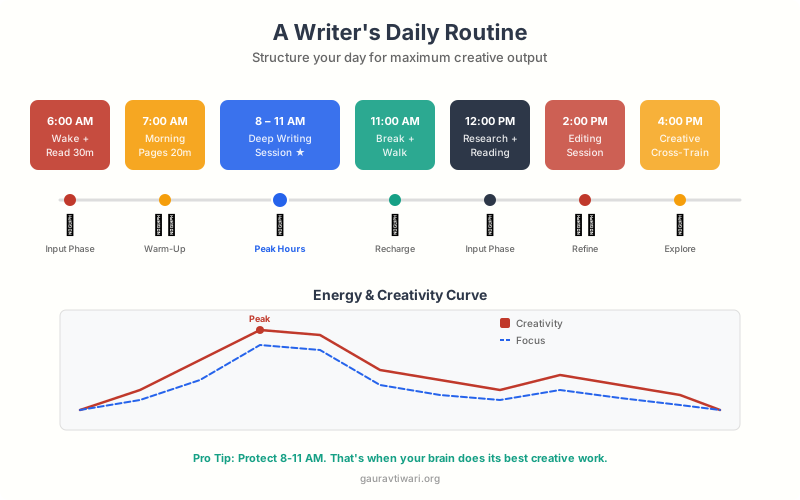
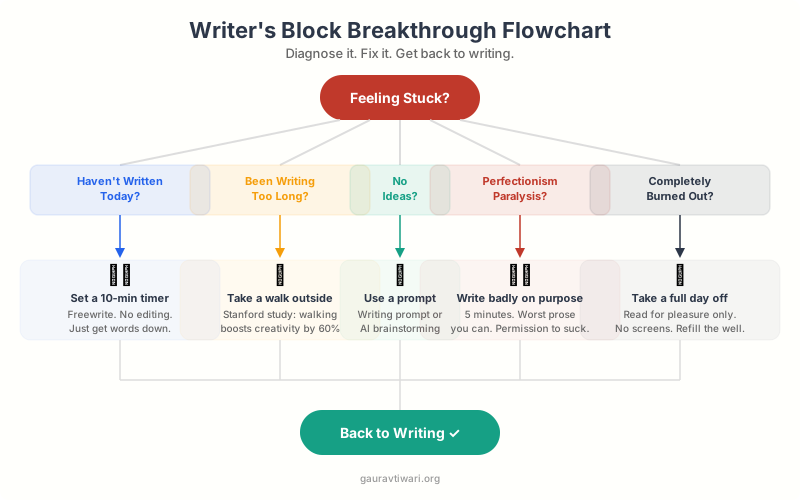
Your brain associates specific locations with specific activities. If you always write at the same desk where you also pay bills, answer emails, and doom-scroll, your brain treats writing as just another chore. Changing your environment breaks that association and triggers fresh thinking.
A 2014 Stanford University study found that walking increases creative output by an average of 60% compared to sitting. That’s not a small bump. It’s a massive shift in creative capacity, and you don’t even need to leave the house. Walking on a treadmill produced the same creative gains as walking outdoors.
I rotate between three writing spots: my home office for focused editing, a cafe for first drafts, and a park bench for brainstorming. Each location triggers a different mode of thinking. The cafe’s ambient noise (around 70 decibels, according to research published in the Journal of Consumer Research) hits the sweet spot for creative cognition.
Quick Environment Hacks
- Change your tool – Switch from keyboard to a pen tablet or handwriting. The physical shift changes how your brain processes language.
- Adjust lighting – Natural light boosts both mood and productivity. A University of Illinois study found employees near windows reported 46 minutes more sleep and better cognitive performance.
- Add background sound – Try brown noise, lo-fi beats, or cafe sounds. Complete silence can actually be counterproductive for creative work.
Where do you do your best writing?
3. Use Writing Prompts to Bypass the Blank Page
The blank page is the enemy of creativity. Writing prompts solve this by giving your brain a starting point, something to react to instead of creating from nothing. It’s the difference between composing a melody from scratch and improvising over a chord progression. Both are creative, but one has far less friction.
Ray Bradbury wrote 1,000 words every single day, even when he had no idea what to write about. He’d start with a random noun (a word from a dictionary, a headline from the newspaper) and write whatever came to mind. Many of his most famous short stories started as prompt-driven exercises.
Effective Prompt Types
- Constraint prompts – “Write about your morning routine using only 50 words.” Constraints force creativity by eliminating easy paths.
- Perspective shifts – “Rewrite your last published article from your reader’s perspective.” This reveals gaps you didn’t know existed.
- Combination prompts – Combine two unrelated concepts: “What does content marketing have in common with jazz?” Forced connections produce the most original ideas.
- AI-generated prompts – Tools like Jasper or ChatGPT can generate prompts tailored to your niche. Ask for 10 prompts related to your topic and pick the one that excites you most.

4. Cross-Train Your Creativity
Writers who only write tend to produce stale, recycled content. The best writing comes from a rich inner life fed by diverse creative inputs. Haruki Murakami runs marathons. He says the physical discipline of distance running directly translates to the mental stamina required for long writing sessions.
This isn’t just anecdotal. Research from the University of Texas at Austin shows that engagement in diverse creative activities improves performance across all creative domains. Musicians write better code. Painters tell better stories. The neural pathways activated by one art form strengthen your capacity in others.
Creative Activities That Improve Writing
- Drawing or sketching – Forces you to observe details you’d normally skip. That observational skill transfers directly to descriptive writing.
- Playing music – Develops a sense of rhythm and pacing that shows up in your prose.
- Photography – Trains you to find interesting angles on ordinary subjects. That’s exactly what good writing does with familiar topics.
- Cooking without a recipe – Builds the same kind of improvisational confidence you need for freewriting.
I picked up watercolor painting during a writing slump two years ago. I’m terrible at it, and that’s the point. Being bad at something removes the pressure of perfection, which is exactly the mindset you need to produce first drafts.
5. Build a Non-Negotiable Writing Routine
Waiting for inspiration is a strategy that produces approximately zero published articles. Every prolific writer I’ve studied, from Ernest Hemingway (who wrote at dawn every day) to Maya Angelou (who rented hotel rooms to write in), built their output on routine rather than motivation.
The science backs this up. A habit takes an average of 66 days to form, according to research published in the European Journal of Social Psychology. Once writing becomes automatic, you stop burning willpower deciding whether to write and start spending that energy on what to write.
Building Your Writing Habit
- Pick a consistent time – Morning works best for most people (cortisol peaks about 30 minutes after waking, which supports focused cognitive work). But any time works if you’re consistent.
- Stack it with an existing habit – Write immediately after your morning coffee. The existing habit acts as a trigger for the new one.
- Start embarrassingly small – Commit to 100 words a day, not 2,000. You’ll almost always write more, but the low bar eliminates resistance.
- Track your streak – Use a simple calendar or an app. The “don’t break the chain” method works because loss aversion is a stronger motivator than reward.
6. Freewrite Without Judgment
Freewriting strips away the perfectionism that causes most writer’s block. Set a timer for 10 minutes and write without stopping, editing, or even thinking about quality. The goal isn’t to produce publishable prose. It’s to bypass your inner critic and access ideas buried beneath self-doubt.
Peter Elbow, who popularized freewriting in his 1973 book “Writing Without Teachers,” found that writers who freewrite regularly produce more original ideas and experience less anxiety about writing. The technique works because it separates the creative process from the editing process, two modes that use different parts of the brain.
My Freewriting Process
- Set a timer for 10 minutes
- Write whatever comes to mind. Don’t fix typos, don’t rewrite sentences, don’t stop
- When the timer goes off, read through what you wrote
- Highlight any sentence or phrase that feels alive
- Use those highlighted bits as seeds for your next piece
About 80% of what I freewrite is garbage. That’s fine. The 20% that isn’t garbage often contains my best, most honest ideas. I’ve pulled entire article concepts from freewriting sessions that I never would have discovered through structured outlining.
7. Mine Real Life for Material
Your personal experiences are the one thing no competitor can replicate. J.K. Rowling drew from her experiences riding trains and observing strangers to build the world of Harry Potter. Neil Gaiman credits his childhood reading habits and early writing groups for shaping his storytelling voice.
You don’t need dramatic life events to find material. The mundane is where the gold is. A frustrating customer service call becomes an article about communication techniques. A failed recipe becomes a metaphor for iterative content creation. The skill isn’t having interesting experiences. It’s noticing the interesting in your everyday.
Capture Systems That Work
- Digital notes – Keep Notion or Apple Notes on your phone. Capture ideas within 30 seconds of having them. If you wait even 5 minutes, you’ll lose half the detail.
- Voice memos – Record observations while walking or driving. Transcribe later using Whisper or your phone’s built-in transcription.
- The “swipe file” – Save screenshots of interesting headlines, tweets, email subject lines, and ad copy. Review weekly for patterns and inspiration.
- People-watching notes – Sit in a public place for 15 minutes and write down overheard conversations, body language, and small dramas. This builds your observational muscle.
8. Set Micro-Goals Instead of Big Targets
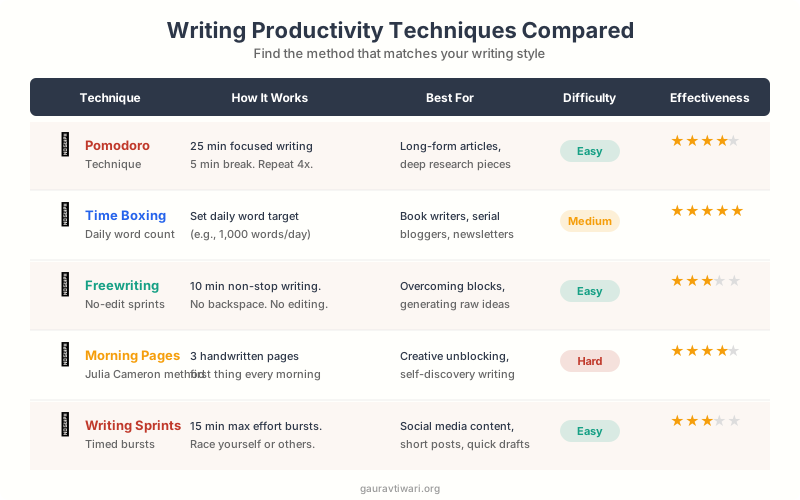
“Write a book” is paralyzing. “Write 300 words before lunch” is doable. Micro-goals work because they exploit a psychological principle called the Zeigarnik Effect: once you start a task, your brain creates tension that pushes you toward completion. The hard part isn’t writing 2,000 words. It’s writing the first 50.
I used this exact approach to publish over 2,000 articles. Each morning, my only goal is 300 words on whatever I’m working on. Most days, I hit 1,000+ because momentum takes over. But on the days I only write 300, that’s still progress. At 300 words per day, you’ll write a 90,000-word book in under a year.
Effective Micro-Goals for Writers
- Word count targets – 200-500 words per session. Not per day, per session. You can always do another session.
- Time-boxed sessions – 25-minute Pomodoro blocks. Write for 25 minutes, break for 5. The countdown creates gentle urgency.
- Section completion – “Finish this H2 section” is better than “write the article.” Each completed section gives you a dopamine hit.
- Daily publishing – Even a short LinkedIn post or tweet counts. Publishing regularly builds the persuasive writing muscle and keeps the creative pipeline flowing.
9. Join a Writing Community
Writing in isolation works for some people, but most writers benefit enormously from community. Feedback sharpens your instincts. Accountability keeps you consistent. And seeing other writers struggle with the same challenges normalizes the difficulty, which reduces the shame spiral that often accompanies writer’s block.
Neil Gaiman has spoken repeatedly about how early writing groups shaped his career. The feedback wasn’t always positive, but the consistent engagement with other writers forced him to articulate and defend his creative choices, which made his writing stronger.
Where to Find Writing Communities
- Wattpad – Best for fiction writers who want reader feedback at scale. Over 90 million users.
- Reddit r/writing – Active community for craft discussions, feedback exchanges, and writing challenges.
- Local writing meetups – Check Meetup.com for groups in your city. In-person feedback hits different than online comments.
- Niche Slack/Discord communities – Content creators, copywriters, and bloggers often have private communities where members share drafts and swap feedback.
10. Use AI Tools as a Creative Partner
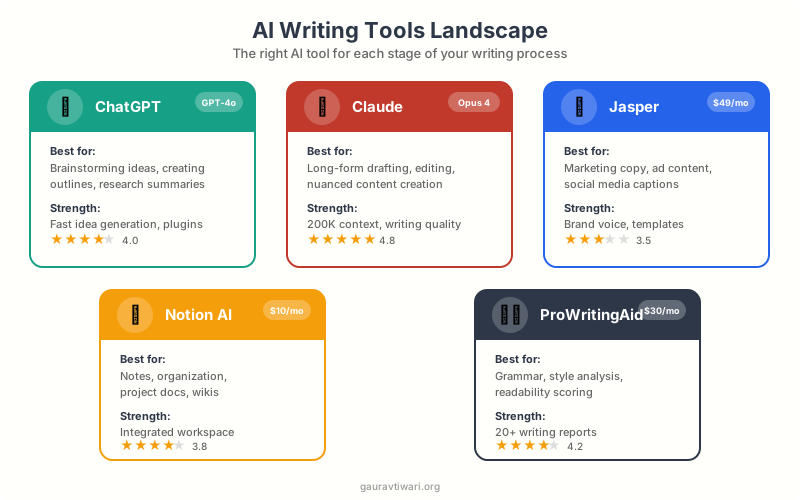
AI writing tools won’t replace your voice, but they’re excellent at breaking through creative blocks. I use them for brainstorming angles, generating outlines, and finding gaps in my arguments. The trick is to treat AI as a sparring partner, not a ghostwriter.
Here’s my typical AI-assisted workflow: I describe my topic and target audience to Jasper, ask it for 10 unique angles I haven’t considered, then pick the 2-3 that resonate. I never publish AI-generated text directly. It’s always a starting point for my own thinking. The best AI writing tools help you think faster, not think less.
Smart Ways to Use AI for Inspiration
- Angle generation – “Give me 10 contrarian takes on [topic].” The ones that make you uncomfortable are usually the most interesting.
- Outline expansion – Feed your rough outline to AI and ask it to identify missing sections or weak arguments.
- Grammar and style cleanup – Run your draft through ProWritingAid or Sapling for sentence-level improvements. These tools catch patterns human eyes miss.
- Research acceleration – Ask AI to summarize research papers or identify statistics related to your topic. Always verify sources before publishing.
One word of caution: AI content without a human voice reads as flat and generic. Your readers will notice. Use AI to accelerate your process, but make sure the final voice is unmistakably yours.
Best Writing Tools to Stay Inspired
The right tools don’t create inspiration, but they remove friction so inspiration has room to emerge. After testing dozens of writing apps and productivity tools, these four consistently help me write more, write better, and waste less time staring at blank screens.

Notion
- Flexible page and database system
- Built-in AI writing assistant
- Templates for content calendars and editorial workflows
- Real-time collaboration with editors
- Free plan covers most individual needs
- Works on web, desktop, and mobile
ProWritingAid
- 20+ writing reports including style and readability
- Integrates with Google Docs, Word, and Scrivener
- Thesaurus and word explorer built in
- Genre-specific writing style checks
- Lifetime license option (rare for SaaS tools)
- Browser extension for editing anywhere

Jasper
- 50+ content templates for different formats
- Brand voice training for consistent tone
- SEO mode with Surfer SEO integration
- Long-form document editor
- Team collaboration and approval workflows
- 7-day free trial with 10,000 words

Sapling
- Context-aware grammar and spelling corrections
- Smart autocomplete suggestions as you type
- API for developers building writing tools
- Works across email, chat, and CMS platforms
- Team-level usage analytics
- Free tier for individual writers
Writer's Inspiration Checklist
Frequently Asked Questions
How do professional writers find inspiration every day?
Professional writers don’t wait for inspiration. They build systems: consistent writing routines, reading habits, capture tools for ideas, and creative cross-training activities. Stephen King writes every morning without exception. Maya Angelou rented hotel rooms to eliminate distractions. The common thread is discipline over motivation.
What is the fastest way to overcome writer’s block?
Freewriting is the fastest method. Set a timer for 10 minutes and write without stopping or editing. This bypasses your inner critic and often produces usable ideas within the first session. If freewriting doesn’t work, try changing your physical environment or switching to a different writing tool.
Does reading actually improve your writing?
Yes. Research consistently shows that regular readers write better. Reading exposes you to sentence structures, vocabulary, argumentation styles, and storytelling techniques that you unconsciously absorb. Stephen King recommends 70-80 books per year. Even 20 minutes of daily reading makes a measurable difference in writing quality.
Can AI tools help with writing inspiration?
AI tools like Jasper and ChatGPT are excellent for brainstorming angles, generating outlines, and identifying gaps in your arguments. They work best as creative partners rather than ghostwriters. Use AI to generate 10 angles on your topic, then develop the 2-3 that excite you most using your own voice and experience.
How many words should I write per day to stay consistent?
Start with 100-300 words per day. This is small enough to never feel overwhelming but large enough to build momentum. At 300 words per day, you’ll produce roughly 109,500 words per year, enough for a full-length book or 50+ blog articles. Consistency matters more than volume.
What is creative cross-training for writers?
Creative cross-training means engaging in creative activities beyond writing, such as painting, music, photography, or cooking. Research from the University of Texas shows that diverse creative engagement improves performance across all creative domains. The neural pathways activated by one art form strengthen your capacity in others, including writing.
How does changing your environment help with writing?
Your brain associates specific locations with specific activities. Writing in the same spot where you browse social media or pay bills creates counterproductive associations. A Stanford study found that walking increases creative output by 60%. Even moving to a different room or writing at a cafe with ambient noise (around 70 decibels) can significantly boost creative thinking.
Are writing communities worth joining?
Writing communities provide three things that solo writing can’t: feedback that sharpens your instincts, accountability that keeps you consistent, and normalization of the creative struggle. Platforms like Wattpad (90+ million users), Reddit r/writing, and local meetups offer different experiences. Neil Gaiman credits early writing groups for shaping his career.
Writer’s block isn’t a permanent condition. It’s a signal that something in your creative system needs adjusting. Maybe you need more input (read more). Maybe you need less pressure (set micro-goals). Maybe you need a different environment or a community to bounce ideas off of.
The writers who produce consistently aren’t more talented or more inspired. They’ve built systems that generate ideas reliably and remove friction from the writing process. Start with one strategy from this list, implement it for 30 days, then add another. Within a few months, you’ll have a creative engine that runs whether you “feel inspired” or not.
Disclaimer: This site is reader-supported. If you buy through some links, I may earn a small commission at no extra cost to you. I only recommend tools I trust and would use myself. Your support helps keep gauravtiwari.org free and focused on real-world advice. Thanks. - Gaurav Tiwari