
20 Best General Relativity Books for Beginners
General relativity is one of the most beautiful and challenging theories in all of physics. Whether you’re a physics undergraduate, a mathematics student curious about Einstein’s theory, or a self-learner determined to understand curved spacetime, the right book makes all the difference. I’ve gone through dozens of general relativity textbooks over the years, and these 20 are the ones that actually deliver.
This list covers everything from conceptual introductions that skip the heavy math to rigorous graduate-level textbooks used in university courses worldwide. Each book serves a different purpose and audience, so I’ve noted who each one is best suited for.
Best General Relativity Books at a Glance
- 1. Spacetime and Geometry (Sean M. Carroll)
- 2. Einstein Gravity in a Nutshell (A. Zee)
- 3. General Relativity from A to B (Robert Geroch)
- 4. A First Course in Differential Geometry: Surfaces in Euclidean Space (Lyndon Woodward, John Bolton)
- 5. Introduction to General Relativity, Black Holes, and Cosmology (Yvonne Choquet-Bruhat)
- 6. A Student’s Manual for A First Course in General Relativity (Robert B. Scott)
- 7. Introduction to General Relativity (Gerard ‘t Hooft)
- 8. Gravity from the Ground Up: An Introductory Guide to Gravity and General Relativity (Bernard Schutz)
- 9. Digestible Quantum Field Theory (Andrei Smilga)
- 10. General Relativity for the Intelligent, Resolute Amateur (Dr. Herbert Roseman)
- 11. General Relativity and its Applications (Valeria Ferrari, Leonardo Gualtieri, Paolo Pani)
- 12. A Short Course in General Relativity and Cosmology (Reinhard Hentschke, Christian Hobling)
- 13. Special and General Relativity: A Beginner’s Introduction to Basic & Advanced Concepts (Preetinder Rahil)
- 14. Modern Differential Geometry for Physicists (Chris J. Isham)
- 15. Introduction to Cosmology (Matts Roos)
- 16. General Relativity: Basics and Beyond (Ghanashyam Date)
- 17. General Relativity: A Concise Introduction (Steven Carlip)
- 18. A Primer in Tensor Analysis and Relativity (Ilya L. Shapiro)
- 19. Relativity: A Journey Through Warped Space and Time (Daniel R. Mayerson, Anthony M. Charles, Joseph E. Golec)
- 20. From Special Relativity to Feynman Diagrams (Riccardo D’Auria, Mario Trigiante)
This guide is for physics and mathematics students (undergraduate through graduate), self-learners with calculus background, and anyone who wants to understand Einstein’s general theory of relativity from actual textbooks rather than pop-science summaries. The books range from conceptual introductions requiring only high-school math to graduate-level texts with full tensor calculus.
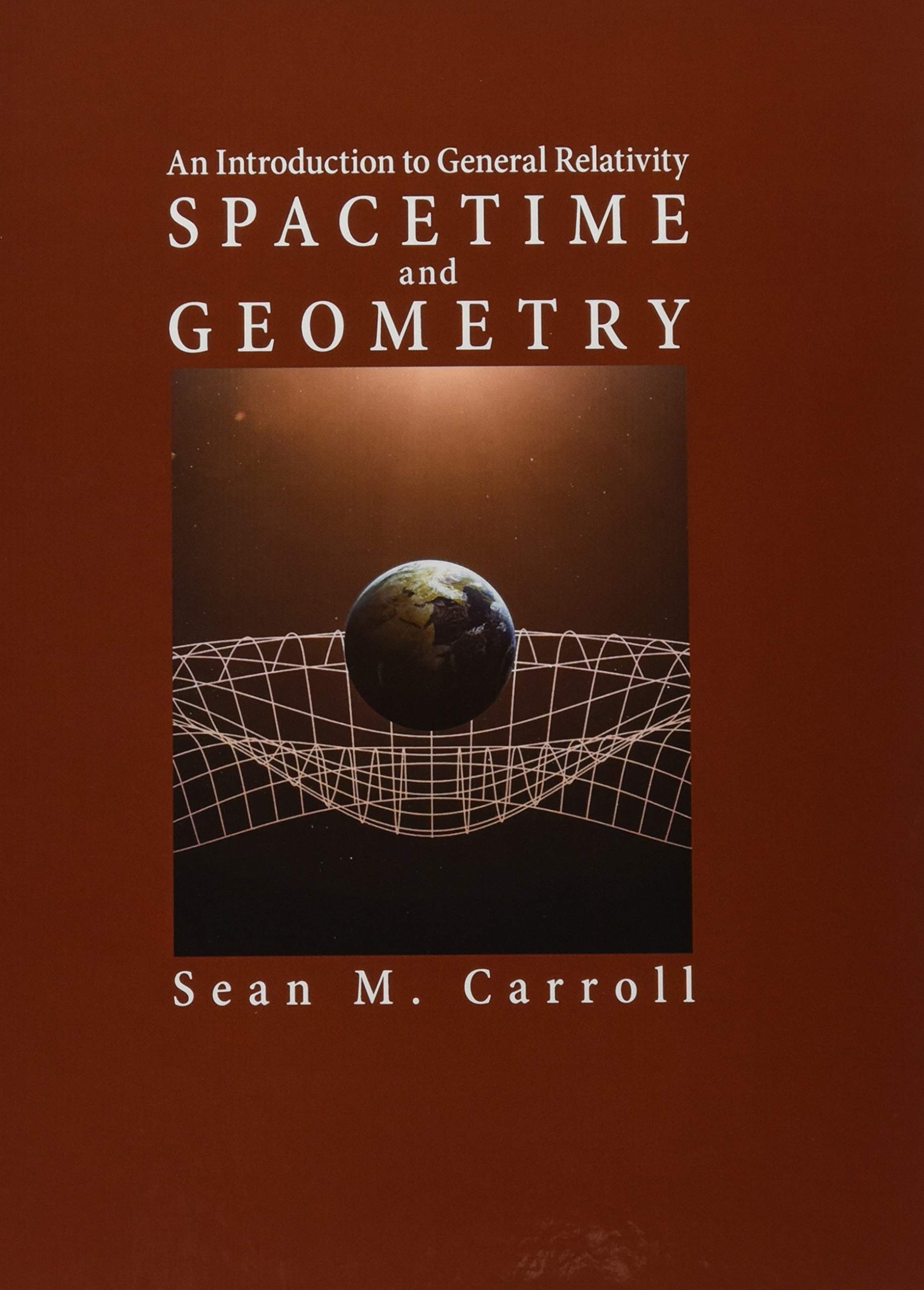
1. Spacetime and Geometry (Sean M. Carroll)
- Covers the Einstein equation and geodesic equation in full mathematical detail
- Thorough treatment of black holes, cosmology, and gravitational waves
- Includes perturbation theory and quantum field theory in curved spacetime
- Suitable for advanced undergraduates and graduate students in physics
- Updated edition with modern notation and expanded problem sets
- Written by a renowned Caltech physicist and popular science communicator
- Covers tensor calculus and differential geometry foundations
- Detailed treatment of black hole physics
Spacetime and Geometry is one of the most widely used general relativity textbooks in university courses worldwide. Sean Carroll delivers a clear, modern treatment of Einstein’s theory that balances mathematical rigor with physical intuition. The book covers the foundations thoroughly: how spacetime curves (the Einstein equation) and how matter moves through curved spacetime (the geodesic equation).
What sets this book apart is Carroll’s ability to explain three of general relativity’s most important applications: black holes, cosmology, and gravitational waves. He also introduces perturbation theory and quantum field theory in curved spacetime. If you want to understand the modern view of the expansion of the universe, or how gravitational waves are generated and detected, this is the book I’d recommend first.
2. Einstein Gravity in a Nutshell (A. Zee)

Einstein Gravity in a Nutshell
- Takes readers from Newtonian mechanics to Kaluza-Klein theory and de Sitter spacetimes
- Emphasizes group theory and action principle as guides for constructing physical theories
- Covers black holes and Hawking radiation in considerable detail
- Includes historical anecdotes that make the physics more engaging and memorable
- Friendly approach to the necessary mathematics with clear explanations
- Ideal for both undergraduate and graduate physics students
- Covers tensor calculus and differential geometry foundations
- Detailed treatment of black hole physics
A. Zee’s Einstein Gravity in a Nutshell is one of the most accessible introductions to general relativity you’ll find at the textbook level. Zee takes you from the fundamentals of Newtonian mechanics all the way to modern research areas like the Kaluza-Klein theory, brane worlds, and de Sitter and anti-de Sitter spacetimes. The emphasis on group theory and the action principle as guides for constructing physical theories gives you a deeper understanding of why the theory works the way it does.
The book’s friendly approach to mathematics, combined with historical anecdotes from the history of physics, makes it genuinely enjoyable to read. The detailed treatment of black holes and Hawking radiation is particularly strong. Whether you’re an undergraduate getting your first taste of general relativity or a graduate student looking for a second perspective, this book delivers.
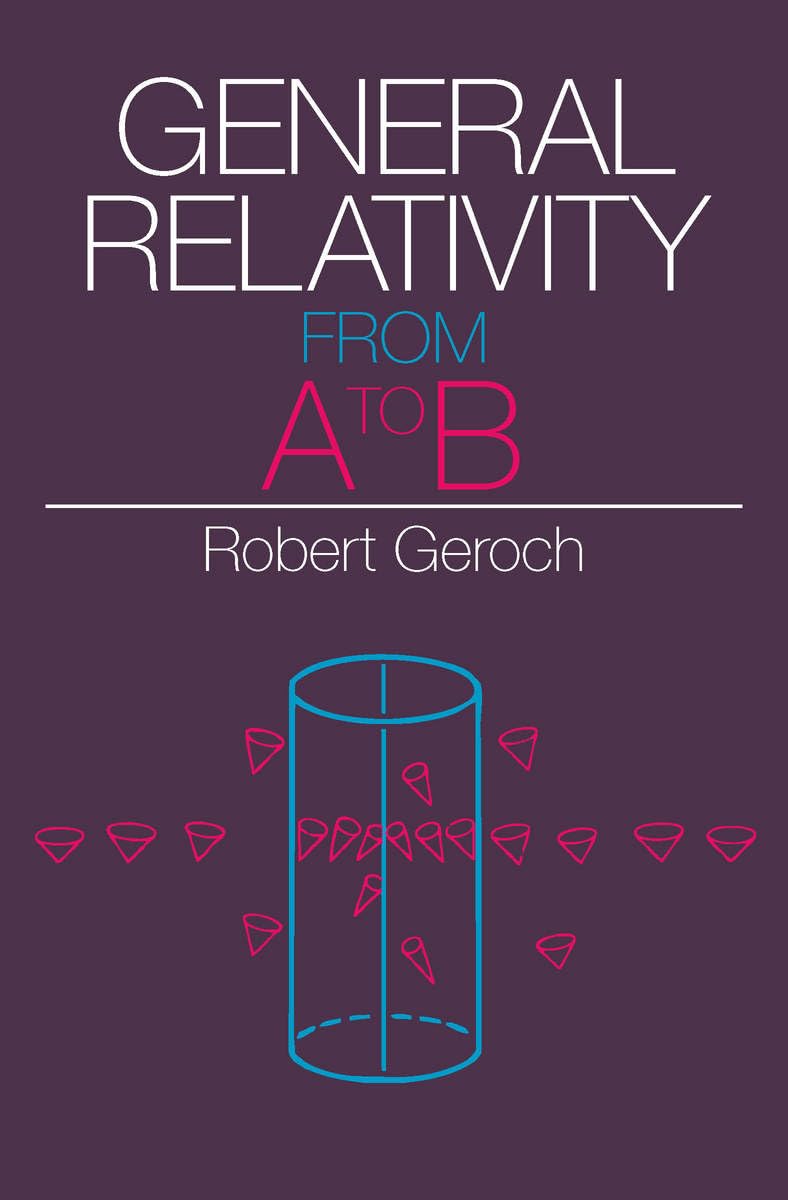
3. General Relativity from A to B (Robert Geroch)
General Relativity from A to B
- Written in lucid prose with minimal equations for maximum conceptual clarity
- First half explores space and time from Galilean and Aristotelian perspectives
- Second half covers elapsed time (interval) and spatial distance as geometric entities
- Ideal for readers who have completed an introductory physics course
- Focuses on building physical intuition rather than mathematical formalism
- A classic text that remains relevant decades after publication
- Covers tensor calculus and differential geometry foundations
- Detailed treatment of black hole physics
Robert Geroch’s General Relativity from A to B takes a completely different approach from most textbooks. Instead of drowning you in tensor calculus, Geroch writes in clear, lucid prose with minimal equations. The focus is entirely on building deep conceptual understanding of what space, time, and geometry actually mean in Einstein’s theory.
The first half deals with notions of space and time from Galilean and Aristotelian perspectives. The second half shows how elapsed time (interval) and spatial distance get incorporated into spacetime as geometrical entities. If you’re a patient reader who values understanding over computation, you’ll find this book deeply rewarding. It’s especially great for anyone who has had an introductory course in physics and wants to understand general relativity at a conceptual level before tackling the math.
4. A First Course in Differential Geometry: Surfaces in Euclidean Space (Lyndon Woodward, John Bolton)
A First Course in Differential Geometry: Surfaces in Euclidean Space
- Based on a popular 20+ year course at Durham University
- Covers Gaussian curvature through to the Gauss-Bonnet theorem
- Focuses on direct routes to explain, prove, and apply main results
- Includes numerous exercises for student self-assessment
- Provides the geometric foundation needed for understanding general relativity
- Written for third-year undergraduate mathematics students
- Covers tensor calculus and differential geometry foundations
- Detailed treatment of black hole physics
Differential geometry is the mathematical language Einstein used to express general relativity, so building a solid foundation here pays off enormously. This textbook, originally written for a popular course at Durham University that ran for over 20 years, offers a detailed introduction to differential geometry as studied by Gauss: curves and surfaces in Euclidean space.
The book covers all the classics, from Gaussian curvature to the Gauss-Bonnet theorem, but takes direct routes to explain, prove, and apply the main results. That efficiency makes it ideal if you want to build the geometric toolkit needed for general relativity without getting lost in abstraction. The numerous exercises give you solid opportunities for self-assessment.
5. Introduction to General Relativity, Black Holes, and Cosmology (Yvonne Choquet-Bruhat)
Introduction to General Relativity, Black Holes, and Cosmology
- Written by Yvonne Choquet-Bruhat, a pioneer in mathematical general relativity
- Part A is accessible to undergraduates; Part B covers advanced topics
- No specialized physics knowledge required from readers
- Describes recent experimental and observational confirmations of the theory
- Covers modern developments in cosmological and astrophysical observations
- Balances mathematical precision with physical insight
- Covers tensor calculus and differential geometry foundations
- Detailed treatment of black hole physics
Yvonne Choquet-Bruhat is one of the most distinguished mathematical physicists of the 20th century, and this textbook reflects her deep expertise. It’s aimed at mathematics students interested in physics and physics students who want exact mathematical formulations. The book doesn’t demand specialized physics knowledge, which makes it surprisingly accessible despite its rigor.
Part A covers the foundations at an undergraduate level and could serve as the basis for a full course on general relativity. Part B goes deeper but keeps the mathematics manageable. What makes this book special is how it connects the mathematical foundations to recent experimental and observational results that confirm the theory. It’s an excellent resource for tracking the modern mathematical progress alongside the latest cosmological discoveries.
6. A Student’s Manual for A First Course in General Relativity (Robert B. Scott)
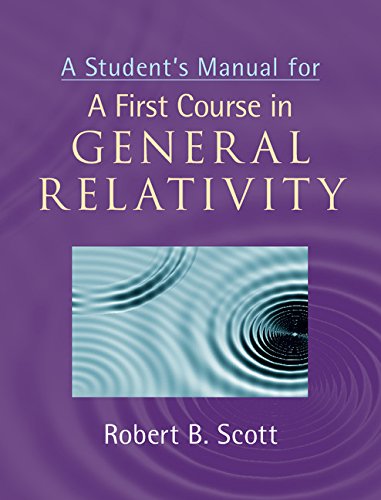
A Student's Manual for A First Course in General Relativity
- Companion to Bernard Schutz's bestselling A First Course in General Relativity
- Step-by-step solutions to over 200 exercises with clear derivations
- 125 fresh supplementary problems addressing subtle points in each chapter
- Detailed index and appendix with transformation matrices and Christoffel symbols
- Suitable for self-learners, undergraduates, and postgraduates
- Covers commonly studied spacetimes with collected mathematical results
- Covers tensor calculus and differential geometry foundations
- Detailed treatment of black hole physics
If you’re working through Bernard Schutz’s bestselling A First Course in General Relativity, this companion manual is essential. Robert B. Scott walks you through every step of more than 200 exercises, with derivations that are simple and easy to follow. That kind of hand-holding matters when you’re wrestling with tensor calculus and curved spacetime for the first time.
Beyond the solutions to Schutz’s problems, Scott adds 125 fresh supplementary problems that address the subtler points in each chapter. The detailed index and the appendix collecting transformation matrices and Christoffel symbols for commonly studied spacetimes make this a reference you’ll keep coming back to. Whether you’re a self-learner or a student in a formal course, it’s one of the best study companions available.
7. Introduction to General Relativity (Gerard ‘t Hooft)
Introduction to General Relativity
- Written by Nobel Prize-winning physicist Gerard 't Hooft
- Builds from physical motivations to curved coordinates to Einstein's equations
- Special emphasis on gravitational radiation applications
- Clear logical progression shows how spacetime structure emerges step by step
- Excellent for an elementary course in general relativity
- Connects to active research in gravitational wave detection
- Covers tensor calculus and differential geometry foundations
- Detailed treatment of black hole physics
When a Nobel Prize winner writes an introductory textbook, you pay attention. Gerard ‘t Hooft’s Introduction to General Relativity presents the theory as a scheme to describe the gravitational field and the equations it obeys. The book starts from physical motivations, then introduces curved coordinates before adding the affine connection field and eventually the metric field.
This logical buildup lets you clearly see how space and time get progressively more structured until Einstein’s field equations emerge naturally. The special emphasis on gravitational radiation makes it particularly relevant given the ongoing LIGO and Virgo detections. It’s a solid choice for anyone looking for an elementary course text written by one of the greatest living physicists.
8. Gravity from the Ground Up: An Introductory Guide to Gravity and General Relativity (Bernard Schutz)
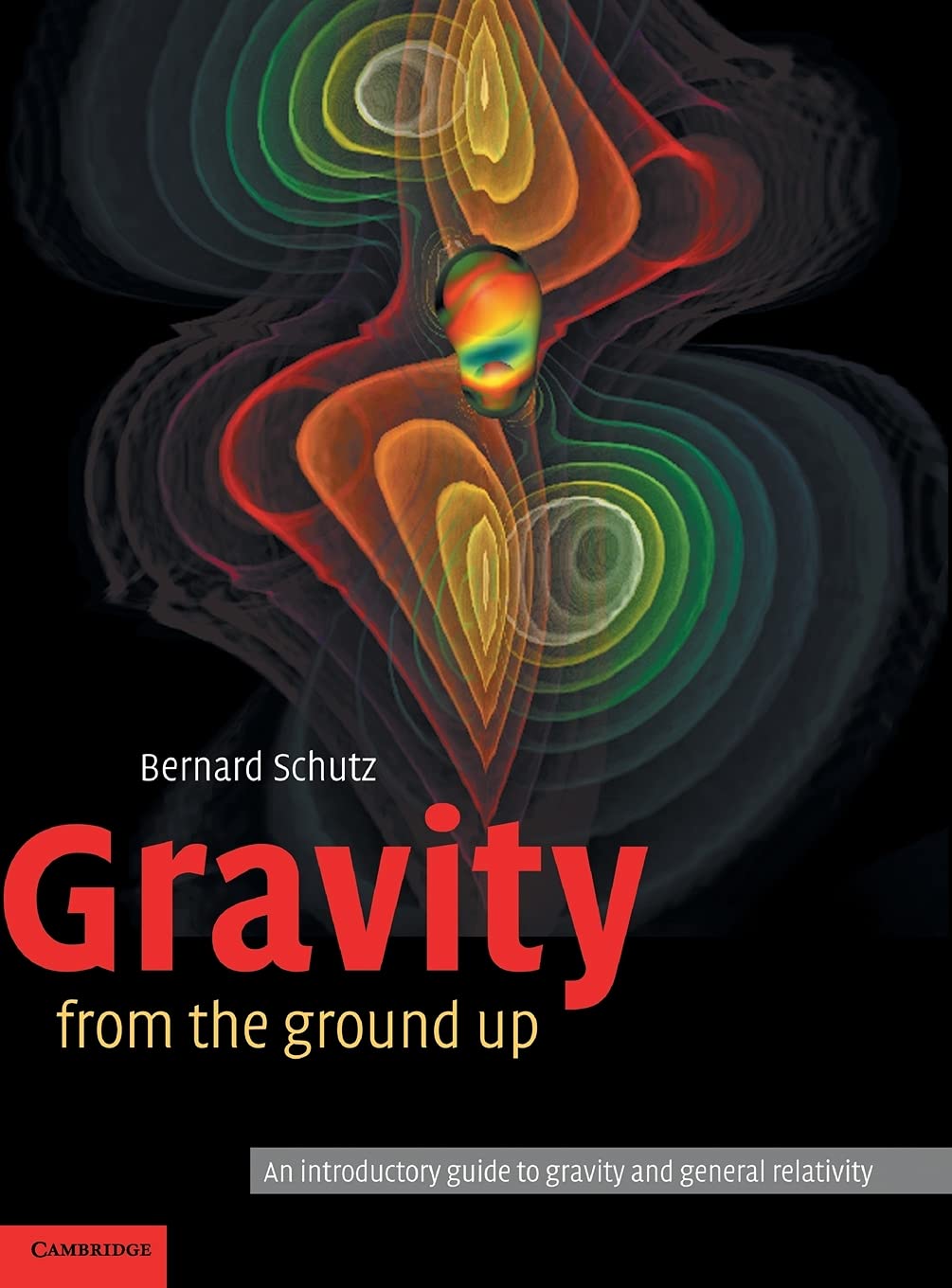
Gravity from the Ground Up: An Introductory Guide to Gravity and General Relativity
- Uses only high-school level mathematics throughout the entire book
- Written by Bernard Schutz, a renowned expert in gravitational physics
- Covers gravity from Newton and Galileo through to Einstein
- Includes optional computer programs for hands-on exploration
- Explains the universe rather than merely describing it
- Accessible introduction suitable for non-specialists and curious readers
- Covers tensor calculus and differential geometry foundations
- Detailed treatment of black hole physics
Bernard Schutz is famous for his rigorous advanced textbooks on relativity, so it’s remarkable that Gravity from the Ground Up uses only high-school level mathematics. The book traces the physics of gravity from Newton and Galileo through to Einstein, with optional computer programs for hands-on exploration.
What makes this book stand out is Schutz’s commitment to explaining the universe rather than just describing it. He doesn’t hand-wave through the difficult parts. Instead, he finds ways to make genuinely deep ideas accessible without sacrificing accuracy. If you want a solid introduction to general relativity and astronomy that doesn’t require calculus, this is the one to get.
9. Digestible Quantum Field Theory (Andrei Smilga)
Digestible Quantum Field Theory
- Provides intermediate-level treatment without heavy calculation details
- Requires only first-degree physics and working knowledge of quantum mechanics
- Includes a broad survey of how quantum field theory ideas developed historically
- Covers the Standard Model, supersymmetry, and quantum gravity
- Reviews essential background in relativity, analytical mechanics, and mathematics
- Written in an accessible style that bridges introductory and advanced texts
- Covers tensor calculus and differential geometry foundations
- Detailed treatment of black hole physics
Digestible Quantum Field Theory lives up to its name. Andrei Smilga provides an intermediate-level treatment of quantum field theory aimed at readers with a first degree in physics and working knowledge of quantum mechanics and the special theory of relativity. The goal is understanding without getting bogged down in calculation details.
After a brief introduction, Smilga surveys how quantum field theory ideas developed over the last century, reviews essential background in relativity and analytical mechanics, then describes the Standard Model, supersymmetry, and the mysterious realm of quantum gravity. It’s the kind of book that bridges the gap between introductory courses and the dense research literature.
10. General Relativity for the Intelligent, Resolute Amateur (Dr. Herbert Roseman)
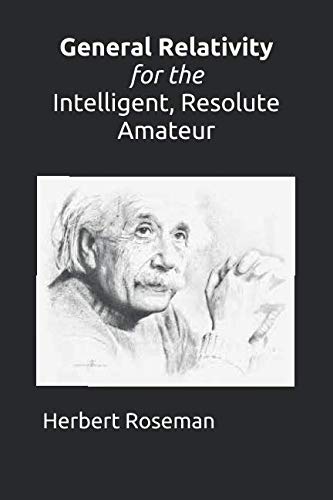
General Relativity for the Intelligent, Resolute Amateur
- Develops all necessary mathematics starting from basic calculus
- Covers curved space, tensors, and Einstein's field equations and their solutions
- Discusses the precession of Mercury's perihelion as a classic test case
- Addresses modern topics: cosmology, inflation, black holes, gravitational lensing
- Includes five philosophical essays related to Einstein and general relativity
- Written specifically for intelligent amateurs who want Einstein's authentic theory
- Covers tensor calculus and differential geometry foundations
- Detailed treatment of black hole physics
Most books on general relativity for non-specialists avoid the mathematics. This one goes the opposite direction. Starting from basic calculus, Dr. Herbert Roseman builds up the mathematics of curved space, tensors, and Einstein’s field equations step by step. The payoff is that you get to understand Einstein’s authentic version of general relativity, not a watered-down summary.
The book tackles the classic problem of Mercury’s perihelion precession, then moves to modern topics: cosmology, inflation, black holes, gravitational lensing, and gravitational waves. The five philosophical essays woven in add an extra dimension that you won’t find in other textbooks. If you’re a self-learner with the patience to work through the math, this book rewards that effort generously.
11. General Relativity and its Applications (Valeria Ferrari, Leonardo Gualtieri, Paolo Pani)
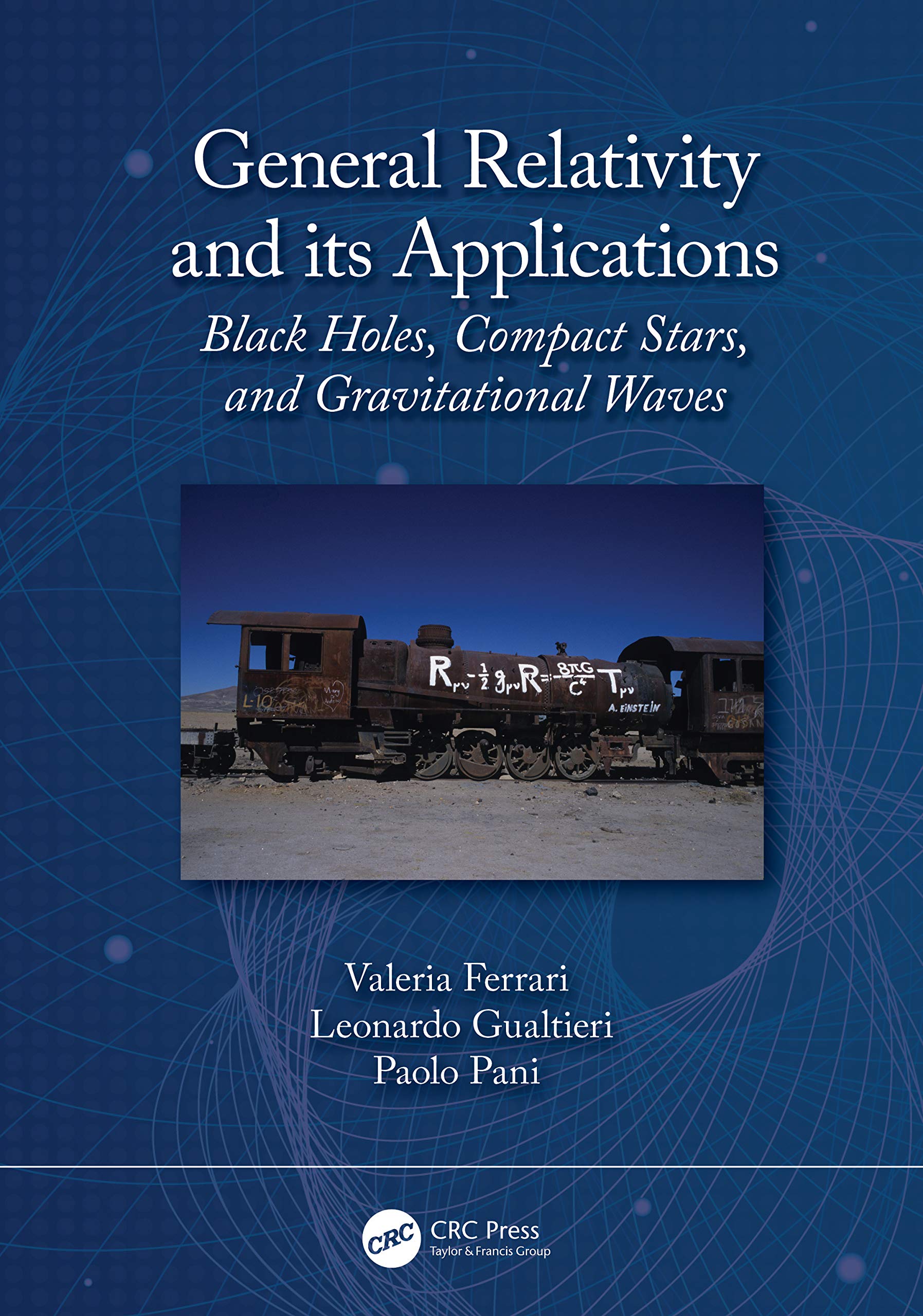
General Relativity and its Applications
- Features the latest groundbreaking discoveries in general relativity
- Focuses on astrophysical consequences: black holes, stellar structure, gravitational waves
- Combines advanced topics with pedagogical boxes and worked examples
- Includes practical applications of the theory alongside mathematical tools
- Ideal for graduate and master's students in astronomy and physics
- Updated with recent gravitational wave detection results
- Covers tensor calculus and differential geometry foundations
- Detailed treatment of black hole physics
General Relativity and its Applications stands out for including the latest groundbreaking discoveries in the field. It covers Einstein’s theory from the basics, then focuses on the most important astrophysical consequences: black holes, stellar structures, and the physics of gravitational waves.
The combination of advanced topics with pedagogical boxes, worked examples, and practical applications makes this book especially useful for graduate and master’s students. It’s the kind of textbook that prepares you not just for exams but for actual research in gravitational physics. The treatment of gravitational waves is particularly strong, reflecting the post-LIGO era.
12. A Short Course in General Relativity and Cosmology (Reinhard Hentschke, Christian Hobling)
A Short Course in General Relativity and Cosmology
- Teaches readers to do calculations, not just understand qualitative answers
- Remarkably brief while maintaining full mathematical accessibility
- Takes the shortest possible path to solid understanding of modern physics
- Encourages readers to check numbers and solve theoretical questions independently
- Provides the foundation needed to read research papers on GR and cosmology
- Designed for upper-undergraduate physics curriculum
- Covers tensor calculus and differential geometry foundations
- Detailed treatment of black hole physics
This book is designed to prepare students to read and understand both textbooks and scientific papers on general relativity and cosmology. Instead of giving qualitative answers, it teaches you to do the calculations yourself, check the numbers, and solve theoretical questions independently.
The most impressive thing about this book is its brevity without any sacrifice in scope or mathematical accessibility. The authors find the shortest possible path to a solid understanding of this crucial part of modern physics. If you’re an upper-undergraduate looking for an efficient, no-nonsense introduction that still covers the essential mathematics, this is a strong choice.
13. Special and General Relativity: A Beginner’s Introduction to Basic & Advanced Concepts (Preetinder Rahil)
Special and General Relativity: A Beginner's Introduction to Basic & Advanced Concepts
- Bridges the gap between popular science books and formal textbooks
- Uses innovative analogies from daily life to build physical intuition
- Accessible even with limited background in mathematics and physics
- Explains the meaning behind relativistic notation, often a major stumbling block
- Develops visualization skills for abstract relativistic concepts
- Covers both special and general relativity in a unified treatment
- Covers tensor calculus and differential geometry foundations
- Detailed treatment of black hole physics
Preetinder Rahil’s book fills an important gap. It sits between the detailed textbooks used in university courses and the simpler popular science books written for general audiences. The goal is to explain the intuition and meaning behind the mathematics and concepts of relativity.
The innovative use of everyday analogies to develop physical intuition is the book’s greatest strength. Even if your background in mathematics and physics is limited, you can follow along. Rahil also tackles relativistic notation head-on, explaining not just what the symbols mean but why they’re written that way. That’s something most textbooks skip, and it’s often the biggest barrier for beginners.
14. Modern Differential Geometry for Physicists (Chris J. Isham)
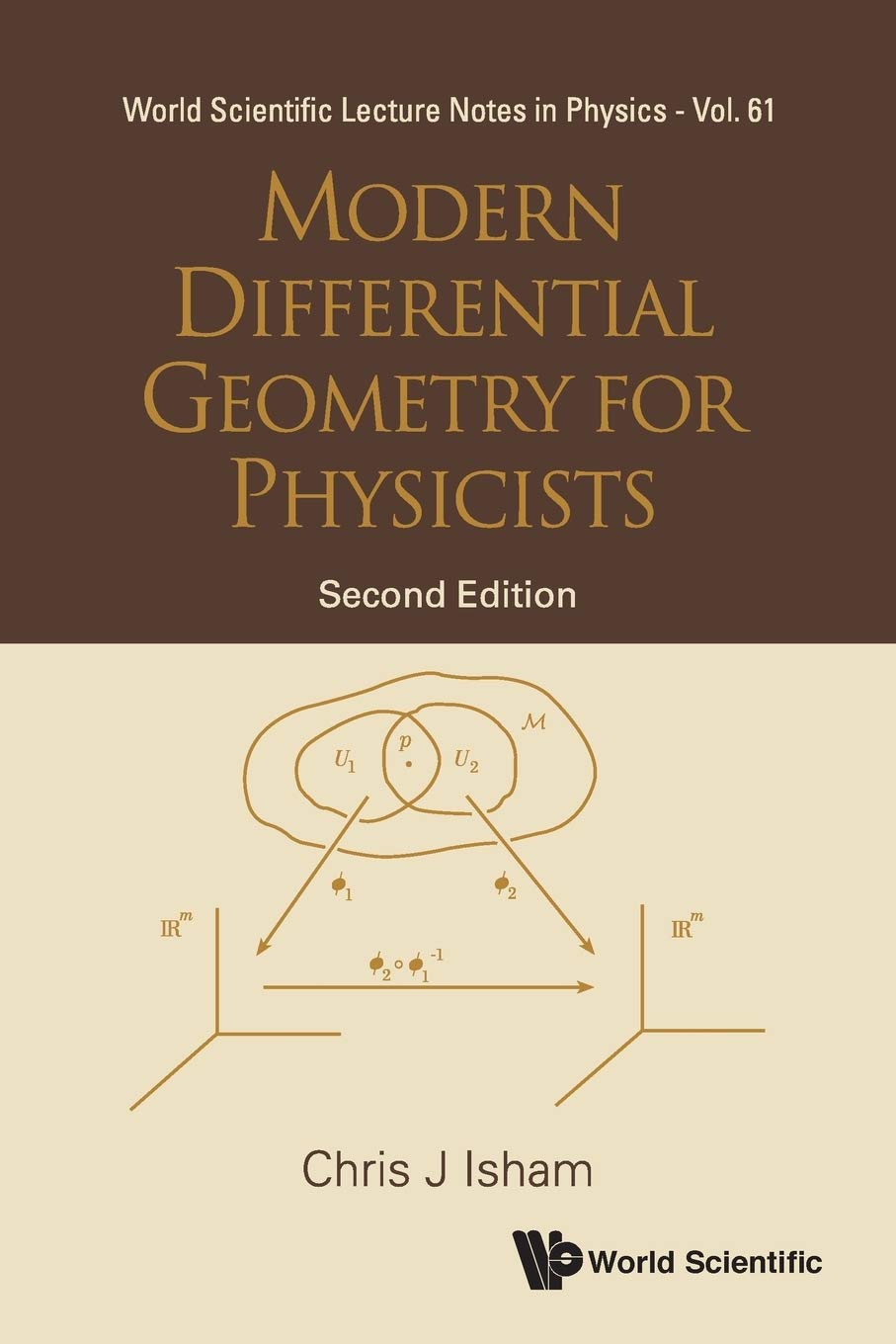
Modern Differential Geometry for Physicists
- Updated edition with new chapter on elementary general topology
- Coordinate-free approach to differential geometry throughout
- Based on Imperial College M.Sc. course 'Quantum Fields and Fundamental Forces'
- Topics selected for direct application to modern theoretical physics
- Suitable for first-year theoretical physics Ph.D. students
- Covers manifolds, fiber bundles, and connections relevant to gauge theory
- Covers tensor calculus and differential geometry foundations
- Detailed treatment of black hole physics
Chris Isham’s Modern Differential Geometry for Physicists is a classic. This new edition adds a chapter on elementary general topology, a prerequisite for the differential geometry that follows. The lecture notes come from an introductory course on coordinate-free differential geometry at Imperial College, taken by M.Sc. students in “Quantum Fields and Fundamental Forces” and first-year theoretical physics Ph.D. students.
While the book is almost exclusively mathematics, every topic has been selected for its relevance to modern theoretical physics. If you’re serious about understanding the geometric foundations behind gauge theory, general relativity, and quantum gravity, this is the standard reference. It’s demanding but precise, which is exactly what you need at this level.
15. Introduction to Cosmology (Matts Roos)
- Begins from fundamental principles and the ancient history of cosmology
- Covers curved spacetimes, gravitational lensing, and cosmological models
- Includes detailed material on observational astrophysics and extended gravity models
- Features engaging illustrations and detailed references throughout
- Problems at the end of every chapter for student practice
- Excellent for undergraduates taking a first course in cosmology
- Covers tensor calculus and differential geometry foundations
- Detailed treatment of black hole physics
Matts Roos’s Introduction to Cosmology is compact and efficient. It starts from fundamental principles and the ancient history of cosmology, then progresses through curved spacetimes, the thermal history of the universe, gravitational lensing, general and special relativity, and modern cosmological models including black holes and extended gravity.
The all-new theoretical approaches and richly detailed material on observational astrophysics make this more than a standard textbook. The engaging illustrations, detailed references, and end-of-chapter problems round it out nicely. If you’re an undergraduate in astrophysics or physics taking your first cosmology course, this book gives you everything you need in a manageable package.
16. General Relativity: Basics and Beyond (Ghanashyam Date)
General Relativity: Basics and Beyond
- First five chapters serve as a complete introductory course on general relativity
- Later chapters cover gravitational waves, cosmological spacetimes, and black holes
- Includes evolutionary interpretation for globally hyperbolic spacetimes
- Covers numerical relativity and modern computational approaches
- Sufficient background material for readers to engage with current research
- Written in a clear pedagogical style accessible to advanced students
- Covers tensor calculus and differential geometry foundations
- Detailed treatment of black hole physics
Ghanashyam Date’s book does something smart: the first five chapters form a self-contained introductory course on general relativity, while the remaining chapters take you into more advanced territory. This means you can use it as a beginner textbook and keep going without needing to switch books.
The advanced sections cover gravitational waves, cosmological spacetimes, black holes, numerical relativity, and the evolutionary interpretation for globally hyperbolic spacetimes. The coverage of numerical relativity is especially valuable since it’s become increasingly important in the era of gravitational wave astronomy. The pedagogical style provides enough background material to prepare you for engaging with current research papers.
17. General Relativity: A Concise Introduction (Steven Carlip)
General Relativity: A Concise Introduction
- Concise treatment designed for physicists across all specializations
- Covers standard topics found in most introductory GR textbooks
- Includes brief introductions to advanced topics beyond the basics
- Final chapter provides guidance from quantum gravity to mathematical relativity
- Features some of the latest research developments in the field
- Relevant for condensed matter, high energy physics, and cosmology students
- Covers tensor calculus and differential geometry foundations
- Detailed treatment of black hole physics
Steven Carlip recognizes that general relativity matters to a much wider group of physicists than just specialists. His concise textbook is designed for anyone in physics, whether you’re studying condensed matter theory, high energy physics, gravitational radiation, or cosmology.
Beyond the standard topics, Carlip includes brief introductions to more advanced areas and ends with a chapter on where to go next, from quantum gravity to mathematical relativity. That roadmap for further study is something most introductory texts lack, and it’s incredibly useful when you’re trying to figure out which subfield to pursue. The writing is efficient without being terse.
18. A Primer in Tensor Analysis and Relativity (Ilya L. Shapiro)
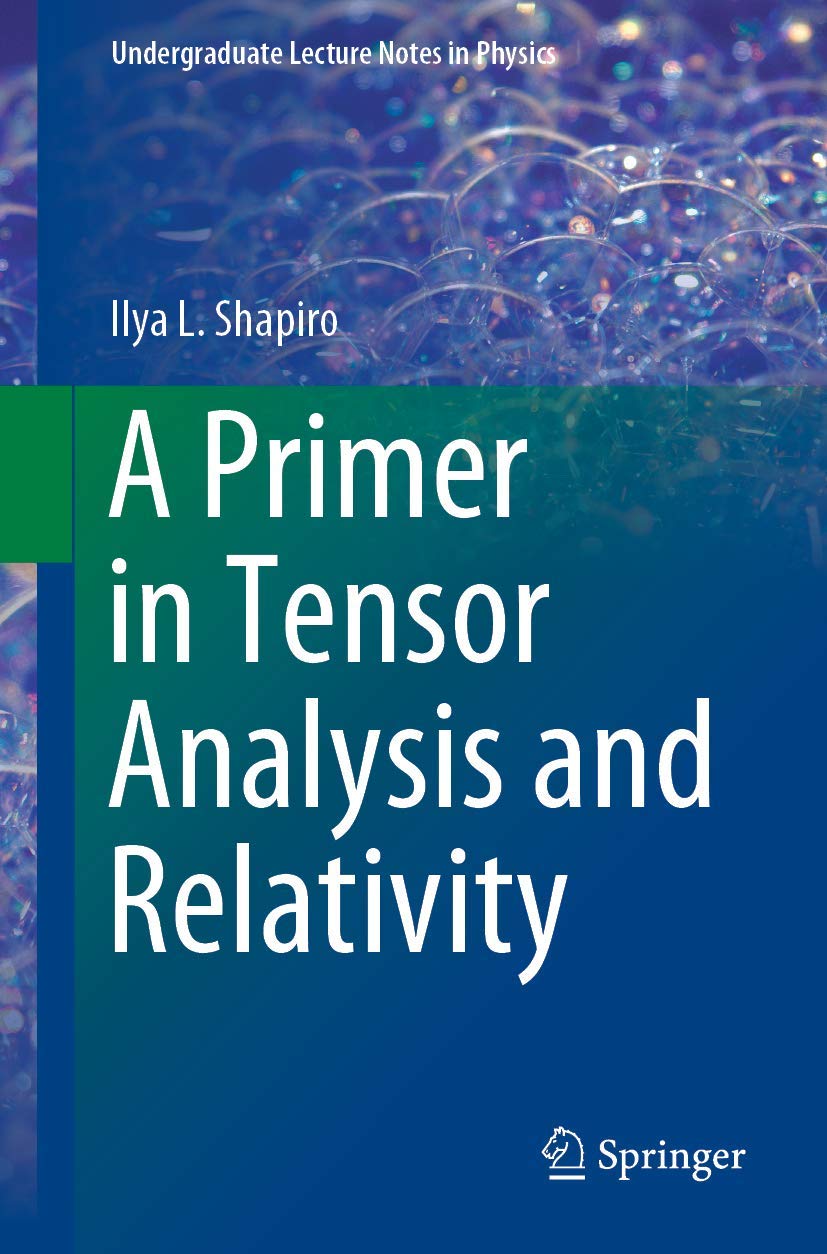
A Primer in Tensor Analysis and Relativity
- Covers tensor algebra, tensor analysis, special relativity, and general relativity
- Large number of explanations, exercises, and worked examples throughout
- Includes accessible descriptions of Riemann normal coordinates
- Covers conformational transformations rarely found in other texts
- Divided into three well-structured parts based on decades of lecture notes
- Written for mathematicians and future experimental and theoretical physicists
- Covers tensor calculus and differential geometry foundations
- Detailed treatment of black hole physics
Ilya Shapiro’s textbook solves a common problem: most general relativity books assume you already know tensor analysis, and most tensor analysis books don’t connect to physics. This book covers both in one volume, making it a complete package for undergraduates. It deals with tensor algebra, tensor analysis, special relativity, and general relativity.
The large number of explanations, exercises, and examples give you plenty of practice. What’s particularly valuable is the accessible description of Riemann normal coordinates and conformal transformations, which are technical topics that are hard to find explained clearly elsewhere. The three-part structure, based on two decades of lecture notes, has been refined for classroom teaching and shows.
19. Relativity: A Journey Through Warped Space and Time (Daniel R. Mayerson, Anthony M. Charles, Joseph E. Golec)
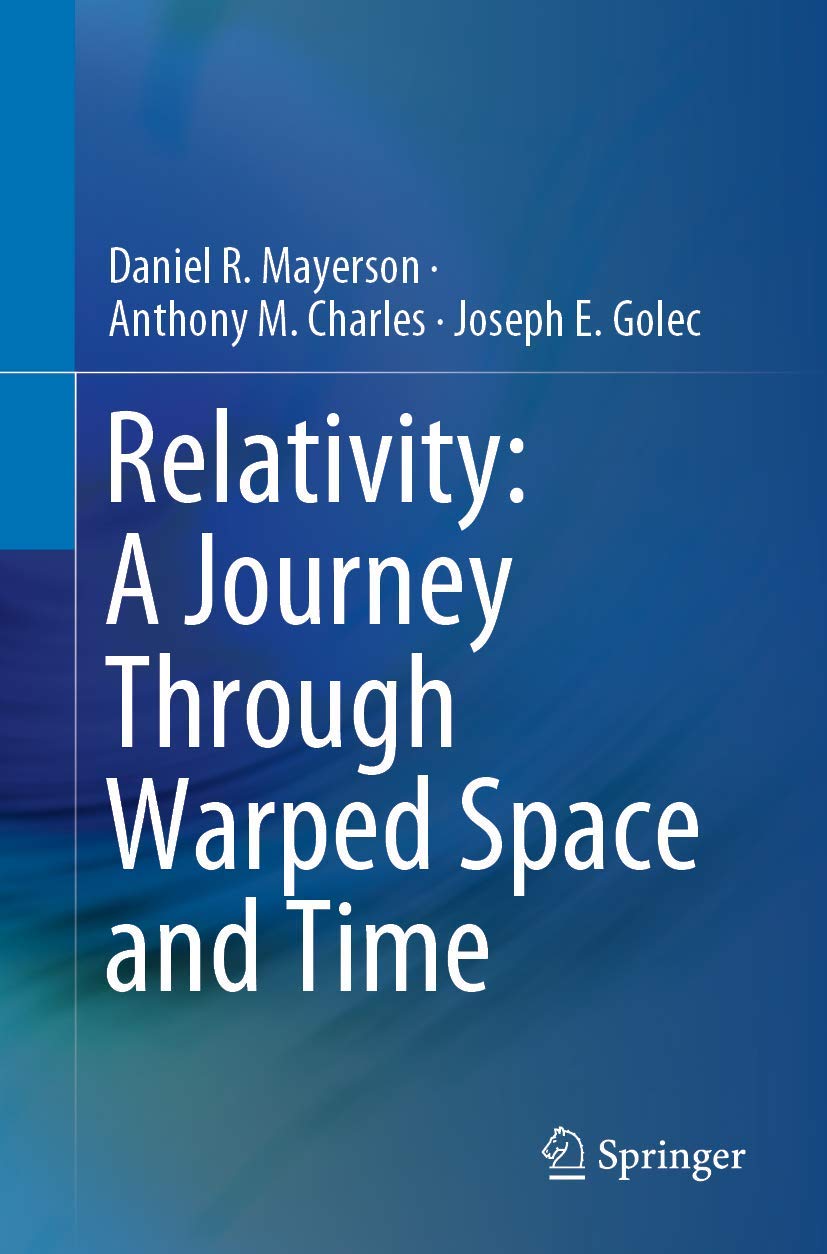
Relativity: A Journey Through Warped Space and Time
- Suitable for both high school students and undergraduate physics students
- Covers Lorentz transformations, time dilation, length contraction, and twin paradox
- Includes Einstein's equivalence principle, geodesics, and Minkowski spacetime
- Addresses black holes, wormholes, time machines, and gravitational waves
- Numerous exercises and engaging illustrations throughout the book
- Clear explanations of curvature, parallel transport, and Einstein's GR equations
- Covers tensor calculus and differential geometry foundations
- Detailed treatment of black hole physics
This book is one of the most accessible entry points into both special and general relativity. It works for high school students wanting a first look and undergraduate students who need a solid foundation before tackling heavier textbooks. The explanations are clear, and the numerous exercises and illustrations help you build genuine understanding.
The range of topics is impressive for an introductory text: Lorentz transformations, time dilation, length contraction, the twin paradox, the Einstein equivalence principle, geodesics, Minkowski spacetime, curvature, Einstein’s equations, parallel transport, cosmology, wormholes, black holes, time machines, and gravitational waves. If you want one book to preview the entire landscape of relativity, this is it.
20. From Special Relativity to Feynman Diagrams (Riccardo D’Auria, Mario Trigiante)
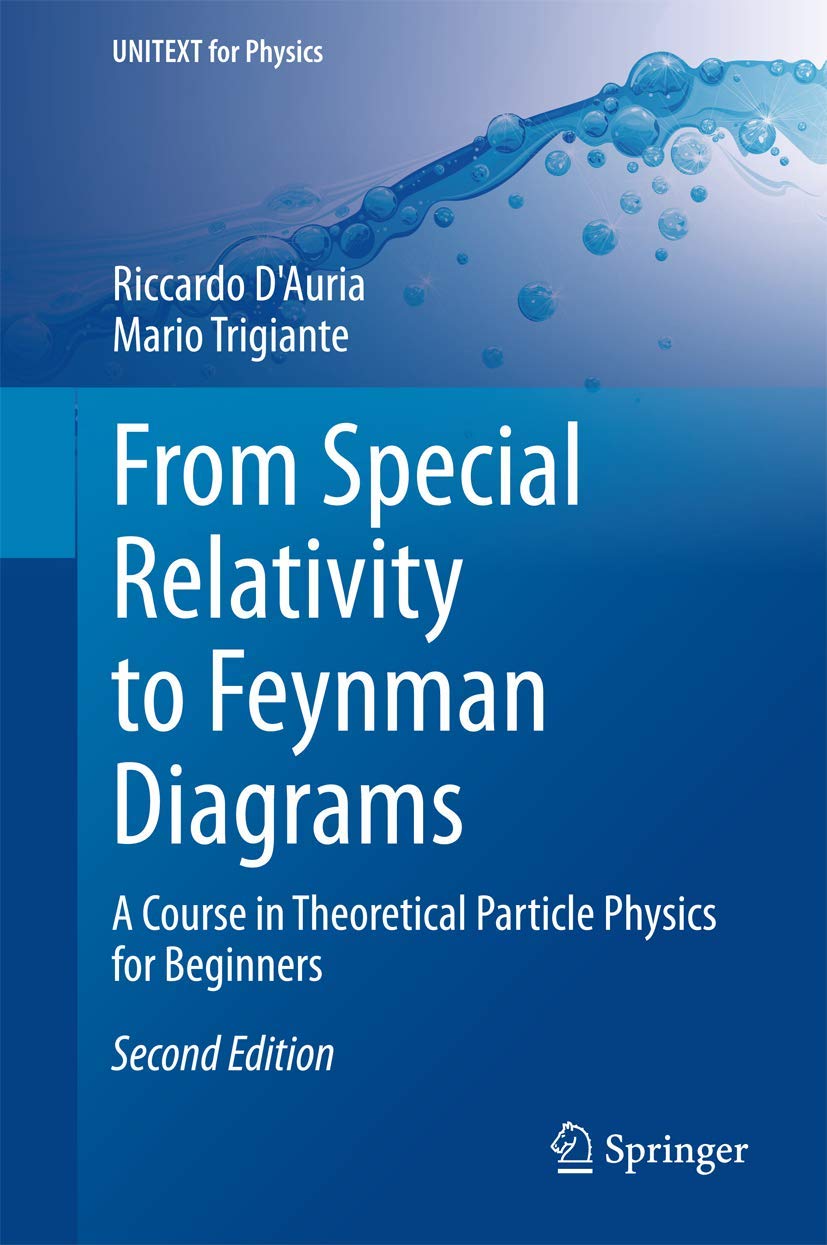
From Special Relativity to Feynman Diagrams
- Bridges the gap between basic mechanics courses and advanced field theory
- Covers special relativity, group theory, Lie algebras, and tensor calculus
- Introduces the Poincare and Lorentz groups with clear explanations
- Final chapters develop quantum field theory leading to Feynman diagrams
- Includes representation theory and the group of rotations
- Ideal for lecturers, engineers, and students in theoretical particle physics
- Covers tensor calculus and differential geometry foundations
- Detailed treatment of black hole physics
From Special Relativity to Feynman Diagrams fills a critical gap between basic quantum and classical mechanics courses and the advanced courses in field theory and relativistic quantum mechanics. It starts with a comprehensive introduction to special relativity, covers the basics of general relativity, then builds through group theory and Lie algebras to quantum field theory.
The final four chapters develop quantum field theory and introduce Feynman diagrams for graphically describing interaction processes. The coverage of the Poincare and Lorentz groups, tensor calculus, and representation theory provides the mathematical toolkit you’ll need for modern theoretical particle physics. It’s an excellent text for students, lecturers, and engineers who want to understand the conceptual foundations of the field.
How to Choose the Right General Relativity Book
No math background: Start with Gravity from the Ground Up (Schutz) or General Relativity from A to B (Geroch). Undergraduate level: Spacetime and Geometry (Carroll) or Einstein Gravity in a Nutshell (Zee). Self-learner with calculus: General Relativity for the Intelligent, Resolute Amateur (Roseman). Math-focused: A First Course in Differential Geometry (Woodward & Bolton) or Modern Differential Geometry for Physicists (Isham).
The best general relativity book for you depends on your current math level and what you want to get out of it. If you’re looking for conceptual understanding without heavy math, Geroch and Schutz are your best bets. If you want to do actual calculations and solve problems, Carroll and Zee are the standard university choices. And if you’re a self-learner willing to put in serious effort, Roseman’s book respects your intelligence while building from the ground up.
One thing I’d recommend: don’t try to start with the most advanced book you can find. General relativity rewards patience. Start with a conceptual introduction, then move to a computational textbook, then tackle the specialized topics. That progression will save you months of frustration.
Frequently Asked Questions
What is the best general relativity textbook for beginners?
For absolute beginners, I recommend Gravity from the Ground Up by Bernard Schutz. It uses only high-school mathematics and explains the physics of gravity from Newton to Einstein. For undergraduate students with calculus, Spacetime and Geometry by Sean Carroll is the most widely used textbook in university courses.
Can you learn general relativity without advanced math?
Yes, you can understand the core concepts of general relativity without advanced math. Books like General Relativity from A to B by Robert Geroch use minimal equations and focus on building conceptual understanding. However, to solve problems and do calculations in general relativity, you’ll need calculus, linear algebra, and eventually tensor analysis.
What math do I need before studying general relativity?
At minimum, you need multivariable calculus, linear algebra, and ordinary differential equations. Familiarity with special relativity helps too. For the full mathematical framework, you’ll also want some background in differential geometry, which books like Woodward and Bolton’s A First Course in Differential Geometry can provide.
What is the difference between special and general relativity?
Special relativity deals with objects moving at constant velocities in flat spacetime. It gives us E=mc² and explains time dilation and length contraction. General relativity extends this to accelerating reference frames and gravity, showing that mass and energy curve spacetime itself. General relativity is the more complete theory and is needed for understanding black holes, gravitational waves, and cosmology.
How long does it take to learn general relativity?
With a solid math background (calculus and linear algebra), a dedicated self-learner can grasp the fundamentals of general relativity in 3-6 months of consistent study. A typical university course covers the basics in one semester (about 4 months). Reaching a research-level understanding takes 1-2 years of focused study beyond that.
Is general relativity harder than quantum mechanics?
They’re hard in different ways. General relativity requires strong geometric intuition and comfort with tensor mathematics. Quantum mechanics requires comfort with probability, linear algebra, and abstract mathematical spaces. Many physicists find general relativity more conceptually challenging because the math (differential geometry) is less commonly taught in standard physics curricula.
Which general relativity book has the best problem sets?
Spacetime and Geometry by Sean Carroll and A First Course in General Relativity by Bernard Schutz are both known for their excellent problem sets. If you need solutions, Robert B. Scott’s A Student’s Manual for A First Course in General Relativity provides step-by-step solutions to over 200 exercises from Schutz’s textbook.
Are these general relativity books available as ebooks?
Most of these textbooks are available in Kindle or ebook format on Amazon. The pricing for ebook versions is typically lower than print editions, especially for the Springer and Cambridge University Press titles. Some older titles may only be available in print.