
 by
by
The best jobs with no experience are not the ones advertised as “easy.” They are jobs where an employer can teach the core task quickly and you can prove reliability before you have the title. Customer service, stocking, home care, construction support, and administrative work all fit that test, but they demand very different strengths.
My rule is simple: choose the entry barrier you can clear, not the job title that sounds impressive. Some roles accept a clean application and open availability. Others need a driver’s license, background check, short credential, or work sample. The catches matter just as much as the pay.
If you only want online options, use my separate guide to the best online jobs. This guide is broader and deliberately includes local jobs because they are often easier to verify, easier to enter, and less crowded than remote listings.
20 Jobs With No Experience: Quick Comparison
Start with the work pattern you can tolerate. Pay is useful, but schedule, physical load, interruptions, and licensing determine whether a beginner job lasts. The table uses the May 2025 BLS Occupational Employment and Wage Statistics, released in May 2026.
| Role | Median pay | Friction |
|---|---|---|
| Customer service | $21.53/hour | Low to medium |
| Retail sales | $17.03/hour | Low |
| Home care aide | $17.21/hour | Medium |
| Receptionist | $18.27/hour | Low to medium |
| Stocker or order filler | $17.95/hour | Low |
| Warehouse worker | $19.35/hour | Low |
| Construction laborer | $22.66/hour | Medium |
| Landscaper | $18.82/hour | Low |
| Server | $16.94/hour | Low |
| Fast food or counter worker | $15.00/hour | Low |
| Housekeeping cleaner | $17.07/hour | Low |
| Childcare worker | $16.82/hour | Medium |
| Animal caretaker | $17.00/hour | Low to medium |
| Security guard | $18.28/hour | Medium |
| Light truck driver | $21.57/hour | Medium |
| Electrician helper | $20.51/hour | Medium |
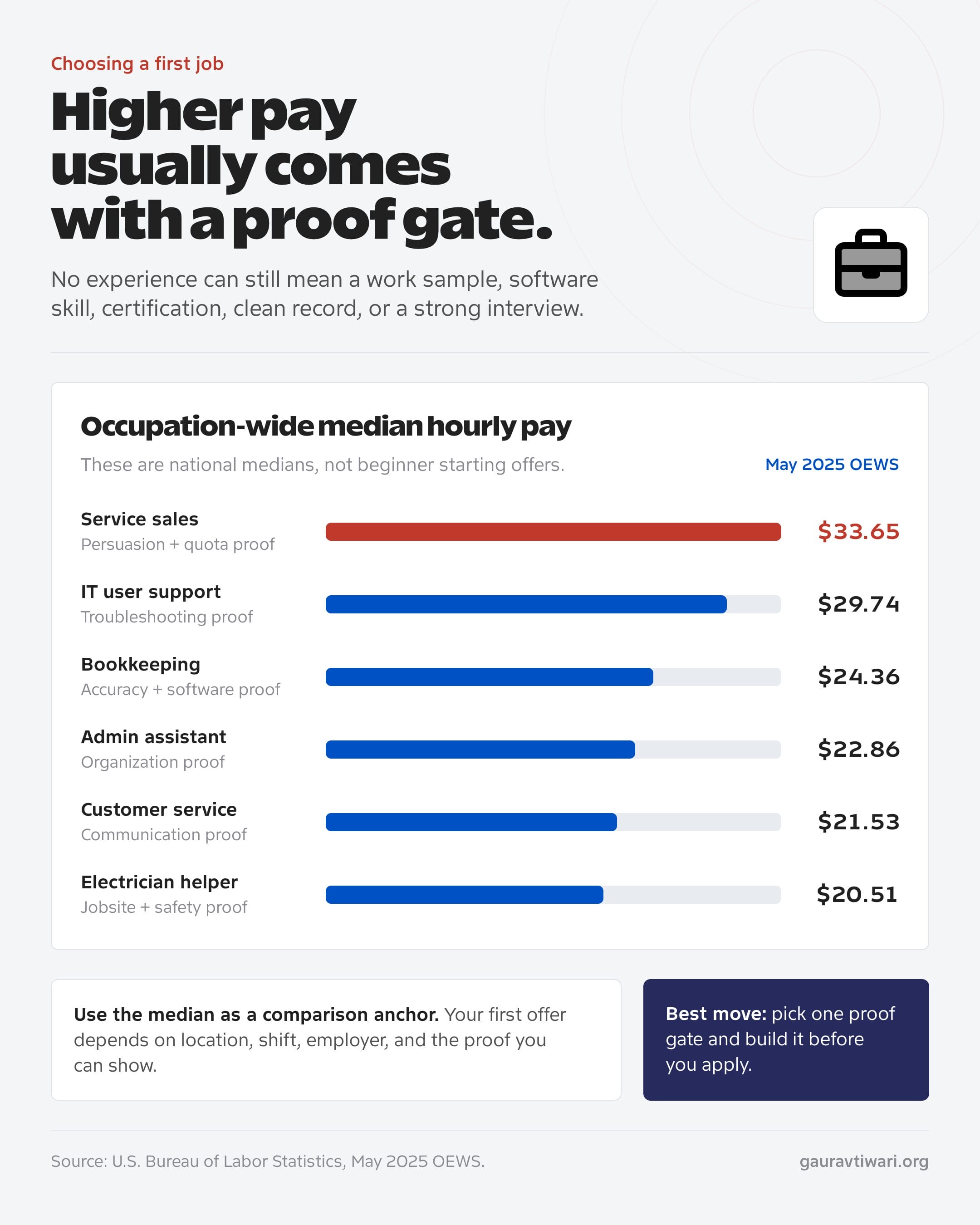
| IT user support | $29.74/hour | High |
| Sales development | $33.65/hour* | Medium |
| Bookkeeping clerk | $24.36/hour | Medium to high |
| Administrative assistant | $22.86/hour | Medium |
*For sales development representatives, the BLS comparison uses the broader occupation of sales representatives of services, except advertising, insurance, financial services, and travel. Treat that median as context, not an expected beginner offer.
What “No Experience” Actually Means
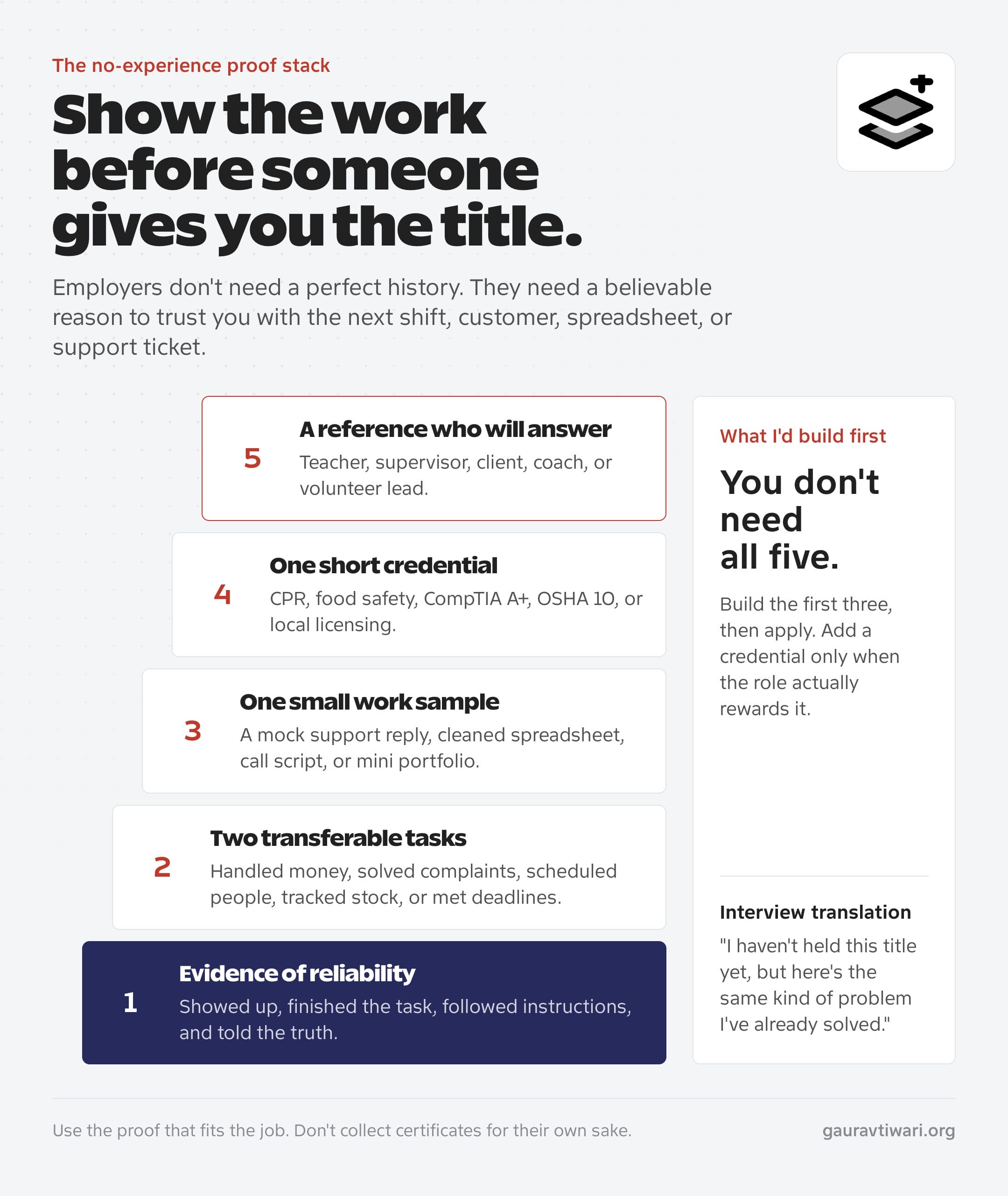
“No experience needed” usually means no previous paid experience in that exact occupation. It rarely means no standards. An employer still needs evidence that you will show up, learn the process, communicate clearly, and handle the work without creating extra risk.
- Reliability: attendance, completed responsibilities, deadlines, and honest communication.
- Transferable tasks: handling money, calming complaints, organizing records, tracking inventory, or helping customers.
- A small work sample: a mock support reply, a cleaned spreadsheet, a call script, or a basic troubleshooting note.
- A relevant credential: CPR, food safety, OSHA 10, CompTIA A+, or a state license only when the job rewards it.
- A reference: a teacher, coach, volunteer lead, previous client, or supervisor who will answer the phone.
A resume lists claims. Proof makes those claims easier to believe. That is why a small work sample can beat another generic certificate. If you are unsure which document to build, compare a portfolio versus a resume before you spend a weekend formatting the wrong thing.
How I Chose These Beginner Jobs
I did not include a job merely because one employer used the word entry-level. These jobs with no experience had to offer a plausible path for a first-time applicant and enough public labor data to compare honestly.
- Entry path: at least some employers hire without prior occupation-specific paid experience.
- Training: the core work can be learned through short employer training, a small portfolio, or an accessible credential.
- Pay: May 2025 national BLS median hourly wages are used for consistency. These are occupation-wide medians, not starting salaries.
- Friction: licensing, background checks, driving records, physical requirements, and software expectations are counted as real barriers.
- Tradeoff: every recommendation names the schedule, pressure, physical load, or uncertainty that job ads tend to soften.
Use the BLS Occupational Outlook Handbook finder to check education, training, and outlook for a specific occupation. State licensing rules and local pay can differ sharply from national data.
Beginner Jobs With Short Employer Training
These ten roles have the simplest entry path on the list. They are realistic starting points when you need income quickly, but low barriers also mean more competition, less schedule control, or physically demanding work.
1. Customer service representative
Customer service is a strong first office job if you can stay calm while another person is frustrated. Employers can teach the product and ticketing system. You need to show that you can listen, write clearly, and follow a process without taking complaints personally.
- National median pay: $21.53 per hour
- What replaces experience: A mock email response, a clear phone introduction, and examples of solving problems for classmates, customers, or community members.
- Biggest catch: Call volume, scripts, monitoring, and angry customers can make the work draining. Remote openings attract far more applicants than local call-center roles.
2. Retail salesperson
Retail is one of the fastest ways to turn everyday communication into paid experience. A hiring manager can observe your punctuality, product learning, cash handling, and customer service within a few shifts. That experience transfers into support, sales, hospitality, and office roles later.
- National median pay: $17.03 per hour
- What replaces experience: Open availability, a neat application, basic mental math, and a specific example of helping someone choose or find something.
- Biggest catch: Evening, weekend, and holiday shifts are common. You may spend most of the day standing and still be measured against sales targets.
3. Receptionist or information clerk
Reception work looks simple until the phone rings while a visitor arrives and a meeting changes. It suits beginners who are warm, organized, and comfortable switching between a few predictable systems. Clinics, schools, gyms, salons, and local service businesses are practical places to look.
- National median pay: $18.27 per hour
- What replaces experience: A sample phone script, calendar exercise, accurate message-taking example, and confident use of email and basic office software.
- Biggest catch: Interruptions are the job. If frequent task switching exhausts you, stocking, cleaning, landscaping, or some warehouse roles may fit better.
4. Stocker or order filler
Stocking is a better fit than front-counter work when you prefer concrete tasks: receive items, scan them, place them correctly, and keep the area safe. Grocery stores, wholesalers, and fulfillment operations often teach their system on the job.
- National median pay: $17.95 per hour
- What replaces experience: Reliable attendance, comfort using a handheld scanner, attention to labels, and the ability to meet the stated lifting requirement.
- Biggest catch: Early mornings, overnight shifts, repetitive movement, and productivity targets are common. Ask about lifting limits before accepting the role.
5. Warehouse laborer or material mover
Warehouse material moving can pay more than retail without requiring customer-facing polish. The work rewards safe habits, steady pace, and accurate scanning. It can also create a route into inventory control, forklift operation, dispatch, or team leadership.
- National median pay: $19.35 per hour
- What replaces experience: A safety-first answer in the interview, reliable transportation, and examples of following checklists or completing physical tasks consistently.
- Biggest catch: The work can be repetitive and physically hard. Some facilities use aggressive rate targets, so ask how performance is measured and how breaks work.
6. Fast food or counter worker
Food counter work is not glamorous, but it teaches speed, food safety, teamwork, cash handling, and customer recovery quickly. Those are useful proof points for later hospitality, retail, and supervisor applications.
- National median pay: $15.00 per hour
- What replaces experience: Availability during busy periods, hygiene awareness, basic arithmetic, and a willingness to learn one station before rotating.
- Biggest catch: Noise, heat, queues, and simultaneous orders create heavy multitasking. The low national median also means you should compare local employers carefully.
7. Waiter or waitress
Table service can be accessible without formal experience, especially at smaller restaurants that train hosts, runners, or servers in stages. People who remember details, move quickly, and recover from mistakes can build strong communication and sales evidence here.
- National median pay: $16.94 per hour
- What replaces experience: Menu-learning effort, a friendly introduction, mental math, and examples of handling several requests without losing accuracy.
- Biggest catch: Income can swing with tips, season, shift assignment, and local wage rules. Rush periods demand constant prioritization and emotional control.
8. Maid or housekeeping cleaner
Cleaning has a clear output: a room, home, or facility meets a defined standard. That makes it easier to prove competence than in vague entry-level office roles. Hotels, hospitals, schools, and cleaning companies often provide checklists and equipment training.
- National median pay: $17.07 per hour
- What replaces experience: A methodical checklist, reliability, respect for privacy, and references from volunteer, household, or paid cleaning responsibilities.
- Biggest catch: Repetition, bending, lifting, chemical exposure, and tight room quotas can wear you down. Ask what protective equipment and paid travel time are provided.
9. Landscaping or groundskeeping worker
Landscaping suits beginners who prefer visible progress and outdoor work. Crews can teach mowing, trimming, cleanup, planting, and equipment care in sequence. Consistent work can lead toward irrigation, arboriculture, equipment operation, or crew supervision.
- National median pay: $18.82 per hour
- What replaces experience: Punctuality, safe tool handling, physical readiness, and evidence that you can follow a site plan or repeat a quality standard.
- Biggest catch: Heat, cold, rain, pollen, noise, and seasonal slowdowns are real. Confirm whether travel between sites is paid and equipment is supplied.
10. Animal caretaker
Kennels, shelters, boarding facilities, stables, and pet day-care businesses hire for cleaning, feeding, observation, and safe handling. Genuine comfort with animals helps, but dependable sanitation and reporting matter more than affection alone.
- National median pay: $17.00 per hour
- What replaces experience: Shelter volunteering, pet-care references, careful observation, and willingness to handle feeding, waste, medication logs, and cleaning.
- Biggest catch: Weekend shifts, bites, scratches, odors, and emotionally difficult cases are part of the work. It is not paid pet cuddling.
Beginner Jobs With a License, Check, or Physical Gate
These jobs may not require previous experience, but they do have a gate you must clear. A clean driving record, state registration, background check, physical ability, or safety credential can shrink the applicant pool in your favor.
11. Home health or personal care aide
Home care is one of the most direct ways to get paid for being dependable and attentive. You may help with meals, mobility, errands, medication reminders, or personal care. Training requirements vary by employer, state, and whether the agency receives Medicare or Medicaid funding.
- National median pay: $17.21 per hour
- What replaces experience: CPR or first-aid training, a clean background check, reliable transportation, and examples of caring for a family or community member.
- Biggest catch: The work can be intimate, emotionally heavy, and physically demanding. Scheduling may include split shifts, weekends, or travel between clients.
12. Childcare worker
Day-care centers, after-school programs, camps, and family employers need adults who can supervise routines and respond safely. Previous paid childcare is not always required, but informal care only counts if you can describe what you handled and provide a reference.
- National median pay: $16.82 per hour
- What replaces experience: CPR and first aid, a background check, a clear safety scenario answer, and references from families, schools, or volunteer programs.
- Biggest catch: You carry serious responsibility for modest national pay. Ratios, noise, illness exposure, and licensing rules vary, so inspect the workplace before accepting.
13. Security guard
Security work ranges from checking badges at a quiet desk to patrolling busy public spaces. Some employers train and sponsor licensing; others expect registration first. Calm observation, accurate incident notes, and rule-following matter more than acting tough.
- National median pay: $18.28 per hour
- What replaces experience: Background eligibility, a state guard card where required, clear written reporting, and the ability to stay alert during repetitive shifts.
- Biggest catch: Night work and long quiet periods can change into urgent situations without warning. Ask whether the site is solo, armed, public-facing, or vehicle-based.
14. Light truck driver
Parcel, parts, rental, catering, and local delivery employers may use vehicles that do not require a commercial driver’s license. The entry gate is your driving record and ability to follow routes, scan items, and represent the employer at the door.
- National median pay: $21.57 per hour
- What replaces experience: A valid license, clean driving history, route-planning confidence, safe lifting, and proof that you meet age or insurance requirements.
- Biggest catch: Traffic, weather, delivery windows, parking, and repetitive lifting create pressure. Read the posting carefully because some contractor roles shift fuel and vehicle costs to you.
15. Construction laborer
Construction laborers prepare sites, move materials, clean hazards, assist trades, and learn job-site routines. Contractors can hire beginners, but they notice safety awareness immediately. Showing up early with the correct basic gear is part of the interview.
- National median pay: $22.66 per hour
- What replaces experience: OSHA 10 can help, but reliability, basic tool familiarity, physical readiness, and a safety-first attitude matter more for many starter roles.
- Biggest catch: Weather, dust, noise, falls, lifting, and irregular project schedules are unavoidable. Confirm worker classification, overtime, protective equipment, and training.
16. Electrician helper
An electrician helper carries materials, prepares tools, drills, pulls wire under direction, and keeps the site organized. It can be a useful bridge into a registered apprenticeship, but a helper title is not automatically an apprenticeship or a license path.
- National median pay: $20.51 per hour
- What replaces experience: Basic tool recognition, accurate measuring, safety awareness, reliable transportation, and a clear question about the employer’s apprenticeship pathway.
- Biggest catch: The work is physical and potentially hazardous. State rules differ, and some jobs offer labor without structured advancement. Get the training path in writing.
Proof-First Office, Tech, and Sales Jobs
These four roles have better national medians, but they are not the easiest applications. The word entry-level is often abused here. A small, role-specific sample gives a hiring manager a reason to take you seriously when another applicant already has a year of experience.
17. Administrative assistant
Administrative assistants manage calendars, documents, messages, records, and follow-up. A beginner can compete by showing clean written communication and accuracy with everyday tools. Build one sample packet instead of listing Microsoft Office with no evidence.
- National median pay: $22.86 per hour
- What replaces experience: A formatted agenda, calendar exercise, short spreadsheet, professional email, and proof that you can protect confidential information.
- Biggest catch: The role can become a dumping ground for unrelated requests. Ask which three responsibilities take most of the week and who sets priorities when deadlines collide.
18. Bookkeeping, accounting, or auditing clerk
Bookkeeping clerks record transactions, reconcile accounts, and keep financial records organized. Some small employers train careful beginners, but you need to show more than interest. A sample set of categorized transactions and a reconciled mock statement is far more convincing.
- National median pay: $24.36 per hour
- What replaces experience: Spreadsheet fluency, a basic bookkeeping course, a clean sample ledger, and an explanation of how you check your own work.
- Biggest catch: Accuracy is unforgiving, and many postings expect QuickBooks or similar software. Automation is changing routine tasks, so reconciliation and judgment matter.
19. Computer user support specialist
IT support can be a first tech job, but it is not a zero-effort shortcut. You troubleshoot devices, accounts, networks, and software while keeping a user informed. A public troubleshooting notebook or home lab can substitute for some experience, not all of it.
- National median pay: $29.74 per hour
- What replaces experience: A small home lab, three written troubleshooting cases, customer-service proof, and a relevant credential such as CompTIA A+ only if local postings request it.
- Biggest catch: BLS Occupational Requirements Survey data show many employers still require prior experience. Expect stronger competition and prove both technical thinking and patience.
20. Sales development representative
A sales development representative researches prospects, writes outreach, handles objections, and books meetings. Employers may hire for communication and coachability, especially when you can demonstrate that you prepared for their product and customer.
- National median pay: $33.65 per hour for the broader BLS service-sales occupation
- What replaces experience: A 30-second call opener, two tailored emails, basic CRM familiarity, and a respectful follow-up sequence built for the employer’s market.
- Biggest catch: Quota pressure and rejection are constant. Base pay can be much lower than advertised on-target earnings, so ask what percentage of the team hit quota last quarter.
Which Beginner Jobs Involve Less Multitasking?
No job guarantees a quiet, single-task day. The employer, shift, staffing level, and location can change the same title completely. Still, roles built around a physical sequence tend to involve less rapid context switching than phones, front desks, food service, or administration.
- Often more sequential: stocking, landscaping, housekeeping, material moving, and some overnight security posts.
- Often interruption-heavy: reception, customer service, retail sales, fast food, table service, and administrative support.
- Ask in the interview: What does a normal hour look like? How often is one task interrupted by another? Who resets priorities? Are performance targets individual or team-based?
- Do not rely on the title: a hotel housekeeper may face aggressive room targets, while a well-staffed warehouse may have a calm, repeatable pick path.
If task switching is hard for you, do not hide it from yourself to win an offer. Pick a role where the workflow helps you succeed. A slightly lower wage that you can sustain is worth more than a higher wage you leave after three weeks.
How to Get Hired With No Experience
A beginner application should reduce uncertainty. You cannot manufacture a work history, but you can make it easy for an employer to see the same habits the job requires.
- Choose one job family. Apply to customer support, warehouse work, or administration for two focused weeks. Do not send the same resume to all three.
- Collect ten local postings. Highlight repeated tools, shifts, credentials, and tasks. Build for what employers actually request.
- Create one proof sample. Write a support reply, reconcile a mock spreadsheet, prepare a call script, or document a troubleshooting case.
- Rewrite your evidence. Translate school, volunteering, family responsibilities, freelance work, and community work into tasks and outcomes without inflating them.
- Practice the risk question. Be ready to explain why you can learn the role, how you handle mistakes, and why you will stay long enough for training to pay off.
Use a clean one-page resume unless the role requires a portfolio. My comparison of the best resume builders can save time, but no template can rescue vague evidence. Then rehearse specific stories with this job interview guide.
Where to Find Legitimate Openings
Use broad job boards to discover employers, then verify the role on the employer’s own website. Local organizations, staffing firms, workforce centers, and apprenticeship programs can be easier to validate than anonymous remote listings.
- CareerOneStop: use the U.S. Department of Labor-sponsored job finder and local American Job Center resources.
- Apprenticeship.gov: search the official apprenticeship job finder for structured paid training.
- Indeed: use exact titles, location filters, and date filters. My guide to using Indeed explains how to narrow noisy results.
- Employer career pages: apply on the official domain when possible, especially for hospitals, universities, retailers, utilities, and local government.
- People you already know: ask for information about teams that train beginners. Do not ask someone to guarantee you a job they cannot control.
Avoid No-Experience Job Scams
Scammers target beginners because urgency can override skepticism. The U.S. Federal Trade Commission warns that honest employers do not ask you to pay for the promise of a job. Review the FTC guidance on avoiding work-from-home job scams before sending money or sensitive information.
- You must pay first: fees for equipment, training, software, background checks, or guaranteed placement go to an individual or suspicious payment account.
- A fake check is involved: the employer sends a check and asks you to buy equipment or return part of the money.
- The interview is text-only: there is no verifiable company email, video call, phone call, or named hiring manager.
- Sensitive data comes too early: they request a Social Security number, bank login, or identity documents before a verified offer and legitimate onboarding.
- The work is vague: task jobs, product boosting, reshipping, crypto transfers, and unrealistic pay for simple clicks are common warning signs.
Search the company name, recruiter name, phone number, and the word scam. Call the company through the number on its official site. A five-minute verification is cheaper than recovering a stolen identity.
Frequently Asked Questions
What job is easiest to get with no experience?
Retail sales, food counter work, stocking, housekeeping, and warehouse material moving usually have the lowest formal entry barriers. The easiest job for you depends on schedule, transportation, physical requirements, and local demand. Apply where your availability and existing habits match the work.
Which no-experience jobs pay the most?
In the May 2025 national BLS data used here, IT user support, service sales, bookkeeping, construction labor, and administrative support have higher occupation-wide medians than most low-barrier roles. They also have more competition or stronger proof requirements, and the median is not a beginner starting offer.
Can I get a remote job with no experience?
Yes, but remote customer support, sales, and administrative roles attract a national applicant pool and more scams. A local or hybrid role is often a faster first step. Build six to twelve months of credible results, then use that evidence to compete for remote openings.
What should I put on a resume with no job experience?
Use education, volunteering, projects, caregiving, freelance tasks, clubs, and community responsibilities that prove relevant behavior. Name the task, tool, result, and frequency. Add one small work sample when possible, and never invent an employer, title, date, or metric.
Which beginner jobs involve less multitasking?
Stocking, landscaping, housekeeping, material moving, and some overnight security assignments can be more sequential than reception, customer service, retail, food service, or administration. The workplace matters more than the title, so ask how often tasks are interrupted and how priorities are assigned.
Pick the Proof Gate You Can Clear This Week
Do not apply to all 20 jobs with no experience on this list. Pick two job families, collect ten local postings for each, and compare the repeated requirements. Then build the smallest honest proof that answers those requirements.
A first job is not a lifetime identity. Its job is to give you income, references, habits, and evidence for the next move. Choose one you can enter and sustain, learn what it teaches, and leave with proof instead of only a title.
Tell Google you want more of this.
Add Gaurav Tiwari as a preferred sourceOne tap, and this site shows up more often in your own Top Stories, AI Overviews and AI Mode. Remove it any time.